

HS Code for Handmade Candles: Classification Guide for Importers
Handmade candles sit under indicative heading 3406, candles, tapers and the like, with a single six-digit line 340600; the EU splits scented and plain candles at eight digits while the US and UK keep one line each.
Short answer
Handmade candles are classified under indicative heading 3406, candles, tapers and the like, at the single six-digit line 340600. The method of making them does not create a separate line: what matters is whether the article is a candle, whether it is plain or perfumed at EU level, and whether a holder or set gives the shipment its essential character. Confirm the full national code before filing.
On this page
Key takeaways
Handmade candles sit under indicative heading 3406 at the single six-digit line 340600: there is no separate handmade line and no six-digit split by wax type, scent or shape.
The method of making a candle does not move the code: what matters is whether the article is a candle, whether a holder or set gives the shipment its essential character, and whether bulk wax is filed separately.
The EU splits candles at eight digits into plain, not perfumed candles at 34060011 and other candles at 34060019, while the United States keeps one line at 3406.00.00 and the United Kingdom one at 3406 0000 00.
Only the first six digits are shared worldwide, so a code that is right in one destination can be incomplete in another: confirm the full national code and, for borderline products, a binding decision before filing.
If you buy handmade candles from Bangladesh for resale in the United States, the United Kingdom, the European Union or the United Arab Emirates, the hs code for handmade candles is the line your customs entry, duty treatment and origin claim rest on. The Harmonized System is a multipurpose international product nomenclature developed by the World Customs Organization (WCO), comprising more than 5,000 commodity groups, each identified by a six-digit code.1 For candles, the question is narrower than it looks: heading 3406 carries one six-digit line for every candle, so the work is proving the article is a candle, then reading the national extension. This guide covers classification only, and every heading below is indicative until you confirm it in the destination tariff.
Quick answer: the indicative HS heading for handmade candles
Handmade candles fall under indicative heading 3406 at the single six-digit line 340600. The United States schedule lists the line as 3406.00.00.2 The United Kingdom tariff carries the same goods as commodity code 3406 0000 00.3 In the European Union, the Combined Nomenclature splits the same heading at eight digits into plain, not perfumed candles at 34060011, other candles at 34060019, and other articles at 34060090.4
Destination | Indicative code | What it covers |
|---|---|---|
Worldwide, first six digits | 340600 | Candles, tapers and the like |
United States, HTS | 3406.00.00 | Candles, tapers and the like |
European Union, CN | 34060011 / 34060019 / 34060090 | Plain, not perfumed candles / other candles / other |
United Kingdom, commodity code | 3406 0000 00 | Candles, tapers and the like |
Treat every code here as indicative, and confirm the full national code for your exact product before filing. The method of making a candle, by hand or by machine, does not create a separate heading: the heading text says candles, tapers and the like, with no handmade line beside it.2
How HS codes are structured (2-4-6 digits)
The Harmonized System organizes its approximately 5,000 six-digit product categories in a hierarchy of sections, chapters at two digits, headings at four digits and subheadings at six digits.5 Chapter 34 covers candles and similar articles, heading 3406 narrows it to candles, tapers and the like, and subheading 340600 is the single six-digit line inside it. Countries then subdivide the six-digit categories into national subheadings, and the Combined Nomenclature of the European Union uses eight-digit codes.5
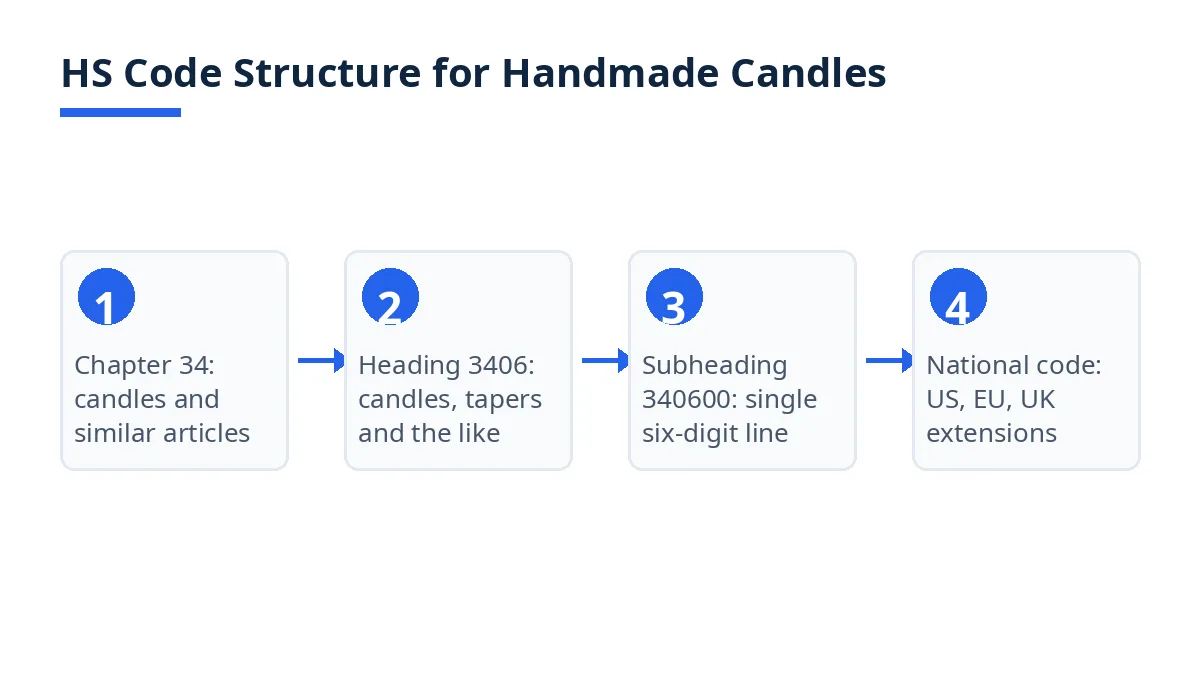
The current version of the system is HS 2022.5 Read the harmonized system explainer and the product classification guide for the method. The diagram above shows the path: chapter 34, heading 3406, subheading 340600, then the national extension.
Factors that decide the code for handmade candles
Is the article a candle. Classification is governed first by the terms of the headings and any relative section or chapter notes.3 A candle, in tariff terms, is a fuel body with a wick that burns to give light, whether a taper, a pillar, a votive or a container candle. A product with no wick and no burning function, such as a wax melt, needs a separate test before you file it under 3406.2
Handmade status does not move the heading. Nothing in heading 3406 distinguishes a hand-poured candle from a machine-made one, and decoration, color or shape do not create a new heading either.2 What changes the code is the article itself, not how it was made.
Scented or plain matters at EU level only. The EU split turns on perfume: plain, not perfumed candles sit at 34060011 and other candles at 34060019.4 A scented and an unscented pillar candle therefore take different eight-digit lines into the EU, while the United States and the United Kingdom keep both on one line each.2 3 Record whether each candle is perfumed, and keep scented and unscented styles separate for EU shipments.
Wax type does not change heading 3406. Paraffin, soy, beeswax and blended wax candles all sit under the same heading, because the heading describes the finished article, not its fuel.2 Bulk wax shipped on its own is a different matter: the chapter notes for heading 3404 limit artificial and prepared waxes to waxy products of defined kinds, and exclude unmixed animal or vegetable waxes, which sit elsewhere.2 Never file a carton of bulk wax, or a carton of wicks, under the candle line.
Candle, holder and set are tested separately. A candle poured into a glass jar is still filed as a candle when the candle gives the article its essential character: mixtures and composite goods that cannot be classified by a more specific description are classified as if they consisted of the component which gives them their essential character.3 For a gift set, test each component, then apply the same rule to the set as a whole rather than copying the candle code onto every piece.3
Container and presentation do not change the line. Packing materials and containers presented with the goods are classified with the goods when they are of a kind normally used for packing such goods.3 A decorative container clearly suitable for repetitive use needs its own test.
National codes: US HTS, EU CN/TARIC, UK commodity code
United States: HTS, ten digits. The United States keeps one line for all candles at 3406.00.00.2 Because there is no scented or plain split, scented and unscented candles can be filed together, but the goods must still be described precisely, since related measures can turn on descriptions the tariff line does not show. Check published rulings for similar candles on the Customs Rulings Online Search Service, known as CROSS, before you file.6
European Union: CN at eight digits, TARIC for measures. The Combined Nomenclature is an eight-digit coding system comprising the HS codes with further EU subdivisions.5 For candles, the three eight-digit lines are 34060011 for plain, not perfumed candles, 34060019 for other candles, and 34060090 for other articles.4 The same codes appear in EU tariff measures with TARIC extensions added for specific measures.7 Read the confirmed line in TARIC for the entry date.
United Kingdom: commodity code, ten digits. The United Kingdom carries candles as commodity code 3406 0000 00, candles, tapers and the like.3 There is no scented or plain split in the United Kingdom line, so scented and unscented candles share the code, but the entry still needs an accurate product description.
United Arab Emirates: same six digits, local extension. The first six digits are shared worldwide, since the system is used by more than 200 countries and economies as a basis for their customs tariffs.1 For the United Arab Emirates, start from 340600 and read the full national extension in the destination tariff, rather than copying a United States, EU or United Kingdom line onto a UAE entry.
How to confirm the code officially
Write a precise description: candle form, wax type, perfumed or plain, container or holder, and whether the shipment is a single candle, a set or bulk wax.
Start from the official tariff for the destination: the USITC Harmonized Tariff Schedule, TARIC or the United Kingdom Trade Tariff, and read the heading text and chapter notes.
Check published rulings for similar candles. For the United States, the USITC advises traders to use CROSS, because the correct classification of many items can be found there.6
For a borderline product, such as a wickless wax melt or a set with a reusable container, apply for a binding decision before you ship. In the EU, a Binding Tariff Information application needs a separate application for each type of product and a detailed description, including images or samples where possible.8 In the United Kingdom, a legally binding decision is generally valid for 3 years, through an Advance Tariff Ruling.9 In the United States, if the merchandise is not described in any ruling on CROSS, you may request a binding ruling from U.S. Customs and Border Protection.6
Give your broker the description and confirmed code for each style, and use the same codes throughout the entry.
Common classification mistakes
Filing bulk wax as candles. Heading 3406 covers candles, tapers and the like, not wax in bulk.2 The chapter notes for heading 3404 limit the prepared-wax heading and exclude unmixed animal and vegetable waxes.2 Ship wax, wicks and finished candles on separate lines.
Filing every EU candle as plain. The EU line 34060011 covers plain, not perfumed candles only, and other candles sit at 34060019.4 A scented candle filed as plain takes the wrong eight-digit line.
Filing a candle in a jar as glassware. The essential-character rule classifies composite goods by the component which gives them their essential character.3 A poured candle in a jar is filed as a candle.
Filing a gift set under one code. Goods put up in sets for retail sale are tested under the same essential-character rule.3 Break the set down before you file it.
Copying a code from another country. Only the first six digits are shared: the EU extends to eight digits in the Combined Nomenclature,5 the United States keeps candles on one ten-digit line,2 and the United Kingdom carries its own ten-digit commodity code.3 A code right in one destination can be incomplete in another.
Assuming handmade means a special line. The heading text makes no handmade distinction.2 The word handmade belongs in the product description, not in the tariff search.
Related duties and documents
This guide states no duty rates: the code decides which duty line customs applies, and a rate read beside one national line does not carry to another destination. Read the rate beside your confirmed code for your origin.
A wrong code can put the wrong duty, licensing or quota treatment on the entry. A binding decision helps in advance: it provides assurance that the goods have the correct commodity code and helps calculate duties, licensing requirements and quotas in advance.9 Keep the style description, confirmed codes, any binding decision and origin evidence together in the shipment file, with scented and unscented styles and sets as separate invoice lines.
FAQs
What is the HS code for handmade candles?
The indicative code is heading 3406, candles, tapers and the like, at the single six-digit line 340600.2 National extensions are 3406.00.00 in the United States,2 34060011 for plain, not perfumed candles and 34060019 for other candles in the European Union,4 and 3406 0000 00 in the United Kingdom.3
Is the HS code the same in every country?
Only the first six digits are shared worldwide.1 Beyond six digits, each country adds its own lines: eight digits in the EU Combined Nomenclature,5 and ten digits in the United States and the United Kingdom.2 3
How do I confirm the correct code?
Describe each candle precisely, read the heading text and chapter notes in the destination tariff, and check published rulings, such as CROSS for the United States.6 For a borderline product, apply for a binding decision before shipping: a Binding Tariff Information decision in the EU,8 an Advance Tariff Ruling in the United Kingdom,9 or a CBP binding ruling in the United States.6
What happens if I use the wrong code?
Duty, licensing and quota treatment are worked out from the code on the declaration, so a wrong code brings the wrong treatment. A binding decision in advance helps you calculate the duties and restrictions.9
Next steps on Exportain
Browse Bangladeshi suppliers on Exportain, and read the harmonized system explainer and the product classification guide before you brief your broker. State the confirmed code for each candle style, scented or plain, in your RFQ so suppliers quote on the same description customs will see. Exportain is not a party to the goods contract and does not inspect goods, book freight or clear customs.
Sources
- What is the Harmonized System (HS)?. World Customs Organization (accessed )
- Harmonized Tariff Schedule of the United States, Chapter 34 (2013). U.S. International Trade Commission (accessed )
- Commodity code 3406000000: Candles, tapers and the like - UK Integrated Online Tariff. GOV.UK, HM Revenue and Customs (accessed )
- Combined Nomenclature, Chapter 34 (Council Regulation (EC) No 1359/95, Annex I). legislation.gov.uk (accessed )
- Harmonised System. European Commission (accessed )
- MTB 2019: Get Out Ahead of the Pack with a Binding Ruling from CBP. U.S. International Trade Commission (accessed )
- Council Regulation (EC) No 393/2009 imposing a definitive anti-dumping duty on imports of certain candles, tapers and the like originating in China. European Union, EUR-Lex (accessed )
- European Binding Tariff Information (EBTI). European Commission, Taxation and Customs Union, (accessed )
- Check what you'll need to get a legally binding decision on a commodity code. GOV.UK, HM Revenue and Customs (accessed )
About the author
Sourcing from Bangladesh?
Post a request for quotation and suppliers on Exportain can send you their quotes directly.
Post an RFQ


