HS Code for Hand Tools: Classification Guide for Importers
Single hand tools take their named Chapter 82 heading, with 8205 as the residual heading, while retail sets across headings 8202 to 8205 are tested against heading 8206 and sets inside 8205 against subheading 8205.90.
Short answer
Hand tools have no single HS code. Tools take their named Chapter 82 heading, with hammers, chisels, and screwdrivers tested against the residual heading 8205, pliers in 8203, spanners in 8204, handsaws in 8202, and agricultural tools in 8201. A retail set from two or more headings among 8202 to 8205 is tested against heading 8206, while a set from subheadings of heading 8205 only is tested against subheading 8205.90. Every heading is indicative until the tariff confirms it.
On this page
Key takeaways
Heading 8205 is residual: named tools go first, with pliers in 8203, spanners in 8204, handsaws in 8202, and agricultural hand tools in 8201.
A retail set from two or more headings among 8202 to 8205 is tested against heading 8206, while a set from subheadings of heading 8205 only is tested against subheading 8205.90.
The working part must be of a Chapter 82 material, and power tools are tested in Section XVI, not in Chapter 82.
Parts of general use are excluded from Chapter 82, and interchangeable bits are tested against heading 8207.
Only the first six digits are shared worldwide: the EU extends to eight digits and the United States and United Kingdom to ten.
If you import wrenches, hammers, pliers, or a cased tool set, the code on the customs entry starts with the tool itself, not with the trade name on the carton. Hand tools sit mainly in Chapter 82, and the heading changes with the kind of tool, its working part, and whether it ships loose or put up in a set. Every heading below is indicative until the destination tariff confirms it.
Quick answer: indicative HS heading (with verify note)
For a single hand tool, start from the named heading for its kind, and use heading 8205 only when no earlier named heading fits. Heading 8205 covers hand tools not elsewhere specified or included, including glass cutters, blow torches, vises, clamps and the like, anvils, portable forges, and hand or pedal operated grinding wheels with frameworks.1 That residual wording matters: 8205 is not a catch-all for every tool with a handle.
Shipment | Indicative heading |
|---|---|
Hammer, wood chisel, or screwdriver shipped loose | Heading 8205 |
Pliers, file, or metal cutting shears shipped loose | Heading 8203 |
Spanner or wrench, including a socket wrench, shipped loose | Heading 8204 |
Handsaw shipped loose | Heading 8202 |
Spade, axe, secateurs, or other agricultural hand tool shipped loose | Heading 8201 |
Set from two or more subheadings of heading 8205 only | Subheading 8205.90 |
Retail set from two or more headings among 8202 to 8205 | Heading 8206 |
Confirm the full national code for the destination and the entry date before filing.
How HS codes are structured (2-4-6 digits)
The Harmonized System is a multipurpose international product nomenclature developed by the World Customs Organization, comprising more than 5,000 commodity groups, each identified by a six digit code, and used by more than 200 countries and economies as a basis for their customs tariffs.2 The structure is hierarchical: sections group chapters, chapters take two digits, headings take four digits, and subheadings take six digits.3 Countries then subdivide the six digit categories into national subheadings.3
Chapter 82 covers tools, implements, cutlery, spoons and forks, of base metal, and parts thereof of base metal.1 Inside it, 82 fixes the chapter, 8205 the heading, and 8205.20 the subheading for hammers. The current version is HS 2022.3 For background, see the HS code harmonized system explainer.
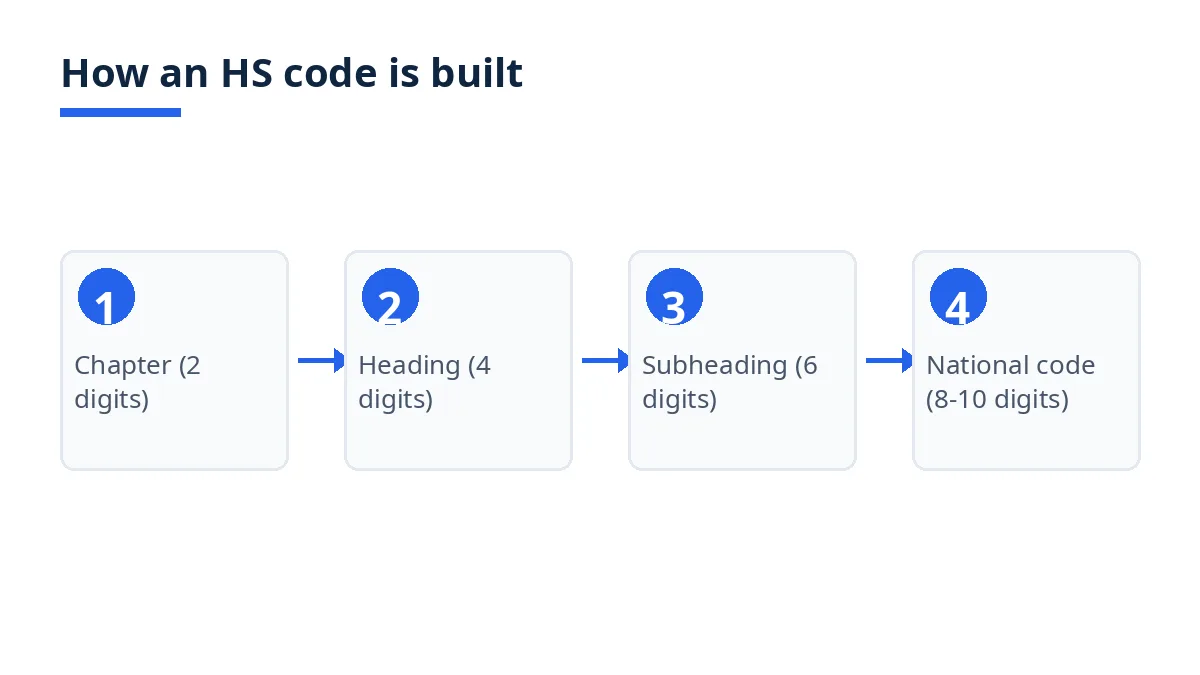
Read the code from left to right: chapter, heading, then subheading.
Factors that decide the code for hand tools
The named heading comes first. Work through headings 8201 to 8205 in order before settling on the residual heading 8205. Pliers belong in heading 8203, spanners in heading 8204, and handsaws in heading 8202, even though all three are hand tools in ordinary language.1 Filing a named tool under 8205 is the most common shortcut in this chapter, and it is wrong.
Function decides the group inside 8205. The subheadings split by what the tool does: drilling, threading, or tapping tools at 8205.10, hammers and sledge hammers at 8205.20, planes, chisels, gouges, and similar cutting tools for working wood at 8205.30, and screwdrivers at 8205.40.1 Household tools take subheading 8205.51.1 A hammer head over a stated weight threshold takes a different statistical line from a lighter hammer head in the United States schedule, so record the head weight for hammers.1
The working part must be of a Chapter 82 material. Apart from the listed exceptions, Chapter 82 covers only articles with a blade, working edge, working surface, or other working part of base metal, metal carbides or cermets, precious or semiprecious stones on a base metal support, or abrasive materials on a base metal support where the article keeps base metal cutting teeth or grooves.1 A tool outside that note needs a fresh test outside Chapter 82.
Single tool, set inside one heading, or retail set across headings. This decision separates 8205 from 8206 and turns on presentation as much as on the tools. A set from two or more subheadings of heading 8205, put up for sale directly to users without repacking, is tested against subheading 8205.90.4 Add a wrench from heading 8204 and it is no longer a set under 8205.90; packaged for retail sale, it fits heading 8206 instead.4 A simple spanner and screwdriver combination qualifies under heading 8206 when put up in sets for retail sale.4 Photograph the retail packaging, because it is part of the classification evidence.
Parts follow the tool, with two carve-outs. Parts of base metal of Chapter 82 articles are classified with those articles, except parts separately specified as such and toolholders for hand tools, which fall in heading 8466.1 Parts of general use are in all cases excluded from Chapter 82.1 Ordinary screws or bolts shipped with a tool set are therefore not automatically tool parts. Interchangeable tools are separate: heading 8207 covers interchangeable tools for hand tools, whether or not power operated, or for machine tools.1 A drill bit or screwdriver bit is tested against heading 8207, not against the heading of the tool it fits.
Hand tools are not power tools. Section XV does not cover articles of Section XVI, which covers machinery, mechanical appliances, and electrical goods.5 A cordless drill, a powered grinder, or a powered saw is tested in Section XVI, not in Chapter 82, even when it performs the same job as a hand tool.
National codes: US HTS, EU CN/TARIC, UK commodity code
United States: HTS, ten digits. The United States schedule runs the six digit subheading out to ten digits with statistical suffixes, separating hammers by head weight and household tools by material.1 For sets, it carries both lines: subheading 8205.90.60 for sets of articles of two or more subheadings of heading 8205, and subheading 8206.00.00 for tools of two or more of headings 8202 to 8205 put up in sets for retail sale.1 Read the full ten digit line for each tool and each set.
European Union: CN at eight digits, TARIC for measures. The Combined Nomenclature uses eight digit codes, comprising the HS codes with further EU subdivisions.3 Check the TARIC line for the entry date and the origin.
United Kingdom: commodity code. The United Kingdom tariff lists heading 8205 with ten digit codes under each six digit line, including hammers at 8205 2000 00, screwdrivers at 8205 4000 00, and sets of articles of two or more subheadings of the heading at 8205 9090 00.5 The first six digits match the HS subheading, so a code confirmed for the United States cannot be copied onto a United Kingdom entry without reading the United Kingdom line.
How to confirm the code officially
Write a precise description for each tool and each set: tool kind, working part material, function, head weight for hammers, intended use, and, for a set, every member tool plus a photo of the retail packaging.
Start from the official tariff for the destination and read the heading text and the chapter and section notes.
Check published rulings for similar tools and sets.4
For a borderline case, apply for a binding decision before shipping. In the European Union, a Binding Tariff Information application needs a separate application for each type of product.6 In the United Kingdom, a legally binding decision is generally valid for 3 years, through an Advance Tariff Ruling.7 In the United States, request a binding ruling from United States Customs and Border Protection where no published ruling covers the goods.
Give your broker the description and the confirmed code for each tool and each set, and use the same codes across the invoice, the packing list, and the entry.
Common classification mistakes
Filing every hand tool under 8205. Headings 8201 to 8204 name their own tools first. Pliers belong in 8203, spanners belong in 8204, handsaws belong in 8202, and agricultural hand tools belong in 8201.1
Filing a retail set under the heading of its largest tool. A retail set from two or more headings among 8202 to 8205 belongs in heading 8206, not under the heading of the tool that dominates the case.4 A set whose members all come from subheadings of heading 8205 is tested against subheading 8205.90, not heading 8206.4
Filing loose tools in one carton as a set. A carton of fifty hammers and twenty-five chisels is not automatically a set. The set provisions turn on being put up for sale directly to users without repacking, or for retail sale.4
Filing a power tool as a hand tool. A powered drill, saw, or grinder is tested in Section XVI, not Chapter 82, because Section XV does not cover articles of Section XVI.5
Filing an interchangeable bit under the hand tool heading. Drill bits and screwdriver bits are tested against heading 8207, whether or not power operated.1
Filing loose fasteners as tool parts. Parts of general use are excluded from Chapter 82 in all cases.1 Screws and bolts shipped with a tool set need their own heading test and invoice line.
Copying a code from another country. The European Union extends the six digits to eight,3 and the United States and the United Kingdom run to ten digits with their own extensions.1 5
Describing the shipment only as hand tools. Customs classifies from the description, the working part, and the presentation, so omit none of them.
Related duties and documents
This guide states no duty rates: the code decides which duty line customs applies, and a rate beside a hammer line does not carry to a screwdriver line or a set line. Read the rate beside your confirmed code for your origin and entry date, and check what proof of origin a preference claim requires.
Keep the classification file with the shipment documents: tool descriptions, confirmed codes per tool and per set, a photo of the retail packaging for any set, any binding decision, and the origin evidence, with each tool and each set on its own invoice line. Where a set is classified under heading 8206, the invoice should still list the member tools.
FAQs
What is the HS code for hand tools?
There is no single code for hand tools as a group. Hammers, chisels, and screwdrivers are tested against heading 8205, while pliers sit in heading 8203, spanners in heading 8204, handsaws in heading 8202, and agricultural hand tools in heading 8201.1 A retail set from two or more headings among 8202 to 8205 is tested against heading 8206, and a set from subheadings of heading 8205 only against subheading 8205.90.1 4 Every heading here is indicative until the destination tariff confirms it.
Is the HS code the same in every country?
Only the first six digits are harmonized. Beyond six digits, each country adds its own lines: eight digits in the European Union Combined Nomenclature,3 and ten digits in the United States and the United Kingdom.1 5
How do I confirm the correct code?
Describe each tool and each set precisely, read the heading text and notes in the destination tariff, and check published rulings.4 For a borderline set, apply for a binding decision before shipping: a Binding Tariff Information decision in the European Union,6 an Advance Tariff Ruling in the United Kingdom,7 or a binding ruling from United States Customs and Border Protection.
What happens if I use the wrong code?
Duty, licensing, and quota treatment are worked out from the code on the declaration, so a wrong code brings the wrong treatment. A binding decision in advance helps you calculate the duties and restrictions that will apply.7
Next steps on Exportain
Browse Bangladeshi suppliers on Exportain and state the confirmed code for each tool and each set in your enquiry, with the retail packaging noted for any set. For the classification method behind this guide, read how to classify your product. Exportain is not a party to the goods contract and does not inspect goods, book freight, or clear customs.
Sources
- Harmonized Tariff Schedule of the United States, Chapter 82 (2026 Revision 18). U.S. International Trade Commission (accessed )
- What is the Harmonized System (HS)?. World Customs Organization (accessed )
- Harmonised System. European Commission (accessed )
- Hand Tool Sets Classified Under Subheadings 8205.90.00 and 8206.00.00. U.S. Customs and Border Protection (accessed )
- Hand tools: UK Integrated Online Tariff, heading 8205. GOV.UK, HM Revenue and Customs (accessed )
- European Binding Tariff Information (EBTI). European Commission, Taxation and Customs Union, (accessed )
- Check what you'll need to get a legally binding decision on a commodity code. GOV.UK, HM Revenue and Customs (accessed )
About the author
Sourcing from Bangladesh?
Post a request for quotation and suppliers on Exportain can send you their quotes directly.
Post an RFQ