

HS Code for Generic Medicines: Classification Guide for Importers
Generic medicines classification: the indicative heading 3004 for measured-dose and retail-packed products, the bulk-mixture split to 3003, constituent subheadings, and US, EU and UK national codes to confirm.
Short answer
For a finished generic medicine in measured doses or retail packing, the indicative starting point is heading 3004, to be verified in the destination tariff. The settled code depends on presentation, the constituent family inside 3004, and the full national line on the entry date. A bulk mixture not in measured doses or retail packing starts instead from heading 3003, also to be verified.
On this page
Quick answer: indicative HS heading (with verify note)
For a finished generic medicine in measured doses or in a packing for retail sale, the indicative starting point is heading 3004: medicaments, excluding goods of headings 3002, 3005 and 3006, consisting of mixed or unmixed products for therapeutic or prophylactic uses, put up in measured doses, including transdermal systems, or in forms or packings for retail sale.1 Treat 3004 as a starting point only. The subheading, and the full national code after it, must be checked in the destination tariff for the exact product as presented on the entry date.
The word generic does not decide classification: the heading texts contain no generic line. The line is decided by the product as presented. This guide covers classification only, and makes no statement about any product's effect, safety, or market authorisation.
How HS codes are structured (2-4-6 digits)
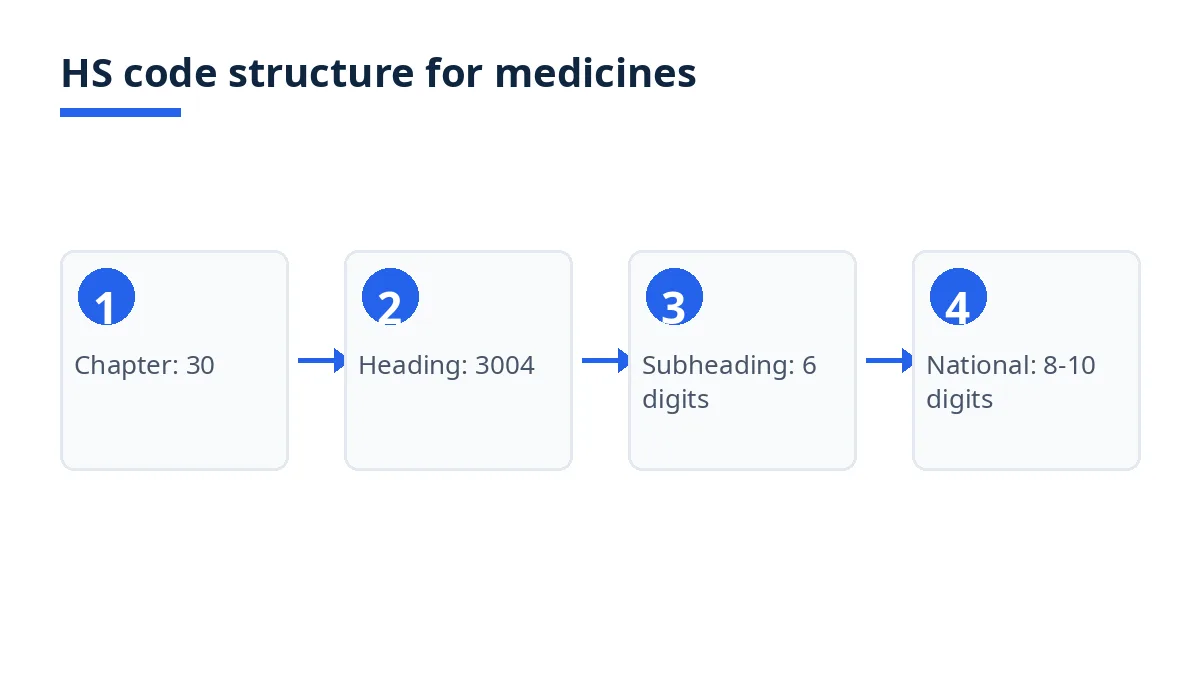
The Harmonized System is international only to six digits: the first two give the chapter, the first four the heading, and all six the subheading. National systems add digits after that.2 Here, chapter 30 is pharmaceutical products, heading 3004 is the four-digit level, and 3004.90 is a six-digit subheading.
Rule 1 states that classification follows the terms of the headings and any relevant section or chapter notes, and that titles are for ease of reference only.3 Rule 6 adds that only subheadings at the same level are comparable.3 Read the heading text first, read the notes, then compare lines at the same dash level.
Factors that decide the code for generic medicines
1. Presentation: measured dose or retail packing, or neither
Presentation is the first split inside chapter 30. Heading 3004 covers medicaments put up in measured doses or in forms or packings for retail sale.1 Heading 3003 covers medicaments of two or more constituents mixed together for therapeutic or prophylactic uses, not put up in measured doses or in forms or packings for retail sale.1 The same formulation can therefore point to a different heading depending on how it ships.
Measured doses include tablets, capsules, ampoules, drops, pastilles, and transdermal systems.4 A retail packing is one clearly intended, by its indications, for sale directly to users without repacking. A bulk drum of unmeasured powder does not meet that test. Record the form as shipped.
2. Constituent family inside heading 3004
Inside heading 3004, the six-digit subheading turns on the constituent family: 3004.10 penicillins and streptomycins; 3004.20 other antibiotics; 3004.31 insulin; 3004.32 corticosteroid hormones; 3004.39 other hormones and heading 2937 products; 3004.40 alkaloids; 3004.50 vitamins and heading 2936 products; 3004.60 antimalarial principles in subheading note 2; and 3004.90 other medicaments.1 Where two subheadings seem to fit, the more specific description is preferred, and for mixtures the essential-character component decides, with the last-in-numerical-order rule as tie-breaker.3
3. Chapter 30 notes and exclusions
Chapter notes can remove a product from heading 3004 even when the heading text looks like a fit. Chapter 30 does not cover foods or beverages, other than nutritional preparations for intravenous administration; nicotine products for tobacco use cessation in heading 2404; or soap and heading 3401 products containing added medicaments.1 Heading 3004 also excludes goods of headings 3002, 3005 and 3006.1 So a vaccine is a heading 3002 question, a coated dressing is a heading 3005 question, and a sterile surgical material, dental cement, first-aid kit, or waste pharmaceutical product is a heading 3006 question under note 4.1
4. Combination products and intended user
For a combination product, do not classify by the largest ingredient by weight alone, or by the ingredient named first in a trade name. The rule asks for essential character.3 A device or bulk ingredient shipped alongside a finished product likewise needs its own heading check.
Whether a medicine is presented for human or veterinary use is also a classification question, not an assumption from the product name. Heading 3004 itself does not split human and veterinary lines, but the United States schedule shows statistical suffixes distinguishing lines for veterinary use inside some 3004 subheadings.1 Ask the destination tariff whether its line splits by intended user.
Worked example: the same formulation, two presentations
Shipment A is tablets in blister strips inside labelled retail cartons stating the dose and directions. Its indicative starting point is heading 3004, to be verified, because it is put up in measured doses and in a retail packing.1 Shipment B is the same formulation as loose, unmeasured powder in drums for further processing. Its indicative starting point is heading 3003, to be verified, because it is a mixture not put up in measured doses or in a retail packing.1 The formulation did not change, but the starting point did, because presentation changed. A published United States ruling on tablets in dosage form shows the same logic: the tablets were placed in a 3004.90 national line, limited to the specific facts in the request.4
Presentation as shipped | Indicative starting point (verify) | Confirm before declaring |
|---|---|---|
Finished product in measured doses or retail packing | Heading 3004 (verify) | Subheading by constituent family, then the full national line on the entry date |
Mixed product, not in measured doses or retail packing | Heading 3003 (verify) | Whether it is a mixture of two or more constituents, then the full national line |
Bulk active ingredient, not a finished medicament | Outside heading 3004 (verify) | The chemical heading as presented, and any chapter 30 mixed-or-unmixed note |
Vaccine, blood product, or immunological product | Outside heading 3004 (verify) | Heading 3002, then the full national line |
Coated dressing with a pharmaceutical substance | Outside heading 3004 (verify) | Heading 3005, then the full national line |
No line in this table is a settled code for any shipment.
National codes: US HTS, EU CN/TARIC, UK commodity code
The first six digits are shared. Everything after them is national. Confirm the full code in the system of the country where the goods will be declared, on the entry date, and record the date of the check.
The United States uses the Harmonized Tariff Schedule, maintained through the United States International Trade Commission and applied by United States Customs and Border Protection, running to ten digits.2 Chapter 30 of the 2026 schedule carries the heading texts, notes, and 3004 subheading families used above.1
The European Union builds on the six digits with the Combined Nomenclature, an eight-digit extension, extended further in the TARIC database with EU measures.2 Find the six-digit subheading first, then read the eight-digit line and any TARIC detail for the destination member state.
The United Kingdom uses a ten-digit commodity code in the UK Trade Tariff.2 The first six digits should agree with the international subheading, while later digits are United Kingdom decisions for the entry date. During preparation of this guide, the UK Trade Tariff heading page for 3004 returned an access denial and was not used as a source, so no United Kingdom line is asserted here and no fact here depends on that page: confirm the full line in the UK Trade Tariff before declaring.
For goods leaving Bangladesh, compare the exporter's declared code with the destination code. Agreement on the first six digits is reassuring; disagreement after the sixth digit is expected.5 Ask the supplier for the specification behind its code, so the invoice, packing list, and declaration describe the same presentation.
How to confirm the code officially
Write the product description as shipped: each constituent, the dosage form, the strength per unit where the packing states it, the packing, and the intended user as presented. It should match across the specification, invoice, and packing list. Read the heading texts and notes for headings 3002 to 3006 together before settling on a candidate.1 Apply the General Rules in order, compare subheadings only at the same level, extend the six digits in the destination tariff, and cross-check published rulings: CROSS and binding rulings in the United States, Binding Tariff Information in the European Union, and an Advance Tariff Ruling in the United Kingdom.5 Another trader's ruling is not a decision about your goods.4 Where two headings remain in contention, ask a destination-country broker or apply for a binding ruling before shipping.5
Common classification mistakes
Copying a supplier's full national code into a different destination. Only the first six digits travel.
Classifying from a trade name, brand name, or photograph. Customs classifies goods as presented.
Treating generic status as a heading. The heading texts contain no generic line.
Assuming a finished medicine and its bulk form share a code. Measured doses and retail packing point to 3004; an unmeasured bulk mixture points to 3003.
Skipping the chapter notes. Exclusions for foods, nicotine products, and goods of headings 3002, 3005 and 3006 can remove a product from 3004.1
Comparing subheadings at different dash levels. Under Rule 6, only subheadings at the same level are comparable.3
Ignoring a combination product's essential character.3
Declaring a code once and never re-checking it after a change in form, packing, constituent, destination, or tariff edition.
Related duties and documents
This guide states no duty rate for any medicine. Duty treatment is national, changes over time, and depends on the full national line, origin, and any measure attached to that line on the entry date. Read the current treatment in the destination tariff for the confirmed line, through the broker, rather than carrying a rate from a previous shipment or supplier quotation.
The documents that support the check are those that let a broker test the description: the supplier specification sheet, the invoice and packing list in the same terms, the supplier's classification note with reasoning, and, where obtained, the broker's confirmation or binding ruling. For a repeating product, keep a classification file with the description, reasoning, rulings checked, and the full national code with its confirmation date.5
FAQs
What is the HS code for generic medicines?
There is no single settled HS code for generic medicines as a group. The indicative starting point for a finished generic medicine in measured doses or retail packing is heading 3004, to be verified.1 The settled code depends on presentation, the constituent family inside 3004, and the full national line on the entry date. A bulk mixture starts instead from heading 3003, to be verified.1
Is the HS code the same in every country?
The first six digits should be the same internationally for the same product, because they come from the shared Harmonized System.2 The full code is not the same everywhere, because each country adds its own digits and measures after the sixth digit: ten digits in the United States, an eight-digit Combined Nomenclature code extended in TARIC in the European Union, and a ten-digit commodity code in the United Kingdom.2 Confirm the full code in the destination tariff.
How do I confirm the correct code?
Write the description as shipped, read the heading texts and notes for headings 3002 to 3006, apply the General Rules in order, compare subheadings only at the same level, extend the six digits in the destination tariff, and cross-check published rulings.3 5 Where two headings remain in contention, or the product will repeat, ask a destination-country broker or apply for a binding ruling before shipping.5
What happens if I use the wrong code?
Customs can reclassify the goods, reassess duty and tax treatment, delay clearance, and impose penalties, and a wrong code can mean a missed measure or control. Consequences are national and vary. If an error is found, tell the broker promptly and update the classification file.
Next steps on Exportain
Start with HS Code (Harmonized System Code), then work through HS codes: how to classify your product. When the classification is settled, compare suppliers on the same written specification through Exportain suppliers.
Sources
- Harmonized Tariff Schedule of the United States, Chapter 30: Pharmaceutical Products (Revision 16, 2026). United States International Trade Commission (accessed )
- HS Code (Harmonized System Code). Exportain (accessed )
- General Rules for the Interpretation of the Harmonized System. World Customs Organization (accessed )
- CBP Ruling N359387: Tariff classification of tablets in dosage form (3004.90.9216). U.S. Customs and Border Protection (accessed )
- How to Find an HS Code: Step-by-Step. Exportain (accessed )
About the author
Sourcing from Bangladesh?
Post a request for quotation and suppliers on Exportain can send you their quotes directly.
Post an RFQ


