

HS Code for Fruit Juices: Classification Guide for Importers
Fruit juices point indicatively to heading 2009, but orange, apple, grape, and mixed juices split by Brix value, frozen state, and concentration, and diluted or flavoured drinks may point to 2202. This guide works through the deciding factors and how to confirm the full national code.
Short answer
The indicative heading for fruit juices is 2009, with subheadings by fruit, Brix value, frozen state, and mixture, and flavoured sweetened drinks that have left heading 2009 point indicatively to 2202 as a question to be verified in the destination tariff on the entry date.
On this page
If you import fruit juice, the name on the carton does not settle the customs code. A chilled juice, a frozen concentrate, a sweetened apple juice, a grape juice, a nectar, and a flavoured drink can each point to a different line. File by the product as presented.
Quick answer: indicative HS heading
The indicative heading for fruit juices is 2009, covering unfermented fruit juices without added spirit, whether or not containing added sugar or other sweetening matter.1 Every line below is indicative only; verify it in the destination tariff for the entry date.
Product as presented | Indicative line | Verify note |
|---|---|---|
Unfermented juice, no added spirit | 2009 | Verify before filing |
Orange juice, frozen | 2009.11 | Verify frozen state |
Orange juice, not frozen, Brix not exceeding 20 | 2009.12 | Verify Brix reading |
Other orange juice | 2009.19 | Verify Brix and concentration |
Apple juice, Brix value not exceeding 20 | 2009.71 | Verify added sugar split |
Other apple juice | 2009.79 | Verify Brix and concentration |
Grape juice, Brix not exceeding 30 (United States line) | 2009.61 | Verify national Brix split |
Other grape juice | 2009.69 | Verify concentration |
Mixtures of juices | 2009.90 | Verify mixture test |
Flavoured or sweetened waters and other drinks, excluding 2009 juices | 2202 | Verify it has left 2009 |
How HS codes are structured (2-4-6 digits)
The Harmonized System, developed by the World Customs Organization (WCO), comprises more than 5,000 commodity groups, each identified by a six-digit code.2
Level | Digits | For fruit juices |
|---|---|---|
Chapter | 2 digits (20) | Fruit, nut and vegetable preparations |
Heading | 4 digits (2009 or 2202) | Fruit juices in 2009, or waters and drinks in 2202 |
Subheading | 6 digits (2009.11, 2009.71, 2009.90) | International detail, such as frozen orange juice or mixtures |
National extension | 8 to 10 digits | Set by the importing country |
Only the first six digits are shared internationally; copying a full 10-digit code from another country into a new declaration is unsafe.
Factors that decide the code for fruit juices
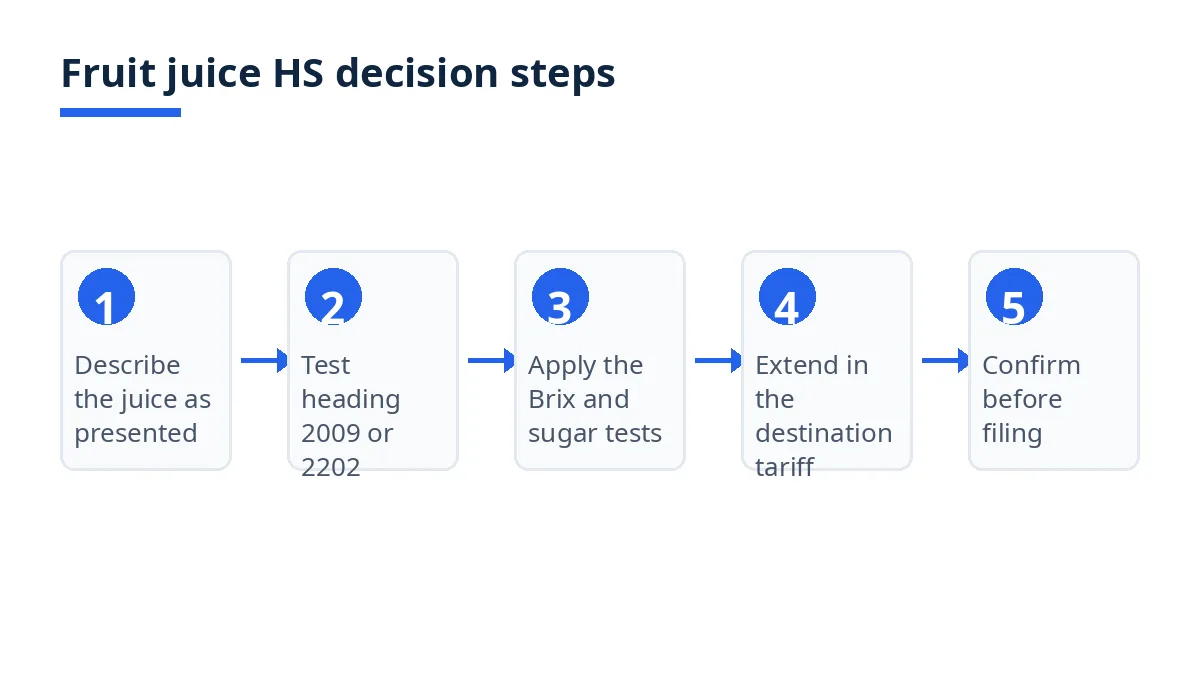
Classification follows the heading wording and the chapter notes, not the trade name. Apply five tests in order: juice character, fruit or mixture, Brix value, added sugar and loss of character, and presentation.
First, fermentation and spirit. Heading 2009 covers juices unfermented and not containing added spirit, defined as juices of an alcoholic strength by volume not exceeding 0.5 percent vol.3 Second, fruit or mixture: single fruits have their own groups inside 2009, and mixtures sit in 2009.90. Third, Brix value. In the United States chapter notes, Brix value means the direct reading of degrees Brix from a hydrometer or refractive index as percentage sucrose content from a refractometer, at 20 degrees Celsius or corrected for 20 degrees Celsius.3
Fourth, added sugar and loss of character. Heading 2009 allows added sugar or other sweetening matter, so added sugar alone does not remove a juice from 2009.1 The notes add a limit: juices with added sugar, Brix not exceeding 67, and less than 50 percent by weight of fruit juice lose their original character as 2009 juices, except concentrated natural juices.1 Fifth, presentation. Frozen, concentrated, made from concentrate, powdered, and diluted with water are national splits. United States notes define reconstituted juice as concentrate mixed with water to the average Brix value of like natural juice, and juice below a concentration degree of 1.5 as natural unconcentrated juice.3
Orange juice not from concentrate: is this a single-strength juice, or a concentrate in disguise
Deciding factor: Brix value, frozen state, and concentration. A chilled juice never concentrated, not frozen, Brix not exceeding 20 points indicatively to 2009.12, to be verified.3 Frozen juice goes to 2009.11 first; Brix over 20 goes to 2009.19.
Orange juice from concentrate: does reconstitution return it to a single-strength line
Deciding factor: concentration and the Brix value after reconstitution. A frozen concentrate points indicatively to 2009.11, to be verified.3 A non-frozen juice made from concentrate with Brix over 20 points indicatively to 2009.19, to be verified.3
Apple juice with added sugar: does added sugar move it out of heading 2009
Deciding factor: the heading wording, then the character test. Added sugar alone does not move apple juice out of 2009, because the heading allows added sugar or other sweetening matter.1 An apple juice with Brix not exceeding 20 points indicatively to 2009.71, to be verified, and the United Kingdom tariff splits that subheading by added sugar.1 The boundary question arises only when added sugar, water, and other ingredients leave less than 50 percent by weight of fruit juice in a product with Brix not exceeding 67. Then test 2202.1
Grape juice: which Brix split applies in the destination tariff
Deciding factor: the national Brix split for grape juice. In the United States tariff, grape juice, including grape must, Brix not exceeding 30 points indicatively to 2009.61, and other grape juice to 2009.69, each to be verified.3 That 30 threshold differs from the 20 threshold for orange and apple juice, so do not borrow an orange threshold.
Mixed fruit nectar: is this a mixture of juices, or a diluted drink
Deciding factor: juice content, Brix value, and dilution. A blend of two or more juices with no added water beyond reconstitution points indicatively to 2009.90, to be verified.3 A nectar commonly adds water and sweetening, so the question is whether it still reads as a mixture or as a diluted drink. A product with added sugar, Brix not exceeding 67, and less than 50 percent by weight of fruit juice loses its original character as a 2009 juice.1 If it fails that test, test 2202.4
Flavoured sweetened drink: is this a juice at all, or a 2202 beverage
Deciding factor: whether the product is juice as presented or water that has been flavoured and sweetened. Heading 2202 covers waters, including mineral and aerated waters, containing added sugar or other sweetening matter or flavoured, and other non-alcoholic beverages, not including 2009 juices.4 A genuine juice of heading 2009 cannot be placed in 2202 merely because it is sweetened or flavoured. A water-based drink with flavouring, sweetening, and only a small juice component points indicatively to 2202, with lines under 2202.10 and 2202.99 to be confirmed on the entry date.4
National codes: US HTS, EU CN/TARIC, UK commodity code
Each line below is to be confirmed in that country's tariff on the entry date. Do not copy a line into another country's declaration.
United States HTS, to confirm on the entry date: Revision 15 (2026), Chapter 20, lists orange juice frozen at 2009.11, not frozen Brix not exceeding 20 at 2009.12, and other orange juice at 2009.19, with concentration and container splits.3 The same chapter lists grape juice at 2009.61 and 2009.69, apple juice at 2009.71 and 2009.79, and mixtures at 2009.90.3 Read the full 10-digit line in the current HTS, not from an old invoice.
European Union CN/TARIC, to confirm on the entry date: start from the same six-digit subheadings, extend to the 8-digit Combined Nomenclature line, then confirm the full TARIC line on the entry date. The Northern Ireland Online Tariff, which applies the same CN and TARIC structure, shows the 2202.99 diluted-drink splits, and every EU line here must be confirmed in TARIC before filing.5
United Kingdom commodity code, to confirm on the entry date: the United Kingdom tariff lists orange juice under 2009.11, 2009.12, and 2009.19, with Brix, container, sugar, and powder splits.1 For apple juice, the lines opened here are 2009.71, split by added sugar, and 2009.79 for other apple juice.1 Mixtures sit at 2009.90, and 2202 lists waters under 2202.10 and other beverages under 2202.99, including diluted juice lines, each to be confirmed on the entry date.1 4
How to confirm the code officially
First, write the full description: fruit, single juice or mixture, frozen state, concentration, Brix with method and temperature, added sugar, water, flavouring, juice content, and pack size. Second, read the heading text and chapter notes, then compare subheadings only at the same level. Third, extend the six digits to the national line and note the entry date. Fourth, search published rulings for similar goods.
For a borderline product, apply for a binding decision before shipment. In the United Kingdom, an Advance Tariff Ruling must be applied for before all customs procedures have been completed, because decisions cannot be made retrospectively, with a separate application for each type of goods.6 HMRC will reply in 30 to 120 days with the correct code, validity start date, and reference number.6 For Northern Ireland or the European Union, guidance directs traders to a Binding Tariff Information decision.6
Common classification mistakes
First, filing by flavour word: a flavoured drink is not automatically a juice of that fruit, and a blend is not automatically the line of its first-named fruit. Second, ignoring Brix value: a juice filed under a Brix split without a laboratory reading, or with a reading at an unstated temperature, can sit in the wrong subheading. Third, treating added sugar as a heading changer on its own: heading 2009 allows added sugar, so the test is character and juice content. Fourth, copying a national line across borders. Fifth, filing a concentrate as a retail drink, or a retail drink as a concentrate. Sixth, leaving a nectar in 2009 without character and dilution tests, or pushing a genuine juice into 2202 because it is sweetened.
Related duties and documents
This guide states no duty rate. Duty treatment follows the full national code, the origin of the goods, and any measure or preference that applies on the entry date, read in the destination tariff at that time, not from this guide. Keep the classification file with the shipment file: the supplier specification, Brix result with method and temperature, ingredient list with juice content, process description, and tariff line with entry date. If a broker files on your behalf, share that file in writing and ask the broker to confirm the national line back to you before filing.
FAQs
What is the HS code for fruit juices?
The indicative heading is 2009 for unfermented fruit juices without added spirit, whether or not containing added sugar or other sweetening matter, with subheadings by fruit, Brix value, frozen state, and mixture, each to be verified on the entry date.1 Drinks that have left heading 2009 point indicatively to 2202 as a question to be verified.4
Is the HS code the same in every country?
Only the first six digits are shared internationally. The Harmonized System is used by more than 200 countries and economies, and national tariffs then extend those digits for their own lines.2
How do I confirm the correct code?
Write the description, read the heading text and chapter notes, compare subheadings only at the same level, and extend the six digits to the national line. For a borderline product, apply before shipment for a binding decision, such as a United Kingdom Advance Tariff Ruling.6
What happens if I use the wrong code?
Customs can reclassify the goods, reassess the duty and tax treatment from the correct line, hold the shipment, and apply the penalties or controls for the correct code. A wrong code can delay clearance and affect later shipments if repeated. If you find an error, tell your broker promptly and re-check shipments that used the same line.
Next steps on Exportain
Read the general HS structure first in HS Code (Harmonized System Code), then work through the method in How to Find an HS Code: Step-by-Step. To compare suppliers, browse Bangladeshi manufacturers and exporters and ask each supplier for the full specification, including Brix value and juice content, before you confirm a code.
Sources
- Fruit or nut juices (including grape must and coconut water) and vegetable juices - UK Integrated Online Tariff, heading 2009. GOV.UK, HM Revenue and Customs (accessed )
- What is the Harmonized System (HS)?. World Customs Organization (accessed )
- Harmonized Tariff Schedule of the United States Revision 15 (2026), Chapter 20. U.S. International Trade Commission (accessed )
- Waters, including mineral waters and aerated waters, containing added sugar or other sweetening matter or flavoured, and other non-alcoholic beverages - UK Integrated Online Tariff, heading 2202. GOV.UK, HM Revenue and Customs (accessed )
- Waters, including mineral waters and aerated waters, containing added sugar or other sweetening matter or flavoured, and other non-alcoholic beverages - Northern Ireland Online Tariff, heading 2202. GOV.UK, HM Revenue and Customs (accessed )
- Apply for an Advance Tariff Ruling. HM Revenue & Customs (GOV.UK), (accessed )
About the author
Sourcing from Bangladesh?
Post a request for quotation and suppliers on Exportain can send you their quotes directly.
Post an RFQ


