HS Code for Face Masks: Classification Guide for Importers
Face masks classification: the indicative heading 6307 and subheading 6307.90 for textile masks without a replaceable filter or mechanical parts, the 9020 fork, the paper-mask question, and US, EU, and UK national codes to confirm.
Short answer
For a textile face mask without a replaceable filter or mechanical parts, the indicative starting point is heading 6307, subheading 6307.90, to be verified in the destination tariff for the exact goods as presented. The settled code turns on the made-up test first, then the filter and mechanical-parts fork, then the material, and finally the full national line on the entry date.
On this page
Quick answer: indicative HS heading (with verify note)
For a textile face mask without a replaceable filter or mechanical parts, the indicative starting point is heading 6307, subheading 6307.90, to be verified in the destination tariff for the exact goods as presented on the entry date.1 The World Customs Organization reference lists textile face masks without a replaceable filter or mechanical parts at 6307.90, including surgical masks, disposable nonwoven masks, and N95 particulate respirators.1 A simple exhalation valve does not by itself turn such a respirator mask into a gas mask in that reference.1
That starting point is not a settled code for any shipment. Heading 6307 is residual, so the mask must first pass the made-up test, then the filter question, then the material question, and only then the national line. A United States ruling on woven polyester masks assembled by sewing reached 6307.90.9875 for its goods, to be verified, and decides those goods only.2 No duty rate is stated anywhere in this guide.
How HS codes are structured (2-4-6 digits)
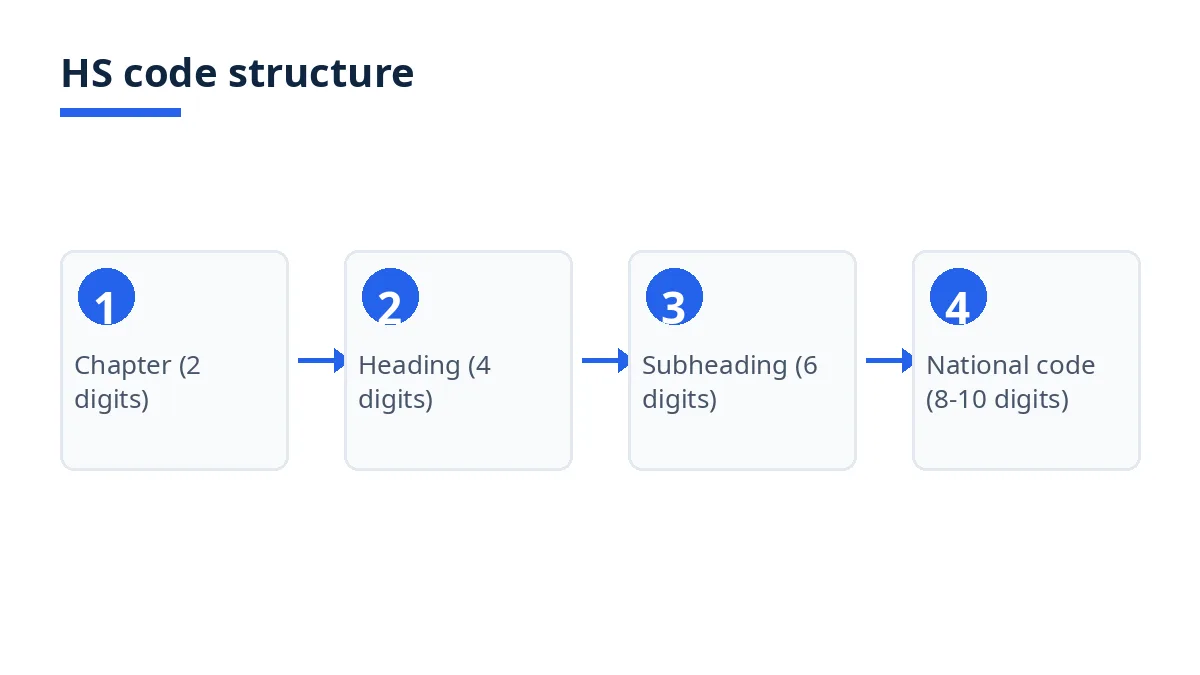
The Harmonized System is international only to six digits: the first two digits give the chapter, the first four the heading, and all six the subheading. National systems add digits after the sixth.3 Here, chapter 63 covers other made-up textile articles, heading 6307 covers other made-up articles, and 6307.90 is the six-digit subheading.1 2
Rule 1 states that classification follows the terms of the headings and any relevant section or chapter notes, and Rule 6 adds that only subheadings at the same level are comparable.4 Read the heading text and notes first, settle the heading, compare subheadings at the same level, then extend the six digits in the destination tariff.
Factors that decide the code for face masks
Work through the questions in this order: made-up first, then the filter fork, then the material, then the intended-use question at the national level. A word on the carton cannot move a mask between headings.
1. Made up first: is the mask a made-up article
Heading 6307 covers made-up articles of any textile material not included more specifically in other headings of Section XI or elsewhere.2 For Section XI, "made up" includes articles assembled by sewing, gumming, or otherwise, cut otherwise than into squares or rectangles, produced in the finished state, hemmed, or knitted or crocheted to shape.5 A woven polyester mask assembled by sewing passed that test in the ruling cited above.2 Fabric still in the piece, not yet cut or assembled, is a different question from a finished mask.
2. Material: nonwoven, woven, or another textile
At six digits, material alone does not split 6307.90: a woven mask and a nonwoven mask that pass the made-up test, with neither a replaceable filter nor mechanical parts, both raise the same 6307.90 question, to be verified.1 2 A Japan Customs example places a three-layer nonwoven mask in heading 63.07, citing the note for dust and odour masks of several nonwoven layers.6 Material matters twice: record every fibre and share by weight, since mixed materials are classified as wholly of the predominating material,5 and material splits national lines, as in the United Kingdom tariff below.5
3. The 9020 fork: mechanical parts or replaceable filters
Heading 9020 covers other breathing appliances and gas masks, excluding protective masks having neither mechanical parts nor replaceable filters.7 A mask with neither is excluded from 9020, pointing back to 6307 for a textile mask; a mask with mechanical parts or a replaceable filter raises a 9020 question, to be verified.1 7 Construction decides, not a product name: N95 respirators with simple exhalation valves stay in 6307.90, while gas masks with mechanical parts or replaceable filters sit at 9020.00.1 State the filter position exactly: no filter, fixed layer, simple valve, or replaceable unit. Only the last raises the replaceable-filter question.
4. Paper, plastic shields, and articles that are not face masks
A cellulose or paper mask raises a different question: the reference notes classification in most countries is to 4818.90 rather than 4818.50, and advises confirming with the customs administration where in doubt.1 Do not carry a textile code onto a paper mask, or the reverse. A plastic face shield covering more than the eye area is separate, noted at 3926.90 in most countries.1 Test each article alone.
5. Intended use: medical, general-purpose, or fashion, as a classification question
At six digits, surgical masks and disposable nonwoven masks sit together at 6307.90, so a medical, surgical, or general-purpose word on the carton creates no separate six-digit line.1 Use splits national lines instead, including medical descriptions in the United Kingdom, each to be confirmed on the entry date.2 5 A reusable fashion cloth mask is tested the same way: made-up first, filter fork second, material third. A mask presented as part of a garment needs its own heading test. Never describe a mask as meeting a standard unless the specification states it, and never treat a standard description as classification proof.5
Worked example: the same mask shape, three different questions
Shipment A is a three-layer nonwoven textile mask, sewn, with ear loops, no replaceable filter, and no mechanical parts: 6307.90, to be verified.1 6 Shipment B is the same shape with a replaceable filter unit: a 9020 question, to be verified.7 Shipment C is a cellulose mask of the same shape: a 4818.90 question, to be verified.1 Shape unchanged; construction and material changed, so the question did.
Goods as presented | Indicative starting point (verify) | Confirm before declaring |
|---|---|---|
Textile mask, made up, no filter, no mechanical parts | 6307.90 (verify) | Made-up test, then national line |
Textile mask with a replaceable filter or mechanical parts | 9020 question (verify) | Filter construction, then national line |
Cellulose or paper mask | 4818.90 question (verify) | Material; confirm where in doubt |
Plastic face shield, more than eye area | 3926.90 question (verify) | Shield construction |
Fabric in the piece, not yet made up | Outside 6307 question (verify) | Fabric heading as presented |
Old ruling quoting a national suffix | Stale suffix, re-check (verify) | Current line for entry date |
No line in this table is a settled code for any shipment.
National codes: US HTS, EU CN/TARIC, UK commodity code
The first six digits are shared. Everything after them is national. Confirm the full code in the destination system on the entry date.
The United States uses the Harmonized Tariff Schedule, running to ten digits.3 Extend 6307.90 to the full ten-digit line in the current schedule: the woven-mask ruling above reached 6307.90.9875 for its goods, to be confirmed on the entry date.2 Do not copy that suffix onto a different mask, or a suffix from an old ruling: national suffixes are dated.
The European Union builds on the six digits with the Combined Nomenclature, an eight-digit extension, extended further in TARIC with EU measures.3 Find the six-digit subheading first, then the eight-digit line and any TARIC detail for the entry date.
The United Kingdom uses a ten-digit commodity code for imports and an eight-digit code for exports.8 The first six digits should agree with the international subheading; the later digits are United Kingdom decisions. Under subheading 6307 90 95, the tariff organises nonwoven masks into medical face masks according to EN 14683 and other masks conforming to a similar standard, and other nonwoven masks, alongside other materials split into hand-made and other lines, each to be confirmed before declaring.5
For goods leaving Bangladesh, compare the exporter's declared code with the destination code. Agreement on the first six digits is reassuring; disagreement after the sixth digit is expected.3
How to confirm the code officially
Write the description as shipped: every textile material and share by weight, the construction method, the filter position and whether any filter is replaceable, any mechanical part, and whether the mask is disposable or reusable, matching on the specification, invoice, and packing list. Read the heading texts and notes for headings 6307, 9020, and 4818 together, not 6307 alone.1 2 7 Apply the General Rules in order, compare subheadings only at the same level, extend the six digits in the destination tariff, and cross-check published rulings: the CROSS database in the United States, Binding Tariff Information in the European Union, and an Advance Tariff Ruling in the United Kingdom.4 9 Another trader's ruling is evidence of how customs reasons, not a decision about your goods.9 Where headings remain in contention, ask a broker or apply for a binding ruling before shipping.9
Common classification mistakes
Copying a supplier's full national code into a different destination. Only the first six digits travel.3
Classifying from a trade name, photograph, or fashion or medical label. Customs classifies goods as presented.2
Treating a simple exhalation valve as an automatic move to 9020. Such respirator masks stay at 6307.90.1
Treating medical or surgical as a separate six-digit line. Surgical and disposable nonwoven masks sit together at 6307.90.1
Treating a fixed filter layer and a replaceable unit as the same fact. Only the replaceable unit raises the 9020 question.7
Carrying a textile code onto a paper mask, or a mask code onto a shield.1
Copying a national suffix from an old ruling without re-reading the current line.2
Skipping the section notes, or comparing subheadings at different levels.4 5
Declaring a code once and never re-checking it after a specification change.
Related duties and documents
This guide states no duty rate for any mask. Duty treatment is national and depends on the full national line, origin, and any measure attached to that line on the entry date. Read the current treatment for the confirmed line, through the broker and the destination tariff.
The supporting documents are those that let a broker test the description: the supplier specification sheet stating every material and share by weight, the construction method, the filter position and whether any filter is replaceable, and any mechanical part; the invoice and packing list in the same terms; the supplier's classification note with its reasoning and the rulings checked; and, where obtained, the broker's confirmation or binding ruling.9 For a repeating product, keep a classification file with the description, reasoning, rulings checked, and the national code and confirmation date.
FAQs
What is the HS code for face masks?
There is no single settled HS code for face masks as a group. The indicative starting point for a textile mask without a replaceable filter or mechanical parts is 6307.90, to be verified.1 A mask with a replaceable filter or mechanical parts raises a 9020 question, and a paper mask raises a 4818.90 question, each to be verified.1 7 The settled code depends on construction, material, and national line.
Is the HS code the same in every country?
The first six digits should be the same internationally, because they come from the shared Harmonized System.3 The full code differs: ten digits in the United States, an eight-digit Combined Nomenclature code extended in TARIC in the European Union, and a ten-digit commodity code for imports in the United Kingdom.3 8
How do I confirm the correct code?
Write the description as shipped, apply the General Rules in order, compare subheadings only at the same level, extend the six digits, and cross-check published rulings.4 9 Where headings remain in contention, ask a broker or apply for a binding ruling before shipping.9
What happens if I use the wrong code?
Customs can reclassify the goods, reassess duty and tax treatment, delay clearance, and impose penalties. If an error is found, tell the broker promptly and update the file.9
Next steps on Exportain
Work through HS Code (Harmonized System Code) first for the digit structure, then use HS codes: how to classify your product to run the checks in order. Once the code is confirmed, compare suppliers on the same written specification through Exportain suppliers.
Sources
- HS Classification Reference for COVID-19 Medical Supplies (Edition 3). East African Community (hosting the World Customs Organization reference) (accessed )
- HQ H313043: Tariff classification of certain polyester woven face masks. CustomsMobile (reproduction of a U.S. Customs and Border Protection ruling) (accessed )
- HS Code (Harmonized System Code). Exportain (accessed )
- General Rules for the Interpretation of the Harmonized System (archived). Canada Border Services Agency (accessed )
- Subheading 63079095 - Other. GOV.UK (UK Trade Tariff) (accessed )
- Nonwoven fabric mask - Heading 63.07. Japan Customs (accessed )
- Other breathing appliances and gas masks, excluding protective masks having neither mechanical parts nor replaceable filters. GOV.UK (UK Trade Tariff) (accessed )
- Classifying your goods. GOV.UK (UK Trade Tariff) (accessed )
- How to Find an HS Code: Step-by-Step. Exportain (accessed )
About the author
Sourcing from Bangladesh?
Post a request for quotation and suppliers on Exportain can send you their quotes directly.
Post an RFQ