

HS Code for Corrugated Cartons: Classification Guide for Importers
Corrugated cartons take indicative subheading 4819.10 inside heading 4819, split from non-corrugated folding cartons at 4819.20, with US, EU and UK national codes to confirm before filing.
Short answer
Corrugated cartons take the indicative subheading 4819.10, cartons, boxes and cases of corrugated paper or paperboard, inside heading 4819. The split turns on the board itself: solid paperboard folding cartons sit at 4819.20, sacks and other packing containers take their own lines, and the United States, EU and United Kingdom add national digits that must be confirmed for the exact carton before filing.
On this page
Key takeaways
The indicative six-digit code for a corrugated carton, box or case is 4819.10 inside heading 4819, while a folding carton of non-corrugated paper or paperboard sits at 4819.20.
Sacks and bags take 4819.30 and 4819.40, other packing containers take 4819.50, and office and shop articles take 4819.60, so form and use must be tested before filing under 4819.10.
In the United States, 4819.10.00 splits into statistical suffix 20 for sanitary food and beverage containers and suffix 40 for other corrugated cartons.
The EU Combined Nomenclature code is 4819 10 00 and the United Kingdom tariff lists commodity 4819 10 00 00, so only the first six digits carry across borders.
Print that is not merely subsidiary to packing use and a plastics layer over half the total thickness can move a carton out of Chapter 48, so both tests must be checked for printed or laminated cartons.
If you import cartons to pack and ship goods, the hs code for corrugated cartons is the line your customs entry depends on. The Harmonized System is a multipurpose international product nomenclature developed by the World Customs Organization (WCO), comprising more than 5,000 commodity groups, each identified by a six-digit code, and used by more than 200 countries and economies as a basis for their customs tariffs.1 This guide covers classification only. The background reading is the HS code harmonized system explainer and the steps in how to classify your product.
Quick answer: indicative HS heading (with verify note)
The indicative heading for corrugated cartons is 4819, and the indicative six-digit subheading is 4819.10, cartons, boxes and cases, of corrugated paper or paperboard.2 3 Treat every code in this guide as indicative and verify the full national code before filing, for the exact carton, the destination country, and the entry date. Heading 4819 covers cartons, boxes, cases, bags and other packing containers of paper or paperboard, plus box files and letter trays for office or shop use.2
Carton type | Indicative code | Why |
|---|---|---|
Carton, box or case made of corrugated paper or paperboard | 4819.10 | Names corrugated paper or paperboard |
Folding carton, box or case made of non-corrugated paper or paperboard | 4819.20 | Limited to non-corrugated board; uses folding |
Paper sack or bag | 4819.30 or 4819.40 | Own subheadings, split by base width |
Other packing container, including a drum or tube form | 4819.50 | Residual packing-container line |
Box file, letter tray or storage box for office or shop use | 4819.60 | Reserved for office and shop articles |
How HS codes are structured (2-4-6 digits)
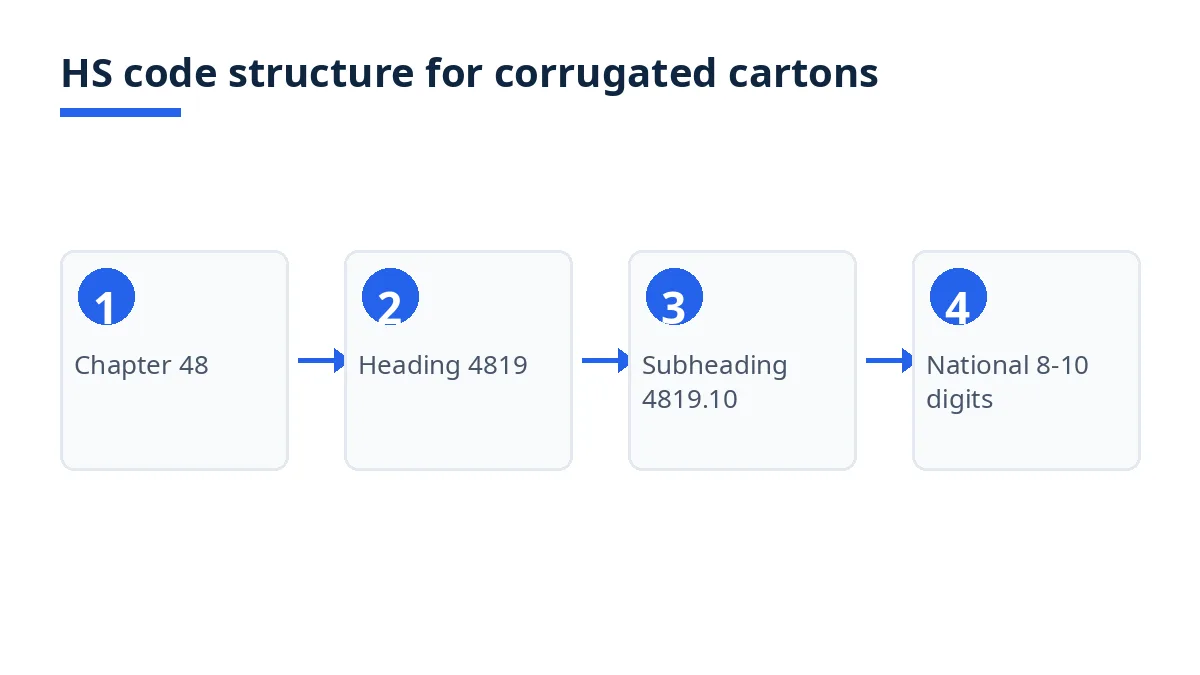
The Harmonized System is organized in a hierarchical structure by sections, chapters (2 digits), headings (4 digits) and subheadings (6 digits).4 Chapter 48 covers paper and paperboard and articles of paper pulp, of paper or of paperboard.3 Heading 4819 sits inside that chapter, and subheading 4819.10 narrows it to cartons, boxes and cases of corrugated paper or paperboard.2 3
Countries then subdivide the six-digit categories into national subheadings.4 The European Union uses eight-digit codes,4 and the United States and the United Kingdom extend to ten digits. The first six digits are shared worldwide, and every digit after the sixth is national.
Factors that decide the code for corrugated cartons
Corrugated board, not the sales name. The deciding test is the board itself. Subheading 4819.10 covers cartons, boxes and cases of corrugated paper or paperboard, while 4819.20 covers folding cartons, boxes and cases of non-corrugated paper or paperboard.2 A solid paperboard box sold as a shipping box is not a corrugated carton, and a carton made of corrugated board is not a folding carton under 4819.20, even if it ships flat. Record the board type on the specification sheet, not only the product name, and describe it the same way on the invoice.
Carton, box or case versus sack, bag or other container. Heading 4819 runs from cartons, boxes and cases at 4819.10 through sacks and bags at 4819.30 and 4819.40 to other packing containers, including record sleeves, at 4819.50.3 A paper sack, a cone, or a drum-shaped packing container takes a different subheading from a rectangular shipping carton. The United States schedule places fiber drums, cans, tubes and similar containers inside the other packing containers line at 4819.50.40.2 Test tube and drum forms against 4819.50 before filing them as cartons.
Office and shop articles take their own line. Subheading 4819.60 covers box files, letter trays, storage boxes and similar articles, of a kind used in offices, shops or the like.3 A corrugated storage box marketed and used as office filing storage sits on the border between 4819.10 and 4819.60, and its stated use and form decide which line fits.
Material in rolls or sheets is not a finished carton. Headings 4803 to 4809 apply only to paper, paperboard, cellulose wadding and webs of cellulose fibers in strips or rolls of a width exceeding 36 cm, or in rectangular sheets with one side exceeding 36 cm and the other side exceeding 15 cm in the unfolded state.2 A roll or sheet of corrugated board supplied for conversion is material, while a cut, creased and formed carton is an article under 4819. State whether you are buying board or finished cartons, and classify the goods as presented at the border.
Print and coating can change the chapter test. Chapter 48 note 12 provides that, except for the goods of heading 4814 or 4821, paper, paperboard, cellulose wadding and articles thereof, printed with motifs, characters or pictorial representations, which are not merely subsidiary to the primary use of the goods, fall in Chapter 49.2 Ordinary brand print that is subsidiary to packing use does not move a shipping carton out of 4819, but a carton whose printed matter is its main purpose needs the Chapter 49 test. Chapter 48 note 2 also excludes paper-reinforced stratified sheeting of plastics, and one layer of paper or paperboard coated or covered with a layer of plastics where the plastics layer constitutes more than half the total thickness, other than wallcoverings of heading 4814, and a travel-goods style case falls under heading 4202 rather than Chapter 48.2 A heavily plastic-laminated carton needs that thickness test before filing.
Paper includes paperboard for this chapter. Chapter 48 note 1 states that, except where the context otherwise requires, a reference to paper includes references to paperboard, irrespective of thickness or weight per square meter.2 Do not split a carton line by board thickness.
National codes: US HTS, EU CN/TARIC, UK commodity code
United States: HTS, ten digits. The United States schedule lists 4819.10.00 for cartons, boxes and cases, of corrugated paper or paperboard, with statistical suffix 20 for sanitary food and beverage containers and suffix 40 for other cartons.2 The full ten-digit lines are therefore 4819.10.0020 for a sanitary food or beverage container and 4819.10.0040 for other corrugated cartons. Use the same suffix on every line for the same carton type. The schedule also lists 4819.20.00 for folding cartons of non-corrugated paper or paperboard, with the same sanitary versus other suffix split.2
European Union: CN at eight digits, TARIC for measures. The Combined Nomenclature uses eight-digit codes, comprising the HS codes with further EU subdivisions.4 For corrugated cartons, the eight-digit CN code is 4819 10 00, built from heading 4819 and subheading 481910.4 3 TARIC adds further digits for measures, so confirm the full TARIC code for the entry date and the origin before filing.
United Kingdom: commodity code. The United Kingdom online tariff lists commodity 4819 10 00 00 for cartons, boxes and cases, of corrugated paper or paperboard, and states that the code for exporting and Intrastat reporting is 4819 10 00.5 For an entry into Great Britain, confirm the code on the Great Britain tariff for the entry date, since measures can differ even when the commodity code matches.
United Arab Emirates and other destinations. For other destinations, including the UAE, the first six digits are the shared base, so confirm the national extension in the destination tariff.1 4
How to confirm the code officially
Write a precise description: corrugated or non-corrugated board, carton, box, case, sack or other container form, flat or erected state, office storage use if any, print and coating details, and food-contact use for a United States entry.
Start from the official tariff for the destination, and read the heading text and chapter notes.4 2 5
Check the neighboring subheadings before settling: 4819.20 for non-corrugated folding cartons, 4819.30 and 4819.40 for sacks and bags, 4819.50 for other packing containers, and 4819.60 for office and shop articles.3
For a borderline carton, such as a corrugated office storage box or a heavily printed carton, ask the destination customs authority for a binding decision before you ship, and give it the full description from step 1.1
Give your broker the description and the confirmed national code for each carton type, and use the same codes on the invoice, the packing list and the entry.
Common classification mistakes
Filing every paperboard box under 4819.10. The corrugated line covers only cartons, boxes and cases of corrugated paper or paperboard, while folding cartons of non-corrugated paper or paperboard sit at 4819.20.2 A solid board folding carton filed under 4819.10 is on the wrong subheading, even if it ships goods.
Filing sacks, tubes and drums as cartons. Sacks and bags take 4819.30 and 4819.40, and other packing containers take 4819.50.3 A tube or drum form needs the 4819.50 test, and the United States schedule places fiber drums, cans and tubes inside that line.2
Filing board material as finished cartons. A roll or sheet of corrugated board is material, and headings 4803 to 4809 carry size limits for material in rolls or sheets.2 Classify board and finished cartons as separate goods, with separate lines.
Copying a code from another country. Only the first six digits are shared. The European Union uses eight-digit codes,4 the United States schedule splits 4819.10.00 into statistical suffixes 20 and 40,2 and the United Kingdom tariff lists the ten-digit commodity 4819 10 00 00.5
Ignoring the print and coating tests. Print that is not merely subsidiary to packing use moves the goods toward Chapter 49 under Chapter 48 note 12, and a plastics layer over half the total thickness moves the goods out of Chapter 48 under note 2.2 Check both tests for printed or laminated cartons before filing under 4819.10.
Using one code for a mixed carton shipment. A shipment that mixes sanitary food and beverage containers with other corrugated cartons needs separate United States suffix lines, 4819.10.0020 and 4819.10.0040.2
Related duties and documents
This guide states no duty rates: the code decides which duty line customs applies, and a rate read beside one code does not carry to another code or entry date. Read the rate beside your confirmed code for your origin and entry date.
Keep the carton description, the board specification, the confirmed national code for each carton type, any binding decision, and the origin evidence together in the shipment file. Put each carton type on its own invoice line, with the board type, the form, the state, and the food-contact use stated.
FAQs
What is the HS code for corrugated cartons?
The indicative six-digit code is 4819.10, cartons, boxes and cases, of corrugated paper or paperboard, inside heading 4819.2 3 Verify the full national code before filing: 4819.10.0020 or 4819.10.0040 in the United States,2 4819 10 00 in the EU Combined Nomenclature,4 3 and 4819 10 00 00 on the United Kingdom tariff.5
Is the HS code the same in every country?
Only the first six digits are shared worldwide. The Harmonized System comprises more than 5,000 commodity groups, each identified by a six-digit code, and is used by more than 200 countries and economies as a basis for their customs tariffs.1 Beyond six digits, countries subdivide the categories into national subheadings, and the European Union uses eight-digit codes.4
How do I confirm the correct code?
Describe the carton precisely, read the heading text and chapter notes in the destination tariff, and check the neighboring subheadings 4819.20, 4819.30, 4819.40, 4819.50 and 4819.60.2 3 For a borderline carton, ask the destination customs authority for a binding decision before shipping.1
What happens if I use the wrong code?
The code on the declaration decides the treatment customs applies, so a wrong code brings the wrong duty line, the wrong measures, and a shipment held for correction. A binding decision taken before shipping reduces that risk.
Next steps on Exportain
Browse Bangladeshi suppliers on Exportain and state the confirmed carton codes per carton type in your inquiry. Read the HS code harmonized system explainer and the steps in how to classify your product before your next entry.
Sources
- What is the Harmonized System (HS)?. World Customs Organization (accessed )
- Harmonized Tariff Schedule of the United States, Chapter 48 (2026 Revision 18). U.S. International Trade Commission (accessed )
- HS, 2012 - Code 4819. United Nations Statistics Division (accessed )
- Harmonised System. European Commission (accessed )
- Commodity code 4819100000: Cartons, boxes and cases, of corrugated paper or paperboard - Northern Ireland Online Tariff. GOV.UK, HM Revenue and Customs (accessed )
About the author
Sourcing from Bangladesh?
Post a request for quotation and suppliers on Exportain can send you their quotes directly.
Post an RFQ


