HS Code for Chili Powder: Classification Guide for Importers
Chili powder points indicatively to heading 0904 (verify): ground powder to the crushed-or-ground split, dried whole chili to the dried split, and flakes and spice blends are boundary questions under the Chapter 9 mixture notes; confirm the national line on the entry date.
Short answer
Chili powder points indicatively to heading 0904, to be verified for your product and destination. Ground chili powder points to the crushed-or-ground split at 0904.22, while dried whole chili points to 0904.21, and chili flakes and spice blends are boundary questions under the Chapter 9 mixture notes. The full national code must be confirmed in the destination tariff on the entry date.
On this page
Quick answer: indicative HS heading
Chili powder points indicatively to heading 0904 — verify this heading for your product and destination before you declare it. Heading 0904 covers "Pepper of the genus Piper; dried or crushed or ground fruits of the genus Capsicum or of the genus Pimenta."1 Chili powder is ground Capsicum fruit. Within 0904, the six-digit split turns on form: dried fruit neither crushed nor ground falls on one side, crushed or ground fruit on the other — verify which side your product falls on.
Product as described | Indicative line — verify before declaring |
|---|---|
Ground chili powder, dried Capsicum ground to powder | 0904.22 (crushed or ground) — verify |
Dried whole chili, pods dried, not crushed or ground | 0904.21 (dried, neither crushed nor ground) — verify |
Crushed chili or chili flakes | 0904.22 candidate, boundary question — verify |
Chili blended with spices of other headings | 0910 or 2103 boundary question — verify |
No full national code is stated here; confirm each national line on the entry date.
How HS codes are structured (2-4-6 digits)
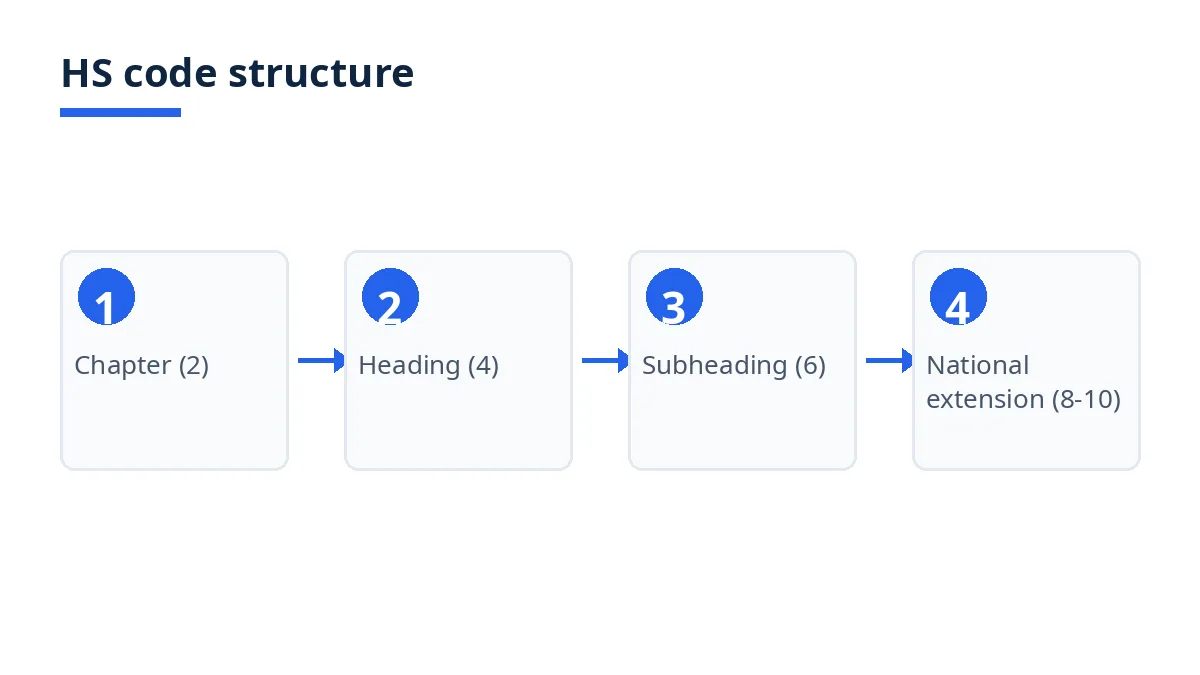
The Harmonized System is a multipurpose international product nomenclature developed by the World Customs Organization (WCO). It comprises more than 5,000 commodity groups, each identified by a six-digit code, and it is used by more than 200 countries and economies as the basis for their customs tariffs.2 The first six digits are the international part; everything after them is national detail, and only the first six digits are used worldwide.3
Chapter 09 is "Coffee, tea, maté and spices": 09 is the chapter, 0904 the heading, and all six digits the subheading, the most detailed level countries share. National tariffs then extend the six digits: the EU Combined Nomenclature adds digits seven and eight, and TARIC adds digits nine and ten.4
Digits | Level | Chili powder example — verify |
|---|---|---|
09 | Chapter | Coffee, tea, maté and spices |
0904 | Heading | Pepper (Piper); dried, crushed or ground Capsicum or Pimenta fruit |
0904.22 | Subheading | Fruits of the genus Capsicum, crushed or ground — verify |
8–10 digits | National extension | Read the destination tariff line on the entry date — confirm |
Factors that decide the code for chili powder
Four questions decide the classification, answered from the heading text and the Chapter 9 notes before any national line.
1. Which genus is it?
Heading 0904 holds three genera, and they do not share a subheading. Pepper of the genus Piper (black and white pepper) has its own lines, chili is fruit of the genus Capsicum, and allspice is fruit of the genus Pimenta. Check the botanical source: a product sold as "pepper" is not automatically chili.
2. What form is it in on arrival?
The heading text draws the form line itself: "dried or crushed or ground." Dried whole pods sit on the dried side; powder and crushed chili sit on the crushed-or-ground side. The U.S. Chapter 9 notes add that, except as otherwise indicated, the chapter covers the named products whole or in crushed or powdered form.1 Form must still be stated exactly on the specification.
3. Is anything else mixed in?
Chapter 9 Note 1 is the mixture rule. Mixtures of products of the same heading stay in that heading; mixtures of products of different headings are classified in heading 0910. Adding other substances does not change the classification while the mixture keeps the essential character of the goods of those headings; if it does not, the mixture leaves the chapter, and mixed condiments or mixed seasonings are classified in heading 2103.1 Test any chili powder with added salt, garlic, or other spices against this note; do not assume it stays in 0904.
4. Does the variety name change anything?
The U.S. tariff text names cayenne pepper, paprika, and red pepper under fruits of the genus Capsicum.1 A variety name describes which Capsicum fruit you have, not a separate heading. National tariffs may split these lines further by variety, so read the national line on the entry date.
Worked examples as classification questions
Each example is a question to confirm, not a settled classification — verify every line before declaring.
Ground chili powder. Dried Capsicum fruit, ground to powder, nothing added. Heading 0904, crushed-or-ground split 0904.22 — verify. Question: does the specification confirm nothing else was added in milling?
Crushed chili. Dried Capsicum fruit in coarse pieces, not ground. Crushing is named in the heading text, so 0904.22 is the candidate — verify. Question: crushed fruit, or cut or processed in a way the heading text does not name?
Chili flakes as a boundary question. Flakes sit between whole and ground, where disputes start. If crushed fruit, 0904.22 is the candidate; if cut pieces presented as something else, the answer needs a broker or ruling. Do not declare flakes under either line unchecked — verify.
Dried whole chili. Whole dried Capsicum pods, not crushed, not ground. The dried-neither-crushed-nor-ground split points to 0904.21 — verify. Question: dried only, or also smoked, oiled, or otherwise treated?
Spice-mixture boundary question. A chili-cumin-coriander blend mixes products of different headings, so Note 1(b) points to 0910 — verify. Sold as a mixed seasoning without Chapter 9 essential character, heading 2103 is the question to test — verify. Get the blend percentage and pack name in writing.
National codes: US HTS, EU CN/TARIC, UK commodity code
The six digits are shared; the digits after them are not, and product-specific decisions are particular to each country.3 No settled 8–10 digit code is stated here; confirm each line on the entry date.
System | What it is | Length | Line to confirm on the entry date |
|---|---|---|---|
US HTS | Harmonized Tariff Schedule of the United States (USITC) | 10 digits, full national level | Read the 0904 lines in the current HTS — confirm |
EU CN / TARIC | Combined Nomenclature (8 digits) plus TARIC digits 9 and 104 | 8 digits CN, 10 digits TARIC | Read the 0904 TARIC lines — confirm |
UK commodity code | UK Trade Tariff code, found with the Trade Tariff tool3 | 10 digits | Read the 0904 UK Trade Tariff lines — confirm |
The U.S. HTS shows how far national detail goes: under each six-digit split it lists further lines by variety and presentation.1 That is why a six-digit subheading is not a declaration code.
This guide states no duty rate. The code works out duty, import VAT, taxes, and preferential rates, but the rate is read in the destination tariff on the entry date.3
How to confirm the code officially
Work in this order, recording each step with its date.
Read the heading text and the Chapter 9 notes in the destination tariff. Start from the words of heading 0904 and Note 1, not from a supplier listing or search result.
Look up the national line. Use the Harmonized Tariff Schedule for the United States, the TARIC consultation for the European Union, and the UK Trade Tariff tool for the United Kingdom.3 Read the line in force on the entry date, with its measures.
Search published rulings for similar goods. In the United States, CBP gives full and careful consideration to written ruling requests on a specifically described transaction, requestable under Part 177 of the CBP Regulations by a person with a direct and demonstrable interest.5 They show how customs reasons, not a decision about your goods.
Apply for a binding decision before you ship, if the answer is doubtful. In the United Kingdom, apply for an Advance Tariff Ruling before all customs procedures have been completed, since decisions cannot be retrospective; HMRC replies in 30 to 120 days with the correct commodity code and a reference number.6 For Northern Ireland or EU goods, a Binding Tariff Information decision is the equivalent route.6 In the United States, a ruling request goes to CBP by letter or through the eRulings template.5
Common classification mistakes
Copying a supplier's full code. A supplier code is a starting point for the first six digits only; later digits may not exist, or may mean something different, in your country.3
Treating all "pepper" as one product. Black pepper is genus Piper; chili is genus Capsicum. Their subheadings differ.
Declaring flakes as whole or as powder without checking. Flakes are the boundary case here; picking a side without evidence is how a shipment gets reclassified.
Assuming a blend stays in 0904. Note 1 moves different-heading mixtures to 0910, and mixed seasonings that lose their Chapter 9 character to 2103.1
Using a variety name as a code. Cayenne, paprika, and red pepper are Capsicum names, not codes.1
Declaring from an old tariff. The WCO updates the Harmonized System every 5 to 6 years, and national tariffs are revised in between.2 An old invoice code is not evidence for a new shipment.
Related duties and documents
The code is entered on the import declaration, and the destination tariff shows what follows from it: duty and tax treatment, whether a licence is needed, and whether measures such as tariff quotas or anti-dumping duties apply.3 Never state a duty rate from memory or a supplier quotation; read the rate and measures on the destination line.
Keep a classification file per product: supplier specification (genus, form, blend composition), heading and subheading chosen, chapter notes relied on, national line and date read, and any ruling reference. If you hold a UK Advance Tariff Ruling, declare its reference in Box 44 and tell the person completing your customs documents that a ruling has been given and what code to use.6 Share the file with your supplier and broker in writing, and re-check it on any specification change, tariff update, or new destination.
FAQs
What is the HS code for chili powder?
Chili powder points indicatively to heading 0904 — verify this heading for your product and destination. Within it, ground chili powder points to the crushed-or-ground split at 0904.22 — verify. No full national code is stated here: read the 8–10 digit line in the destination tariff on the entry date first.
Is the HS code the same in every country?
The first six digits are shared internationally, because they come from the WCO system.2 The full code is not the same everywhere: countries add their own digits, duty rates, and rules after them.3
How do I confirm the correct code?
Read heading 0904 and the Chapter 9 notes in the destination tariff, then read the national line in the HTS, TARIC, or UK Trade Tariff on the entry date. If two readings remain plausible, search published rulings or apply for a binding decision before you ship: a UK Advance Tariff Ruling, an EU Binding Tariff Information decision, or a U.S. CBP ruling.6 5
What happens if I use the wrong code?
Customs can reclassify the goods, reassess duty and taxes, and delay clearance while the classification is corrected. An incorrect declaration may also lead to a penalty, a rejected declaration, and the loss of reliefs or simplifications.4 If you find an error in a code already used, tell your broker promptly and correct it through the proper channel.
Next steps on Exportain
For the general system behind this guide, read HS Code (Harmonized System Code), which explains the structure digit by digit and HS vs HTS vs TARIC. For the classification method step by step, read How to Find an HS Code. When you are ready to source, browse Bangladeshi suppliers on Exportain and ask each supplier for the full written specification — genus, form, blend composition — so the code you declare matches the goods that arrive.
Sources
- Harmonized Tariff Schedule of the United States Revision 18 (2026), Chapter 9. U.S. International Trade Commission (accessed )
- What is the Harmonized System (HS)?. World Customs Organization (accessed )
- Finding commodity codes for imports or exports. GOV.UK (HM Revenue & Customs), (accessed )
- Using commodity codes and related additional codes in the Customs Declaration Service. GOV.UK (accessed )
- What are Ruling Letters?. U.S. Customs and Border Protection (accessed )
- Apply for an Advance Tariff Ruling. HM Revenue & Customs (GOV.UK), (accessed )
About the author
Sourcing from Bangladesh?
Post a request for quotation and suppliers on Exportain can send you their quotes directly.
Post an RFQ