

HS Code for Ceramic Tiles: Classification Guide for Importers
Ceramic tiles point indicatively to heading 6907, split at six digits by water absorption: 6907.21, 6907.22 and 6907.23, plus mosaic at 6907.30 and finishing ceramics at 6907.40. Glaze and size change the national digits.
Short answer
Ceramic tiles point indicatively to heading 6907, which covers ceramic flags and paving, hearth or wall tiles, mosaic cubes and finishing ceramics. The six-digit split is by water absorption: 6907.21 for absorption not exceeding 0.5%, 6907.22 for absorption exceeding 0.5% but not exceeding 10%, and 6907.23 for absorption exceeding 10%, with 6907.30 for mosaic cubes and 6907.40 for finishing ceramics. Glazed or unglazed status and tile size change the national digits, so confirm the full national code before filing.
On this page
Key takeaways
Ceramic tiles point indicatively to heading 6907, split at six digits by water absorption: 6907.21 for absorption not exceeding 0.5%, 6907.22 for absorption exceeding 0.5% but not exceeding 10%, and 6907.23 for absorption exceeding 10%.
Glazed or unglazed status does not change the six-digit code in the current schedule: glazed and unglazed lines sit inside the same heading 6907 and part ways only in the national digits.
Mosaic cubes sit at 6907.30 and finishing ceramics at 6907.40, outside the absorption bands, and mosaic cubes are covered whether or not on a backing.
In the United States, tiles for heading 6907 do not include any article 3.2 cm or more in thickness, and the national lines further separate tiles by glaze status and face size.
Only the first six digits are shared worldwide: the European Union extends to eight digits and the United States and United Kingdom to ten, so confirm the full national code per tile type.
If you are importing ceramic tiles, start with the water absorption result, not the showroom name. Porcelain-look, vitrified, terracotta-style and mosaic are sales descriptions. Customs reads the fired tile, its absorption band, its glaze, its size and its form. Every heading here is indicative: confirm the full national code before filing.
Quick answer: indicative HS heading (with verify note)
Ceramic tiles point indicatively to heading 6907, which covers ceramic flags and paving, hearth or wall tiles, ceramic mosaic cubes and the like, whether or not on a backing, and finishing ceramics.1 The six-digit split inside that heading is by water absorption, not by the room the tile will go in.
Tile | Water absorption by weight | Indicative six-digit subheading |
|---|---|---|
Low-absorption floor or wall tile | Not exceeding 0.5% | 6907.21 |
Mid-absorption floor or wall tile | Exceeding 0.5% but not exceeding 10% | 6907.22 |
High-absorption wall tile | Exceeding 10% | 6907.23 |
Mosaic cubes and the like, other than finishing ceramics | Not split by absorption at six digits | 6907.30 |
Finishing ceramics, such as tile trim pieces | Not split by absorption at six digits | 6907.40 |
Treat this table as a starting point, not a finished entry. Older lists that split glazed tiles into their own heading do not match the current schedule, which places glazed and unglazed lines inside the same heading 6907.1 Glaze still matters, but at the national level in the United States, not at the six-digit level. The HS code explainer covers the shared six digits, and the classification method guide walks through reading heading texts and notes.
How HS codes are structured (2-4-6 digits)
The Harmonized System is a multipurpose international product nomenclature developed by the World Customs Organization (WCO), comprising more than 5,000 commodity groups, each identified by a six-digit code, and used by more than 200 countries and economies as a basis for their customs tariffs.2 The European Commission describes the same hierarchy: chapters at two digits, headings at four digits and subheadings at six digits.3
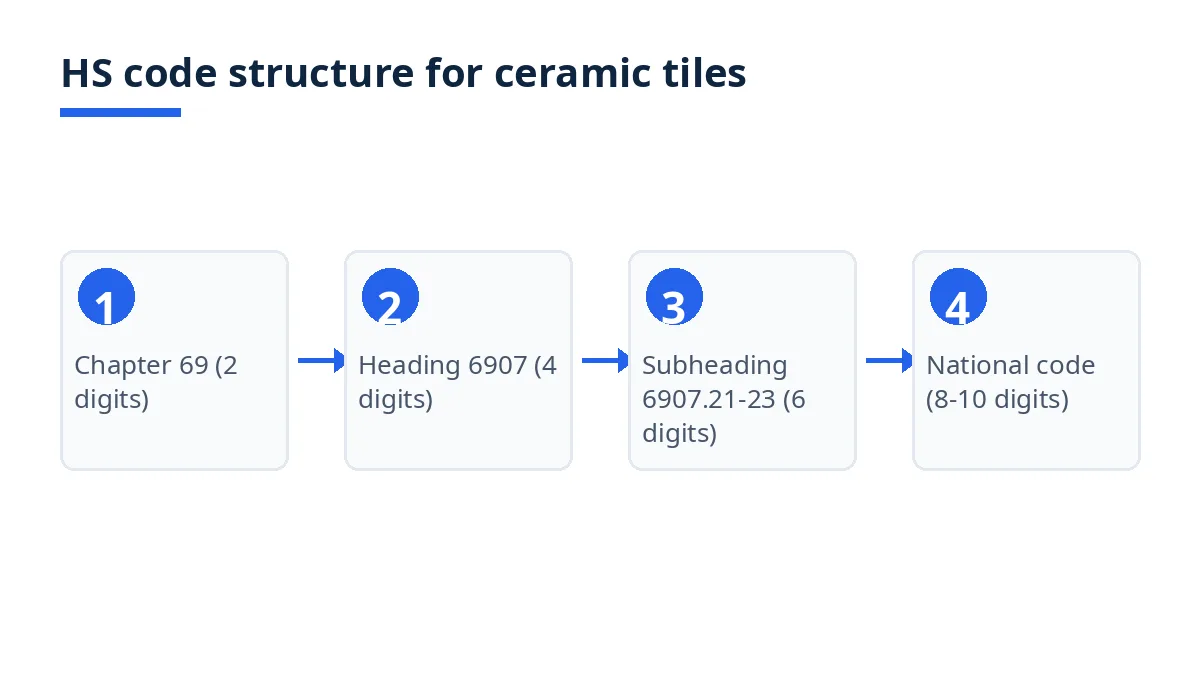
For ceramic tiles the build-up is: Chapter 69 for ceramic products; heading 6907 for flags and paving, hearth or wall tiles, mosaic cubes and finishing ceramics; then a six-digit subheading such as 6907.21, 6907.22 or 6907.23 by water absorption. Countries subdivide the six-digit categories into national subheadings.3 The current version is HS 2022, although some countries stay with a previous version for a time.3
Factors that decide the code for ceramic tiles
The tile must be a fired ceramic product. Chapter 69 applies only to ceramic products fired after shaping, and articles heated below 800 degrees Celsius to cure resins or remove water are not considered fired and are excluded.1 The United Kingdom tariff repeats the same note.4 Ask the supplier to state the firing process in writing.
Water absorption decides the six-digit line. The United States schedule splits flags and paving, hearth or wall tiles, other than mosaic and finishing ceramics, into 6907.21, 6907.22 and 6907.23 by the bands in the table above.1 Get a test result for the tile body, not a general claim for the range, and record it per tile type.
Glazed or unglazed is a national split, not a six-digit split. Inside each absorption band, the United States schedule separates unglazed lines from glazed lines.1 A glazed and an unglazed low-absorption tile therefore share 6907.21 and part ways only in the national digits. Record glaze status on every order line.
Mosaic and finishing pieces leave the absorption bands. Mosaic cubes and the like, other than finishing ceramics, sit at 6907.30, and finishing ceramics sit at 6907.40.1 A mesh-backed mosaic sheet is still covered, because the heading covers mosaic cubes whether or not on a backing.1 Do not file a mosaic sheet or a trim piece as a field tile.
Size and thickness change the national line, and thickness can remove the tile from the heading. In the United States, tiles for headings 6905 and 6907 do not include any article 3.2 cm or more in thickness.1 A thick paver at or above that limit needs a different heading test. Inside 6907, the United States statistical lines further separate tiles by face size, including tiles enclosed in a square with a side of less than 7 cm, and tiles with a side of 30 cm or less against larger tiles.1 Record length, width and thickness per tile type.
Wall use and floor use do not create separate six-digit codes. The heading covers flags and paving, hearth or wall tiles together.1 Use alone does not move a tile between 6907.21, 6907.22 and 6907.23. Keep intended use on the product sheet, but do not let it choose the code.
Wear class is a product specification, not a tariff split. The tariff lines here split by absorption, glaze, form and size, with no wear-class line. Keep any wear rating on the product specification, and ask for the absorption result if a supplier offers only a wear rating.
Neighbouring headings to rule out first. Roofing tiles sit at 6905.10, not in 6907.1 Siliceous fossil meal and refractory goods sit in headings 6901 to 6903, and headings 6904 to 6914 apply only to products other than those classifiable in 6901 to 6903.1 Rule those headings out for thick, refractory or roof products before you settle on 6907.
National codes: US HTS, EU CN/TARIC, UK commodity code
United States: HTS, ten digits. Inside each absorption band, read the unglazed line, then the glazed lines, then the size lines for the tile face.1 For glazed tiles, the schedule further separates small-face tiles, including tiles with not over 3229 tiles per square metre where most faces are bounded entirely by straight lines, tiles under 38.7 square centimetres, and other glazed tiles.1 Take the full ten-digit line per band, glaze status and face size, not one code for the whole container.
European Union: CN at eight digits, TARIC for measures. The Combined Nomenclature uses eight-digit codes, built on the six-digit subheading with further EU subdivisions.3 Start from the absorption band, then read the confirmed eight-digit line in TARIC for the entry date and origin Bangladesh, and check the origin rules behind any preference claim. Do not carry a United States ten-digit suffix into an EU entry.
United Kingdom: commodity code, ten digits. The code builds on the same first six digits, with its own extension after them.3 The United Kingdom tariff lists 6907 2100 00 for absorption not exceeding 0.5%, 6907 2200 00 for absorption exceeding 0.5% but not exceeding 10%, 6907 2300 00 for absorption exceeding 10%, 6907 3000 00 for mosaic cubes and 6907 4000 00 for finishing ceramics.4 The supplementary unit is the square metre.4
How to confirm the code officially
Write a precise description for each tile type: fired ceramic body, water absorption result and test method, glazed or unglazed, length, width and thickness, mosaic or field tile, finishing piece or not, and backing if any.
Start from the official tariff for the destination, and read the heading text and chapter notes.
Check published rulings for similar tiles. For the United States, the USITC advises traders to use the Customs Rulings Online Search Service (CROSS), because the correct classification of many items can be found there.5
For a borderline tile, such as one near an absorption boundary or the 3.2 cm thickness limit, apply for a binding decision before you ship. In the European Union, a Binding Tariff Information application needs a separate application for each type of product and a detailed description.6 In the United Kingdom, a legally binding decision is generally valid for 3 years, through an Advance Tariff Ruling.7 In the United States, if the merchandise is not described in any ruling on CROSS, you may request a binding ruling from Customs and Border Protection.5
Give your broker the description, test result and confirmed code for each tile type, and use the same codes throughout the entry.
Common classification mistakes
Filing a glazed tile under an old separate glazed heading. The current schedule places glazed and unglazed lines inside heading 6907.1 Replace an old glazed heading with the current absorption band plus the national glazed line.
Filing by sales name instead of absorption. Porcelain-look, vitrified and terracotta-style are not tariff tests. A porcelain-look tile with absorption above 10% belongs in 6907.23, not 6907.21, and a vitrified claim without a test result settles nothing.1
Filing a mosaic sheet or trim piece as a field tile. Mosaic cubes sit at 6907.30 and finishing ceramics at 6907.40, outside the absorption bands.1 Keep mosaic and trim lines separate on the invoice.
Filing a thick paver as a tile. In the United States, tiles for heading 6907 do not include any article 3.2 cm or more in thickness.1 Measure thickness before you file.
Copying a full national code across destinations. Only the first six digits are shared. The European Union extends to eight digits,3 and the United States and the United Kingdom extend to ten.1 4
Related duties and documents
This guide states no duty rates: the code decides which duty line customs applies, and a rate on a low-absorption glazed line does not carry to a high-absorption unglazed line. Read the rate beside your confirmed code for your origin and entry date, and check what proof of origin a preference claim requires. Keep the absorption result, glaze statement, dimensions, backing description, confirmed codes, any binding decision and origin evidence together in the shipment file, with each band, glaze status and size as a separate invoice line. Declare the area in square metres, the supplementary unit on the United Kingdom lines for heading 6907.4
FAQs
What is the HS code for ceramic tiles?
Ceramic tiles point indicatively to heading 6907: 6907.21 for absorption not exceeding 0.5%, 6907.22 for absorption exceeding 0.5% but not exceeding 10%, 6907.23 for absorption exceeding 10%, 6907.30 for mosaic cubes and 6907.40 for finishing ceramics.1 Confirm the full national code before filing, because glaze and size change the national digits.1
Is the HS code the same in every country?
Only the first six digits are shared. The European Union Combined Nomenclature uses eight-digit codes,3 and the United States and the United Kingdom extend to ten digits.1 4
How do I confirm the correct code?
Describe each tile type precisely, including the absorption result, glaze status and dimensions, read the heading text and chapter notes in the destination tariff, and check published rulings such as CROSS for the United States.5 For a borderline tile, apply for a binding decision before shipping: Binding Tariff Information in the European Union,6 an Advance Tariff Ruling in the United Kingdom,7 or a Customs and Border Protection ruling in the United States.5
What happens if I use the wrong code?
A wrong code brings the wrong duty line, the wrong import controls and a delayed clearance while customs reclassifies the goods. A binding decision in advance gives a legally binding classification, generally valid for 3 years in the United Kingdom.7 If you find an error after filing, tell your broker promptly.
Next steps on Exportain
Browse Bangladeshi suppliers on Exportain, where supplier profiles carry document and photo review badges, and compare tile ranges with absorption, glaze status and dimensions stated per tile type. The HS code explainer covers the 2-4-6 structure, and the classification method guide walks through reading heading texts and notes. Exportain is not a party to the goods contract and does not inspect goods, book freight or clear customs.
Sources
- Harmonized Tariff Schedule of the United States, Chapter 69 (2026 Revision 18). U.S. International Trade Commission (accessed )
- What is the Harmonized System (HS)?. World Customs Organization (accessed )
- Harmonised System. European Commission (accessed )
- Ceramic flags and paving, hearth or wall tiles; ceramic mosaic cubes and the like, whether or not on a backing; finishing ceramics - UK Integrated Online Tariff, heading 6907. GOV.UK, HM Revenue and Customs (accessed )
- MTB 2019: Get Out Ahead of the Pack with a Binding Ruling from CBP. U.S. International Trade Commission (accessed )
- European Binding Tariff Information (EBTI). European Commission, Taxation and Customs Union, (accessed )
- Check what you'll need to get a legally binding decision on a commodity code. GOV.UK, HM Revenue and Customs (accessed )
About the author
Sourcing from Bangladesh?
Post a request for quotation and suppliers on Exportain can send you their quotes directly.
Post an RFQ


