

HS Code for Biscuits and Cookies: Classification Guide for Importers
Biscuits and cookies point indicatively to heading 1905, but sweet biscuits, waffles, rusks, and other biscuits sit in different subheadings. This guide works through the deciding factors and how to confirm the full national code.
Short answer
The indicative heading for biscuits and cookies is 1905, with sweet biscuits indicatively at 1905.31, waffles and wafers at 1905.32, rusks and toasted products at 1905.40, and other biscuits at 1905.90. Every line is indicative: confirm the full national code in the destination tariff for the entry date before filing.
On this page
If you import biscuits and cookies, there is no single settled code for every product sold under those words. A plain sweet biscuit, a chocolate-covered biscuit, a waffle, a rusk, and a savoury cracker can sit in different lines of the same heading. File by the product as presented, not by the name on the packet.
Quick answer: indicative HS heading
The indicative heading for biscuits and cookies is 1905, covering bread, pastry, cakes, biscuits and other bakers' wares, whether or not containing cocoa, with communion wafers, empty cachets, sealing wafers, rice paper and similar products.1 Treat 1905 as the starting heading only.
Product type | Indicative subheading | Verify note |
|---|---|---|
Crispbread | 1905.10 | Verify the crispbread definition |
Gingerbread and the like | 1905.20 | Verify before using it for a spiced biscuit |
Sweet biscuits | 1905.31 | Verify water and fat limits and the national split |
Waffles and wafers | 1905.32 | Verify water content and any coating or salted line |
Rusks, toasted bread and similar toasted products | 1905.40 | Verify the product was toasted, not merely baked |
Other bakers' wares, including other biscuits | 1905.90 | Verify only after the lines above are ruled out |
Every line here is indicative. Confirm the full national code on the entry date in the destination tariff.
How HS codes are structured (2-4-6 digits)
The Harmonized System is a multipurpose international product nomenclature developed by the World Customs Organization (WCO), comprising more than 5,000 commodity groups, each identified by a six-digit code, with well-defined rules for uniform classification.2 The system is used by more than 200 countries and economies as a basis for their customs tariffs and trade statistics, and more than 98 percent of merchandise in international trade is classified in terms of the HS.2
Level | Digits | For biscuits and cookies |
|---|---|---|
Chapter | 2 digits (19) | Preparations of cereals, flour, starch or milk, and pastrycooks' products |
Heading | 4 digits (1905) | Bread, pastry, cakes, biscuits and other bakers' wares |
Subheading | 6 digits (1905.31, 1905.32, 1905.40, 1905.90) | International detail, such as sweet biscuits or waffles and wafers |
National extension | 8 to 10 digits | Set by the importing country |
Only the first six digits are shared internationally.
Factors that decide the code for biscuits and cookies
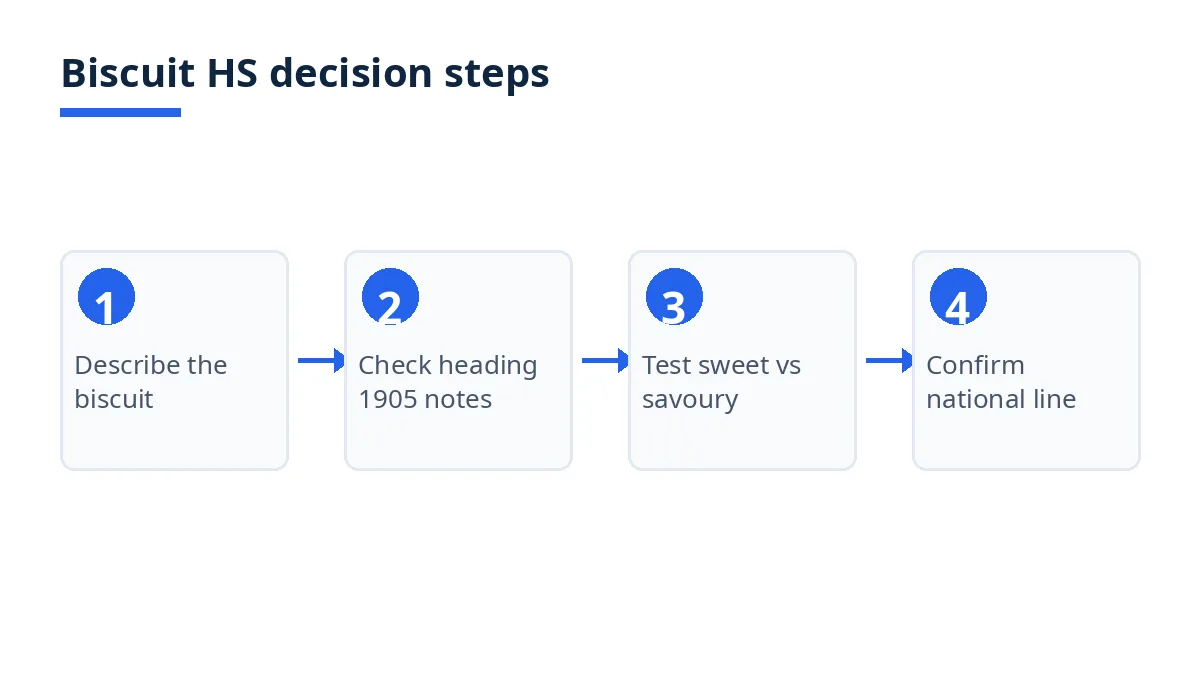
Classification follows the heading wording and the chapter notes, not the trade name. Start with the product as presented: ingredients, baking or toasting, filling or coating, and water and fat contents. The chapter notes exclude biscuits made from flour or starch specially prepared for use in animal feeding, which fall under heading 2309, and medicaments or other products of Chapter 30.1
The second test is sweetness. Sweet biscuits in subheading 1905.31 applies only to products with a water content of not more than 12 percent by weight and a fat content of not more than 35 percent by weight, with fillings and coatings excluded from those contents.3 A product that fails those limits, or that is savoury, cannot be placed in 1905.31 on taste alone. The third test is form: test crispbread, gingerbread, waffles and wafers, and rusks before the residual line 1905.90.
Rule 1 states that classification is determined according to the terms of the headings and any relative section or chapter notes.1 Rule 3 prefers the most specific description where goods are classifiable under two or more headings, and otherwise uses the component giving them their essential character.1 Rule 6 states that only subheadings at the same level are comparable.1
Plain sweet biscuit: is this a sweet biscuit, or a savoury biscuit?
Deciding factor: sweetness with the water and fat limits. A plain, unfilled, uncoated sweet biscuit points indicatively to 1905.31, to be verified against the limits above.3 The United States tariff carries the same line as 1905.31.00.4 If the biscuit is savoury, test the residual lines instead.
Chocolate-covered biscuit: is this still a biscuit, or has chocolate become its essential character?
Deciding factor: whether the product remains a biscuit with a coating, or whether its essential character has shifted to chocolate confectionery under heading 1806. This boundary question is resolved product by product. The lines opened for this guide keep coated sweet biscuits inside 1905.31 at national level, split by pack size, so a coating alone does not automatically move a sweet biscuit out of 1905.3
Waffle: is this a waffle or wafer, or a sweet biscuit in a different shape?
Deciding factor: form and water content. Waffles and wafers point indicatively to 1905.32, to be verified.1 The United States tariff carries waffles and wafers at 1905.32.00.4 Nationally, the United Kingdom tariff splits waffles and wafers by water content, with a separate line above 10 percent by weight, plus coated and salted lines, each to be confirmed on the entry date.3
Rusk: is this a rusk or toasted product, or ordinary baked bread?
Deciding factor: toasting. Rusks, toasted bread and similar toasted products point indicatively to 1905.40, to be verified.1 The United States tariff carries the same line at 1905.40.00.4 Ordinary bread baked once and not toasted does not become a rusk because it is hard or dry.
Cracker: is this a 1905.90 biscuit, or a savoury product that belongs elsewhere in 1905?
Deciding factor: savoury character and the residual-line test. A plain savoury cracker that is not a sweet biscuit, waffle, wafer, or rusk points indicatively to 1905.90 as a question to be verified, not as a settled code.1 Nationally, the United Kingdom tariff lists biscuits under 1905.90, with a separate line for extruded or expanded products, savoury or salted.5
Filled sandwich biscuit: does the filling change the subheading?
Deciding factor: the biscuit itself, with the filling tested separately from the water and fat limits. Fillings and coatings are not taken into consideration in determining those contents for sweet biscuits.3 A sweet sandwich biscuit therefore stays in the 1905.31 test on its biscuit layers, while the national tariff splits sandwich biscuits into their own line, to be confirmed on the entry date.3
National codes: US HTS, EU CN/TARIC, UK commodity code
Each national line below is to be confirmed in that country's tariff on the entry date. Do not copy a line into another country's declaration.
United States HTS, to confirm on the entry date: Revision 8 (2026), Chapter 19, lists crispbread at 1905.10.00, gingerbread at 1905.20.00, sweet biscuits at 1905.31.00, waffles and wafers at 1905.32.00, rusks and toasted products at 1905.40.00, and other goods at 1905.90, with statistical suffixes for frozen goods and for goods containing peanuts.4 Read the ten-digit line in the current HTS, not from an old invoice.
European Union CN/TARIC, to confirm on the entry date: the Combined Nomenclature is the eight-digit HS extension used in the European Union, extended further in TARIC for measures and controls. The Northern Ireland Online Tariff, which applies the same structure, lists coated waffles and wafers at 1905.32.11 and 1905.32.19 by pack size, salted waffles and wafers at 1905.32.91, and other waffles and wafers at 1905.32.99, each to be confirmed in TARIC on the entry date.6
United Kingdom commodity code, to confirm on the entry date: for sweet biscuits, the lines opened for this guide are 1905.31.11.00 for coated goods in packings not exceeding 85 g, 1905.31.19.00 for other coated goods, 1905.31.30.00 for other sweet biscuits with 8 percent or more milkfats, 1905.31.91.00 for sandwich biscuits, and 1905.31.99.00 for other sweet biscuits.3 Under 1905.90, the lines include 1905.90.45.00 for biscuits and 1905.90.55.00 for extruded or expanded products, savoury or salted.5 These are United Kingdom lines only.
How to confirm the code officially
First, write the full description: ingredients, baking and toasting steps, filling and coating, water and fat contents where required, pack size, and state on arrival. Second, read the heading text and chapter notes in the destination tariff, then compare subheadings only at the same level under Rule 6.1 Third, extend the six digits and note the entry date. Fourth, search published rulings for similar goods.
For a borderline product, apply for a binding decision before shipment. In the United Kingdom, an Advance Tariff Ruling must be applied for before all customs procedures have been completed, because decisions cannot be made retrospectively, with a separate application for each type of goods.7 HMRC will reply in 30 to 120 days with the correct code, its validity start date, and a reference number.7 For Northern Ireland or the European Union, the guidance directs traders to a Binding Tariff Information decision.7
Common classification mistakes
Filing one code for every biscuit and cookie. Sweet biscuits, waffles, rusks, and other biscuits sit in different subheadings.
Judging sweetness by taste. The notes test sweet biscuits by water and fat limits, excluding fillings and coatings.3
Assuming a chocolate coating moves the product to heading 1806. Coated sweet biscuits remain inside 1905.31 in the lines opened for this guide.3
Copying a national code into another country. The first six digits are shared. The digits after the sixth belong to one tariff only.
Treating a cracker as a sweet biscuit. A savoury cracker fails the sweet-biscuit test and must be tested against the waffle, rusk, and residual lines.1
Classifying from a photograph or packet name. A photograph cannot show water content, fat content, toasting, or filling proportions.
Filing a code and never re-checking it. The WCO updates the HS every five to six years.2
Related duties and documents
This guide states no duty rate for any biscuit or cookie product. The code decides which duty line and measures customs applies, but rates, preferences, and measures depend on destination, origin, tariff edition, and entry date, and they change. Read the rate beside the confirmed code in the official tariff for your entry date.
Keep the same code on the commercial invoice, the packing list, and any origin declaration, with the tariff printout or ruling reference and the supplier specification, stating recipe, baking and toasting steps, filling and coating, water and fat figures where required, and pack size. If any fact changes, re-check the code before the next shipment.
FAQs
What is the HS code for biscuits and cookies?
There is no single HS code for all biscuits and cookies. The indicative heading is 1905, with sweet biscuits at 1905.31, waffles and wafers at 1905.32, rusks at 1905.40, and other biscuits at 1905.90, each to be verified.1 Test crispbread at 1905.10 and gingerbread at 1905.20 before the residual line.
Is the HS code the same in every country?
The first six digits are shared internationally, because the HS is used by more than 200 countries and economies as a basis for their customs tariffs.2 The full code is not the same everywhere, because each country adds its own digits after the sixth.
How do I confirm the correct code?
Write a precise description covering ingredients, baking and toasting steps, filling and coating, and water and fat contents where required. Read the heading text and chapter notes, compare subheadings only at the same level, and extend the six digits to the full national line.1 For a borderline product, apply for a binding decision before you ship, such as an Advance Tariff Ruling in the United Kingdom, sought before customs procedures are completed.7
What happens if I use the wrong code?
Customs may reclassify the goods and apply the duty line and measures for the correct code, which can delay clearance and change the amount payable. If you find an error, tell your broker promptly and keep the corrected code with the file.
Next steps on Exportain
Start with the general system in the HS code explainer, then the method in how to classify your product. When ready to source, browse suppliers and ask each supplier for the written specification this guide lists.
Sources
- Bread, pastry, cakes, biscuits and other bakers' wares - UK Integrated Online Tariff, heading 1905. GOV.UK, HM Revenue and Customs (accessed )
- What is the Harmonized System (HS)?. World Customs Organization (accessed )
- Sweet biscuits; waffles and wafers - UK Integrated Online Tariff, subheading 190531. GOV.UK, HM Revenue and Customs (accessed )
- Harmonized Tariff Schedule of the United States Revision 8 (2026), Chapter 19. U.S. International Trade Commission (accessed )
- Other - UK Integrated Online Tariff, subheading 190590. GOV.UK, HM Revenue and Customs (accessed )
- Other - Northern Ireland Online Tariff, subheading 19053211. GOV.UK, HM Revenue and Customs (accessed )
- Apply for an Advance Tariff Ruling. HM Revenue & Customs (GOV.UK), (accessed )
About the author
Sourcing from Bangladesh?
Post a request for quotation and suppliers on Exportain can send you their quotes directly.
Post an RFQ


