

HS Code for Auto Parts: Classification Guide for Importers
Heading 8708 indicates parts and accessories of motor vehicles of headings 8701 to 8705, split by vehicle system at six digits, while engines, electrical parts and parts of general use are excluded and national codes run to 8-10 digits.
Short answer
Auto parts for motor vehicles of headings 8701 to 8705 are indicated by heading 8708, split by vehicle system at six digits: brakes at 8708.30, gear boxes at 8708.40, drive-axles at 8708.50, suspension at 8708.80, radiators at 8708.91 and steering at 8708.94. Treat 8708 as indicative only, because engines, electrical parts and parts of general use are excluded, and confirm the full national code before filing.
On this page
Key takeaways
Heading 8708 indicates parts and accessories of motor vehicles of headings 8701 to 8705, split by vehicle system at six digits, such as brakes at 8708.30, gear boxes at 8708.40 and drive-axles at 8708.50.
A part takes 8708 only when it is solely or principally suitable for headings 8701 to 8705 vehicles, is not excluded by Section XVII Note 2, and is not more specifically provided for elsewhere.
Engines and engine parts, pumps, valves and bearings fall in Chapter 84, wiring harnesses, alternators, generators, batteries and light bulbs fall in Chapter 85, and parts of general use such as fasteners and springs are excluded from 8708.
Only the first six digits are shared worldwide: the EU extends to eight digits and the United States and United Kingdom add their own extensions, so confirm the full national code per part.
For a borderline part, check published rulings such as CROSS and apply for a binding decision before shipping: a BTI in the EU, an Advance Tariff Ruling in the United Kingdom, or a CBP binding ruling in the United States.
If you import brake discs, gearboxes, radiators or suspension parts, there is no single six-digit code that covers the whole shipment. The Harmonized System is a multipurpose international product nomenclature developed by the World Customs Organization (WCO), comprising more than 5,000 commodity groups, each identified by a six-digit code, and used by more than 200 countries and economies as a basis for their customs tariffs.1 For auto parts, the code follows the part and its function in the vehicle, not the vehicle it happens to fit and not the name on a supplier catalogue.
Quick answer: indicative HS heading (with verify note)
The indicative heading for parts and accessories of motor vehicles is 8708, described as parts and accessories of the motor vehicles of headings 8701 to 8705.2 Treat 8708 as indicative only and verify the full national code for each part before filing, because the subheading and the national extension are where most errors happen. Inside heading 8708, the six-digit lines split by vehicle system, not by vehicle brand.2
Vehicle system | Indicative six-digit line | Examples |
|---|---|---|
Body and bumpers | 8708.10, 8708.21, 8708.22, 8708.29 | Bumpers, safety seat belts, windscreens and other windows, other body parts |
Braking | 8708.30 | Brakes and servo-brakes and parts |
Transmission | 8708.40, 8708.50, 8708.93 | Gear boxes, drive-axles with differential and non-driving axles, clutches |
Steering | 8708.94 | Steering wheels, steering columns and steering boxes |
Suspension and wheels | 8708.80, 8708.70 | Suspension systems including shock absorbers, road wheels |
Cooling and exhaust | 8708.91, 8708.92 | Radiators, silencers (mufflers) and exhaust pipes |
Safety | 8708.95 | Safety airbags with inflater system |
Residual | 8708.99 | Other parts and accessories not named in the lines above |
A brake disc therefore starts at 8708.30 and a gearbox at 8708.40, even when both parts are destined for the same car.
How HS codes are structured (2-4-6 digits)
The Harmonized System organises its approximately 5,000 six-digit product categories in a hierarchical structure by sections, chapters (2 digits), headings (4 digits) and sub-headings (6 digits).3 The first two digits give the chapter, the next two the heading, and the final two the subheading. Chapter 87 covers vehicles other than railway or tramway rolling stock, and parts and accessories of those vehicles.2 Heading 8708 sits inside that chapter, and subheading 8708.30 narrows it to brakes and servo-brakes and parts.2
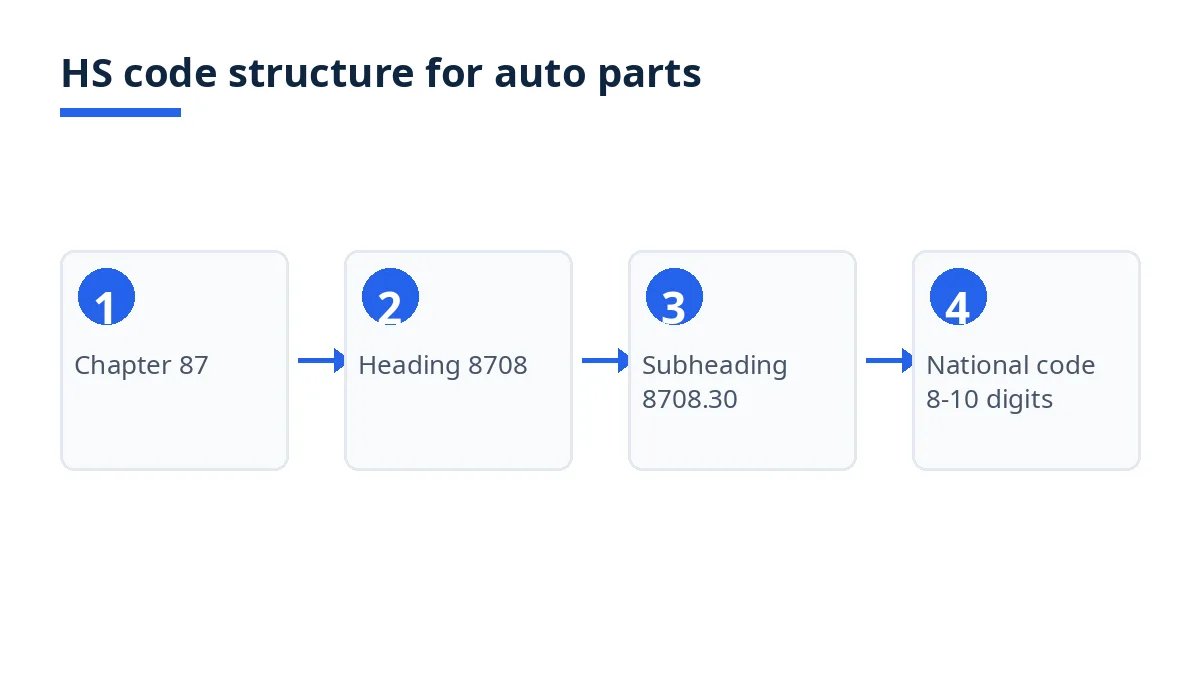
Countries then subdivide the six-digit categories into national subheadings for their tariffs and statistics.3 The current version is HS 2022.3 A brake disc is therefore 8708.30 everywhere at six digits, but it carries a longer national code at entry.
Factors that decide the code for auto parts
The parent vehicle must be in headings 8701 to 8705. Heading 8708 covers parts and accessories of the motor vehicles of headings 8701 to 8705.2 Those headings cover tractors, motor buses and coaches, cars, vehicles for transporting goods, and special purpose motor vehicles such as mobile cranes and fire trucks.4Three conditions must all hold for 8708. For a part or accessory to be classifiable under the 8708 parts provision, it must be identifiable as suitable for use solely or principally with motor vehicles of headings 8701 to 8705, it must not be excluded by Section XVII Note 2, and it must not be more specifically provided for elsewhere in the tariff.4
Function and system decide the subheading, not the vehicle model. Inside 8708, the lines are drawn by what the part does: brakes at 8708.30, gear boxes at 8708.40, drive-axles at 8708.50, road wheels at 8708.70, suspension at 8708.80, radiators at 8708.91, silencers and exhaust pipes at 8708.92, clutches at 8708.93, steering at 8708.94 and airbags at 8708.95.2
Many vehicle parts are excluded from 8708 altogether. Section XVII Note 2 excludes parts of general use such as most fasteners, springs, locks and brackets, many Chapter 84 machines or apparatus such as engines and engine parts, pumps, valves and bearings, Chapter 85 electrical apparatus such as wiring harnesses, alternators, generators, batteries and light bulbs, as well as gaskets, seals and articles of vulcanized rubber.4 These items are excluded from classification under 8708 even if the item was specifically designed and can only be used as a part on a given vehicle.4
A specific heading beats a parts heading. When goods are classifiable under two or more headings, the heading which provides the most specific description is preferred, and a provision for parts or accessories does not prevail over a specific provision for that part.4 Test the specific heading first.
Material and construction can move a part. Chapter notes for Chapter 39 exclude parts of vehicles of Section XVII, so a plastic component specially made to be solely or principally used as a finished auto part, such as a plastic dashboard panel or cover, and not otherwise excluded, is classifiable under 8708 rather than as an article of plastic under Chapter 39.4
An assembly is tested part by part. A kit that mixes a named 8708 system with an excluded Chapter 84 or Chapter 85 component does not take one code for the whole box. Split the shipment into its components and file each component on its own line.
National codes: US HTS, EU CN/TARIC, UK commodity code
United States: HTS, ten digits. The United States extends the six-digit code to ten digits in the Harmonized Tariff Schedule of the United States. Read the full ten-digit line for each part, because the national split is where a brake part, a gearbox part and a residual part diverge further. For published guidance on similar parts, the USITC advises traders to use the Customs Rulings Online Search Service (CROSS), because the correct classification of many items can be found there.5
European Union: CN at eight digits, TARIC for measures. The Combined Nomenclature integrates the HS and adds EU subdivisions, producing eight-digit codes.3 Read the confirmed line in TARIC for the entry date and for origin Bangladesh, and check the origin rules behind any preference claim.
United Kingdom: commodity code. The United Kingdom builds its commodity code on the same first six digits, with its own extension after them.3 Take the full code from the UK Trade Tariff for your part and entry date, and for a borderline part, apply for a legally binding decision, which is generally valid for 3 years.6
How to confirm the code officially
Write a precise description: what the part is, what system it serves, which vehicle headings it fits, and what it is made of.
Start from the official tariff for the destination: the USITC HTS, TARIC or the UK Trade Tariff, and read the heading text and the section and chapter notes.
Test the three conditions for 8708: solely or principally suitable for headings 8701 to 8705, not excluded by Section XVII Note 2, and not more specifically provided for elsewhere.4
Check published rulings for similar parts. For the United States, the USITC advises traders to use CROSS, because the correct classification of many items can be found there.5
For a borderline part, such as a component that could sit in Chapter 84 or in 8708, apply for a binding decision before you ship. In the EU, a Binding Tariff Information decision needs a separate application for each type of product and a detailed description.7 In the United Kingdom, a legally binding decision is generally valid for 3 years, through an Advance Tariff Ruling.6 In the United States, if the merchandise is not described in any ruling on CROSS, you may request a binding ruling from U.S. Customs and Border Protection.5
Give your broker the description and the confirmed code for each part, and use the same codes throughout the entry.
Common classification mistakes
Filing every vehicle part under 8708. Heading 8708 does not cover all parts used on vehicles, and determining whether a part is classifiable under 8708 or elsewhere is likely the key challenge when classifying automotive goods.4 Engines and engine parts, pumps, valves and bearings sit in Chapter 84, and wiring harnesses, alternators, generators, batteries and light bulbs sit in Chapter 85.4
Filing by vehicle instead of by part function. A brake disc, a gearbox and a radiator for the same car take 8708.30, 8708.40 and 8708.91 respectively.2 One code per vehicle is always wrong for a mixed shipment.
Filing parts of general use under 8708. Most fasteners, springs, locks and brackets are excluded from 8708 by Section XVII Note 2, even when they were made for one vehicle.4
Filing a specific part under the residual line 8708.99. The residual line covers other parts and accessories not named in the lines above.2 Use it only after checking every named line from 8708.10 to 8708.95.
Copying a code from another country. The EU extends the six digits to eight,3 and the United States and the United Kingdom split the 8708 lines further.
Filing an assembly as one part. A kit that mixes a named 8708 system with an excluded Chapter 84 or Chapter 85 component must be split and tested component by component.
Filing a part for the wrong parent vehicle. Heading 8708 covers only the motor vehicles of headings 8701 to 8705.2
Related duties and documents
This guide states no duty rates: the code decides which duty line customs applies, and a rate on a brake line does not carry to a gearbox line or to a residual line. Read the rate beside your confirmed code for your origin and entry date, and check what proof of origin a preference claim requires.
Keep the part description, the function and system test, the confirmed codes, any binding decision and the origin evidence together in the shipment file, with each part as a separate invoice line. A binding decision helps you calculate the duties and restrictions that will apply in advance.6
FAQs
What is the HS code for auto parts?
There is no single six-digit code for auto parts as a group. Parts and accessories of motor vehicles of headings 8701 to 8705 are indicated by heading 8708,2 split by system at six digits: brakes at 8708.30, gear boxes at 8708.40, drive-axles at 8708.50, road wheels at 8708.70, suspension at 8708.80, radiators at 8708.91, silencers and exhaust pipes at 8708.92, clutches at 8708.93, steering at 8708.94 and airbags at 8708.95.2 Treat 8708 as indicative and confirm the full national code for each part. Engines, electrical parts and parts of general use are excluded.4
Is the HS code the same in every country?
Only the first six digits are harmonised. Beyond six digits, each country adds its own lines: eight digits in the EU Combined Nomenclature,3 and ten in the United States, with the United Kingdom adding its own extension.3
How do I confirm the correct code?
Describe each part precisely, read the heading text and the section and chapter notes, and test the three conditions for 8708.4 Check published rulings, such as CROSS for the United States.5 For a borderline part, apply for a binding decision before shipping: a BTI in the EU,7 an Advance Tariff Ruling in the United Kingdom,6 or a CBP binding ruling in the United States.5
What happens if I use the wrong code?
Duty, licensing and quota treatment are worked out from the code on the declaration, so a wrong code brings the wrong treatment. Taking a binding decision in advance helps you calculate the duties and restrictions that will apply.6
Next steps on Exportain
Browse Bangladeshi suppliers on Exportain and post a free RFQ with the confirmed codes stated per part. The harmonized system explainer is the background read, and the product classification guide walks through the classification steps for a new product. Exportain is not a party to the goods contract and does not inspect goods, book freight or clear customs.
Sources
- What is the Harmonized System (HS)?. World Customs Organization (accessed )
- HS, 2017 - Code 8708. United Nations Statistics Division (accessed )
- Harmonised System. European Commission (accessed )
- Special Considerations When Classifying Automotive Goods Under the Harmonized Tariff Schedule of the United States (HTSUS). Braumiller Law Group (accessed )
- MTB 2019: Get Out Ahead of the Pack with a Binding Ruling from CBP. U.S. International Trade Commission (accessed )
- Check what you'll need to get a legally binding decision on a commodity code. GOV.UK, HM Revenue and Customs (accessed )
- European Binding Tariff Information (EBTI). European Commission, Taxation and Customs Union, (accessed )
About the author
Sourcing from Bangladesh?
Post a request for quotation and suppliers on Exportain can send you their quotes directly.
Post an RFQ


