

HS Code for APIs and Pharma Ingredients: Classification Guide for Importers
Bulk APIs are tested in HS Chapter 29 on their chemistry: antibiotics at 2941, hormones at 2937 and alkaloids at 2939 as indicative starting points, while mixed bulk medicaments sit under 3003, measured doses under 3004, and immunological products under 3002.
Short answer
Bulk active pharmaceutical ingredients are tested in HS Chapter 29 on their chemistry, not on their therapeutic use: a separate chemically defined compound takes the heading for its chemical family, with antibiotics at 2941, hormones at 2937 and alkaloids at 2939 as indicative starting points. Mixed bulk medicaments fall under heading 3003, products in measured doses or retail packs under heading 3004, and immunological products under heading 3002. Every heading is indicative and must be confirmed in the destination tariff.

On this page
Key takeaways
A bulk, separate chemically defined API is tested in Chapter 29 on its chemistry, with antibiotics at 2941, hormones at 2937 and alkaloids at 2939 as indicative starting points.
Chapter 29 note 5 decides salt and ester forms: inorganic salts follow the organic compound, while salts between two organic compounds follow the base or acid occurring last in numerical order.
A mixed bulk medicament is tested under heading 3003, a product in measured doses or retail packaging under heading 3004, and immunological products under heading 3002, not Chapter 29.
Name the substance by its INN plus its modified INN salt or ester form: a brand name hides the form that decides the heading.
Only the first six digits are shared worldwide: the United States runs to ten digits, the EU uses an eight-digit CN code extended to ten in TARIC, and the United Kingdom uses a ten-digit commodity code.
If you buy a bulk active pharmaceutical ingredient (API) for formulation abroad, the hs code for apis and pharma ingredients is the line your customs entry, duty treatment and import controls turn on. There is no single code for "APIs": customs classifies the chemistry in front of it, in the form in which it arrives. A bulk powder, a mixed bulk medicament and a box of tablets made from the same substance can sit in three different places. Every heading below is indicative: confirm the full national code in the destination tariff before you file.
Quick answer: indicative HS heading (with verify note)
A bulk API that is a separate chemically defined organic compound is tested in Chapter 29, Organic chemicals, first. A mixed medicament not put up in measured doses or for retail sale is tested under heading 3003, and a product put up in measured doses or for retail sale under heading 3004. Immunological products are excluded from Chapter 29 and tested under heading 3002 instead.1 2
Product in bulk form | Indicative heading |
|---|---|
Heterocyclic compound with nitrogen heteroatoms only | 2933 |
Hormones and their derivatives, including insulin at 2937.91 | 2937 |
Vegetable alkaloids and their salts, including caffeine at 2939.30 | 2939 |
Antibiotics, unmixed; penicillins sit at 2941.10 | 2941 |
Provitamins, vitamins and their derivatives, unmixed | 2936 |
Other organic compounds | 2942 |
Treat every line as indicative: the heading follows the exact compound, its salt or ester form, and the form shipped, not the therapeutic category on a supplier listing.
How HS codes are structured (2-4-6 digits)
The Harmonized System is a multipurpose international product nomenclature developed by the World Customs Organization (WCO), comprising more than 5,000 commodity groups, each identified by a six-digit code, and used by more than 200 countries and economies as a basis for their customs tariffs.3 The six digits narrow in three steps: chapter (2 digits), heading (4 digits), subheading (6 digits). Chapter 29 covers organic chemicals; heading 2933 is one heading inside it; subheading 2937.91 narrows further, to insulin and its salts.
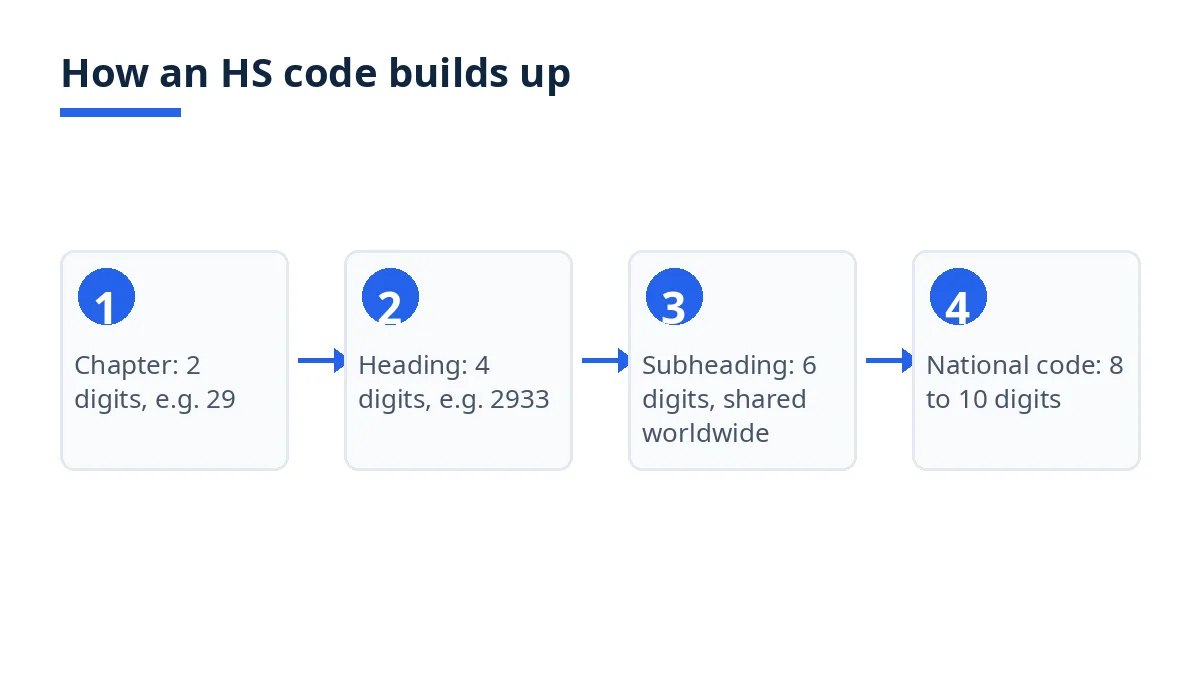
Countries then extend the six digits for their own tariffs and statistics: ten digits in the United States schedule and the United Kingdom commodity code, and an eight-digit Combined Nomenclature code extended to ten digits in TARIC for EU import measures.1 4 Only the first six digits are shared worldwide, so a full national code from one country never transfers directly to another.
Factors that decide the code for APIs and pharma ingredients
Chemical identity comes first
Chapter 29 note 1 limits the chapter, except where the context otherwise requires, to separate chemically defined organic compounds, whether or not containing impurities, plus the mixtures of isomers, solutions and stabilised forms it lists.1 A bulk active substance shipped as a powder with ordinary impurities stays a Chapter 29 candidate, as can the same substance dissolved in water or in another solvent where the solution is a normal and necessary method of putting it up for safety or transport, provided the solvent does not make the product particularly suitable for a specific use rather than for general use.1 A stabiliser added only for preservation or transport does not by itself move the product out, on the same condition.1
Salts, esters and derivatives follow their own tie-break rules
Chapter 29 note 5 sets the tie-breaks: inorganic salts of organic compounds are classified with the organic compound, while salts formed between two organic compounds go with the base or the acid, whichever occurs last in numerical order.1 Esters of acid-function organic compounds with organic compounds of the chapter go with the compound in the heading placed last in numerical order, derivatives within a heading stay in the same subheading unless more specifically covered or a residual "Other" subheading exists, and a product that could fall in two or more Chapter 29 headings goes to the heading occurring last in numerical order.1
Naming helps you apply those rules. An International Nonproprietary Name (INN) is the unique, globally recognised name for a pharmaceutical substance, selected by the World Health Organization for the active part of the molecule only.5 The salt or ester form is then named as a modified INN (INNM), for example mepyramine maleate for the maleate salt of mepyramine, and national names such as British Approved Names and United States Adopted Names are nowadays, with rare exceptions, identical to the INN.5 Describe a shipment with the INN, the INNM salt or ester form, and the chemical name together.
Bulk API, mixed medicament and measured dose are three different tests
United Kingdom guidance states that pharmaceutical products are classified by their purpose, by the way they are made up, and by whether they are intended for retail sale.2 Heading 3003 covers products made of two or more constituents mixed together for therapeutic or prophylactic uses, not put up in measured doses or in packings for retail sale, while heading 3004 covers the same kind of products once they are in measured doses, such as tablets, capsules or ampoules, or packaged for retail sale, whether mixed or unmixed.2 Separate chemically defined compounds not in measured doses or retail medicament packaging are classified in Chapter 28 or 29.2
A worked example makes the boundary concrete. A single, unmixed antibiotic powder shipped in bulk drums for formulation is tested in Chapter 29, at heading 2941, on its chemistry. Press the same substance into tablets in blister packs and it is tested under heading 3004, because the measured dose, not the chemistry, now controls. Mix two active substances together for therapeutic use but ship the mixture in bulk drums, not in measured doses or retail packs, and it is tested under heading 3003. The substance has not changed; the form and the pack have changed the heading. Treat each outcome as indicative.
Mixtures and biologics
Chapter 29 note 1 allows mixtures of isomers of the same compound, not mixtures of different active substances, and immunological products are expressly excluded from Chapter 29, with monoclonal antibodies classified under heading 3002.1 2
National codes: US HTS, EU CN/TARIC, UK commodity code
Destination | System | Full code length |
|---|---|---|
United States | Harmonized Tariff Schedule (HTS) | 10 digits |
European Union | Combined Nomenclature (CN), extended in TARIC | 8 digits for CN, 10 digits for TARIC |
United Kingdom | UK Trade Tariff commodity code | 10 digits |
United Arab Emirates | National tariff built on the shared six digits | Full national line in the UAE tariff |
The Combined Nomenclature code is eight digits long, made of the six HS digits plus two EU digits, and the TARIC code is ten digits long, made of the CN code plus two further digits, generally used for import declarations.4 The United States schedule shows the same build-up: six-digit subheadings split into eight- and ten-digit statistical lines, so read a bulk API line to its final digit.1 For the United Kingdom, read the full ten-digit commodity code from the UK Trade Tariff, and for the United Arab Emirates, the full national line from the UAE tariff. Never copy a supplier's full national code from another destination into your entry.
How to confirm the code officially
Build a description pack for each substance: chemical name, INN and INNM salt or ester form, purity and physical form, any solvent or stabiliser present and why, pack size and type, and its bulk, mixture or measured-dose form.
Read the heading texts and the Chapter 29 notes in the destination tariff: note 1 for eligibility, note 5 for the salt or ester form, note 3 where two headings compete.1
Test the Chapter 30 boundary separately: is the product mixed, and is it in measured doses or retail packaging? That decides 3003 against 3004.2
Search published rulings for the same chemistry and form. For the United States, the USITC advises traders to use the Customs Rulings Online Search Service (CROSS), and to request a binding ruling from U.S. Customs and Border Protection if no ruling on CROSS describes the merchandise.6
For a borderline product, apply for a binding decision before you ship. In the European Union, a Binding Tariff Information application needs a separate application for each type of product and a detailed description.7 In the United Kingdom, an Advance Tariff Ruling is generally valid for 3 years.8
Give your broker the description pack and the confirmed code for each substance, and use the same codes across the entry, the invoice and the shipment file. See how to classify your product for the step-by-step method.
Common classification mistakes
Filing finished tablets under Chapter 29. Once a product is in measured doses or retail packaging, the Chapter 30 test controls, even when the bulk substance is a Chapter 29 compound.2
Filing a bulk API under heading 3004 because it is "a medicine". Heading 3004 needs measured doses or retail packaging; a bulk, unmixed, chemically defined compound is tested in Chapter 29.1 2
Classifying from a brand name. A brand name hides the salt or ester form. Classify from the INN, the INNM form and the chemical name.1 5
Copying a full national code from another country. Only the first six digits are shared; each destination extends them differently.3 4
Related duties and documents
This guide states no duty rates: the code selects the duty line customs applies, and a rate read beside one subheading does not carry to another heading, salt form or destination. Read the rate beside your confirmed code for your origin and entry date. Keep the description pack, the confirmed codes, any binding decision and the origin evidence together in the shipment file, with each substance and form on its own invoice line. Classification and product authorisation are separate checks.
FAQs
What is the HS code for APIs and pharma ingredients?
There is no single code. A bulk, separate chemically defined API is tested in Chapter 29 on its chemistry, with antibiotics at 2941, hormones at 2937 and alkaloids at 2939 as indicative starting points.1 A mixed bulk medicament is tested under 3003, and a product in measured doses or retail packaging under 3004.2 Every heading here is indicative.
Is the HS code the same in every country?
Only the first six digits are shared. The Harmonized System gives more than 5,000 commodity groups, each identified by a six-digit code, used by more than 200 countries and economies.3 Beyond six digits, countries add their own lines: eight digits in the EU Combined Nomenclature, ten digits in TARIC for EU imports, and ten digits in the United States and the United Kingdom.1 4
How do I confirm the correct code?
Describe each substance precisely, including its INN, salt or ester form and pack, read the heading texts and Chapter 29 notes in the destination tariff, and check published rulings such as CROSS for the United States.1 6 For a borderline product, apply for a binding decision before shipping: a Binding Tariff Information decision in the EU,7 an Advance Tariff Ruling in the UK,8 or a binding ruling from U.S. Customs and Border Protection.6
What happens if I use the wrong code?
Duty, licensing and control treatment are worked out from the code on the declaration, so a wrong code brings the wrong treatment and can delay clearance. A binding decision taken in advance lets you calculate the duties and restrictions that will apply before the shipment moves.8
Next steps on Exportain
Browse Bangladeshi suppliers on Exportain, where supplier profiles carry document and photo review badges, and confirm the description pack for each substance with your supplier before you ask your broker to file. The HS code hub is the background read on the system itself. Exportain is not a party to the goods contract and does not inspect goods, book freight or clear customs.
Sources
- Harmonized Tariff Schedule of the United States, Chapter 29 (2026 Revision 18). U.S. International Trade Commission (accessed )
- Classifying pharmaceutical products and placebos for import and export. GOV.UK, HM Revenue and Customs (accessed )
- What is the Harmonized System (HS)?. World Customs Organization (accessed )
- Tariff classification of goods. Luxembourg Single Window for Logistics (accessed )
- Health products policy and standards. World Health Organization (accessed )
- MTB 2019: Get Out Ahead of the Pack with a Binding Ruling from CBP. U.S. International Trade Commission (accessed )
- European Binding Tariff Information (EBTI). European Commission, Taxation and Customs Union (accessed )
- Check what you'll need to get a legally binding decision on a commodity code. GOV.UK, HM Revenue and Customs (accessed )
About the author
Sourcing from Bangladesh?
Post a request for quotation and suppliers on Exportain can send you their quotes directly.
Post an RFQ


