

HS Code for Agricultural Machinery: Classification Guide for Importers
Indicative HS headings for agricultural machinery: 8432 for soil preparation, 8433 for harvesting, 8434 for dairy and 8436 for other agricultural work, with tractors in 8701 - verify the full 8-10 digit national code before filing.
Short answer
There is no single hs code for agricultural machinery: the code follows the machine's principal job, with soil-preparation machinery indicatively in heading 8432, harvesting machinery in 8433, dairy machinery in 8434 and other agricultural machinery in 8436, while tractors sit in 8701. Only the first six digits are shared worldwide, so confirm the full 8-10 digit national code on the destination tariff before filing.

On this page
Key takeaways
There is no single code for agricultural machinery: soil preparation is indicatively heading 8432, harvesting and threshing 8433, milking and dairy 8434, and other agricultural machinery 8436.
A tractor is a vehicle under heading 8701, while the implement it pulls keeps its own heading, so a tractor-plus-implement shipment needs at least two codes.
A machine used for more than one purpose is classified by its principal purpose, so a combined machine is tested on the job it principally performs.
Parts follow their machine's parts line only when the part has no heading of its own: a motor, pump or bearing with its own heading is classified there.
Only the first six digits are shared worldwide: the EU extends to eight digits and the United States and United Kingdom to ten, so confirm the full national code per machine.
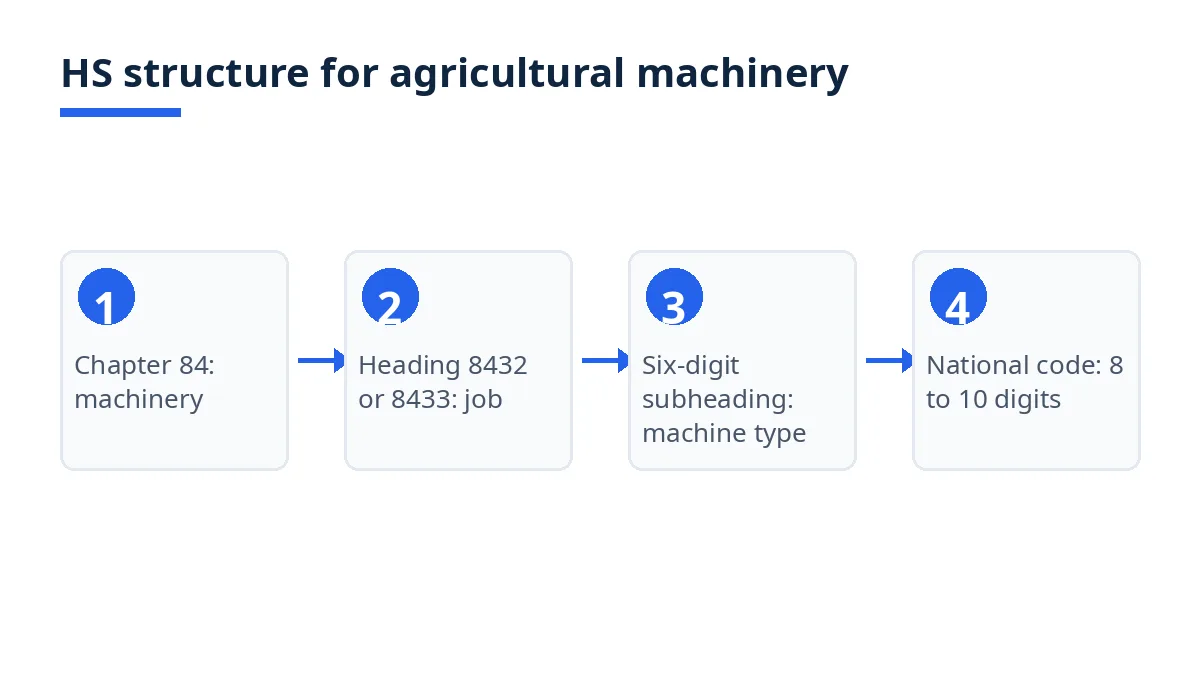
If you are importing a plough, a seeder, a combine harvester or a milking machine, the hs code for agricultural machinery is the line that decides how customs identifies your machine, which tariff line applies and which documents your broker will ask for. There is no single code for "agricultural machinery" as a whole: the Harmonized System classifies machines by what they do, not by the general label on a supplier listing. A soil-preparation machine, a harvesting machine and a dairy machine sit in different headings, and a tractor that pulls an implement sits somewhere else again. This guide covers the indicative headings, the deciding factors, and how to confirm the full national code before you file. The diagram below shows the route from chapter to national code.
Quick answer: indicative hs code for agricultural machinery
All headings in this guide are indicative only — verify the full code for your exact machine on the official tariff of the destination country before filing. The Harmonized System is a multipurpose international product nomenclature developed by the World Customs Organization (WCO), comprising more than 5,000 commodity groups, each identified by a six-digit code, and used by more than 200 countries and economies as a basis for their customs tariffs.1 Within that system, most field machinery falls in Chapter 84, and the job the machine performs points to the heading:
Machine job | Indicative heading | Examples |
|---|---|---|
Soil preparation or cultivation | 8432 | Ploughs, disc harrows, seeders, planters, manure spreaders |
Harvesting or threshing | 8433 | Combine harvester-threshers, other threshing machinery, balers, mowers |
Milking and dairy work | 8434 | Milking machines, dairy machinery |
Other agricultural, horticultural, forestry, poultry-keeping or bee-keeping work | 8436 | Machinery for preparing animal feeds, poultry incubators and brooders, other machinery |
Hauling or pushing, as a vehicle | 8701 | Agricultural tractors and forestry tractors, wheeled |
Heading 8432 covers agricultural, horticultural or forestry machinery for soil preparation or cultivation, including lawn or sports-ground rollers.2 In the United States schedule, its lines run from ploughs at 8432.10 and disc harrows at 8432.21 through no-till seeders at 8432.31, manure spreaders at 8432.41 and fertiliser distributors at 8432.42, with parts at 8432.90.3 Heading 8433 covers harvesting or threshing machinery, including balers and mowers, and its combine harvester-threshers sit at 8433.51.3 Treat every line as a starting point for checking, not a filing instruction.
How HS codes are structured (2-4-6 digits)
The system is organised in a hierarchy: sections, then chapters at two digits, headings at four digits and subheadings at six digits.4 Countries use the HS as the basis for their customs tariffs and then subdivide the six-digit categories into regional or national subheadings, with the European Union's Combined Nomenclature using eight-digit codes.4 The current version is HS 2022.4
Read a code from left to right, each step narrowing the category:
Chapter 84 (2 digits): nuclear reactors, boilers, machinery and mechanical appliances, and parts.
Heading 8432 (4 digits): agricultural, horticultural or forestry machinery for soil preparation or cultivation.
Subheading 8432.10 (6 digits): ploughs, within heading 8432.
National extension (8 to 10 digits): the destination country's further split, for example the United Kingdom's ten-digit commodity code for ploughs at 8432 1000 00.2
Only the first six digits are shared worldwide. Everything after six digits is national, so a code that is complete in one country is incomplete in another.
Factors that decide the hs code for agricultural machinery
Principal job first. A machine used for more than one purpose is treated, for classification, as if its principal purpose were its sole purpose.2 The United States schedule carries the same idea for composite machines.3 Write down the machine's principal job in one sentence before you open any tariff: preparing soil, sowing seed, harvesting a crop, or milking.
Self-propelled vehicle versus implement. A tractor is a vehicle, not an implement. The United Kingdom tariff lists agricultural tractors and forestry tractors, wheeled, under heading 8701, for example at commodity code 8701 9310 00.5 An implement designed to fit a tractor stays in its own heading: a plough pulled by a tractor is still a plough for heading 8432.
Self-propelled versus tractor-drawn harvesting machines. A combine harvester-thresher sits at 8433.51 in the United States schedule.3 A mower or baler drawn by a tractor is still harvesting machinery under heading 8433, but it takes a different subheading from a combine.
Parts follow their machine, with limits. Parts of soil-preparation machinery sit at 8432.90, and parts of other agricultural machinery sit under their own headings' parts lines, such as 8436.91 and 8436.99.3 But parts which are themselves goods included in another heading of Chapter 84 or 85 are classified in their own headings.3 A motor, pump or bearing with its own heading is not automatically a part of the machine it will be fitted to.
What the machine is not. Heading 8432 is about soil preparation and cultivation, not everything used on a farm: a milking machine belongs in 8434 and an animal-feed preparation machine in 8436.3 A grain-cleaning machine for seed or grain is tested under 8437, not 8433, which expressly excludes machinery of 8437.
National codes: US HTS, EU CN/TARIC, UK commodity code
United States: HTS, ten digits. The Harmonized Tariff Schedule builds on the same first six digits and extends them to ten. In the 2026 Revision 18 of Chapter 84, the 8432 lines run from 8432.10 for ploughs through 8432.31 for no-till seeders to 8432.90 for parts.3 Read the full ten-digit line for the machine and the entry date.
European Union: CN at eight digits, TARIC for measures. The Combined Nomenclature is an eight-digit system comprising the HS codes with further EU subdivisions.4 TARIC then shows the measures that apply to a given eight-digit code for a given origin and date. For an EU entry, confirm the eight-digit CN code first, then read the TARIC measures beside it.
United Kingdom: commodity code. The United Kingdom builds its commodity code on the same first six digits, with its own extension. The UK tariff for heading 8432 lists fourteen commodities, including ploughs at 8432 1000 00, disc harrows at 8432 2100 00 and parts at 8432 9000 00.2 Take the full ten-digit code from the UK Trade Tariff for your machine and entry date.
How to confirm the code officially
Describe the machine precisely: principal job, self-propelled or tractor-drawn, what it processes, and every attachment included.
Start from the destination tariff: the USITC HTS, TARIC, or the UK Trade Tariff, and read the heading text with the section and chapter notes. For legal purposes, classification is determined according to the terms of the headings and any relevant notes.5
Check published rulings for similar machines. For the United States, Customs and Border Protection considers written ruling requests on a specifically described transaction, and a tariff classification ruling may be requested by letter or through the eRulings template.6
For a borderline machine, apply for a binding decision before you ship. In the EU, a Binding Tariff Information decision requires a separate application per product type and a detailed description, and only a BTI decision provides binding information.7 In the United Kingdom, apply for an Advance Tariff Ruling before customs procedures are completed; HMRC replies within 30 to 120 days.8
Give your broker the description and the confirmed code for each machine, and use the same codes on the invoice, packing list and entry. If the model, attachment or principal job changes, re-check the code before it ships.
Common classification mistakes
Filing every farm machine under 8432. Heading 8432 covers soil preparation and cultivation only.2 A harvester belongs in 8433, a milking machine in 8434 and an animal-feed preparation machine in 8436.3 "Used on a farm" is not a heading.
Filing a tractor as an implement, or an implement as a tractor. Agricultural tractors and forestry tractors, wheeled, sit under heading 8701.5 The implement the tractor pulls keeps its own heading. One shipment containing both needs at least two codes.
Filing parts under the machine's heading without checking. Parts of soil-preparation machinery sit at 8432.90,3 but a part that is itself a good of another heading is classified in its own heading.3 A pump, a motor or a bearing needs its own test.
Filing a combined machine under its secondary job. A machine used for more than one purpose is treated as if its principal purpose were its sole purpose.2 If the machine principally harvests and only incidentally prepares soil, it is not a soil-preparation machine.
Copying a code from another country. Only the first six digits are shared; the European Union extends them to eight,4 and the United States and the United Kingdom extend them to ten.3 2 A six-digit subheading is not a complete entry code anywhere that requires eight or ten digits.
Filing from a supplier listing or a photograph. A listing that calls a machine a "farm machine" or a "harvester" does not settle its heading. Classify from the heading text, the chapter notes and the machine's principal job, and keep the specification sheet in the shipment file.
Related duties and documents
This guide states no duty rates: the code decides which tariff line customs applies, and a rate beside one subheading does not carry to a neighbouring subheading. Read the rate beside your confirmed code for your origin and entry date, and check what proof of origin any preference claim requires. In the EU, a BTI holder must declare the decision and use it for customs procedures,7 and in the United Kingdom, a ruling holder must declare the Advance Tariff Ruling reference.8
Keep the machine specification, the confirmed code for each machine and part, any binding decision, and the origin evidence together in the shipment file, with tractors, implements and parts as separate invoice lines.
FAQs
What is the HS code for agricultural machinery?
There is no single code: it depends on the principal job. Soil preparation is indicatively 8432, harvesting and threshing 8433, milking and dairy 8434, other agricultural machinery 8436, and agricultural tractors 8701.3 5 Confirm the full subheading and national extension for your exact machine before filing.
Is the HS code the same in every country?
Only the first six digits are harmonised. Countries subdivide them into national subheadings,4 with eight digits in the EU4 and ten in the United States and United Kingdom.3 2 The same machine can therefore carry a different complete code in each destination.
How do I confirm the correct code?
Describe the principal job and construction precisely, read the heading text and chapter notes in the destination tariff, and check published rulings.6 For a borderline machine, apply for a binding decision before shipping: a BTI decision in the EU,7 an Advance Tariff Ruling in the United Kingdom,8 or a CBP ruling in the United States.6
What happens if I use the wrong code?
The code on the declaration drives the tariff line, measures and documents customs applies, so a wrong code brings the wrong treatment and can hold up clearance. A binding decision taken before shipping removes that uncertainty: in the EU, only a BTI decision provides binding information,7 and in the United Kingdom, the ruling gives you the correct commodity code.8
Next steps on Exportain
Browse Bangladeshi suppliers on Exportain and post a free RFQ on Exportain and get quotes from verified Bangladeshi suppliers at Exportain RFQs — state the confirmed code for each machine and part separately, so suppliers quote on the same machine you intend to import. Background reading: the HS code harmonized system guide and the guide to classifying your product. Exportain is not a party to the goods contract and does not inspect goods, book freight or clear customs, so keep your broker and any binding decision at the centre of the entry.
Sources
- What is the Harmonized System (HS)?. World Customs Organization (accessed )
- Agricultural, horticultural or forestry machinery for soil preparation or cultivation; lawn or sports-ground rollers: UK Integrated Online Tariff, heading 8432. GOV.UK, HM Revenue and Customs (accessed )
- Harmonized Tariff Schedule of the United States, Chapter 84 (2026 Revision 18). U.S. International Trade Commission (accessed )
- Harmonised System. European Commission (accessed )
- Commodity code 8701931000: Agricultural tractors and forestry tractors, wheeled. GOV.UK, HM Revenue and Customs (accessed )
- What are Ruling Letters?. U.S. Customs and Border Protection (accessed )
- European Binding Tariff Information (EBTI). European Commission, Taxation and Customs Union, (accessed )
- Apply for an Advance Tariff Ruling. HM Revenue & Customs (GOV.UK), (accessed )
About the author
Sourcing from Bangladesh?
Post a request for quotation and suppliers on Exportain can send you their quotes directly.
Post an RFQ


