How to Import Kids' Shoes From Bangladesh in 2026: Buyer Guide
A full import process for kids' shoes from Bangladesh: US, EU and UK safety rules, sizing and grading, supplier checks, sampling, HS codes, labelling, inspection and a worked 3,600-pair order to Hamburg at $7.54 per pair net.
Short answer
To import kids' shoes from Bangladesh, fix the shoe on paper first: age band, size range in foot length in millimetres, materials by name and colour, and the chemical limits for the destination market. Get the safety file for the exact styles ordered, approve proto, size-set and pre-production samples, and inspect to AQL 0 for critical defects. Classify by the upper material, claim duty-free EU entry under Everything But Arms, and cost German import VAT at 19 percent.
On this page
Key takeaways
A children's product under the CPSIA is one designed or intended primarily for children 12 or younger, and it needs CPSC-accepted lab testing and a Children's Product Certificate.
REACH entry 72 names footwear in its scope: formaldehyde is capped at 75 mg/kg and five phthalates at 1,000 mg/kg.
EN 71 is a toy standard, not a footwear standard; it applies only where a shoe carries a toy feature.
Size by foot length in millimetres, launch with five or six sizes in one age band, and agree the size split in writing before the mould is cut.
Example figures put 3,600 pairs of leather school shoes to Hamburg at USD 27,150 net excluding VAT, or USD 7.54 per pair, with duty at zero under Everything But Arms.
A first order of children's shoes from Bangladesh differs from an adult shoe order in ways that show up late: a size curve that sells through in weeks, a safety file that belongs to one material in one colour, and a fit problem no wearer can describe to you. Bangladesh produces the shoes at scale. In FY2024-25, leather goods and footwear exports reached USD 1.67 billion, with footwear at about USD 1.19 billion, from output of about 423 million pairs made by more than 3,600 units.1
What makes importing kids' shoes different from adult shoes
The wearer cannot report a bad fit, so the buyer must build fit into the specification. Children outgrow shoes in months, which makes the size curve the commercial decision: the middle sizes run out first. Order one age band first. In the United States, a children's product is one designed or intended primarily for children 12 years of age or younger, and the full set of CPSIA duties attaches once a shoe falls inside that definition.2 For under-threes the sharpest risk is mechanical: parts that detach. A report covers only the material and colour it names, so freeze colours before the factory buys materials.
Which safety rules apply in the United States, the EU and the UK
No single standard covers children's shoes everywhere. The destination market decides the file.
United States: CPSIA, third-party testing and the Children's Product Certificate
Under the CPSIA, lead in paint and similar surface coatings on a children's product must not exceed 90 parts per million, and total lead in any part a child can reach must stay under 100 parts per million.2 Eight phthalates are capped at 0.1 percent in accessible plasticized parts of children's toys and child care articles; confirm scope with a broker.2 Testing must be done by a laboratory the CPSC has accepted for the specific test.2 The importer issues a Children's Product Certificate (CPC) on the strength of that testing. It carries seven elements: product identification, each safety rule tested against, the US importer, the person keeping the test records, the dates and places of manufacture and testing, and each CPSC-accepted laboratory behind the testing.2 Tracking labels showing the maker, production place and date, and batch number are also required.2 From 8 July 2026, importers must also file certificate data electronically with US Customs and Border Protection.2
European Union: REACH entry 72, the GPSR and EN 71
In the EU, REACH Annex XVII entry 72 restricts 33 substances classified as carcinogenic, mutagenic or toxic for reproduction, and footwear is named in its scope. The restriction took effect on 1 November 2020.3 Entry 72 caps formaldehyde at 75 mg/kg and eight PAHs at 1 mg/kg, and five phthalates at 1,000 mg/kg, counted singly or together.3 Leather that touches the skin carries its own limit: chromium VI must stay below 3 mg/kg.4
EN 71 is a toy standard, not a footwear standard. It covers safety requirements for toy products, harmonised under the EU Toy Safety Directive, with EN 71-1 covering mechanical and physical properties including small parts.5 An ordinary shoe is not tested against EN 71; it becomes relevant where a shoe carries a toy feature, such as a detachable toy charm.
The General Product Safety Regulation (EU) 2023/988 is the safety net underneath the sector rules. It has applied since 13 December 2024 and requires every consumer product placed on the EU market to be safe.6 The manufacturer must carry out an internal risk analysis and prepare technical documentation, which the importer verifies and keeps for 10 years.6 A product may only be placed on the EU market if an economic operator established in the EU is responsible for it.6
How to size and grade a children's order
Size by foot length in millimetres, never by the number on the retail box. Generic conversion charts do not convert exactly between systems. Ask the factory for its own chart for the last in use, and measure the sample insoles against it. Each size needs its own last, the foot-shaped form the upper is stretched around, and its own cutting dies. Launch with five or six sizes in one age band, and agree the split of pairs across those sizes in writing before the mould is cut. Our wholesale kids' shoes guide works through size curves by age band, and our kids' shoes MOQ guide explains how a wide size range raises the minimum.
How to check a supplier before you pay
Check a supplier in the order a buyer loses money: styles first, papers second, samples third. Ask for the style list with age bands, size ranges, materials and markets supplied. A factory supplier must show the styles and test reports belong to its own production. A trading supplier must name the factory and show the factory's papers. Badges record verification checks on identity, business registration, export registration and factory or office photos. A badge means Exportain staff reviewed the supplier's documents and photos. It is not a factory visit, and it says nothing about the supplier's capacity, quality or delivery. Match the names: the legal name must be identical on the export papers, quotation, invoice and bank account. Do not pay a bulk deposit before the samples and the safety file are approved.
What the sampling rounds must prove
Approve samples in stages, in writing, never on a photograph. The proto sample proves the design. The size-set sample proves the grade across the smallest, one middle and the largest size. The pre-production sample proves the bulk run, with the chemical sample drawn from the same lots. Put the size-set sample through a full week of wear, checking the bond line and fastening daily.
Which HS code and duty apply to kids' shoes
No one code covers a children's shoe: the upper material sets the heading, and the construction and sole set the subheading. The upper is the material covering the greatest external surface area, accessories and reinforcements left out of the count.7 Leather uppers fall under heading 6403 and textile uppers under heading 6404, decided by which material covers the most of the upper's outside.7 Rubber or plastics uppers fall under heading 6402.7 A training shoe is not sports footwear unless it is designed for a sporting activity with the features to match.7 A general trainer without those features usually takes 6404.19, and that one digit moves the duty line. Get the proposed six-digit code from the factory in writing, and have the broker confirm it before you cost the order.
Duty depends on the destination. Bangladesh, as a least developed country, exports to the European Union duty-free and quota-free under the Everything But Arms scheme, apart from arms and ammunition.8 Graduation has moved to 24 November 2029, and the scheme provides a three-year transition after graduation.8 In Germany the standard import VAT rate is 19 percent, charged on the customs value, duty, and freight and insurance to the first EU destination.9 A VAT-registered business reclaims it as input VAT on its German VAT return.9
What labelling and packaging must carry
The label is checked against the production materials, so a material change changes the label. In the UK, the Footwear (Indication of Composition) Labelling Regulations 1995 require the label to state the material covering at least 80 percent of the upper, of the lining and sock, and of the volume of the outer sole.10 Where no one material reaches 80 percent, the label gives the two main materials instead.10 The information may be given by pictogram or written indication, and the label must be affixed to at least one shoe in each pair, visible, securely attached and accessible.10 Export cartons take 12 pairs each, marked with the style, colour, size range and pair count.
How the shipment is inspected before it leaves
Book the pre-shipment inspection once 80 to 100 percent of production is finished and packed.4 The inspector pulls pairs at random from sealed cartons. Inspection runs to AQL, the acceptable quality limit, under ISO 2859-1 sampling plans. The standard levels for footwear are General Inspection Level II, with critical defects at zero, major defects at 2.5 and minor defects at 4.0.4 For children's shoes a protruding nail, a sharp edge, a detached sole or a toxic material is critical, because it can injure a child.4 A sole separation over 5 mm, a wrong size or a broken eyelet is major, and light scratches, minor glue marks or small thread ends are minor.4 For the flex test, the sole is bent at the ball of the foot, and must show no cracking or separation after 25,000 cycles.4 For adhesion, the sole is pulled from the upper, and a cemented construction must reach at least 3.5 N/mm.4
Worked example: 3,600 pairs of leather school shoes to Hamburg
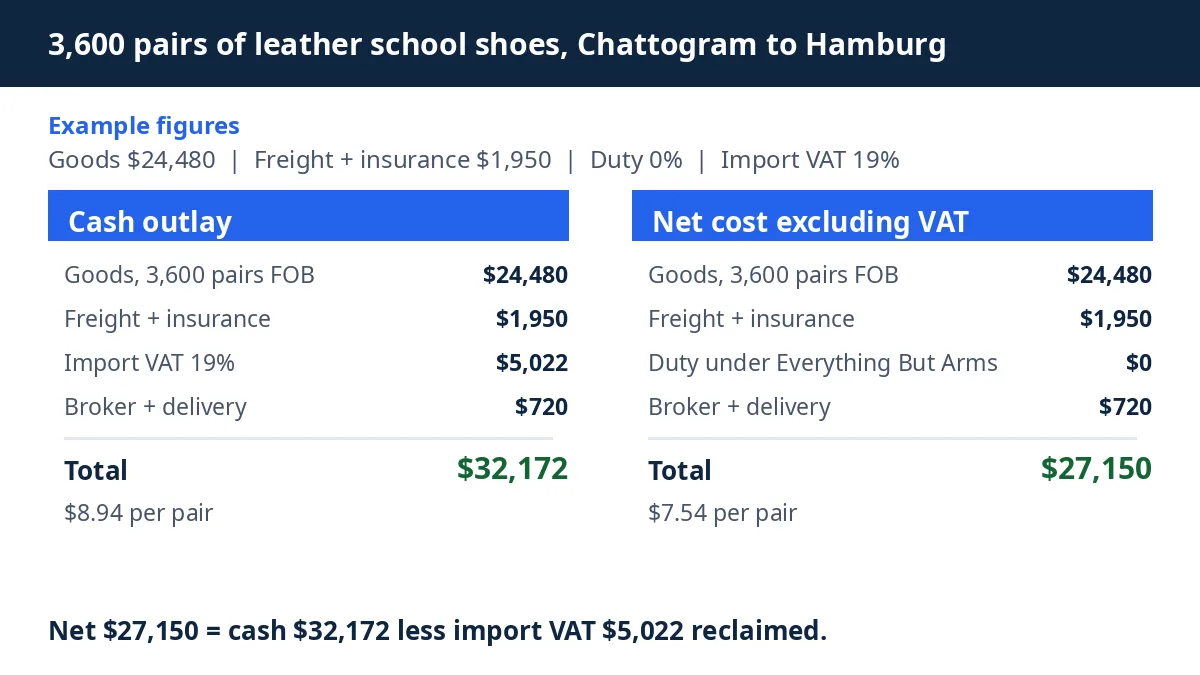
Example figures. A buyer in Germany orders 3,600 pairs of leather school shoes for ages 6 to 10, in two colours, at USD 6.80 per pair FOB. Our kids' shoes price guide takes an FOB quotation apart line by line.
Cost line | Example figures |
|---|---|
Shoes, 3,600 pairs at USD 6.80 FOB | USD 24,480 |
Ocean freight and insurance, Chattogram to Hamburg | USD 1,950 |
Customs value (CIF) | USD 26,430 |
Import duty, 0% under Everything But Arms | USD 0 |
German import VAT, 19% of USD 26,430 | USD 5,022 |
Broker, handling and delivery to the warehouse | USD 720 |
Total cash outlay | USD 32,172 |
Less import VAT recovered on the German VAT return | -USD 5,022 |
Net cost excluding VAT | USD 27,150 |
Net cost per pair excluding VAT | USD 7.54 |
Cash outlay per pair | USD 8.94 |
Duty is zero under Everything But Arms, with proof of origin held.8 Import VAT is 19 percent of the USD 26,430 customs value, USD 5,022.9 A VAT-registered buyer reclaims the USD 5,022, leaving USD 27,150 net, or USD 7.54 per pair.
What documents travel with the shipment
Four documents carry most kids' shoe shipments. The commercial invoice states the style, quantity and value. The packing list gives the pairs in each carton and the size split. The certificate or statement of origin supports the duty-free claim under Everything But Arms.8 The bill of lading is the transport document the buyer needs to take delivery. The safety file adds: the chemical test reports for each material and colour, the CPC for a United States order,2 the EU technical documentation for a European order,6 and the inspection report for the bulk lot.4 Do not pay in full before the inspection result is known.
Mistakes that cost kids'-shoe buyers the most
Ordering by the number on the box gives you a size run no child can wear well. Approving a sample in one upper material and accepting bulk in another gives you a shoe that wears differently from the one you tested. A bulk lot with no chemical report is a shipment the EU will not let you sell.3 Pricing the order before costing the landing leaves you short on the duty and VAT lines.
Questions buyers ask about importing kids' shoes
Do children's shoes need a Children's Product Certificate for the United States?
Yes, where the shoe is a children's product under the CPSIA. The importer issues the CPC on the strength of testing by a CPSC-accepted laboratory, and the certificate must carry all seven elements, including the laboratory behind the testing.2
Does EN 71 apply to children's shoes sold in the EU?
Not as a footwear standard. EN 71 is a set of standards for toy products, harmonised under the EU Toy Safety Directive.5 It applies where a shoe carries a toy feature, such as a detachable toy charm.
Next steps on Exportain
Fix the shoe on paper first: age band, size range, materials, chemical limits and labelling. Then search Bangladeshi suppliers for children's footwear makers, and post an RFQ with the specification, the destination market and the test list attached. Take the factory that answers with last measurements and chemical reports to sample stage.
Sources
- Leather & Footwear as The Next Export Frontier of Bangladesh. LightCastle Partners (accessed )
- Consumer Product Safety Improvement Act: Limits, Testing, Labels. FedLaws (accessed )
- REACH entry 72 requirements. SATRA (accessed )
- Footwear Quality Inspection: Sorting & Grading Guide. AQM BD, (accessed )
- Toy Safety Standards in the European Union: A Complete Guide. ComplianceGate, (accessed )
- GPSR Explained: EU General Product Safety Regulation. Complir (accessed )
- Classifying footwear for import and export. GOV.UK (accessed )
- Bangladesh Pushes Back LDC Graduation, Securing Continued Commercial Benefits in Europe. Modaes, (accessed )
- Guide to Import VAT in Germany for Foreign Companies. Commenda (accessed )
- The Footwear (Indication of Composition) Labelling Regulations 1995. legislation.gov.uk (accessed )
About the author
Sourcing from Bangladesh?
Post a request for quotation and suppliers on Exportain can send you their quotes directly.
Post an RFQ