How to Import Chili Powder From Bangladesh in 2026: Complete Buyer Guide
How to import chili powder from Bangladesh: choose the heat band, set moisture and aflatoxin limits, screen for dyes, classify the powder under HS 0904.22, and check packing, labelling and documents before loading.
Short answer
To import chili powder from Bangladesh, specify the chili type and a heat band in Scoville units, with moisture capped at 11 percent and a Sudan dye screen on the certificate of analysis. Classify ground powder under HS 0904.22, confirm the national tariff line, and require a validated steam treatment for the United States and the European Union. Check the lot against EU aflatoxin and ochratoxin limits, inspect labels and documents, and pay the balance only after the laboratory results release the lot.
On this page
Key takeaways
Ground chili powder is classified under HS 0904.22; dried whole chili sits at 0904.21, and blends can leave heading 0904.
Codex caps moisture at 11 percent for chili peppers and sets the chili pungency floor at 900 Scoville heat units, with no colour minimum for chili.
For the EU, aflatoxin B1 is capped at 5 and total aflatoxins at 10 micrograms per kilogram for Capsicum, with ochratoxin A at 20.
Name the Sudan dye screen, the treatment method and the heat band in the order, and pay the balance only after the laboratory results release the lot.
A buyer who orders chili powder from Bangladesh is ordering a ground spice whose value sits in three numbers: heat, colour and moisture.
What exactly are you buying when you order chili powder from Bangladesh?
Chili powder is ground dried chili. The Codex standard for dried chili pepper defines it plainly: ground chili pepper is obtained by grinding whole dried chili, with or without the placenta, seeds, calyx and stalk, and without any other added matter.1 Anything else — a filler, a dye, another spice — is not part of the product unless your order says so.
The standard also draws a line buyers often miss: ground paprika is ground with the placenta, seeds, calyx and stalk excluded, while ground chili pepper may keep them.1 A powder sold as chili powder that is really paprika is a different product. State the chili type, the style, whether seeds and stalk are included, and whether an anticaking agent is used, which the standard allows up to 2 percent.1
Which chili variety and heat band fits your use?
Bangladesh grows everyday red chili for the domestic table and one variety the rest of the world knows by name. Naga morich, also called bhut jolokia, grows in Sylhet in Bangladesh and in Assam, and it is described as the hottest naturally occurring chili pepper, rated at about one million Scoville heat units.2
Most import orders are for ordinary dried red chili, where the heat band is a commercial choice. The Codex standard sets the floor for chili peppers at 900 Scoville heat units, puts paprika at 480 or below, and places hot paprika between 480 and 900.1 Use those bands in your specification instead of words such as mild, medium or hot.
Use | Heat band to specify |
|---|---|
Everyday curry powder | 900 to 30,000 Scoville units |
Hot sauce and spicy snacks | 30,000 to 75,000 Scoville units |
Colour-led blends and mild pastes | Below 900 Scoville units |
Superhot flavouring and extracts | Above 800,000 Scoville units, Naga morich |
How is chili powder ground, and which fineness grade should you specify?
Grinding decides how the powder behaves in your factory. A coarse grind suits dry rubs and spice mixes that are blended again; a fine grind suits sauces, marinades and instant mixes that must dissolve evenly. The Codex standard sets no single fineness for chili powder: particle size is as agreed between the parties.1 That puts the decision on you, and the order is where it belongs.
Write the fineness as a sieve result, not as a word. State the sieve size and the share that must pass through it, for example 95 percent through a named mesh, and ask for the sieve record on the certificate of analysis. Keep a sealed sample from the approved batch and compare every later lot against it by sight, smell and laboratory result.
How do you read colour and heat on a laboratory report?
Colour and heat are measured by different tests, and a buyer who confuses them pays for one and gets the other. Heat is a chemical measurement of capsaicinoids, the compounds in the placental tissue of the pod, and in trade it is quantified in Scoville heat units, typically measured by high-performance liquid chromatography (HPLC).3 Colour is measured as an ASTA colour value: pigment is extracted with acetone and read with a spectrophotometer.3
The two numbers move independently. A powder can be vivid red and nearly heatless, or dull in colour and fiercely hot. That is why the Codex standard gives chili peppers a pungency floor of 900 Scoville heat units and no colour minimum at all, while paprika grades carry ASTA colour minima of 120 for Extra, 100 for Class I and 80 for Class II in ground form.1 Judge colour against your approved sample and heat against the laboratory result. Ask for heat, ASTA colour and moisture on every certificate of analysis, with the method named.
What moisture and aflatoxin limits protect the shipment?
Moisture is the number that decides whether the powder survives the voyage. The Codex standard caps moisture at 11 percent for chili peppers, with a note that some varieties reach 15 percent in all styles.1 Write your limit into the order, and test moisture at several points in the lot rather than taking one reading, because damp bags hide among dry ones.
Aflatoxin is the risk that follows moisture. Aflatoxins are toxic byproducts of Aspergillus moulds, which thrive in warm, humid conditions and can start to grow within 48 hours when freshly harvested chilies are piled damp without ventilation.3 The European Union sets the limits for Capsicum species, dried whole or ground, including chili powder, at 5 micrograms per kilogram for aflatoxin B1 and 10 micrograms per kilogram for total aflatoxins.4 It sets ochratoxin A for the same products at 20 micrograms per kilogram.4 Food above those levels may not be sold, used as an ingredient, or mixed with food that complies.4
How do you screen for adulteration before loading?
A bright red powder is the oldest trap in the chili trade. A non-permitted dye can restore the colour a weak lot lost, and mineral filler can add weight that no eye can see. The Codex standard requires the product to be free from adulteration,1 and your order should name the screens that prove it.
Start with the ash numbers. The Codex standard caps total ash at 10 percent and acid-insoluble ash at 1.6 percent on a dry basis for chili peppers.1 Acid-insoluble ash is the filler signal: sand, soil and brick dust raise it, so a high result sends the lot to microscopy. Then name the dye screens. Require a Sudan I, II, III and IV screen on the laboratory report, with the method and lot number named, and add any other non-permitted colour your market watches, such as metanil yellow or rhodamine B. Any detection is a hold, not a re-grade.
The European Union also runs increased official controls on certain foods from certain third countries, with official certificates and sampling results required for listed consignments.5 Check whether yours falls under them before you ship. Draw samples randomly across bags and cartons, and keep a sealed retention sample.
Does the powder need a microbial kill step?
Chili powder is a low-moisture food, and low moisture does not mean sterile. Spices have been linked to outbreaks of salmonellosis and to recalls of ready-to-eat products, and Salmonella can persist for long periods under typical storage conditions.6 The incidence of Salmonella in spices presented for import to the United States is reported at 6.6 percent, or 187 of 2,844 containers.6
Most buyers for the United States and the European Union now require a validated kill step, with a 5-log reduction of Salmonella as the working target. Steam treatment is the most widely accepted method: it leaves no chemical residue and is accepted in every major market. Research on vacuum-assisted steam pasteurisation found Salmonella needed 83 seconds on peppercorns and 70 seconds on cumin seeds for a 5-log reduction at about 86.7 degrees Celsius.6
Treat those times as evidence, not settings: a kill step must be validated for the specific product and process. Ask for the validation record for chili powder, the target log reduction, and the monitoring record for your batch. Name the permitted method in the order: ethylene oxide is not allowed on food in the EU.
How should the powder be packed and labelled?
Chili powder loses colour and aroma to light, heat, oxygen and moisture, so the pack is part of the specification, not an afterthought. Use a moisture-proof inner liner inside a strong outer bag or carton, sealed so that no powder escapes and no damp gets in.
Labelling follows the Codex general standard for prepackaged foods, which requires the name of the food, an ingredients list except for single-ingredient foods, net contents, and the name of the manufacturer and country of origin details.7 The chili standard adds its own rules: the common name must include the style, the trade name or variety may be listed, and the country of origin shall be declared.1 Write the label check into your inspection: product name with the style, net weight, lot number, country of origin, and ingredients where anything was added. The lot number must match the certificate of analysis and the packing list.
Which HS code and documents does the shipment need?
Ground chili powder is classified under heading 0904, which covers pepper of the genus Piper and dried or crushed or ground fruits of the genus Capsicum or of the genus Pimenta.8 Within that heading, the form decides the subheading: dried chili that is neither crushed nor ground sits at 0904.21, while crushed or ground Capsicum fruit sits at 0904.22.8 Your powder is 0904.22 at six digits. Our HS code guide for chili powder works through the boundary cases, including flakes and blends, which can leave 0904 altogether.
The document set is short but each paper must match the others. Keep one file per shipment with the commercial invoice, packing list, bill of lading or airwaybill, certificate of analysis, certificate of origin where your destination requires it, and the phytosanitary certificate if your destination requires one for dried ground spice.
Document | What it must show |
|---|---|
Commercial invoice | Product name, style, quantity, unit price, Incoterm, HS code |
Packing list | Pack count, net and gross weight, lot numbers, marks |
Certificate of analysis | Heat, moisture, ash, colour, dye screens, contaminants, lot number |
Bill of lading | Shipper, consignee, port pair, container number, seal number |
The product name, lot number and quantity must read the same on the invoice, the packing list, the certificate of analysis and the bill of lading.
A worked example: a first order from enquiry to loading
Example figures: a spice wholesaler in the United Arab Emirates buys chili powder for repacking into 500-gram retail bags. The buyer wants 5 tonnes of ground dried red chili at 15,000 to 25,000 Scoville heat units, moisture at 11 percent maximum and a Sudan I to IV screen with no detection.
The buyer picks the seller whose certificate of analysis matches the specification and whose sample matches the colour and aroma of the approved sample. The seller confirms steam treatment with a validation record for chili powder, 25-kilogram bags with moisture-proof liners, and 200 cartons on pallets. A pre-shipment inspection is booked for packing day.
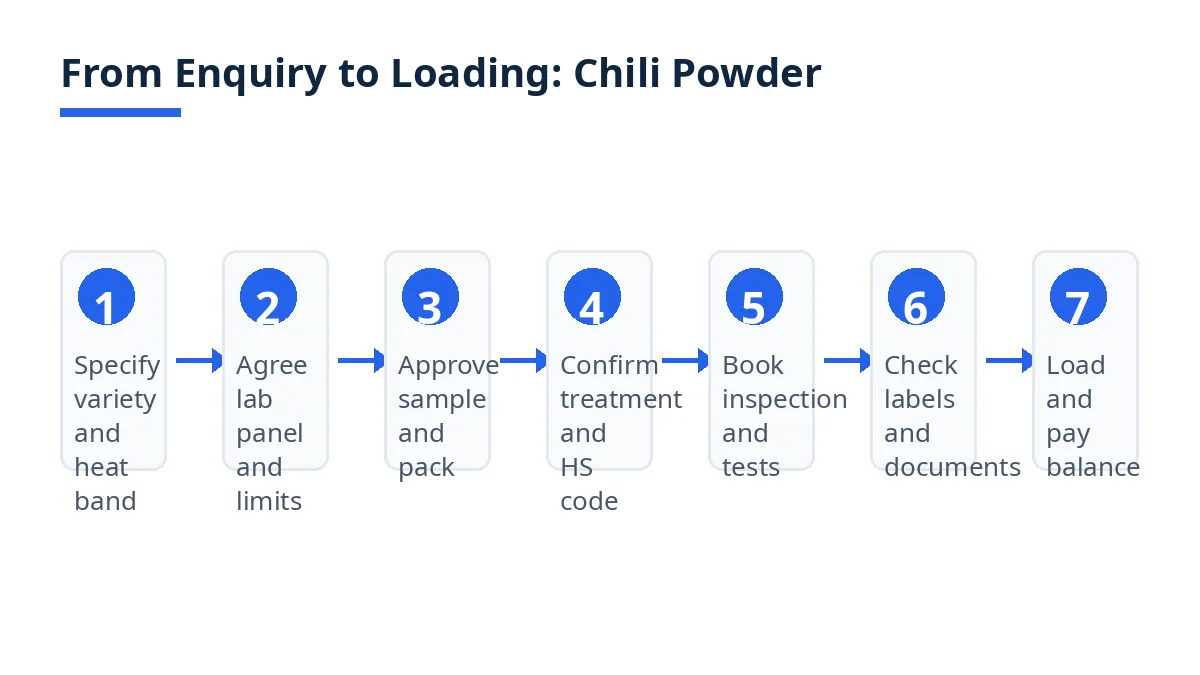
The laboratory results come back inside the limits, the inspector releases the lot, and the seller loads a 20-foot container with the documents in one file: invoice, packing list, certificate of analysis, certificate of origin and bill of lading, all showing the same product name, lot number and quantity. The buyer pays the balance only after the release, not on the shipping date.
Which mistakes cost chili powder buyers the most?
Ordering by colour alone. A vivid red powder can hide weak heat, added dye or mineral filler.
Writing mild or hot instead of a heat band. Words do not test. State the Scoville range and the method on the order.
Skipping the moisture test at loading. One damp bag in a container can spoil its neighbours.
Accepting a certificate of analysis for a different lot. Check the lot number on every report against the lot number on the bags.
Leaving the treatment method open. Name the method, or the seller may choose one your market forbids.
Declaring the wrong HS code. Ground powder is 0904.22, not 0904.21.
Paying the balance before the laboratory results arrive. Pay on release of the lot, not on the shipping date.
Next steps on Exportain
Write your specification first, then let sellers answer it. Post a request for quotation that names the chili type, the heat band in Scoville units, the moisture and ash limits, the Sudan screen, the treatment method, the pack size and the destination, and ask each seller to attach a certificate of analysis for the lot they would ship. Our guide to writing an RFQ shows how to set out those terms so quotes arrive comparable. Compare the laboratory numbers and the treatment record before you compare the price,
Sources
- Standard for Dried or Dehydrated Chilli Pepper and Paprika CXS 353-2022. Codex Alimentarius (accessed )
- Hot, Hotter, Hottest. The Daily Star, (accessed )
- Wholesale Red Chilli: SHU, ASTA Color and Aflatoxin Prevention. Exim Internationals, (accessed )
- Commission Regulation (EU) 2023/915 on maximum levels for certain contaminants in food. EUR-Lex, (accessed )
- Commission Implementing Regulation (EU) 2019/1793 on the temporary increase of official controls. EUR-Lex, (accessed )
- Inactivation of Salmonella enterica and Surrogate Enterococcus faecium on Whole Black Peppercorns and Cumin Seeds Using Vacuum Steam Pasteurization. Frontiers in Sustainable Food Systems, (accessed )
- General Standard for the Labelling of Prepackaged Foods (CXS 1-1985). FAO / Codex Alimentarius (accessed )
- Harmonized System: Heading 0904. World Customs Organization (accessed )
- Bangladesh exports
- Food Safety
- aflatoxin
- chili powder
- HS code 0904.22
- Scoville heat units
- ASTA colour value
About the author
Sourcing from Bangladesh?
Post a request for quotation and suppliers on Exportain can send you their quotes directly.
Post an RFQ