Typical MOQ for Hotel Linen in Bangladesh (and How to Negotiate It Down)
No single hotel linen MOQ in Bangladesh: how loom setup, dye lots and per-item versus per-set minimums set the floor, and the negotiation levers that can move it.
Short answer
There is no single hotel linen MOQ in Bangladesh. Each supplier sets its minimum per item and per colour from loom set-up, bleach or dye lots, cutting plans per size, and whether you buy loose pieces or complete sets. Ask for every minimum line by line, then negotiate by trading colours, sharing one fabric, or paying set-up as a separate line.
On this page
Key takeaways
There is no single hotel linen MOQ in Bangladesh, because each supplier sets its minimum per item and per colour from its own production setup.
Loom set-up, bleach and dye lots, cutting plans per size, set assembly, and logo set-up each carry a separate floor, and the binding one is rarely the headline total.
Fewer colours, one fabric shared across items, and stocked white fabric lower the floor, while new dye lots, extra sizes, and logo set-ups raise it.
Negotiate with trades, not requests: cut a colour, share a fabric, pay set-up separately, or stage the programme, and record every agreement in writing.
Exportain verification is a document and photo review, not a factory inspection, and a badge is not a guarantee of capacity, quality or delivery.
Ask three mills for the hotel linen MOQ in Bangladesh for the same room programme and you will get three different answers, and none of them is wrong. There is no single hotel linen MOQ in Bangladesh, because each supplier sets its minimum from the way your linen is actually made: the loom set-up, the bleach or dye lot, the cutting plan for each size, and whether you are buying loose pieces or complete room sets.
Most enquiries miss that point: a buyer who asks for one total minimum then discovers that one dyed colour, one size, or one logo sits below its own separate minimum. This guide explains those mechanics and the trades that can lower them.
Why a hotel-linen MOQ exists at all
A hotel-linen order is several fabric runs, cutting plans and finishing steps, each with a floor of its own.
Loom and fabric set-up. Sheeting is woven to a width and construction, and terry towelling is woven on a terry loom with its own pile set-up. Changing the fabric means changing the set-up, so a mill prefers a long run of one fabric. One sheeting shared by sheets, pillowcases and duvet covers shares a fabric run; a different construction per piece carries its own floor.
Bleach and dye lots. White hotel linen is bleached, and coloured linen is dyed, in batches. A batch has a minimum size because the bath, chemicals and shade matching are the same whether the batch is small or large. A standard white bleach can therefore sit lower than a dyed programme, where each colour is a separate lot.
Cutting per size. A flat sheet, a fitted sheet and a duvet cover do not share a cutting plan, and neither do a hand towel and a bath sheet. Each size needs its own marker, and small sizes cut from a wide fabric leave more waste per piece, so a programme with many sizes carries more minimums at the same total piece count.
Per-item versus per-set minimums. This is where hotel linen differs from apparel. A supplier may set a minimum per item, such as per sheet, or per set, such as per complete room set of sheet, pillowcases and duvet cover. A per-set minimum can look lower and still be harder to meet, because every piece must clear its own fabric and cutting floor before the set can be assembled. Never compare a per-item figure with a per-set figure as if they were the same offer.
Logo and finishing set-up. A woven logo, an embroidered monogram and a printed label each need their own set-up: a loom or embroidery file, a screen, or a print run. That work is fixed whether the run is short or long, so the supplier recovers it through a minimum or a set-up charge, as with special packing such as room-set packs.
Hotel linen sits under heading 6302 in the Harmonized System, which covers bed linen, table linen, toilet linen and kitchen linen, with bed linen split by construction and fibre.1 If you sell into the European Union, Regulation (EU) No 1007/2011 states that a textile product shall be labelled or marked with the name and percentage by weight of all constituent fibres in descending order.2 See the HS code for hotel linen guide and the MOQ definition guide.
Mechanism | What sets the floor | Ask for it as |
|---|---|---|
Loom set-up | Fabric width and construction change | One fabric shared across items where possible |
Bleach or dye lot | One batch per colour or white shade | Quantity per colour, per item |
Cutting plan | One marker per size | Quantity per size, not only per item |
Set assembly | Every piece in the set must be ready | Whether the minimum is per item or per set |
Logo set-up | One file, screen or print run per treatment | Logo method, size and placement |
Packing | Carton contents by item and size | Pieces per pack and per carton |
Example figures: a buyer orders complete sets and finds the duvet cover below its fabric floor while the sheets clear theirs, so the sets cannot be assembled until the cover quantity rises or its fabric is shared. The example shows structure only, not a typical MOQ, price or lead time.
Negotiation levers that actually move it
Negotiation works when you offer the supplier something that lowers its own cost or risk, not when you ask for an exception to a physical floor. Get every agreed change in writing.
Trade colours for quantity per colour. Offer to cut one colour from the programme and move those pieces into the remaining colours. The total stays the same, but the quantity per dye lot rises, which is exactly what the supplier needs to say yes.
Trade variety for a shared fabric. Offer to run the duvet cover in the same sheeting as the sheets, or the bath sheet in the same terry as the bath towel. One shared lot replaces two small lots, and the supplier can meet the combined floor even if neither item could meet its own.
Pay set-up as a separate line. Where the floor comes from a logo file, an embroidery digitisation or a label print run, ask for that cost apart from the unit price. The run can then be shorter, because the fixed work is already paid for, and the same set-up serves the repeat order. Record which set-ups you have paid for, so you do not pay them twice.
Stage the programme. Place a smaller first order in the stocked white range, with a written repeat price and minimum for the dyed range once the first order is approved, so you test the linen in service before committing to colour.
Simplify the logo and packing first. One logo method, one size, one placement, and standard packing remove set-ups before you ask for any other concession.
Do not trade away the controls. Do not negotiate by dropping sample approval, wash testing or inspection. The inspection control that matters here is agreed before production: ISO 2859-1:2026 defines a system of acceptance sampling plans for inspection by attributes, indexed by acceptance quality limit (AQL) for lot-by-lot inspection.3 AQL is the maximum average percentage of defective items considered acceptable during random sampling, and it determines sample sizes and acceptance or rejection thresholds.3
Step-by-step: how to ask for an MOQ that can be answered
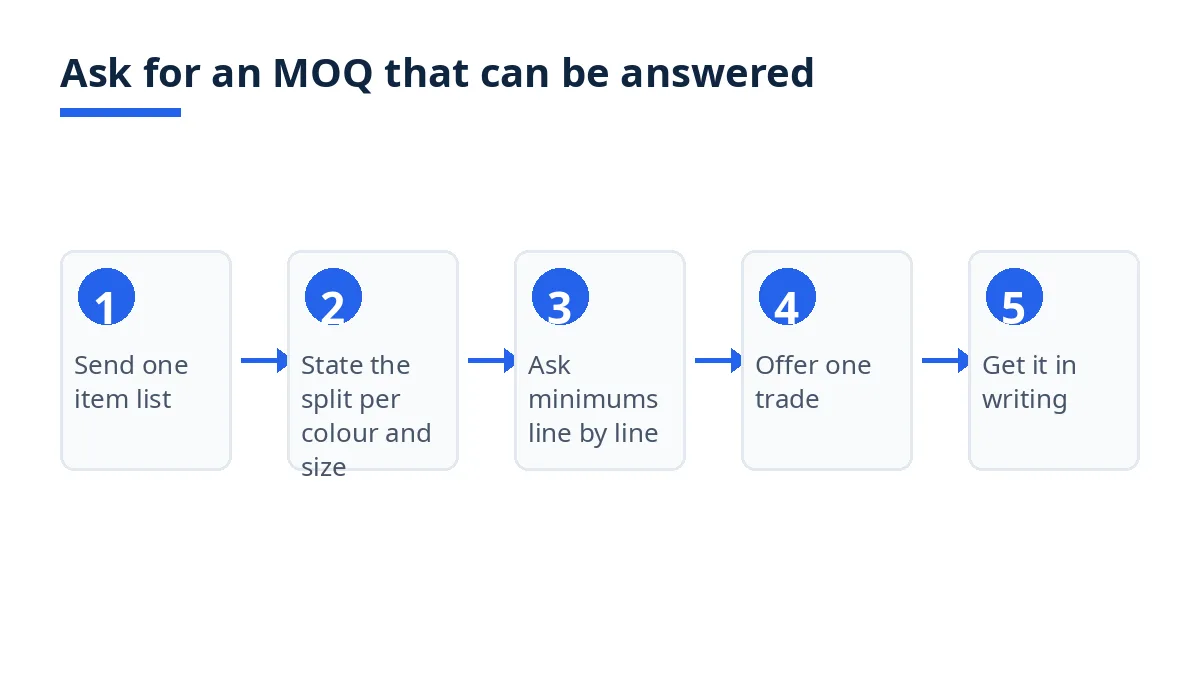
Send one item list to every candidate. Name each item, its use, fibre and construction, finished size, colour or white shade, logo method and placement, and packing by item and size. A list without sizes and colours cannot produce a usable minimum.
State the split, not only the total. Give the quantity per item, per colour, per size and per set where sets are used. A total without a split hides the binding minimum.
Ask for the minimums line by line. Ask for the minimum per item, per colour and dye lot, per size where it applies, per set where sets are used, and any separate logo, label and carton minimums. Ask which line is binding for your split.
Ask what is stocked. Record whether each fabric and colour is stocked or made to order, and whether the logo and label treatments are stock or new set-ups. Stocked inputs are where a lower minimum is most often possible.
Offer one trade at a time. Put your proposed trade in the enquiry: fewer colours, a shared fabric, a paid set-up line, or a staged programme.
Approve samples in writing. Approve a pre-production sample in the actual fabric, colour and logo treatment, wash it as your laundry will wash it, and record the approval in writing.
Agree inspection and delivery term before you confirm. Write the inspection level and AQL values into the purchase order, following ISO 2859-1,3 and state one Incoterm and named place for every quotation. The Incoterms 2020 rules provide 11 rules with a clear allocation of cost, risk and obligations,4 so compare minimums only on the same term.
Costs, timelines and documents
What are the typical costs and timelines?
There are no typical costs or timelines a guide can state as fact, for the same reason there is no typical MOQ. Each supplier prices your fabric, construction, dye or bleach lot, logo set-up, packing and delivery term,4 and each timeline depends on fabric availability, lot scheduling, correction rounds and line capacity. Ask for sampling, fabric ready, production and inspection dates as separate lines, not a single delivery week.
Which documents are needed?
For export clearance in Bangladesh, goods may not be loaded unless an export declaration, the Bill of Export or Shipping Bill, is submitted to Customs and approved.5 Enclosed documents include the export contract or purchase order where there is no export letter of credit, the commercial invoice, the packing list, the EXP form certified by an authorized dealer, and a certificate of origin issued by the EPB or a Chamber of Commerce and Industry.5 Keep the order documents alongside them: the item list, the itemized quotation, and the purchase order carrying the agreed split and inspection terms.
Bangladesh-specific rules and tips
Confirm the fabric route before you negotiate the floor. Ask whether sheeting is woven in-house or bought in, and whether bleaching or dyeing is done in-house or by a third party. A bought-in fabric or an outside dye lot adds a supplier of its own, with its own lot minimum, and that outside lot may be the real binding line.
Keep one legal name across every paper. The export declaration names the exporter and the foreign buyer,5 so the name on the trade licence, quotation, proforma invoice and payment account should match. A name mismatch delays clearance after you have already negotiated the order.
Treat white shade as a colour. Two whites from two bleach lots can differ enough to fail as a room set, even though both are called white. Name the white standard, keep sets within one lot, and check shade across pieces that will sit in one room.
Mistakes and red flags
What are the most common mistakes?
Asking for a total MOQ only. The binding minimum is usually per colour, per size or per set. An order can clear the total and still fall below the per-colour dye minimum for one colour, which then carries a surcharge or removal.
Comparing minimums on different bases. A lower minimum quoted per set is not lower than a higher minimum quoted per item. Compare only replies to the same item list, on the same per-item or per-set basis, and on the same Incoterm.4
Accepting a verbal exception. Record any agreed lower minimum, shared lot, paid set-up or staged programme on the quotation and purchase order, with the split it applies to.
Paying set-up twice. Keep the paid set-up lines from the first purchase order and attach them to the repeat enquiry, naming the logo file, embroidery digitisation or label run already paid for.
Treating a profile or a badge as capacity. A profile is a starting point for enquiries. It does not test whether a mill can weave, bleach and sew your programme, and a badge is not a guarantee of capacity, quality or delivery.6
Dropping inspection to save time. Sampling under ISO 2859-1 checks a lot against an agreed AQL,3 the last control before the goods become your stock.
Checklist
Before you confirm, every line should be answered in writing.
Item list sent: item, fibre, construction, finished size, colour or white shade, logo, packing.
Split stated per item, per colour, per size and per set where sets are used.
Minimum confirmed per item and per colour; binding line named.
Fabric status per colour recorded: stocked or made to order.
Logo, label, tag and carton minimums confirmed apart from the item minimum.
Set-up costs itemized apart from the unit price; paid set-ups recorded.
One trade offered and agreed: fewer colours, shared fabric, or paid set-up.
Pre-production sample washed and approved in writing.
Inspection level and AQL values in the purchase order.3
Quotations compared on the same item list, basis and Incoterm.4
Export set agreed: invoice, packing list, EXP form, certificate of origin.5
How Exportain helps
On Exportain, browse suppliers and post a request for quotation (RFQ) on the RFQ board with your item list, split per colour and size, and delivery term, so suppliers quote against the same specification and state their minimum per item and per colour.
Read the badges for what they record. Exportain Verified means Exportain has checked identity, phone, email and business registration, and Export Verified means it has checked the Export Registration Certificate (ERC).6 Factory Verified means it has reviewed photos of the manufacturer factory, while Trading Company Verified means it has reviewed photos of the trading company office or warehouse.6 Verification is a document review by staff, free, and never granted by membership plans.7 It is not a factory inspection,6 7 so sample approval and inspection stay with you.
FAQs
What should I know first about hotel linen?
There is no single MOQ to look up. The minimum is set per item and usually per colour by loom set-up, bleach or dye lots, cutting plans per size, set assembly and logo set-up. Hotel linen sits under HS heading 6302, which covers bed linen, table linen, toilet linen and kitchen linen.1
What are the typical costs and timelines?
There are no typical figures a buyer can rely on, because each supplier sets its price, minimum and lead time for your specification. Fabric, construction, dye or bleach lots, logo set-up, packing and the delivery term drive the price,4 and fabric availability, lot scheduling and line capacity drive the timeline.
Which documents are needed?
The order documents are the item list, the itemized quotation and the purchase order, with the minimum per item and per colour on both. The export set is the Bill of Export, commercial invoice, packing list, EXP form certified by an authorized dealer, and a certificate of origin issued by the EPB or a Chamber of Commerce and Industry.5
What are the most common mistakes?
The most common mistakes are asking only for a total MOQ, comparing minimums quoted on different per-item and per-set bases or different terms,4 accepting a lower minimum verbally, paying a set-up twice, and reading a badge as a guarantee. A badge is not a guarantee of capacity, quality or delivery.6
Next steps on Exportain
Browse suppliers, then post your item list and split per colour and size on the RFQ board so suppliers state their minimum per item and per colour. Before you confirm, read how to import hotel linen from Bangladesh and the MOQ definition guide.
Sources
- Classification Detail — HS Code 6302. United Nations Statistics Division (accessed )
- Regulation (EU) No 1007/2011 on textile fibre names and related labelling and marking of the fibre composition of textile products. European Union, (accessed )
- ISO 2859-1:2026 - Sampling procedures for inspection by attributes — Part 1: Sampling schemes indexed by acceptance quality limit (AQL) for lot-by-lot inspection. ISO (accessed )
- Incoterms® 2020. International Chamber of Commerce (ICC) (accessed )
- Customs Clearance Procedures for Export. Bangladesh Customs, National Board of Revenue (accessed )
- Trust & Safety Center. Exportain (accessed )
- Supplier verification: Earn trust badges buyers can see. Exportain (accessed )
About the author
Sourcing from Bangladesh?
Post a request for quotation and suppliers on Exportain can send you their quotes directly.
Post an RFQ