Hoodies and Sweatshirts Exporters in Bangladesh: Verified Supplier Checklist
A numbered supplier checklist for hoodies and sweatshirts exporters in Bangladesh: identity and export standing, specification fit, capacity, MOQ and price drivers, samples and labels, export documents, with fixes for common failures.
Short answer
Use this checklist to find and check hoodies and sweatshirts exporters in Bangladesh before you order: confirm the legal name and whether the supplier sews or trades, send one specification to every candidate, confirm MOQ per style and per color, compare itemized quotations on one delivery term, approve a pre-production sample and labels, and agree the export documents and inspection before production ends.
On this page
Key takeaways
Compare exporters on evidence, not claims: one legal name across quotation, invoice and payment account, and the sewing factory and subcontracted steps named in writing.
BKMEA represents approximately 2,540 knitwear member factories, and knitwear exports reached $5.963 billion in July to September 2026, per EPB data.
MOQ is set per style and per color, with separate minimums for labels, tags and cartons, so confirm all three before paying for samples.
Compare quotations only on the same specification and the same Incoterms 2020 delivery term, split by fabric, finishing, sewing, artwork, trims, labels and packing.
Exportain badges record document and photo reviews, not factory inspections, and a badge is not a guarantee of capacity, quality or delivery.
If you buy fleece knitwear, this checklist helps you find hoodies and sweatshirts exporters in Bangladesh and check each candidate the same way. The supplier behind an offer may be a knitwear factory, a garment factory with knit lines, or a trading company.
The supply base is large enough to compare. The Bangladesh Knitwear Manufacturers and Exporters Association (BKMEA), established in 1996, is the apex trade body for the knitwear sector and represents approximately 2,540 knitwear member factories.1 Knitwear exports reached $5.963 billion in July to September 2026, within ready-made garment exports of $10.578 billion, according to data released by the Export Promotion Bureau (EPB).2 Scale alone does not qualify a supplier for your order.
Why this checklist matters
A hoodie order fails in predictable places: the company that quoted is not the company that sews, the price was built on a lighter fleece, the minimum was quoted per style while your split falls per color, or the export papers name a different legal business than the one you paid. Each failure is visible early, on paper.
A written checklist makes suppliers comparable: every candidate answers the same questions, against the same specification and delivery term. BKMEA represents the knitwear sector,1 while the Bangladesh Garment Manufacturers and Exporters Association (BGMEA) represents the readymade garment industry, particularly the woven garments, knitwear and sweater sub-sectors.3 A membership claim is a starting point for a check, not evidence of capacity.
Before you start
Do not score suppliers until your documents are complete: a tech pack stating fabric composition and weight, hood or crew neck, pocket and zip details, size chart, artwork, trims, labels and packing.
Set the classification early: heading 6110 covers jerseys, pullovers, cardigans, waistcoats and similar articles, knitted or crocheted.4 See the HS code for hoodies and sweatshirts guide, and confirm the code with your broker.
Fix one delivery term for every quotation: the Incoterms 2020 rules set out 11 rules with a clear allocation of cost, risk and obligations,5 so a lower price on a different term is a different offer. Prepare label content before bulk printing: under Regulation (EU) No 1007/2011, a textile product sold in the European Union shall be labelled with the name and percentage by weight of all constituent fibres in descending order.6
The full checklist (numbered, printable)
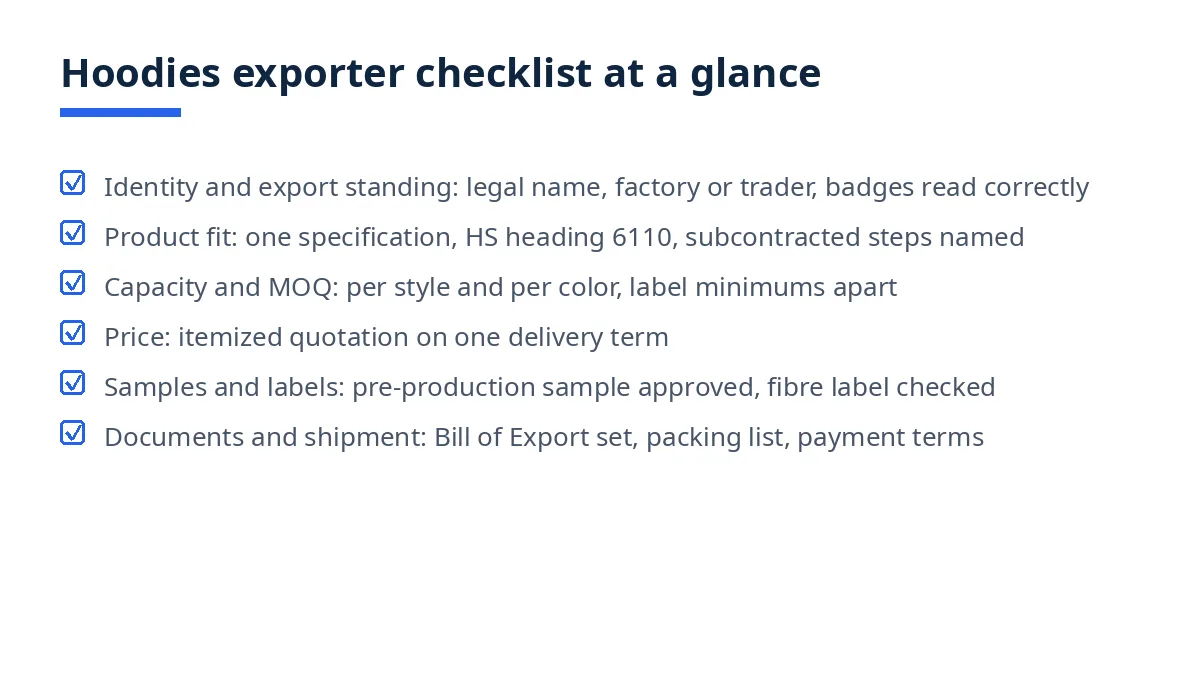
Work through the list per candidate. A line that cannot be answered is a finding, not a detail to settle later.
Identity and export standing
Record the supplier's full legal name, and check the same name appears on the quotation, proforma invoice and payment account.
Record whether the supplier sews your order itself or is a trading company, and name the sewing factory in the second case.
Record the factory address separately from any head office, and where knitting, dyeing, printing, sewing and packing take place.
Confirm any BKMEA or BGMEA membership claim with the association. BKMEA represents approximately 2,540 knitwear member factories,1 and BGMEA reports around 4,500 member factories.3
Read Exportain badges for what they record: Exportain Verified means identity, phone, email and business registration checked; Export Verified means the Export Registration Certificate (ERC) checked.7
Note what a badge does not show: verification is a document review, not a factory inspection, and a badge is not a guarantee of capacity, quality or delivery.7
Product and specification fit
Send the same specification version to every candidate, and record the date and version sent.
Confirm the supplier produces fleece hoodies and sweatshirts in your fabric weight and finish, not knitwear in general.
Confirm the classification: heading 6110 covers jerseys, pullovers, cardigans, waistcoats and similar articles, knitted or crocheted,4 with the final code confirmed by your broker.
Ask which steps are in-house and which are subcontracted, per step, because each transfer adds handling and time.
Check the supplier can produce your labels and packing: main, size, care and content labels, hang tag and carton marks.
Record any proposed change, such as a substitute fabric or trim, as a change to approve or reject in writing.
Capacity, minimums and price drivers
Ask how many lines run fleece hoodies and what share is booked for your window, in writing.
Confirm the minimum order quantity (MOQ) per style and per color in writing. See the minimum order quantity definition.
Confirm separate minimums for woven labels, printed tags and printed cartons, produced apart from the sewing run.
Ask for the quotation split by line: fabric, dyeing and finishing, sewing, artwork, trims, labels, packing and delivery.
Compare quotations only where specification and term match, because the Incoterms 2020 rules allocate cost, risk and obligations differently under each rule.5
Record sample and set-up charges, and which are credited against a bulk order.
Example figures: 1,200 pieces in four colors gives 300 per color; in two colors, 600 per color. Example figures only: the per-color figure doubles, which can decide whether a dye minimum is met, not a typical MOQ or price.
Samples, labels and market rules
Order a pre-production sample in your actual fabric, color, artwork and labels, and measure and wash it before approval.
Approve the sample, or list corrections, in writing, and keep one sealed reference sample for later inspection.
Check the sewn-in content label against the fabric specification: for the European Union, it names each fibre and its percentage by weight in descending order.6
Check care information, size labels and barcodes against the order, because an approved error repeats on every piece.
If the supplier cites a certificate or test report, check its scope names your fabric, product and order.
Agree in the purchase order how the lot will be inspected and what happens to a failing lot. Use the hoodies and sweatshirts quality control checklist for garment-level checks.
Documents, payment and shipment
Agree the export document set before production ends. Bangladesh Customs requires an export declaration, the Bill of Export or Shipping Bill, approved before goods may be loaded.8
Confirm the enclosed documents: export contract or purchase order where there is no export letter of credit, commercial invoice, packing list, EXP form certified by an authorized dealer, and a certificate of origin from the EPB or a Chamber of Commerce and Industry.8
Check the exporter name on the export papers matches the legal name at item 1, because the declaration names the exporter and the foreign buyer.8
Agree payment terms in writing, including what event releases each payment.
If a funds hold is proposed on Exportain, note it applies only when both parties agree, and a paid hold is released after the supplier files an export clearance document and the buyer confirms completion.7
Confirm packing list, carton count and marks against the order, and file the final document copies.
Common failures and how to fix them
The most common failure is comparing prices that were never for the same garment: one quotation uses a lighter fleece, another leaves out your labels, a third uses a different term. Reissue one specification and one term to every candidate and ask each to re-quote, line by line.5
The second failure is the wrong company in the papers, or the sewing factory never named. Fix it at items 1 to 3. The third is a minimum discovered after sampling. Fix it at items 14 and 15, before paying for the sample.
The fourth failure is reading a badge as a promise: a badge records a document or photo review and does not guarantee capacity, quality or delivery.7 The fifth is a label approved without a check, so the fibre content shipped does not match the fabric ordered. For the European Union the label is a legal statement of fibre names and percentages by weight,6 so proof it at sample stage.
Downloadable template / summary table
Copy this table into your sourcing sheet, add one column per candidate, and record the evidence seen for each block.
Block | Checks | Evidence to record |
|---|---|---|
Identity | Legal name, factory or trader, addresses, membership claims | Quotation, profile badges, association check |
Product fit | Specification sent, product type, HS heading, subcontracted steps | Tech pack version, code confirmation |
Capacity and MOQ | Lines and booked share, MOQ per style and per color, label minimums | Written MOQ, itemized quotation |
Price | Fabric, finishing, sewing, artwork, trims, labels, packing, term | Quotation split on one Incoterm |
Samples and labels | Pre-production sample, label content, certificates | Written approval, sealed sample |
Documents and shipment | Bill of Export set, payment terms, packing list | Invoice, packing list, EXP form, origin certificate |
How Exportain helps
On Exportain, buyers browse suppliers, review profiles and post a request for quotation (RFQ) on the RFQ board. An RFQ states quantity, target price, destination, Incoterm, certifications and deadline, and suppliers in that category can quote against it.9 Quotations are versioned with price, MOQ, lead time, Incoterm, payment terms and validity, and accepting one creates an order record.9
Read profiles for the checks behind them. Verification is a document review by staff, each check reviewed separately before a badge is shown.7 It is free, is a document and photo review rather than a factory inspection, and membership plans never grant a badge.10 Exportain is not a party to the goods contract and does not inspect goods. See how supplier verification works on Exportain.
FAQs
When should this checklist be used?
Use it when you shortlist exporters, before paying for samples, and again at quotation stage, because MOQ and document names are confirmed against a specific order, not a profile.
Who should complete it?
The buyer or the buyer's sourcing agent, using the specification, quotations and supplier documents. One person should own the sheet so every candidate is scored on the same evidence.
What are the most common failures?
Quotations compared on different specifications or terms, a legal name that changes between documents, a minimum found late, a badge read as a guarantee, and a content label approved unchecked.
Can a third party do it?
Yes. An agent or inspection company can work through it if you give them the specification, delivery term and evidence standard first, and require the documents behind each answer to be filed with the sheet.
Next steps on Exportain
Shortlist on the suppliers directory, read how supplier verification works on Exportain before relying on any badge, and check your split against the minimum order quantity definition. Then post a free RFQ via RFQs with your specification and delivery term, and score each reply with it.
Sources
- BKMEA at a Glance. BKMEA (accessed )
- Exports up over 6% to $13.1bn in Q1 of current fiscal. United News of Bangladesh (accessed )
- BGMEA at a glance. Bangladesh Garment Manufacturers and Exporters Association (BGMEA) (accessed )
- Classification Detail — HS Code 6110. United Nations Statistics Division (accessed )
- Incoterms® 2020. International Chamber of Commerce (ICC) (accessed )
- Regulation (EU) No 1007/2011 on textile fibre names and related labelling and marking of the fibre composition of textile products. European Union, (accessed )
- Trust & Safety Center. Exportain (accessed )
- Customs Clearance Procedures for Export. Bangladesh Customs, National Board of Revenue (accessed )
- How to source and buy from Bangladesh. Exportain (accessed )
- Supplier verification: Earn trust badges buyers can see. Exportain (accessed )
- supplier verification
- knitwear
- buyer guide
- Bangladesh sourcing
- bangladesh garments
- Hoodies and sweatshirts
About the author
Sourcing from Bangladesh?
Post a request for quotation and suppliers on Exportain can send you their quotes directly.
Post an RFQ