

Hilsa Fish Lead Time From Bangladesh: Production and Shipping Timeline
No single hilsa lead time in Bangladesh: ban windows, fresh or frozen handling, grade assembly, and inspection set the date.
Short answer
There is no single typical lead time for hilsa fish from Bangladesh. The timeline depends on the conservation ban window, whether the order travels fresh or frozen, the size grade assembled, and inspection and transit. Check the current ban notice first, fix the form and grade in writing, and compare quotations only on the same form, grade, and delivery term.

On this page
Key takeaways
There is no single typical hilsa lead time: the conservation ban window, the fresh-or-frozen choice, and the size grade set the date.
A 22-day nationwide hilsa fishing ban ran from 8 to 29 October 2026, prohibiting fishing, transport, storage, marketing, purchase, sale, and exchange.
Fresh hilsa travels chilled and usually by air, while frozen hilsa is graded, frozen, and held at minus 18 degrees Celsius or below.
Hilsa is the national fish of Bangladesh and a GI product registered in 2017, so species, form, grade, and origin must match on every document.
For frozen fish, a Department of Fisheries quality control certificate is necessary where the destination country requires it.
A hilsa order from Bangladesh does not start at a factory gate. It starts in a river, in a season, and under a conservation ban that can close the fishery for weeks. The first question is therefore not how fast a plant can process the fish, but whether fresh fish can legally be caught at all, and whether the order should travel fresh or frozen.
There is no single typical timeline for hilsa fish from Bangladesh. A fresh order and a frozen order are different jobs with different clocks, and two frozen orders can still differ because one is filled from cold storage and the other waits for a new catch and a single size grade. This guide follows the hilsa-specific sequence: the ban window, the fresh-or-frozen choice, size-grade assembly, ice and freezing, inspection and clearance, and transit.
What should I know first about hilsa fish?
Hilsa, Tenualosa ilisha, is the national fish of Bangladesh and a migratory shad. The IUCN study of hilsa in Bangladesh and India describes it as an anadromous fish that lives in the sea for most of its life and migrates into inland freshwater to spawn.1 That migration is why catch is seasonal rather than steady, and why a buyer who orders without asking about the season is ordering blind.
Hilsa is also a registered geographical indication (GI) product of Bangladesh. The GI certificate for hilsa was handed to the Department of Fisheries in August 2017, making it the second GI product of the country after Jamdani, and the certificate is marked "Bangladesh Ilish".2 A GI sign identifies a product as originating in a given place, with qualities or a reputation due to that origin.2 Origin therefore matters for hilsa in a way it does not for a generic frozen fillet, so the origin statement, species name, and state of the fish must be exact on every document.
Fresh or chilled whole hilsa sits at subheading 0302.89 and frozen whole hilsa at 0303.89; see the HS code for hilsa fish guide. State the form in the enquiry, because it decides the code, the cold chain, and the timeline.
Why this matters for buyers and sellers
For the buyer, the hilsa timeline decides whether the fish arrives in the form the market will pay for. Fish begins to spoil immediately after death, with undesirable flavours, softening of the flesh, and loss of fluid, and lowering the temperature retards that spoilage.3 A fresh order that waits for a missing document is not merely late; it is a different product on arrival.
For the seller, the timeline protects the catch and the plant. A seller who accepts a fresh order during a ban window, or who promises one size grade from a mixed landing, has promised something the river and the plant cannot jointly deliver.
The two forks carry different risks. On a fresh order, the risk is time: every hour between catch and flight is an hour of shelf life spent. On a frozen order, the risk is assembly: the plant must gather enough fish of one grade, freeze it properly, and hold it at temperature. Quick-frozen foods must be brought through their zone of maximum ice crystallisation as quickly as possible and then maintained at minus 18 degrees Celsius or below.3
Step-by-step: how it works
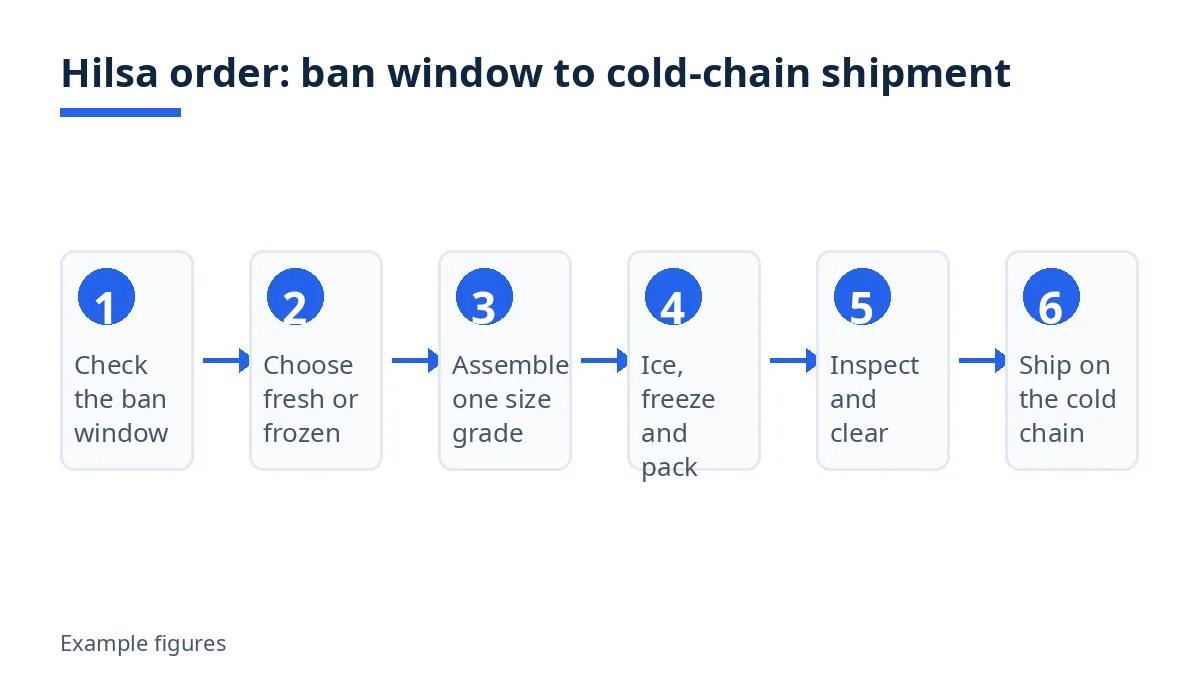
Check the ban window before you discuss a date. Ask whether fishing, transport, storage, marketing, purchase, sale, and exchange of hilsa are currently permitted, and whether the order window overlaps a ban. The government imposed a 22-day nationwide hilsa fishing ban from 8 to 29 October 2026 to protect mother hilsa during the peak spawning season, and during the ban those activities were prohibited nationwide.4 Ban dates change from year to year, so confirm the current notice rather than copying a past year's dates.
Choose fresh or frozen, and write it down. Fresh means chilled, iced, and usually flown, with a timeline measured in days from catch. Frozen means graded, frozen, packed, and held in cold storage, with a timeline measured from lot assembly to sailing. Do not let a quotation leave this choice vague, because it changes the packing, the transport mode, and the documents.
Fix one size grade and one presentation. State the weight range per fish, whether the fish is whole round or gutted, and whether the order allows mixed sizes. A mixed landing cannot be turned into a single-grade lot without sorting time.
Agree the ice and freezing plan. For fresh fish, agree the icing at landing, the chilled transport to the packing point, and the flight booking. For frozen fish, agree the freezing method, the glaze basis where glaze applies, and the storage temperature. Fish should be kept cool before freezing, at about 0 degrees Celsius, with ice or another chilling method.3
Book inspection and the destination gate early. Confirm which certificates the destination market requires and who issues them, before the fish is packed. For frozen fish, Bangladesh Customs notes that a quality control certificate by the Department of Fisheries is necessary where the destination country requires it.5
Confirm the sailing or flight, then the documents. Agree the vessel or flight, the port or airport, and the delivery term, and check that the invoice, packing list, and certificates name the same species, form, grade, and quantity.
Costs, timelines and documents
What are the typical costs and timelines?
There are no typical costs or timelines that hold for every hilsa order, and any guide that states one week count for all hilsa orders is overstating what the market allows. The timeline depends on the ban window, the fresh-or-frozen choice, the size grade, whether the lot comes from a new catch or from cold storage, the inspection queue, and the sailing or flight.
Example figures: the table below illustrates structure only, not typical timelines, prices, or transit times. The fresh case assumes a permitted catch and a booked flight; the frozen case assumes a lot from cold storage.
Fork | What sets the clock | What to ask for as separate lines |
|---|---|---|
Fresh, air | Catch day, icing, flight departure, destination clearance | Catch window, packing date, flight, arrival inspection |
Frozen, from cold storage | Lot availability, packing, inspection, sailing | Stock confirmation, packing date, inspection date, sailing |
Frozen, from new catch | Catch window, grade assembly, freezing, storage | Catch window, grade assembly time, freezing date, sailing |
For costs, the same split applies: a fresh order carries air freight, while a frozen order carries freezing, cold storage, and sea freight. Compare quotations only on the same form, grade, and delivery term. The Incoterms 2020 rules set out 11 rules with a clear allocation of cost, risk, and obligations.6
Which documents are needed?
For export clearance in Bangladesh, goods may not be loaded unless an export declaration, the Bill of Export or Shipping Bill, is submitted to Customs and approved.5 Enclosed documents include the export contract or purchase order where there is no export letter of credit, the commercial invoice, the packing list, the EXP form certified by an authorized dealer, and a certificate of origin issued by the EPB or a Chamber of Commerce and Industry.5 A health certificate from the competent authority is also part of the set where the destination requires it, as is a Department of Fisheries quality control certificate for frozen fish.5
Add the hilsa-specific lines to that set: species name (Tenualosa ilisha), form (fresh, chilled, or frozen), size grade, and origin statement. Check that the same four lines appear identically on the invoice, the packing list, and any health or quality certificate. A mismatch between the grade on the invoice and the grade in the boxes is a common cause of a held shipment.
Bangladesh-specific rules and tips
Treat the ban as a scheduling fact, not a rumour. A ban notice can change the earliest lawful catch date for the whole order, and what may be transported or stored during the ban period.4 Ask the supplier to name the current notice and its dates in writing, and what happens to the order if a new notice is issued after confirmation.
Ask where the fish comes from, and what "Bangladesh Ilish" means on your papers. The GI registration identifies hilsa as a fish of Bangladesh origin.2 That does not by itself prove that a particular lot was caught in Bangladesh waters, so ask for the catch or sourcing statement the supplier will stand behind.
Plan around the spawning season, not only the ban. The October ban protects mother hilsa during peak spawning.4 Even outside a ban, catch and size mix follow the migration, since hilsa lives mostly in the sea and migrates to inland freshwater for spawning.1 Ask which season produces the grade you want, rather than assuming every month yields the same mix.
Do not let a frozen lot hide a fresh problem. Freezing does not improve product quality; the final quality depends on the quality of the fish at the time of freezing as well as on freezing, cold storage, and distribution.3 Ask when the fish was caught, how it was chilled before freezing, and how long it has been in storage.
Confirm the destination gate before packing. The Department of Fisheries quality control certificate is the Bangladesh-side document where the destination requires it.5 Agree who applies and how long that step takes before the fish is packed. A certificate applied for after packing is a delay built into the order.
Mistakes and red flags
What are the most common mistakes?
Ordering fresh fish without checking the ban window. The order is confirmed, the buyer plans a promotion, and then the catch cannot lawfully move. Check the window first, in writing, every time.
Leaving fresh or frozen undecided in the quotation. A price quoted for "hilsa" without a form is not a comparable price. It hides different freight, different packing, and a different timeline.
Accepting a single grade from a mixed landing without sorting time. If the landing is mixed and the order needs one grade, sorting takes time. Build that time into the date, or accept a mixed grade in writing.
Comparing a fresh air price with a frozen sea price. The two differ in freight, shelf life, and risk. Compare fresh with fresh and frozen with frozen, on the same grade and the same delivery term.6
Treating a profile or a badge as a guarantee. Exportain verification is a document review by staff, not a factory inspection, and a badge is not a guarantee of production capacity, product quality, or delivery.7
Shipping before the certificate is ready. For frozen fish, the Department of Fisheries quality control certificate is necessary where the destination requires it.5 Packing before that step is complete risks a container that cannot sail on schedule.
Letting the fish wait warm. Fish begins to spoil immediately after death, and chilling retards that spoilage.3 Any stage where fresh fish waits without ice, or frozen fish waits above its storage temperature, shortens the life of the order.
Checklist
Before you confirm, every line should be answered in writing.
Ban window checked: current notice, dates, and effect on the order.
Form fixed: fresh, chilled, or frozen, same wording on every document.
Size grade and presentation fixed: weight range, whole round or gutted, mixed sizes allowed or not.
Source stated: catch or cold-storage origin, and the origin statement.
Ice and freezing plan agreed: icing for fresh fish, freezing and storage temperature for frozen fish.
Inspection and certificates agreed: who applies, what is needed, how long it takes.
Delivery term stated: one Incoterm and named place for every quotation.6
Sailing or flight confirmed: vessel or flight, port or airport, packing date.
Document set agreed: invoice, packing list, EXP form, certificate of origin, Bill of Export, plus health or quality certificates where required.5
Quality points agreed: species, form, grade, and temperature checks on arrival.
How Exportain helps
On Exportain, browse suppliers and post a request for quotation (RFQ) on the RFQ board with the form, size grade, ban-window check, and delivery term, so suppliers quote against the same specification. Ask each reply to state whether the lot comes from a new catch or from cold storage, and whether the quoted date survives a ban notice issued after confirmation.
Read the badges for what they record. Exportain Verified means Exportain has checked identity, phone, email, and business registration, and Export Verified means it has checked the Export Registration Certificate (ERC).7 Factory Verified means it has reviewed photos of the manufacturer factory, while Trading Company Verified means it has reviewed photos of the trading company office or warehouse.7 Verification is a document review by staff, free, and never granted by membership plans.7 It is not a factory inspection, so catch confirmation, grade checks, and temperature checks stay with you. See the hilsa fish quality control checklist for grade, ice, and temperature points.
FAQs
What should I know first about hilsa fish?
Hilsa is the national fish of Bangladesh, a migratory shad that lives mostly in the sea and migrates into freshwater to spawn.1 It received GI registration as a product of Bangladesh in 2017.2 The first decision in any order is fresh or frozen, because that choice sets the transport mode, packing, and timeline. The second is the size grade, and the third is the ban window.
What are the typical costs and timelines?
There are no typical figures for every hilsa order. The ban window, the fresh-or-frozen choice, the size grade, cold-storage availability, inspection, and the sailing or flight set the timeline, and air freight for fresh fish and freezing plus storage for frozen fish set the cost shape. Compare quotations only on the same form, grade, and delivery term.6
Which documents are needed?
The order documents are the enquiry with form and grade, the itemized quotation, and the purchase order. The export set is the Bill of Export, commercial invoice, packing list, EXP form certified by an authorized dealer, and certificate of origin issued by the EPB or a Chamber of Commerce and Industry,5 plus a health certificate and, for frozen fish where required, a Department of Fisheries quality control certificate.5
What are the most common mistakes?
The most common mistakes are ordering fresh fish without checking the ban window, leaving fresh or frozen undecided, accepting a single grade from a mixed landing without sorting time, comparing fresh air prices with frozen sea prices, and packing before the required certificate is ready.5 A badge is not a guarantee.7
Next steps on Exportain
Browse suppliers, then post your form, size grade, ban-window check, and delivery term on the RFQ board so suppliers state whether the lot comes from a new catch or from cold storage. Before you confirm, read how to import hilsa fish from Bangladesh and the Incoterms guide.
Sources
- Migration, Spawning Patterns and Conservation of Hilsa Shad (Tenualosa ilisha) in Bangladesh and India. IUCN (accessed )
- Hilsa gets GI registration officially. New Age, (accessed )
- Freezing and refrigerated storage in fisheries - Influence of temperature. Food and Agriculture Organization of the United Nations (accessed )
- Hilsa fishing, sales continue openly in Barishal despite ban. The Business Standard, (accessed )
- Customs Clearance Procedures for Export. Bangladesh Customs, National Board of Revenue (accessed )
- Incoterms® 2020. International Chamber of Commerce (ICC) (accessed )
- Trust & Safety Center. Exportain (accessed )
About the author
Sourcing from Bangladesh?
Post a request for quotation and suppliers on Exportain can send you their quotes directly.
Post an RFQ


