

Quality Control Checklist for Herbal Cosmetics From Bangladesh
A numbered QC checklist for herbal cosmetics from Bangladesh: botanical identity and purity, active stability, microbial limits, herbal claims and labelling, and packing, with fixes for common failures.
Short answer
Use this herbal cosmetics quality control checklist to check botanical identity and purity, natural active stability, microbial safety, herbal claims and labelling, and packing on herbal cosmetics from Bangladesh before shipment. Agree the sampling plan, tolerances, test methods and acceptance numbers in the purchase order.
On this page
Key takeaways
Check the botanical lot first: species, plant part and extraction method on the certificate must match the agreed formula, with a retained reference sample per lot.
Judge batch-to-batch colour and scent drift against an agreed range, not a single exact shade, and treat any batch outside that range as a failure.
Use the ISO 17516:2014 microbial limits as attributed standard figures, with the four specified organisms absent in 1 gram or 1 millilitre, and trace any failure to its botanical lot, water or filling line.
Never treat an ISO 16128 index as a labelling permission: herbal, natural and organic wording still needs destination-market claim evidence and correct INCI names.
Use this herbal cosmetics quality control checklist to check botanical identity and purity, natural active stability, microbial safety, herbal claims and labelling, and packing on herbal cosmetics from Bangladesh before shipment. Agree the sampling plan, tolerances, test methods and acceptance numbers in the purchase order.
Why this checklist matters
Herbal cosmetics fail in ways ordinary cosmetics checklists miss. The active material is a plant extract, so one batch can differ from the next in colour, scent and strength even on the same recipe. A substituted species, a different plant part or a weaker extract changes what the buyer is selling, and the difference may not show until the product separates or a claim is challenged.
Before you start
Do not begin until the references are complete: the approved sample per formula and shade, the purchase order and packing specification, the full formula with International Nomenclature of Cosmetic Ingredients (INCI) names, botanical certificates, and the labelling artwork for the destination market.
Agree the sampling plan in advance, draw the sample randomly across formulas, shades and cartons, and set acceptance numbers per defect class in the purchase order. Read the AQL acceptance quality limit explainer before fixing them, and see the herbal cosmetics HS code guide for classification.
Before bulk labels are printed, check the safety file for the destination market. Under Regulation (EC) No 1223/2009, an EU-market cosmetic needs a safety report before marketing and an EU-established responsible person who must ensure it meets the regulation's safety requirements.1
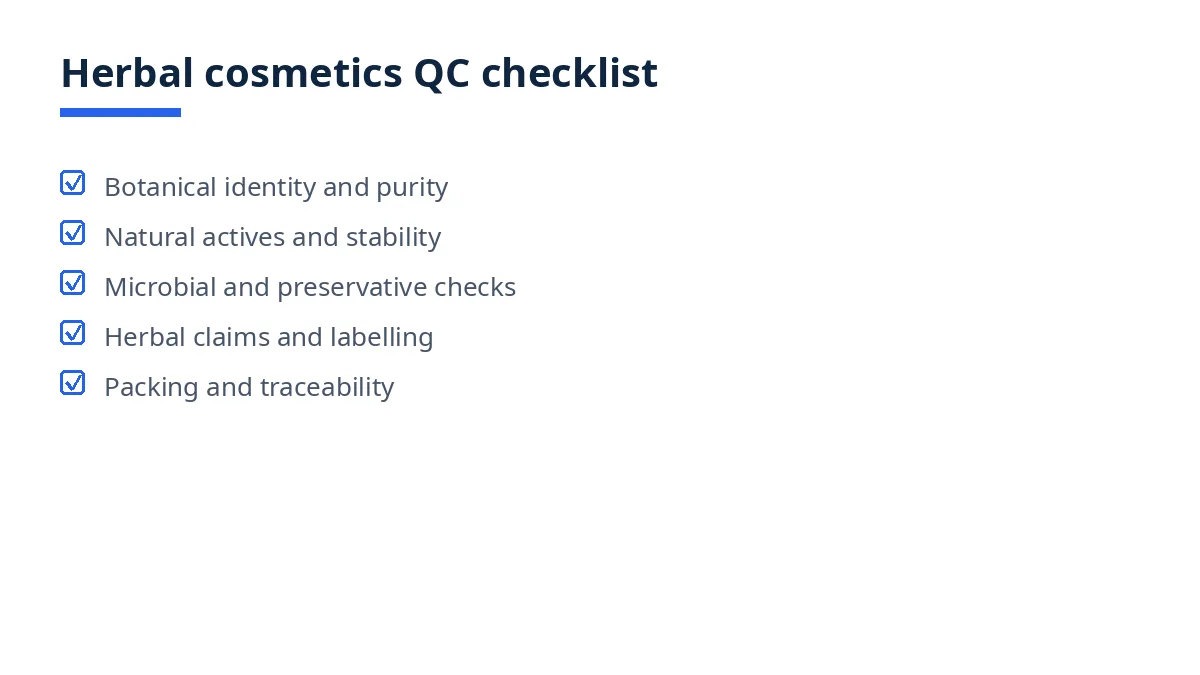
The full checklist (numbered, printable)
Botanical identity and purity
Check the Latin binomial, plant part and extraction method on each botanical certificate against the formula; record any substitution as a failure.
Check that the species matches the pharmacopoeia or authoritative document in the purchase order. World Health Organization guidance states the selected species or variety should match that in the national pharmacopoeia or other authoritative documents of the end-user country.2
Check identity and purity evidence per herbal lot: a supplier certificate naming species and plant part, purity reports including pesticide and heavy metal screening where required, and a retained sample.
Check high-value herbs for adulteration against the approved sample, and send any differing lot for laboratory testing before production.
Check harvest records where available, including collection season and drying conditions. The same WHO guidance notes active constituent levels vary with plant growth stage, so collection should take place in season.2
Natural actives and stability
Check the declared active content or marker range per extract against its certificate; confirm the range was agreed in the purchase order, not taken from a catalogue.
Check batch-to-batch variation against an approved range, not a single shade or scent; treat a batch outside that range as a failure.
Check stability evidence for the finished formula, including appearance, scent, colour and separation over the agreed storage period, for the actual formula.
Check factory storage against the formula needs: keep herbal products away from heat and light, and segregate any product that has separated, darkened or changed scent.
Check the durability or period-after-opening statement against stability evidence, confirm the batch date allows the full stated life, and explain normal variation where required.
Microbial and preservative checks
Check the preservative system against the product type, since water-based herbal products support microbial growth more readily than anhydrous oils, and confirm preservative efficacy evidence for the formula.
Check microbial reports for the finished batch, each naming formula, batch and laboratory. ISO 17516:2014 limits total aerobic mesophilic microorganisms to 100 CFU per gram or millilitre for products for children under three years, the eye area or mucous membranes, and 1000 CFU per gram or millilitre for other products.3
Check that Escherichia coli, Pseudomonas aeruginosa, Staphylococcus aureus and Candida albicans are absent in 1 gram or 1 millilitre under ISO 17516:2014; treat any detection as a failure.3
Check microbial screening for botanical ingredients, which carry field and drying contamination into the factory, and confirm production water is tested, since water is the most common route for microbial load.
Check filling hygiene and traceability: open containers, reused scoops and uncleaned nozzles are contamination points, and the batch record must link the finished batch to its botanical lots, preservative lot and filling date.
Appearance, scent and texture
Check each sampled unit by eye and hand against the approved sample: colour, clarity, scent, texture, spread and absorption, and any grit, sediment or undissolved particles.
Check for separation, creaming, oil bleed or sediment in creams, lotions and oils, including units stored upside down and from the start and end of filling.
Check scent drift across batches, since herbal scent fades with the extract lot, and record any batch markedly weaker, sharper or different from the approved sample.
Check containers, pumps, droppers and caps for fit, leakage and function with the actual product, since herbal oils find weak seals water testing misses, and check fill levels against the nominal content.
Herbal claims and labelling
Check every herbal claim against its evidence: "herbal", "natural" and "organic" mean different things in different markets, and a claim permitted in one market may not be permitted in another.
Check natural and organic wording against ISO 16128 definitions before approving artwork. ISO 16128-1 defines natural ingredients as obtained only from plants, animals, microorganisms or minerals, by physical processes, natural fermentation and traditional preparation without intentional chemical modification, and notes that "herb" can mean "plant".4
Check that an ISO 16128 index is not treated as a labelling permission on its own. ISO 16128 does not address claims and labelling, human safety, environmental safety or cosmetic regulation, so destination-market claim rules still govern.4
Check the ingredient list against the formula using INCI names in the destination market's required order, with every botanical ingredient under its correct INCI name.
Check the full EU labelling set for EU-bound products: responsible person name and address, nominal content, durability date or period after opening, precautions, batch number, function and ingredient list, in indelible, legible lettering.1
Check substantiation for every efficacy claim, such as soothing, brightening or anti-ageing wording. Under the EU framework, cosmetic claims must meet criteria including truthfulness, evidential support, honesty and fairness, and an unjustified claim risks sanctions or withdrawal.5
Check ayurvedic, traditional-use and medical-effect wording separately: traditional-use claims need their own evidence and permission, a product must not be called ayurvedic on a herbal ingredient alone, and no claim may promise a medical effect unless the destination market permits it and evidence supports it.
Packing and traceability
Check that the batch number on each unit matches the batch record and carton, and that the code traces to the botanical lots and filling line.
Check carton contents, ratios, markings, barcodes and warnings against the packing specification, confirm shade, formula and pack size are not mixed within a carton unless allowed, and weigh sample cartons.
Check that packaging protects the formula: light-protective containers where required, seals intact, and no material that reacts with herbal oils or extracts.
Check that retained samples, one per finished batch, are stored with their batch record, so later complaints can be checked against the shipped batch.
Common failures and how to fix them
The most frequent failure is batch-to-batch drift in colour or scent, usually because a new botanical lot entered production without comparison against the approved range. Stop, compare the new lot against the retained reference sample and the agreed range, and only then release the batch. Next is separation or sediment, which traces to extract quality, mixing order or storage temperature: re-check a retained unit before more units are packed.
Microbial failure in a water-based herbal product usually traces to the botanical ingredient, the water supply or filling hygiene rather than the preservative alone. Segregate the batch, test the botanical lots and water records separately, and do not rework a failed batch without a documented decision and retest. Unsupported "natural" or "organic" wording cannot be fixed by sorting: correct the artwork before shipment.
Above the agreed acceptance level, options are re-inspection, documented partial acceptance, or rejection.
Downloadable template / summary table
Copy the checklist into your inspection sheet, add the formula, botanical lots and agreed ranges, and record results per batch.
Section | Checks | Evidence |
|---|---|---|
Botanical identity | Species, part, extraction, purity | Certificates, retained sample |
Actives and stability | Marker range, drift, storage | Stability evidence, batch range |
Microbial | Total count, specified organisms, water | Lab reports per batch |
Appearance | Colour, scent, texture, separation | Sample comparison, fill records |
Claims and labelling | Natural wording, INCI, durability | Artwork check, claim evidence |
Packing | Traceability, cartons, seals | Packing list, batch record |
How Exportain helps
Exportain is a B2B marketplace connecting buyers with Bangladeshi suppliers of cosmetics and herbal products, so the specifications behind this checklist can be agreed at the enquiry stage. Agree the formula, botanical lots and labelling artwork in writing, and plan the check with inspection services when the order is placed. Supplier profiles show which document and photo checks have been recorded, not factory inspections. Exportain is not a party to the goods contract and does not inspect goods.
Good manufacturing practice is the factory system behind most of these checks. ISO 22716:2007 gives guidelines for the production, control, storage and shipment of cosmetic products, covering personnel, premises, equipment, raw materials and finished products.6
FAQs
When should this checklist be used?
Use it at final inspection, when goods are finished, filled and largely packed. For larger and first orders, also use it during production, while a botanical lot can still be replaced.
Who should complete it?
The buyer, a local agent or an independent inspector can complete it, using the approved sample, the formula, the botanical certificates and a random sample.
What are the most common failures?
Batch-to-batch colour and scent drift, separation or sediment, microbial failure in water-based formulas, and unsupported "natural" or "organic" wording are the most common.
Can a third party do it?
Yes, if you share the approved sample, the formula, the botanical certificates, the agreed ranges and the acceptance levels first. Agree in writing what the inspector checks and what happens to a failed lot.
Next steps on Exportain
Before production starts, agree your formula, botanical lots, marker ranges, test methods and label wording, then read the AQL acceptance quality limit explainer and the pre-shipment inspection guide, and plan the check with inspection services. You can also post a free RFQ via RFQs and compare quotes.
Sources
- Regulation (EC) No 1223/2009 on cosmetic products: summary. European Commission, EUR-Lex (accessed )
- WHO guidelines on good agricultural and collection practices (GACP) for medicinal plants. World Health Organization (accessed )
- Importance of Microbiological Quality to Cosmetics. SGS (accessed )
- ISO 16128-1:2017 - Guidelines on technical definitions and criteria for natural and organic cosmetic ingredients and products. International Organization for Standardization (accessed )
- EU Cosmetic Regulation 1223/2009: Complete Compliance Guide. Global Cosmetic Regulations (accessed )
- ISO 22716:2007 - Cosmetics - Good Manufacturing Practices. International Organization for Standardization (accessed )
About the author
Sourcing from Bangladesh?
Post a request for quotation and suppliers on Exportain can send you their quotes directly.
Post an RFQ


