Quality Control Checklist for Handmade Candles From Bangladesh
A numbered QC checklist for handmade candles from Bangladesh: wax and scent, wick centering and trim, burn test and melt pool, hot scent throw, container heat tolerance, safety labels, and packing that protects glass containers, with fixes for common failures.
Short answer
Use this handmade candles quality control checklist to check wax type and scent, wick centering, trim, and priming, burn behavior and melt pool, soot and container heat tolerance, hot scent throw, safety labels, and glass-safe packing on handmade candles from Bangladesh before shipment. Agree tolerances, burn-test cycles, and acceptance numbers in the purchase order.
On this page
Key takeaways
Judge the candle by the burn, not only by appearance: check melt pool, flame, soot, wick drift, and container heat tolerance on burned samples against the approved sample.
Agree the wax, scent, container, burn-test cycles, label artwork, and acceptance numbers per defect class in the purchase order before production starts.
Draw the sample at random across wax batches, scents, colors, and cartons, and record actual measurements, burn times, and scent observations rather than pass marks alone.
Treat safety labels as a checklist item of their own: wax type, warnings in the destination language, and batch codes must match the approved artwork before packing.
Pack glass containers with dividers and cushioning so no container touches another, and check carton count, assortment, and weight against the packing list.
A handmade candle is judged after it is lit, not on the shelf: a candle that looks right unburned can still tunnel, smoke, lose its scent, or crack its container once burning. This checklist covers the unburned candle, the burn test, scent throw, labels, and glass-safe packing, so a buyer can judge a shipment from Bangladesh against an approved sample and the purchase order.
Why this checklist matters
Candles carry a different risk profile from most handmade goods: fuel, flame, and container in one item, and a fault in any of the three changes how it burns. A wick set off center drifts toward the container wall as the wax melts. A wick sized wrong for the wax and container either starves and tunnels or burns high and soots. A container that cannot take full-burn heat can crack late in the burn.
Scent adds a second layer of variation: wax type, fragrance load, and curing time all change how a candle smells cold and hot. A written checklist ties these judgments to the approved sample rather than to memory, and gives the inspector a record the buyer can act on per candle checked.
Before you start
Do not begin until the reference set is complete: an approved sample for each wax, scent, and container combination, the purchase order and packing specification, the label artwork for each destination market, and a burn-test plan naming the observations to record. Agree the sampling plan in advance, and draw the sample at random across wax batches, scents, colors, and cartons, rather than accepting pieces the maker selects. ISO 2859-1 specifies an acceptance sampling system for inspection by attributes, indexed in terms of the acceptance quality limit (AQL), applicable to end items.1
Set acceptance numbers per defect class in the purchase order, and name the burn-test method there too: which candles are burned, cycle lengths, and what counts as a failure. ASTM F2417 prescribes minimum safety requirements for candles and candle ensembles.2 For the European market, indoor candles are expected to meet fire-safety requirements described in EN 15493,3 and to release only a limited amount of soot, tested under EN 15426.4
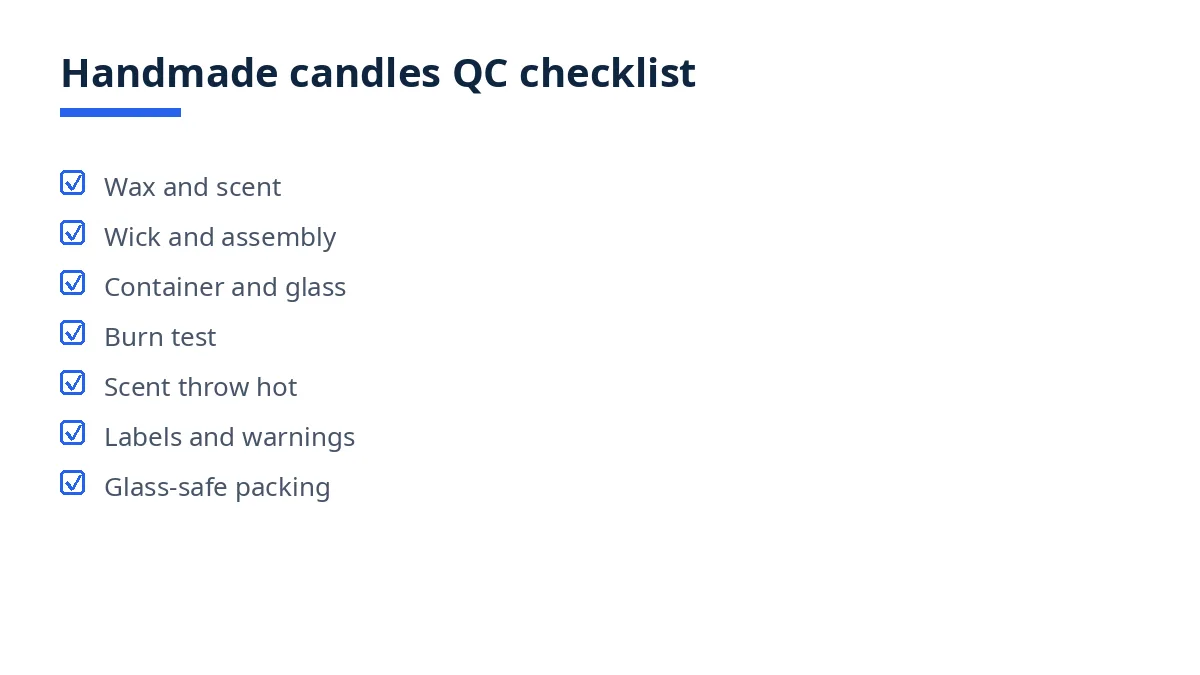
The full checklist (numbered, printable)
Wax, color, and scent unburned
Check the wax type named in the purchase order against the sample, by wax batch, recording any substitution in bulk as a failure.
Check the surface of each sampled candle for cracks, sinkholes, wet spots, and foreign matter, against the approved sample.
Check color within each candle, between candles of one scent, and across batches, under the same light, against the sample.
Check cold scent throw at the distance the pack specifies, against the approved sample of the same scent and cure age.
Check embedded decoration, dried flowers, and glitter for placement: nothing combustible sits close to the wick or in the path of the melt pool.
Wick and assembly
Check wick centering on every sampled candle, from above and from the side, against the tolerance in the pack.
Check that the wick stands upright, not leaning, bent, or buried, and that the wick tab sits flat and secure at the base.
Check the wick trim length against the length named in the pack, and check that the trim is even across the sample.
Check wick count and placement on multi-wick candles: each wick matches the sample position, and spacing is even.
Check that the wick is primed and coated as the sample shows, with no fraying, splitting, or loose fibers at the tip.
Container, lid, and fit
Check every sampled container for chips, cracks, bubbles in the glass, and rough rims, and reject any container with damage near the rim or base.
Check container size, shape, and color against the sample, and check that the fill level is even.
Check lid fit where a lid is specified: it seats fully, closes without forcing, and matches the container and scent in the pack.
Check for wax on the outside of the container, on the rim, and under the base, and check that any base label is centered and legible.
Check the candle weight, net weight on the label, and count per set against the purchase order, recording actual weights rather than pass marks alone.
Burn test
Burn the agreed sample candles in a draft-free location, on a heat-resistant surface, following the burn cycles named in the test plan.
Record the time to a full melt pool, edge to edge, for each burned candle, against the approved sample burn record.
Check flame behavior through the burn: steady flame, no persistent flickering or smoking, and no secondary ignition of decoration, wax, or debris on the melt pool.
Check soot during and after the burn, on the container wall and nearby surfaces, compared with the approved sample. EN 15426 specifies the sooting behavior test method for indoor candles.4
Check wick behavior through the burn: the wick stays centered, does not drift to the container wall, does not mushroom beyond the sample, and does not drown.
Check the container through the full burn and after cooling: no cracking, no scorch marks outside, and no heat damage beneath.
Check the end of the burn: the candle extinguishes cleanly, does not relight on its own, and leaves the residue the sample shows.
Hot scent throw
Check hot scent throw at the distance and room size the pack specifies, after the melt pool is full, against the approved sample of the same scent, in both strength and character: a candle that smells strong but wrong has failed.
Check scent consistency across burned candles of one scent and batch, recording any candle that smells weak, sharp, or different from its batch mates.
Labels and safety warnings
Check that every label states the wax type, scent name, net weight, and maker or importer details the destination market requires.
Check safety warnings against the destination standard. In Europe, EN 15494 requires the general warning sign and warnings that burning candles must not be left unattended, must be kept out of reach of children and pets, and must be placed on a non-combustible surface away from combustible materials.3
Check that warning text is in the language of the destination market, legible at the printed size, and visible before first use.
Check batch or lot codes on the candle, label, or carton, so a failed batch can be traced back to its pour.
Packing that protects glass containers
Check that each glass container is separated from its neighbors by a divider, sleeve, or molded insert, with no glass-on-glass contact.
Check cushioning at the base, sides, and top of each carton, and check that fitted lids cannot work loose.
Check carton strength and closure: cartons close fully, tape holds, and no candle can shift far enough to strike another.
Check carton contents, count, assortment, markings, and gross weight against the packing list, weighing and measuring sample cartons.
Common failures and how to fix them
Tunneling is the most frequent burn failure: the melt pool never reaches the edge, leaving a ring of unburned wax. It usually traces to a wick too small for the container, or to first burns cut short. Burn a sample through the agreed cycle, compare wick size and melt-pool record with the approved sample, and only then approve the wick for bulk pouring.
Heavy soot and mushrooming point the other way, to a wick too large for the wax and container, or to a wick left untrimmed. Re-trim to the length named in the pack, burn a fresh sample, and check soot against the sample before accepting the batch. A wick that drifts off center usually means the tab was not set flat: reset the tab and check centering on a sample pour.
Weak hot scent throw often traces to fragrance load, wax choice, or a cure cut short; compare cure age and fragrance batch with the approved sample, and do not accept a scent fix the maker cannot repeat. Cracked containers point to the container specification or to late-burn heat buildup: burn a sample to the end of its useful life, and change the container before more candles are poured.
Above the agreed acceptance level, options are re-inspection after rework, documented partial acceptance, or rejection.
Downloadable template / summary table
Copy this checklist into your inspection sheet, add the tolerances, and record a result per candle.
Section | Checks | Evidence |
|---|---|---|
Wax, color, scent unburned | Wax type, surface, color, cold throw | Sample comparison |
Wick and assembly | Centering, trim, tab, stability | Measurements, photos |
Container and fit | Glass damage, fill, lid, weight | Visual check |
Burn test | Melt pool, flame, soot, container | Burn record |
Hot scent throw | Strength, character, consistency | Sample comparison |
Labels and warnings | Wax, warnings, language, batch code | Artwork proof |
Packing | Dividers, cushioning, carton count | Packing list |
How Exportain helps
Exportain is a B2B marketplace connecting buyers with Bangladeshi suppliers of handmade candles, so the specifications behind this checklist can be agreed at the enquiry stage. Browse suppliers, and use inspection services when you plan the check. Supplier profiles show which document and photo checks have been recorded, not factory inspections. Exportain is not a party to the goods contract and does not inspect goods.
FAQs
When should this checklist be used?
Use it at final inspection, when goods are finished and largely packed. For larger and first orders, also use it during production, while wick size and fragrance can still be corrected.
Who should complete it?
The buyer, a local agent, or an independent inspector can complete it, using the approved sample, the purchase order, and a randomly drawn sample.
What are the most common failures?
Tunneling, heavy soot and mushrooming, off-center wicks, weak or changed hot scent throw, cracked containers, and missing or wrong safety warnings are the failures buyers find most often.
Can a third party do it?
Yes, if you share the approved references, the burn-test plan, tolerances, and acceptance levels first, and if the inspector records burn observations rather than only the visual check.
Next steps on Exportain
Before production starts, agree your wax, wick, container, burn-test plan, and label wording, then read the AQL acceptance quality limit explainer and the pre-shipment inspection guide, and plan the check with inspection services. You can also post an RFQ via RFQs and compare quotes from Bangladeshi suppliers.
Sources
- ISO 2859-1:1999 - Sampling procedures for inspection by attributes — Part 1: Sampling schemes indexed by acceptance quality limit (AQL) for lot-by-lot inspection. International Organization for Standardization (accessed )
- ASTM F2417 - Standard Specification for Fire Safety for Candles. ASTM International (accessed )
- Requirements on indoor candles. Finnish Safety and Chemicals Agency (Tukes) (accessed )
- EN 15426:2018 - Candles - Specification for sooting behaviour. European Committee for Standardization (accessed )
About the author
Sourcing from Bangladesh?
Post a request for quotation and suppliers on Exportain can send you their quotes directly.
Post an RFQ