

Typical MOQ for Generators in Bangladesh (and How to Negotiate It Down)
No single typical generator MOQ in Bangladesh: what sets the minimum per model, variant, and rating class, how it is counted, and how to negotiate it down without losing test scope or documents.
Short answer
There is no single typical MOQ for generators in Bangladesh. Each supplier sets its minimum per model, variant, and rating class, driven by engine and alternator pairing, enclosure and control batches, and test scope. Ask for the minimum line by line, confirm how it is counted in the written quote, then negotiate the structure: fewer variants, standard specifications, stocked pairings, phased delivery, and set-up paid separately.
On this page
Key takeaways
There is no single typical MOQ for generators in Bangladesh: each supplier sets its minimum per model, variant, and rating class for your specification.
Rating class, variant count, and test scope are the drivers that set the floor, and the binding line is usually per variant, not per order.
Ask for the MOQ line by line, with the quantity split per variant and the counting unit confirmed in the supplier's written quote.
Negotiate the structure first: fewer variants, standard enclosure and control, stocked pairings, set-up paid separately, and phased delivery terms in writing.
Never trade the per-serial test record or the specification sheet for a lower minimum, and never treat a listing as a contract.
There is no single typical MOQ for generators in Bangladesh that a buyer can safely assume. Each supplier sets its minimum per model, per variant, and per rating class for your specification, and the figure that matters is the one in that supplier's written quote. A generating set here means an engine driving an alternator, with its controlgear, switchgear, and auxiliary equipment, and ISO 8528-1:2018 defines classifications for the application, rating, and performance of such sets, intended to help understanding between manufacturer and customer.1 This guide explains why generator minimums exist, what moves them, and how to negotiate them down without giving up the tests and documents that protect the order.
Why this matters for buyers and sellers
For a buyer, the MOQ is a commitment problem as much as a quantity problem. A site may need two sets, while the supplier's smallest workable batch for that exact model and enclosure may be larger. Ordering the larger batch without a plan for the extra sets ties up capital in machines that were never needed. Pushing the quantity down without changing anything else moves the cost elsewhere: a higher unit price, a separate set-up charge, a longer wait, or a thinner test scope.
For a seller, the MOQ protects the batch: the engine and alternator are paired for a rating, the enclosure and control panel are built to that pairing, and the finished set is tested as a unit.
Rating class is the first reason two quotes for the "same" generator can carry different minimums and prices. ISO 8528-1 defines four rating classes: emergency standby power (ESP), prime power (PRP), limited-time running power (LTP), and continuous operating power (COP), each with its own load profile, annual hours, average load factor, and overload capability.2 A set rated for standby duty is not the same commercial offer as the same frame rated for unlimited prime duty. Compare quotes only inside one rating class.
The second reason is variant count. Each change that creates a separate production run can carry its own minimum: a different rating, enclosure type, control scope, voltage or frequency setting, or finish. The third reason is test scope. A load test record per serial number, a transient check for a large motor start, or a witnessed test each consume test-bay time, and test scope should never be traded away to reach a lower quantity.
Step-by-step: how it works
Work through the minimum in this order, keeping one specification sheet per model. A sheet that mixes two ratings, two enclosures, and two control options produces one blended answer that hides three separate minimums.
Define the duty first: standby, prime, limited-time, or continuous duty, with expected running hours and the largest single load step, such as a motor start.
Freeze one model specification: rating class in kW and kVA, engine and alternator models, enclosure type, control scope, destination voltage and frequency, and test scope.
Split the order by variant, listing each model, rating, enclosure, and control combination as its own line, and ask the supplier to confirm the split before quoting.
Ask for the MOQ line by line, per order, per model, per variant, and per rating, and ask which line binds. A minimum is counted per order, per style or product, or per colour or variant as the supplier states, and a supplier can combine a quantity minimum with a minimum order value.3
Ask what drives each minimum: usually the engine and alternator pairing batch, the enclosure and control build batch, the test-bay allocation, or the packing unit.
Negotiate the structure, not just the number, changing the specification, the variant count, or the commercial structure, and record what minimum each change produces.
Lock the result in the written quote, stating quantity per variant, rating class, test scope, spares, price basis, delivery schedule, and validity. If a figure is not in the written quote, treat it as unconfirmed.
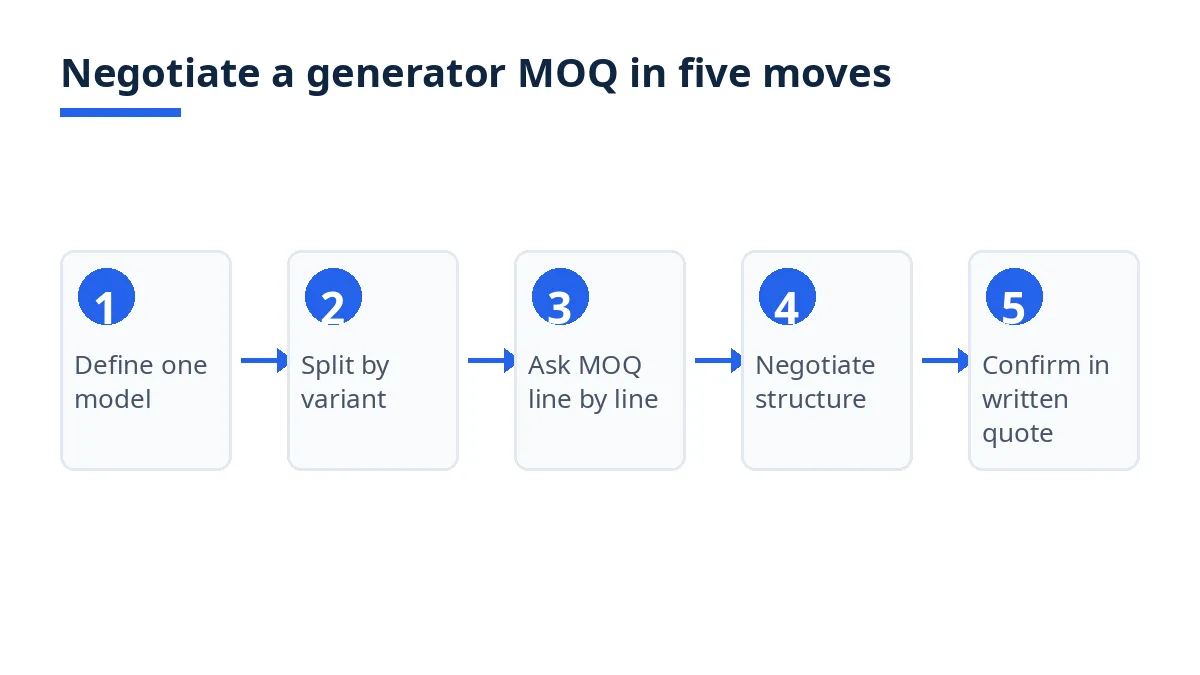
The diagram below summarizes the five moves in this sequence, from defining one model to confirming the result in writing.
Worked counting example
Example figures only, not a market figure and not a promise from any supplier. Suppose a buyer wants two generator models, each in two enclosure types. That is four variants. If the supplier's example minimum is two sets per variant, the smallest order is eight sets, even though the buyer originally asked for four. Drop one enclosure type and the variant count falls to two, so the same example minimum produces a smallest order of four sets. The negotiation changed the variant count, not the supplier's batch logic, and that is why step 3 comes before any discussion of price.
Order structure | Variants | Example minimum per variant | Smallest order |
|---|---|---|---|
Two models, two enclosures each | 4 | 2 sets | 8 sets |
Two models, one enclosure each | 2 | 2 sets | 4 sets |
One model, one enclosure, phased delivery | 1 | 2 sets | 2 sets |
All figures above are example figures. Confirm the real minimum per variant in the supplier's written quote.
Costs, timelines and documents
Costs
There is no typical generator price or typical MOQ surcharge to quote here, because both depend on the rating, pairing, enclosure, control scope, and test scope in the written quote. Ask for the cost structure line by line: set price per rating class with engine and alternator models named; enclosure and control scope, priced separately where possible; test scope, including a load test record per serial number and any witnessed test; spares for the first service interval; packing for your route; and freight, insurance, and inspection on the agreed price basis, each as its own line.
When a supplier offers a smaller quantity at a higher unit price, compare the total order cost, not only the unit price. Example figures: a set-up or test charge spread over two sets has five times the per-set effect of the same charge spread over ten sets. That is why paying a set-up charge separately can beat forcing a batch the supplier cannot run, and why a low unit price tied to a large batch is not a saving if the extra sets are never used.
Timelines
Timelines follow the same batch logic. A stocked pairing with a standard enclosure and test scope can move faster than a built-to-order pairing with a custom enclosure, control program, and witnessed test slot. Ask for the timeline in stages: specification confirmation, production batch, test allocation, inspection booking, packing, and shipment, and ask which stage is longest. Phased delivery helps cash flow, but it does not always reduce the production minimum, because the sets may still be built and tested in one batch and stored until each delivery date. Confirm in writing whether phased delivery means phased production or phased shipment.
Documents
Ask for the document list with the quote, and confirm who issues each document and when: the specification sheet per model; the written quotation, stating quantity per variant, price basis, validity, delivery schedule, and payment terms; the test record per serial number; the manuals for the exact combination supplied; the packing list, commercial invoice, and certificate of origin, where applicable; and the supplier's business and export registration copies, so the company name matches across the quotation, invoice, and shipping documents.
Bangladesh-specific rules and tips
Bangladesh is a sourcing location, not a single factory floor, so the same care that applies to any generator order applies here with three local checks added. First, classify the set correctly. Electric generating sets fall under HS heading 8502, and the United Nations classification lists subheading 850212 for generating sets with compression-ignition engines of an output exceeding 75 kVA but not exceeding 375 kVA.4 Confirm the exact subheading for your set's engine type and output with the supplier and, where needed, a customs adviser, because the subheading follows the machine, not the catalogue headline.
Second, state the destination supply, not the Bangladesh supply. Mains voltage in Bangladesh is 230 volts at 50 Hz.5 That figure describes the local mains, not your site. A set built for a different destination voltage, frequency, or phase arrangement is a different variant and can carry its own minimum, even when the engine is the same. Write the destination voltage, frequency, and phase into the specification sheet.
Third, check the company's export standing in the same pass as the MOQ. Exportain's verification badges record document and photo reviews: Export Verified means Exportain has checked the seller's Export Registration Certificate, and the badge is not a guarantee of production capacity, product quality, or delivery.6 Read the badge meaning on the profile, then run your own model, test, and spares checks before committing. The badge speaks to documents reviewed, while the MOQ speaks to batch economics for your specification. When comparing two Bangladeshi suppliers, compare them on the same rating class, enclosure, control scope, and test scope, or the lower MOQ may simply be the thinner scope.
Mistakes and red flags
The most common mistakes in generator MOQ negotiation are specification mistakes wearing a quantity disguise:
Comparing an ESP figure with a PRP figure. The standby number will look larger for the same machine, and the comparison will mislead both the quantity and the price decision.
Agreeing a number without its counting unit. A minimum of "four sets" means little until it is four per order, per model, or per variant.
Trading test scope for a lower minimum. Dropping the per-serial test record or the witnessed test to reach a quantity saves nothing if the site later finds a set that was never proven under load.
Customizing every variant, so a custom enclosure colour, control program, and finish each create a batch on the same order.
Asking for the lowest minimum and the lowest tier price together. The lowest tier price assumes the tier quantity, and a small order at a large-order price asks the supplier to absorb the batch cost twice.
Promising future volume that cannot be forecast. An honest trial-order explanation with a realistic forecast is stronger than a large forecast that never arrives.
Treating a listing as a contract. What binds both sides is the quotation you accept, with the quantity per variant, rating class, and test scope written in.
Pause on red flags rather than signing faster. A supplier that cannot name the engine and alternator models, cannot state the rating class, or refuses to put the test scope in writing is offering an undefined machine, not flexibility.
Checklist
Use this checklist before accepting any generator MOQ, and keep the completed copy with the quotation:
Duty and rating class stated: ESP, PRP, LTP, or COP, with expected running hours and largest load step.
One specification sheet per model, with engine and alternator models, enclosure, control scope, and destination voltage and frequency.
Order split by variant, with a quantity for each model, rating, enclosure, and control combination.
MOQ stated per order, per model, and per variant, with the binding line identified.
Driver named for each minimum: pairing batch, enclosure batch, control batch, test allocation, or packing unit.
Negotiation levers tested: fewer variants, standard enclosure and control, stocked pairing, set-up paid separately, spares bundled into the first order, and phased delivery clarified as phased production or phased shipment.
Test scope in writing: load test record per serial number, load steps, and any witnessed test agreed.
Total order cost compared, not only the unit price, including set-up, test, spares, packing, freight, and inspection lines.
Documents listed: specification sheets, quotation, test records, manuals, packing list, invoice, and matching company registration copies.
Repeat terms recorded: whether the same minimum, price basis, and test scope apply to a repeat order of the same specification.
How Exportain helps
Exportain is a marketplace that connects buyers with Bangladeshi suppliers, and its verification system is a document and photo review, not a factory inspection or a guarantee.6 Use the profile and badge information to shortlist, then run the specification, variant, and test checks in this guide yourself. Browse Bangladeshi suppliers, read how supplier verification works on Exportain, and read MOQ meaning to check how a minimum is counted.
FAQs
What should I know first about generators?
Know the duty, the rating class, and the variant split before asking about quantity. A generating set is an engine driving an alternator with its controlgear and associated equipment, and ISO 8528-1 defines the rating classifications that let buyer and supplier use the same language.1 State the duty, list each model and enclosure as its own variant, and ask for the minimum per variant in writing.
What are the typical costs and timelines?
There is no typical cost or timeline figure that applies across generator ratings, pairings, enclosures, and test scopes, so treat any single figure offered without a specification as unconfirmed. Costs break into set price per rating class, enclosure and control scope, test scope, spares, packing, freight and insurance on the agreed price basis, and inspection, each confirmed in the written quote. Timelines break into specification confirmation, production batch, test allocation, inspection booking, packing, and shipment, and the longest stage is usually the custom batch or the test slot. Compare total order cost rather than unit price alone.
Which documents are needed?
The documents needed are the specification sheet per model, the written quotation stating quantity per variant and test scope, the test record per serial number, the manuals for the exact combination supplied, and the packing list, commercial invoice, and certificate of origin where applicable. Add the supplier's business and export registration copies, so the company name matches across the quotation, invoice, and shipping documents. Confirm who issues each document and when, before the order is placed.
What are the most common mistakes?
The most common mistakes are comparing different rating classes, agreeing a number without its counting unit, trading test scope for a lower minimum, customizing every variant so each carries its own batch, and treating a listing as a contract. A minimum counted per order, per model, or per variant produces a different smallest order from the same headline number, so the counting unit must be confirmed in writing.3 Keep the specification fixed, the variant count low, the test scope intact, and the agreed terms in the written quote.
Next steps on Exportain
Start with one specification sheet per model, the quantity per variant, and the test scope you require. Post a free RFQ with those details, so suppliers can answer with a minimum per variant rather than a single blended figure. Browse Bangladeshi suppliers to shortlist, read MOQ meaning to check the counting unit, and compare every reply on the same rating class, enclosure, control scope, and test scope before accepting a minimum.
Sources
- ISO 8528-1:2018 — Reciprocating internal combustion engine driven alternating current generating sets — Part 1: Application, ratings and performance. International Organization for Standardization (ISO) (accessed )
- Prime Power vs Standby vs Continuous: Generator Ratings. BLSH Diesel (accessed )
- MOQ Meaning (Minimum Order Quantity). Exportain (accessed )
- Classification Detail - HS Code 850212. United Nations Statistics Division (accessed )
- Bangladesh — Power plug, socket and mains voltage in Bangladesh. WorldStandards, (accessed )
- How Supplier Verification Works on Exportain. Exportain, (accessed )
About the author
Sourcing from Bangladesh?
Post a request for quotation and suppliers on Exportain can send you their quotes directly.
Post an RFQ


