

Top Formal Suits Manufacturers in Bangladesh: How to Find and Verify Them
Formal suits in Bangladesh are made by woven suit groups, canvassed specialists, volume fused-suit factories, cloth-led mills and trading companies. This guide matches each type to your order, explains what drives suit price and MOQ, and sets out the checks to run before you pay.
Short answer
Formal suits manufacturers in Bangladesh fall into seven types: integrated woven suit groups, half- and fully canvassed specialists, fused volume factories, suiting cloth mills, pattern- and fitting-led makers, private-label OEM and ODM suppliers, and exporters and trading companies. Match the type to your construction, cloth and size-curve needs, then check membership, samples, dry-cleaning performance and inspection terms before paying.
On this page
Key takeaways
Formal suits are woven garments, so the supplier pool is the woven sector: woven apparel exports reached US$5.752 billion in July to October 2025, and BGMEA reports around 2,500 active member factories.
Jacket construction is the first specification to settle: a canvassed chest and lapel drape and settle with wear, while a fully fused front is glued, stiffer and can bubble after dry cleaning.
Fit is decided by pattern-making and grading across the full size curve, not by a sample in one size: measure every size against your chart before bulk approval.
Price and MOQ are set per style: suiting cloth is the largest cost element, canvassed construction adds handwork, and each style and colour carries its own MOQ.
Verification is a sequence the buyer runs: association membership, a sample in production cloth tested through dry cleaning, a named producing factory, and an agreed AQL inspection before payment.
A suit is bought as one garment and judged as one garment, yet it is made as two. The jacket and the trouser travel through cutting, sewing, and pressing as separate pieces, and they only become a suit when they agree: same cloth lot, same dye shade, same hand, same standard of finish. A buyer who treats the jacket as the product and the trouser as an accessory will keep finding pairs that look close on the rail and wrong on the customer. Sorting makers by what they do to the jacket, and by how they keep the two pieces together, is a faster route to a usable shortlist than sorting by quoted price.
Three decisions set the result before any price discussion makes sense. The first is the suiting cloth: fiber, weight, and weave decide drape, season, and wrinkle recovery, and no later stage can rescue a cloth that is wrong for the end use. The second is how the jacket front is built: a floating canvas chest behaves differently over years of wear than a heat-bonded front, and the difference shows up after cleaning, not at the first inspection. The third is fit across the whole size range, which is a pattern problem before it is a sewing problem. A maker that is strong on one of these and weak on another can still be the right partner, but only for an order that leans on its strength.
Bangladesh enters this picture as a woven-apparel base. Woven apparel exports reached US$5.752 billion in July to October 2025, according to provisional Export Promotion Bureau data reported by Fibre2Fashion.1 The Bangladesh Garment Manufacturers and Exporters Association (BGMEA) reports around 2,500 active member factories.2 Suit capacity is a narrower slice of that base: woven plants with jacket lines, pattern teams, and pressing departments of their own. The four maker types below describe that slice in the terms a suit buyer actually buys on.
The list: formal suits manufacturers in Bangladesh by type
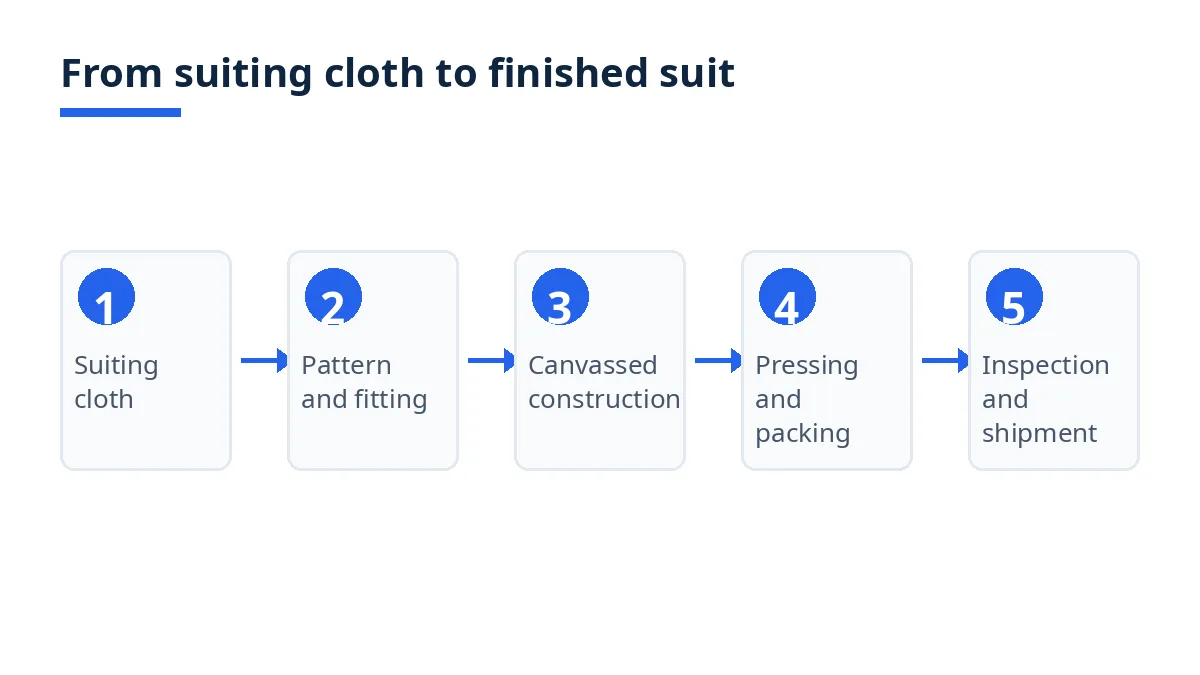
Suit work runs from cloth choice through pattern and fitting, jacket building, pressing, and a last check of the matched pair. Each type below earns its place by handling a different part of that run better than the others.
1. Full-canvass tailoring houses
A full-canvass house builds the jacket around a canvas that floats between the outer cloth and the lining, stitched in rather than glued. The canvas runs the full front, and the lapel is commonly pad-stitched by hand or by a hand-guided machine so the roll holds its curve. Because nothing is bonded to the face cloth, the chest can move with the wearer and settle into shape over months of use instead of holding one pressed shape. These houses usually cut smaller runs, keep senior tailors on the jacket line, and spend more time on basting and fitting than a volume plant can afford.
That craft shows its value on ranges sold for fit and wear life: premium business suits, made-to-order retail programs, and any line where a customer will own the suit for years. The price reflects handwork and slower throughput, and the lead time is longer than a bonded jacket. A buyer who needs a sharp-looking suit at the lowest unit cost is paying for qualities this type does not prioritize, so the match matters more than the headline quality.
Judge a canvass house on the jacket itself. Ask for the construction to be written into the tech pack in plain terms, then run the pinch test on the sample: pinch the chest cloth and lining and pull them slightly apart, and a canvassed jacket shows three layers, outer cloth, canvas, and lining, while a bonded jacket shows only two.3 Repeat the check near the buttons to separate a full canvass from a half canvass, and put the sample through a dry clean before approving bulk, watching the chest and lapel for any change in shape.3 A house that welcomes that test is telling you its construction is the selling point, not a claim to be taken on trust.
2. Fused-production factories
A fused-production factory bonds an interlining to the jacket front with heat and adhesive, which removes the canvas layer and much of the handwork. The line moves faster, the unit cost drops, and the output is consistent from set to set, which is why this type carries most entry-level business suits and high-volume programs. The jacket leaves the press looking clean and sharp, and for a first season or a price-led range that appearance may be all the buyer needs.
The trade-off sits in the bond. A glued front is stiffer against the body, breathes less, and can bubble or pucker after repeated dry cleaning, since the adhesive ages while the cloth does not.3 That failure appears in the customer's wardrobe, not in the factory inspection bay, so the buying decision carries more weight than the final check. A fused suit is not a bad suit by definition, but it is a suit with a shorter expected life, and it should be priced and described as one.
Buy fused suits with cleaning in the specification. Set the dry-cleaning standard the suit must survive, then run a sample through at least two dry cleans and inspect the chest, lapels, and pocket areas after each one for bubbling or new stiffness. Agree the fusing grade and the interlining supplier in writing, and reject a quote that compares a fused jacket with a canvassed one as if they were the same product. When the use case fits, a fused factory is the most economical route to a large, uniform-looking range.
3. Made-to-measure workshops
A made-to-measure workshop starts from the individual customer rather than a stock size curve. Measurements are taken, a pattern is cut or adjusted for that person, and the suit passes through one or more fittings before it is finished. The workshop's real asset is its pattern library and its fitting record: shoulder slope, posture, sleeve pitch, and trouser balance for each client, kept so a repeat order does not start from zero. Output is small, often dozens rather than thousands of sets, and the work is closer to tailoring than to line production.
This type suits retailers and brands that sell fit as the product: made-to-measure programs, wedding and occasion ranges, and corporate clients who want staff measured rather than sized. It also suits a buyer testing a new market, since a workshop can produce a small run of graded patterns and fitted samples before a volume factory takes the program. The limits are scale and speed. A workshop cannot absorb a 5,000-set order at a factory price, and its per-set cost reflects fitting time that a production line never spends.
Check a workshop on its fitting discipline, not its showroom. Ask how many fittings are included, who holds the adjusted pattern files, and what happens to those files if you move the program elsewhere. Order the first samples across the extremes of your size range, not only the middle sizes, and measure each one against your chart before bulk approval. A workshop that records every correction in a revised tech pack is protecting your next order as well as this one.
4. Uniform-suit contractors
A uniform-suit contractor serves programs where many people must look identical: airline crews, hotel staff, bank branches, and corporate teams. The priorities here are repeatability and durability rather than tailoring nuance. Cloth is usually a polyester-viscose or wool-blend suiting chosen for crease resistance and easy care, the cut is standardized, and the contractor's skill is holding shade, size, and finish steady across replenishment orders spread over months or years.
That steadiness is harder than it sounds. A uniform program fails when the second delivery dyes slightly darker than the first, or when a size runs tighter after a pattern file is re-cut. Good contractors manage this with reserved cloth lots, locked patterns, and pressing standards that survive industrial or frequent commercial cleaning. They also plan for staff turnover, keeping core sizes in stock so a new hire can be fitted without a fresh production run.
Judge a contractor on its replenishment record. Ask how it reserves cloth for repeat orders, how it handles a shade difference between lots, and what its size-availability guarantee covers. Test a sample through the cleaning routine the uniforms will actually face, not a gentler laboratory cycle, and confirm the contractor has made suits, not only shirts or trousers, for comparable programs. For a buyer dressing a workforce, a contractor that answers those questions plainly is worth more than a lower quote from a fashion factory.
Cloth merchants, own-label houses, and intermediaries sit around these four types rather than replacing them. A cloth merchant can supply the suiting wool or the uniform blend, an own-label supplier can put your brand on a house block, and a trading company can combine suits with shirts or ties in one contract. In each case the question stays the same: name the factory that will cut and press the suit, and judge that factory by the construction, fit, and pressing tests above.
Summary table
Suit price and minimum order quantity (MOQ) are set per style, not per supplier type. Suiting cloth is the largest cost element, followed by jacket construction, since a canvassed jacket carries more handwork than a fused one and a wool-rich cloth costs more than a polyester-viscose blend. Quantity spreads pattern work, dye lots, and line setup across more sets, which is why each style and color carries its own MOQ. For how MOQ works across a range, read the guide to MOQ.
Type | Best for | Main check before ordering |
|---|---|---|
Full-canvass tailoring houses | Premium ranges, long wear life | Pinch test and dry-clean test on the sample |
Fused-production factories | Entry-level and high-volume business suits | Two dry cleans without bubbling |
Made-to-measure workshops | Fit-led retail, small fitted runs | Fitting record and pattern ownership |
Uniform-suit contractors | Workforce programs, repeat replenishment | Cloth-lot reservation and shade control |
How Exportain helps
Exportain lists Bangladeshi suppliers and products for buyers to search by category and keyword, and lets buyers post a request for quotation (RFQ) stating quantity, target price, destination, Incoterm, required certifications, and deadline for suppliers in that category to quote against.4 Use a supplier profile as a starting filter and then run the construction, fitting, and pressing checks in this guide on your shortlist, including suppliers found on the platform. For what each profile badge does and does not cover, read how supplier verification works on Exportain.5
Before shipment, fix the inspection rule in the order itself. ISO 2859-1 provides sampling schemes indexed by acceptance quality limit (AQL) for lot-by-lot inspection, so an inspector can accept or reject a shipment against a published rule instead of an opinion.6 Agree the AQL level, the defect list, and who pays for a failed inspection before production starts, and apply the same rule to the jacket and the trouser as a matched pair. For the ordering and shipping steps that follow, see the guide to importing formal suits from Bangladesh.
FAQs
What is the biggest mistake?
Buying a suit on cloth and price while leaving construction and fit undecided. A fused jacket quoted against a canvassed jacket is a different product at a different price, and a sample approved in one size says nothing about the ends of the size curve. Both gaps surface after delivery, when the range fits unevenly or ages badly, and by then the cost of fixing them is a second order, not a correction.
How can I avoid it?
Put cloth, construction type, size range, lining, buttons, pressing standard, and packing into one specification, and send the identical document to every supplier you quote. Approve a sample cut in the production cloth, dry-clean it, measure the full size range against your chart, and set the AQL inspection level in writing before production starts. Suppliers that answer that document precisely are the ones worth shortlisting.
Who is responsible?
Suit accountability splits along the paper trail: the factory must deliver the suit to the agreed specification and the approved sample, jacket and trouser in matching shade, while the buyer must write a specification that can be checked and inspect against it before shipment. If a dispute follows, the written specification, the sealed sample and the inspection report outweigh anything recalled from conversation.
Where can I get help?
Work from evidence that already exists: BGMEA member listings confirm registration, the certificate issuer stands behind any audit or fibre claim, and an inspection provider handles the pre-shipment check.2 On Exportain, check what each profile badge actually covers before leaning on it, and keep questions and answers in the supplier's profile thread so nothing is lost.5 The formal suits quality control checklist converts the sample and inspection checks in this guide into garment-level steps.
Next steps on Exportain
Start from woven suit listings on exportain.com/suppliers, narrowed by badge, MOQ and own-label capability. Confirm what each badge means in the verification guide, then send a free RFQ stating the suit specification, construction type, quantity, destination and Incoterm. Compare replies only when they answer that same specification.
Sources
- Woven garments outpace knits in Bangladesh export growth in Jul-Oct. Fibre2Fashion, (accessed )
- BGMEA to enforce ESG reporting for all member factories. The Business Standard, (accessed )
- How to Spot a Cheap Suit: Canvassing. Montagio Custom Tailoring (accessed )
- How to source and buy from Bangladesh. Exportain (accessed )
- Supplier verification: Earn trust badges buyers can see. Exportain (accessed )
- ISO 2859-1:2026 — Sampling for Inspection by AQL. American National Standards Institute (ANSI) (accessed )
About the author
Sourcing from Bangladesh?
Post a request for quotation and suppliers on Exportain can send you their quotes directly.
Post an RFQ


