

Quality Control Checklist for Flexible Packaging From Bangladesh
A numbered QC checklist for flexible packaging from Bangladesh: film thickness in microns, pouch and seal dimensions, print and colour, lamination bond, seal strength and leakage, zipper function, barrier results, food-contact papers, and carton packing, with fixes for common failures.
Short answer
Use this flexible packaging quality control checklist to check film structure and thickness in microns, pouch dimensions, gusset and seal widths, print and colour against the approved proof, lamination bond, seal strength and leakage, zipper function, barrier results, food-contact declarations, and carton packing on flexible packaging from Bangladesh before shipment. Agree tolerances, test methods, and acceptance levels in the purchase order first.

On this page
Key takeaways
Agree the film structure, pouch drawing, tolerances, test methods, and acceptance levels before inspection, and draw samples at random across rolls, print runs, and cartons.
Measure film thickness in microns and pouch, gusset, and seal dimensions against the drawing, recording actual values rather than pass marks alone.
Test seals for appearance, strength, and leakage, and test every zipper and closure on sampled pouches, since seal and closure faults are the most common failures.
Check barrier results and food-contact declarations for the exact film lot and destination market, and record unsupported claims as failures.
A flexible pouch fails in places a rigid pack never does: along a heat seal, across a laminate, or at the zipper track. The film can look right and print cleanly, yet still leak, split on the filling line, or admit moisture at sea. This checklist covers film, pouch build, print, lamination, seals and closures, barrier evidence, food-contact papers, and packing.
Why this checklist matters
A pouch is two or more films laminated together, printed, sealed, and fitted with a zipper, spout, or valve. A fault in any layer changes how the whole pouch behaves: thin film stretches and bursts, a weak seal peels under stack load, and a delaminated laminate loses its barrier. Because pouches are light and cheap per unit, tens of thousands can ship before one failure shows at the filling line.
A written checklist keeps judgment on the agreed sample and specification. Record each point as pass, fail, or not applicable, with measurements where measurable. Agree tolerances, test methods, and acceptance levels in the purchase order first.
Before you start
Do not begin until the references are complete: an approved finished-pouch sample, the film structure and thickness specification, the artwork proof, the dimension drawing with tolerances, and the packing specification. Confirm the destination market, since food-contact papers and label wording differ between the USA, the UK, the EU, and the UAE.
Agree the sampling plan in advance and draw at random across film rolls, print runs, and cartons, never from pieces the factory selects. ISO 2859-1 specifies an acceptance sampling system for inspection by attributes, indexed in terms of the acceptance quality limit (AQL), for lot-by-lot inspection.1 Set acceptance numbers per defect class in the purchase order, and file the inspection sheet with the lot. See the AQL acceptance quality limit explainer.
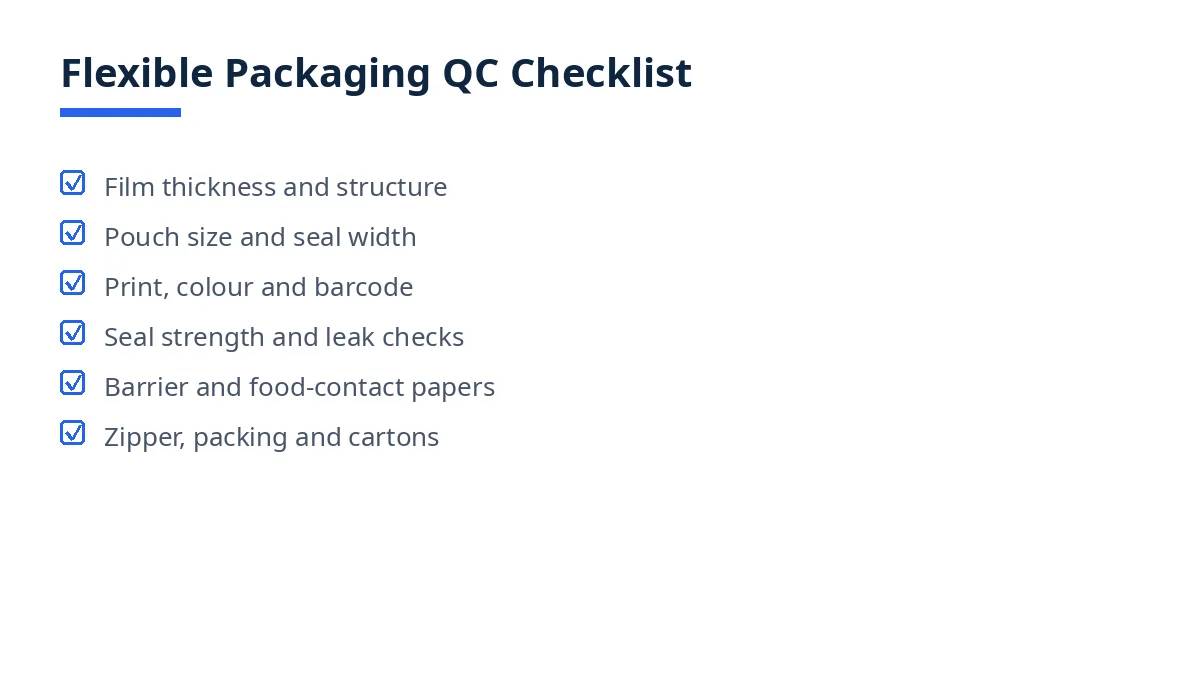
The full checklist
Film, structure and thickness
Confirm the film structure against the specification: each layer in order, and the total construction named.
Check the film for gels, fisheyes, streaks, scratches, and contamination on both sides, across the web.
Measure film thickness in microns at several points across the web and roll, and record actual values. ISO 4593 specifies thickness measurement of plastics film or sheeting by mechanical scanning, excluding embossed film.2
Compare readings with the agreed tolerance for the total laminate and, where named, individual layers.
For film on rolls, check width, roll diameter, and core size, and confirm direction and print orientation match the drawing.
Where film strength is lab tested, confirm the agreed method and limit. ASTM D882 determines the tensile properties of thin plastic sheets and films, including force and extension at break.3
Pouch dimensions and construction
Measure pouch length and width flat, without stretching, against the drawing tolerance.
Measure gusset depth and bottom width on stand-up pouches; check the pouch stands upright without tipping.
Measure seal widths on all sides against the drawing, including the bottom seal on stand-up pouches.
Check shape and symmetry: parallel side seals, corners matching the drawing, no twisted or uneven pouches.
Check notches, tear lines, and punch holes for position and clean cutting, and open one sampled pouch by its tear notch.
Print, colour and artwork
Compare printed pouches with the approved artwork proof: brand name, product name, net weight, barcode, batch area, and mandatory market wording.
Check print registration: no fringes, doubling, or drift between stations, and fine text legible at reading distance.
Check colour against the approved proof under the same light, pouch by pouch and across the run; record shade drift between rolls.
Check print adhesion with a tape pull: ink must not lift from the film in flakes.
Scan barcodes from pouches in different cartons; each code must read correctly and match product and size.
Lamination and film defects
Check lamination by eye and hand for tunnelling, wrinkling, and bubbles, especially near seals and gusset folds.
Peel a sampled laminate by hand at a cut edge; layers must not separate cleanly where a bonded laminate is specified.
Check for delamination after sharply folding a sampled pouch at gusset and seal corners, where weak bonds show first.
Hold sampled pouches against a light table for pinholes, thin spots, and inclusions; record any visible pinhole as a failure.
Seals, zippers and closures
Inspect every seal for channels, wrinkles, folds through the seal, burnt areas, and trapped product or dust.
Check seal appearance along the full length: even width, no gaps, no unsealed sections at corners or junctions.
Pull sampled seals by hand and record the failure mode: clean peel, torn film, or split laminate each points to a different cause.
Where seal strength is lab tested, confirm the agreed method and limit. ASTM F88/F88M measures the maximum force to separate a one-inch sealed section, using unsupported and supported techniques at 90 and 180 degrees.4
Check leakage with a bubble test where the construction allows it. ASTM D3078 rapidly assesses gross leaks in flexible packaging, with bubbles emerging from a submerged sample under vacuum.4
Where dye testing is used on nonporous pouches, confirm the method suits the construction. ASTM F3039 applies dye to one side of the seal and examines the other side after a set time.4
Test every zipper on sampled pouches: smooth travel, no gaps when locked, no jamming or separating after several open-close cycles.
Check spouts, valves, and caps where fitted: centred, fully sealed, opening as intended, leak-free when squeezed gently.
Barrier and lab evidence
Where the product needs a moisture barrier, ask for the water vapour transmission result on the same film lot. ASTM F1249 measures water vapour transmission through flexible barrier materials up to 3 mm thick, in grams per square metre per day.5
Where the product needs an oxygen barrier, ask for the oxygen transmission result on the same film lot, with test temperature and humidity, against the limit.
Confirm every lab report names film structure, lot, and test method; check values against agreed limits, not a summary.
Food-contact and market papers
For food pouches sold in the EU, check the declaration of compliance for market and film structure. Under Regulation (EC) No 1935/2004, food-contact materials must not transfer constituents to food in quantities that could endanger health, change composition unacceptably, or harm organoleptic characteristics.6
For plastic food-contact pouches sold in the EU, check the overall migration position. Under Regulation (EU) No 10/2011, the overall migration limit is 10 mg per square decimetre, and 60 mg per kilogram of food for packaging for infants and young children.7
For food pouches sold in the USA, check the regulatory basis for the polymer and its conditions of use. Title 21, Part 177 covers indirect food additives in polymers, including packaging films, and controls composition and conditions of food contact.8
Check that any claim on the pouch, such as recyclable or compostable wording, matches evidence for that exact structure, and record unsupported claims as failures.
Cartons, pallets and shipment
Count pouches per inner pack and carton on sampled cartons; confirm counts, sizes, and print versions match the packing list.
Check carton labels for product, size, quantity, lot, and barcode; confirm the barcode scans and matches contents.
Check carton strength, closure, and moisture protection; confirm pallets are stable, wrapped, and labelled against shifting or crushing.
Common failures and how to fix them
The most frequent failure is a seal that looks closed but leaks or peels under load, usually from sealing temperature, pressure, dwell time, or contamination in the seal area. Stop, check samples, adjust one sealing variable at a time, and re-test before the run continues. Record the failure mode, not only the failure: a clean peel and a burnt-through seal need different fixes.
Next is thickness drift across the web, shown by pouches that burst or stretch unevenly. Re-measure across the full width and segregate affected rolls before more pouches are made. Delamination at gusset folds usually points to weak bond or excess fold stress: check bond on flat samples first, then on folded samples.
Print shade drift points to more than one print session or ink batch: re-sort against the approved proof before packing. Zippers that jam or separate usually trace to zipper profile, sealing temperature at the zipper ends, or pouch width tolerance: test samples from several cartons before accepting the lot.
Above the agreed acceptance level, options are re-inspection after sorting or rework, documented partial acceptance, or rejection.
Downloadable template / summary table
Copy the checklist into your inspection sheet with the pouch drawing, film specification, tolerances, and acceptance numbers, and record a result per pouch or carton.
Section | Checks | Evidence |
|---|---|---|
Film and thickness | Structure, defects, micron readings | Thickness log |
Dimensions | Length, width, gusset, seal width | Measurements |
Artwork, colour, barcode | Proof, scans | |
Lamination | Tunnelling, bond, pinholes | Peel and light checks |
Seals and closures | Seal appearance, strength, leaks, zipper | Pull, bubble, zipper |
Barrier and lab | Moisture and oxygen results | Reports per lot |
Market papers | Food-contact declarations, claims | Declarations on file |
Packing | Counts, labels, cartons | Packing list |
How Exportain helps
Exportain is a B2B marketplace connecting buyers with Bangladeshi suppliers of flexible packaging, so film structure, pouch dimensions, and test methods can be agreed at the enquiry stage. Browse suppliers and plan the check with inspection services before ordering. Supplier profiles show which document and photo checks have been recorded, not factory inspections. Exportain is not a party to the goods contract and does not inspect goods.
FAQs
When should this checklist be used?
Use it at final inspection, when pouches are finished, printed, and packed. For larger and first orders, also use it during production, while sealing and print can still be corrected.
Who should complete it?
The buyer, a local agent, or an independent inspector can complete it, using the approved sample, drawing, film specification, and a random sample.
What are the most common failures?
Weak or leaking seals, thickness drift, delamination at folds, print shade drift, and jamming zippers are the failures buyers find most often.
Can a third party do it?
Yes, if you share the approved references, tolerances, test methods, and acceptance levels first.
Next steps on Exportain
Before production, agree film structure, pouch drawing, tolerances, test methods, and label wording, then read the AQL acceptance quality limit explainer and pre-shipment inspection guide, and plan the check with inspection services.
Sources
- ISO 2859-1:1999 - Sampling procedures for inspection by attributes — Part 1: Sampling schemes indexed by acceptance quality limit (AQL) for lot-by-lot inspection. International Organization for Standardization (accessed )
- ISO 4593:1993 - Plastics — Film and sheeting — Determination of thickness by mechanical scanning. International Organization for Standardization (accessed )
- ASTM D882 Plastic Film Sheet Tensile Testing. Infinita Lab (accessed )
- Testing the Integrity of Package Seals. Institute of Food Technologists, (accessed )
- Water Vapor Transmission Rate (WVTR) ASTM F1249. Intertek (accessed )
- Regulation (EC) No 1935/2004 of the European Parliament and of the Council of 27 October 2004 on materials and articles intended to come into contact with food and repealing Directives 80/590/EEC and 89/109/EEC. European Union (accessed )
- The EU's Plastics Regulation: What You Should Know. PackagingLaw (Keller and Heckman LLP) (accessed )
- 21 CFR 177: Indirect Food Additives and Polymers. LegalClarity (accessed )
- pre-shipment inspection
- quality control
- buyer guide
- Bangladesh sourcing
- aql inspection
- Packaging Bangladesh
About the author
Sourcing from Bangladesh?
Post a request for quotation and suppliers on Exportain can send you their quotes directly.
Post an RFQ


