FCA vs CIF: Key Differences, Costs and Which One to Choose
CIF puts freight and a seller-bought policy inside one price, but the risk still passes on board at Chattogram and the policy is Clause C minimum cover. This comparison follows one hardware load from Keraniganj to Genoa and prices it both ways.
Short answer
Under CIF, the seller pays ocean freight to the named destination port and contracts insurance cover for the buyer, at Clause C minimum wording and at least 110% of the contract value, while risk still passes when the goods go on board at the port of shipment. Under FCA, the seller hands the goods to the carrier the buyer named at an agreed place and owes no policy, so the buyer buys its own cover from the handover.
On this page
Key takeaways
Under CIF the seller must contract insurance cover for the buyer, at Clause C minimum wording and at least 110% of the contract value, while risk still passes to the buyer when the goods go on board at the port of shipment.
Clause C covers only expressly named risks such as fire, explosion, stranding, capsizing, and general average; theft is not insured under the minimum wording, and broader cover must be agreed in the contract at the buyer's extra cost.
FCA is any-mode and the seller owes no policy, so the buyer's own cover must run from the carrier handover; CIF is sea and inland waterway only, and its policy window opens at loading on board, leaving the road leg and terminal wait outside it.
In the worked example the FCA buyer total is 15,103 dollars and the CIF buyer total is 15,245 dollars before duty, a gap of 142 dollars once destination handling and a 54-dollar top-up for broader cover are priced in.
A buyer in Italy orders brass padlocks and door hardware from a maker in Keraniganj. The cartons will travel by truck to Chattogram, go on board a vessel, and sail to Genoa. Two quotations arrive for the same cartons. One is FCA at the maker's premises. The other is CIF Genoa. The CIF figure is higher, and the buyer has to decide what the extra money actually buys.
The extra money buys two things the FCA figure does not contain: ocean freight to Genoa, and an insurance policy the seller contracts for the buyer. It does not buy a promise that the cartons arrive undamaged, and it does not buy cover for every kind of loss. Under CIF, the seller must contract insurance cover for the buyer against loss of or damage to the goods from the port of shipment to the port of destination, while the risk itself still passes to the buyer when the goods go on board at Chattogram.1 The policy, not the term, decides which losses the buyer can recover. This comparison follows the hardware consignment under each term, reads the minimum policy line by line, and sets out when seller-bought cover genuinely protects the buyer and when it leaves the buyer exposed.
Quick verdict: the policy is inside the price, the risk is not
Question | FCA (Free Carrier) | CIF (Cost, Insurance and Freight) |
|---|---|---|
Delivery point | Handover to the carrier the buyer nominated, at the agreed place | Loading on board the vessel, at the shipment port |
Risk moves to the buyer | At the handover just described | At loading on board |
Transport modes covered | Every mode, single or combined | Sea and inland waterway carriage only |
Place the contract must name | The agreed place of handover | The destination port; delivery stays at the shipment port |
Main carriage | Buyer arranges and funds it from handover onward | Seller arranges and funds it to the destination port |
Insurance for the buyer | None owed by the seller; buyer arranges its own | Seller must arrange it, at Clause C minimum unless upgraded |
Customs split | Export: seller. Import and duty: buyer | Export: seller. Import and duty: buyer |
Loads it fits | Carrier handovers, containers, multimodal journeys | Seller-loaded bulk and loose cargo |
Put plainly, the sea/inland-waterway-only rules are FOUR — FAS, FOB, CFR, CIF; CPT is any-mode; DPU is any-mode; DDP is any-mode (seller clears import customs, pays duty); FCA is any-mode.1 That division rules out CIF for any load that flies, rides a train, or travels by road for part of its journey. A load that sails port to port from Chattogram to Genoa can use either term, and then the choice turns on two questions: who should buy the freight and the policy, and how much cover the buyer actually needs.
FCA suits a buyer that already holds a carrier relationship and an insurance arrangement it trusts, and wants to run both from the handover onward. CIF suits a buyer that wants one seller price to the destination port with a policy already inside it, and accepts that the policy is the minimum wording at the minimum sum unless the contract upgrades it. Neither term moves risk to Genoa. Under both, the buyer owns the voyage risk from an origin point, and the difference is only whether a seller-bought policy stands behind that risk.
What the seller-bought policy actually contains
CIF is one of only two Incoterms 2020 rules that tell the seller to buy insurance for the buyer, and the level it sets is the lower of the two. Under CIP the seller must obtain cover on Clause A terms, described as all risks or maximum cover, while under CIF the cover required is Clause C, described as minimum cover, of the Institute Cargo Clauses.2 The seller may choose the limited Clause C wording rather than the wider Clause A wording, unless the sales contract says otherwise.1 A buyer that reads the letters CIF and assumes broad protection has misread the bargain. The letters promise a policy. The clause letter decides how far the policy reaches.
Clause C covers a selection of expressly named risks. The named risks include fire and explosions, stranding, capsizing, and general average measures.3 A loss counts only if it falls within one of the named perils in the wording. Theft, for example, is not insured under the minimum wording.3 A buyer that wants protection against war or strikes, or stronger protection for goods that are fragile, valuable, or attractive to thieves, must agree that broader cover in advance, and the buyer bears the additional cost of the upgrade.3 The scope of insurance can be adjusted by mutual agreement, and the contract is the place to record the adjustment, with the clause letter, the sum insured, and who pays the extra premium written in plain words.3
The sum insured has a floor as well as a wording. The cover is taken for at least 110% of the goods sales value in the contract, in the contract currency, and it runs from the delivery point through to the destination port.3 The same floor appears in the other standard summary: in both CIF and CIP cover should reach no less than 110% of the goods' value as the sales contract states it, and should run at least to the point of delivery.4 The 110% figure is a minimum sum, not a payout promise. Check the insurance document itself: the clause letter, the sum insured, the currency, and the destination port must match the contract, and any gap between the document and the contract is a gap in the buyer's protection, whatever the quotation said.
The claim route is the buyer's, not the seller's. If a claim later occurs within the insurance coverage, the buyer can make a claim directly to the insurance company through the insurance policy, and the seller is not responsible for whether the claim succeeds.1 The C rules carry the same structure in general terms: under CIF and CIP the seller must arrange and pay insurance up to the named place or port of destination, and the policy must let the buyer, or anyone else holding an insurable interest, pursue the claim straight with the insurer.5 That direct route only works if the buyer holds the right papers before the vessel sails: the insurance certificate or policy, the bill of lading, and proof that the policy names the buyer or a party that can claim on the buyer's behalf. A policy the buyer has never seen, in the seller's name alone, with no document in the buyer's file, is cover in name only. Ask for the insurance document with the shipping documents, and read the beneficiary line before paying the invoice.
What each term means before the vessel sails
FCA turns on a handover the buyer controls. Under FCA, handover does double duty: when the seller passes the goods to the carrier the buyer nominated, or to the buyer's named representative, at the agreed place and point, delivery is complete and the risk moves with it.6 At the seller's own premises, delivery is complete once the goods sit loaded on the vehicle the buyer sent to collect them. At a different agreed place, for instance a container terminal at a port, the seller's duty ends when the load reaches the carrier or designated person in a state ready for unloading off the seller's vehicle.6 In either case the seller completes the export formalities, and the buyer arranges the transport and handles import formalities.6 FCA suits any mode of transport, including multimodal journeys, and container transport in particular suits the rule.6 No policy changes hands under FCA. The buyer buys cover, chooses the insurer and the wording, and sets the start date at the handover.
CIF turns on a loading the seller controls. Under CIF, delivery and the passing of risk occur together: the moment the cartons sit on board the vessel at the named shipment port, both move to the buyer, and the seller must also arrange and pay for the port-to-port carriage and insurance of the goods up to the port of destination.2 CIF is confined to sea and inland waterway carriage, and it applies to port-to-port shipments.2 The seller handles export clearance, loads the goods, pays the freight, and contracts the Clause C policy. The buyer handles import clearance and pays duty, and the buyer still carries the risk from the moment of loading. The seller's duty is to ship and to insure to the minimum standard, not to see the goods safely into Genoa. Although the seller is responsible for freight and cargo insurance, it does not promise to ensure that the goods arrive at the destination intact, in the specified quantity, or at all.1
The two handovers also fix two different policy windows. Under FCA, the buyer's own policy must run from the handover at Keraniganj, or from the terminal handover if the parties agreed a separate place, because the buyer's risk starts there and no seller policy follows. Under CIF, the seller-bought policy extends from the point of delivery, which is loading on board at Chattogram, to the destination port.3 The road leg from Keraniganj to Chattogram and the wait before loading sit outside the CIF policy window. They sit inside the seller's risk period, since the seller carries the risk until loading, but the buyer holds no seller-bought cover for them. A buyer on CIF that assumes the whole journey from the factory gate is insured has assumed cover the policy does not contain.
Cost, risk, and responsibility, split at loading
The price split follows the delivery split. The FCA seller price carries the goods, their packing, loading where handover takes place on the seller's own ground, and the export paperwork. Everything past handover, onward carriage, insurance, and import paperwork, is the buyer's to arrange and fund. Under CIF, the seller's price carries the goods, the inland movement to the port, the loading, the ocean freight to Genoa, and the Clause C premium, while import clearance, duty, and carriage beyond Genoa sit with the buyer. The obligations of seller and buyer under CIF are essentially the same as under CFR, with the insurance duty added on top of the freight duty.1 The buyer under CIF still takes delivery at the port of shipment in the legal sense, receives the goods from the carrier at the destination port, and bears the risk from loading on board.
The bundle has a convenience value and a control cost. A CIF buyer gets one price, one carrier chosen by the seller, and one policy chosen by the seller, with no freight booking and no insurance purchase to arrange. The buyer gives up the choice of vessel and sailing, the choice of insurer, and the choice of wording. The buyer may prescribe the choice of insurance company, and may impose specifications on the shipping company, since Incoterms can be adapted as required, but those prescriptions must be agreed before the contract is signed, not requested after the vessel sails.3 An FCA buyer keeps every choice and carries every task: carrier, route, sailing, insurer, wording, and start date. A buyer with its own ocean rates and an annual cargo policy it can extend to a new load will usually buy cover more cheaply and more broadly on FCA than the seller buys it on CIF. A buyer with no insurer, no broker, and no freight contact will usually get moving faster on CIF, provided the minimum wording is enough for the goods in the cartons.
Destination charges need the same written precision under either term. Who pays for unloading at Genoa depends on the carriage contract: the seller's bill covers it only when that contract puts it on the seller's side, and in all other cases the buyer settles it.5 A CIF quotation that names Genoa does not, on its own, settle who pays to unload at Genoa, who pays quay dues, or who pays the terminal handling. Get the seller's written word on which Genoa charges its freight already covers, file it beside the bill of lading, and add whatever remains to each buyer total before any ranking. The worked example below keeps destination handling outside both seller prices, so the comparison stays honest about the charge.
The container and terminal gap that CIF shares with CFR
CIF was built for loads the seller itself puts on the vessel. It works well with general cargo or bulk goods, where the seller loads the goods on board directly, and it fits less well where containers are delivered to a terminal and the terminal handles the next steps.3 Where containers are handed to the terminal responsible for loading, the seller may not be able to fulfil the CIF loading requirement at all, and in the transition from terminal to loading the risk remains with the seller.3 The same physical point appears in the standard guidance: CIF is best used where sellers have direct access to the vessel for loading, for bulk cargo or non-containerized goods, while CIP is the better choice for most containerized exports.4 A buyer that orders containerized hardware, hands the boxes to a terminal days before loading, and still writes CIF on the order has written a term whose delivery point the seller cannot perform in the way the term describes.
FCA has no such gap, because its delivery point is the handover itself. A sealed container handed to the buyer's carrier at a terminal is delivered under FCA at that handover, and the buyer's risk and the buyer's cover both start there. The container then waits at the buyer's risk, under the buyer's policy, until the vessel loads it. Under CIF, the same container waits at the seller's risk, with no seller-bought policy yet running, because the policy window opens at loading on board. If the container is damaged in the terminal during that wait, the CIF buyer has no policy to claim on for that stretch, and the seller's answer depends on arrangements the buyer cannot see. The gap is narrow in days and wide in consequence: the stretch of the journey where the goods are most handled, and least covered, is the stretch before the vessel.
That gap is also why the cover start date matters more than the premium figure. An FCA buyer needs a policy dated from the carrier handover, spanning the terminal wait, the loading, and the voyage. A CIF buyer needs the seller's policy live from the loading date shown on the bill of lading, and needs its own top-up or separate policy for any loss type the Clause C wording does not reach. A policy dated from sailing, in either column, leaves the loading operation and the terminal wait outside the cover. Under the C rules the seller must notify the buyer that delivery has occurred, but delivery and the transfer of risk take place regardless of when that notification is given, so the buyer may learn the delivery date after the risk has already passed.5 Fix the notice route when ordering: vessel name, loading date, and bill of lading number, dispatched on the loading date itself to someone able to verify the policy that day.
Priced both ways: brass hardware from Keraniganj to Genoa
Every figure in this section illustrates one load only. Before placing a real order, have a forwarder, a broker, and an insurer re-price each leg on live terms. A buyer in Italy orders one consignment of brass padlocks and door hardware in cartons from a maker in Keraniganj, for the port of Genoa. The cartons travel by truck to Chattogram, load onto a vessel, and sail to Genoa. Under FCA, the place the parties agreed is the maker's premises at Keraniganj, and the buyer's nominated carrier collects the cartons there. Under CIF, the named port of destination is Genoa, and the seller carries the cartons to Chattogram, loads them, pays the ocean freight, and contracts Clause C cover. Two seller prices attach to the same cartons: the CIF figure folds in inland movement, loading, ocean freight, and the premium, while the FCA figure leaves those to the buyer, and the two sides book ocean freight at different rates.
Price element | FCA at Keraniganj | CIF to Genoa |
|---|---|---|
Goods and export packing | 11,850 | 11,850 |
Loading at the maker's premises | 95 | 95 |
Export papers | 205 | 205 |
Inland carriage, Keraniganj to Chattogram | Buyer pays 340 | 340 |
Port handling at Chattogram | Buyer pays 160 | 160 |
Loading on board | Buyer pays 120 | 120 |
Ocean freight, Chattogram to Genoa | Buyer pays 1,980 | 2,140 |
Transit premium | Buyer pays 168 | 96 |
Destination terminal handling, Genoa | Buyer pays 185 | Buyer pays 185 |
Buyer top-up premium for broader cover | Not needed; buyer chose the wording | Buyer pays 54 |
Seller's quoted price | 12,150 | 15,006 |
Buyer-paid legs after the price | 2,953 | 239 |
Buyer total before duty | 15,103 | 15,245 |
The chart that follows sets each seller price beside the balance still owed by that buyer.
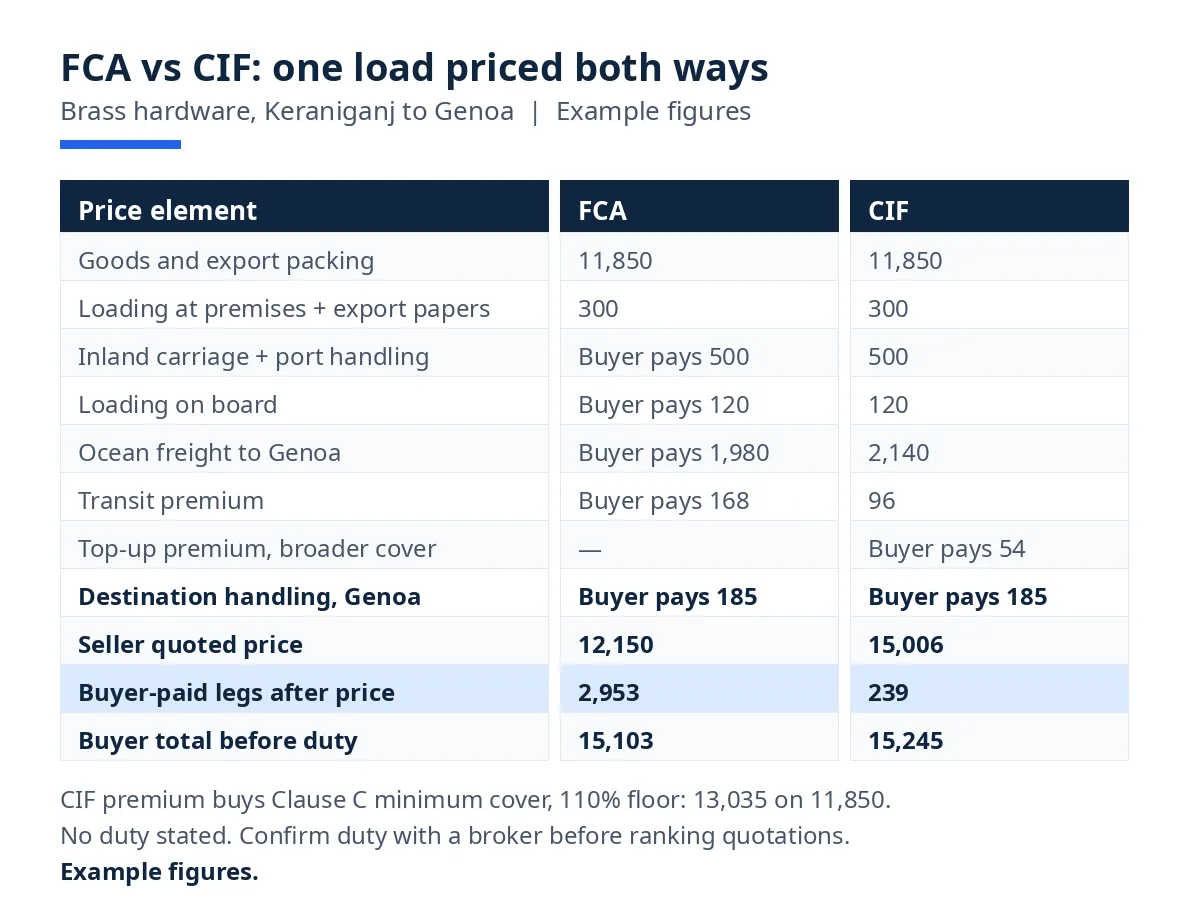
FCA: 12,150 plus 2,953 equals 15,103. CIF: 15,006 plus 239 equals 15,245. The seller prices sit 2,856 apart, and the buyer totals sit 142 apart, with CIF the higher total on these figures: the seller's ocean rate runs 160 above the buyer's rate, and the buyer still pays 185 for destination handling plus 54 to top up the Clause C wording, against the buyer's own 168 premium under FCA. The 110% floor illustrates the same point in miniature. If the contract price for the goods is 11,850, the minimum sum insured under the Clause C policy is 13,035, which is 110% of 11,850.3 That sum is the floor the seller must reach, not the value the buyer should expect back on every loss. A higher contract price lifts the floor; a broader clause lifts the protection. Duty, the import clearance charge, and onward carriage from Genoa to the warehouse sit outside both totals. This article states no duty percentage, since it draws on no Italian tariff schedule. Ask a broker for the duty figure, add duty, clearance, and the final leg to each column, and only then decide which quotation costs less.
Read the premium lines as a choice, not as a saving. The CIF premium of 96 buys the minimum Clause C wording at the minimum sum, chosen by the seller. The FCA premium of 168 buys the wording the buyer chose, from the handover at Keraniganj, at a sum and with perils the buyer set. The 54 top-up in the CIF column is the price of closing part of that distance after the fact: broader cover on top of a minimum policy, bought by the buyer, running from loading. A buyer that needs broad cover and buys it twice, once inside the CIF price and once as a top-up, can end up paying more for cover than the FCA buyer paid once. Settle the clause letter and the sum before signing, and the top-up line may disappear from the comparison altogether.
When seller-bought cover protects the buyer, and when it leaves the buyer exposed
Seller-bought cover protects the buyer where four conditions hold together. First, the goods suit the term: bulk or non-containerized loads the seller itself puts on the vessel at Chattogram, with direct access to the vessel.4 Second, the loss type suits the wording: a named peril such as fire, explosion, stranding, or general average, inside the policy window from loading to Genoa.3 Third, the papers suit the claim: the buyer holds the insurance certificate or policy before the vessel sails, the beneficiary line lets the buyer claim directly, and the sum insured reaches at least 110% of the contract value in the contract currency.3 Fourth, the price suits the risk: the CIF total, once duty, clearance, destination handling, and the last leg are added, still beats the FCA total with buyer-bought cover. Where all four hold, CIF gives the buyer a policy without a separate purchase, and the buyer can claim directly from the insurer if a covered peril strikes during the voyage.1
The buyer stands exposed wherever one of those conditions fails. Containerized cartons handed to a terminal before loading fall outside the loading pattern CIF describes, and the terminal wait falls outside the policy window.3 A theft, or damage that no named peril covers, falls outside the Clause C wording even though the voyage itself was insured.3 A policy document that never reaches the buyer, a beneficiary line that names only the seller, or a sum insured below the 110% floor leaves the direct claim route blocked or short, whatever the quotation promised. And a CIF price that hides destination charges the buyer must still pay can look lower than an FCA price while the buyer total runs higher. None of these exposures is a fault in the seller. Each one is a term of the bargain the buyer accepted by writing CIF without upgrading the clause, checking the document, or pricing the destination charges.
Situation | Term that fits |
|---|---|
Bulk or loose cargo the seller itself loads on the vessel at the load port | CIF, with the Clause C policy checked before sailing |
Containerized load handed to a terminal days before loading | FCA, with buyer-bought cover from the handover |
Buyer holds its own cargo policy and wants to choose the wording and insurer | FCA |
Buyer has no insurer and wants a policy inside the seller price | CIF, if Clause C cover is enough for the goods |
Buyer needs cover against theft, handling damage, war, or strikes | Neither minimum wording alone; agree Clause A or buy a top-up, and price it in |
Buyer wants seller responsibility all the way to Genoa | Neither; choose a D rule for destination delivery |
Load travels by air, road, or rail for any leg | FCA; CIF cannot describe it |
Buyer has no carrier, forwarder, broker, or insurer arranged | Neither term alone; arrange carriage, cover, and clearance help first |
Start with the cargo shape and the loading pattern, not with the headline price. Goods the seller can place on the vessel itself, in a form that needs no terminal handover, fit CIF. Goods that pass through a terminal in a sealed container, or that change mode on the way, fit FCA, and the insurance question then becomes which policy the buyer buys, not which policy the seller owes. Next, read the policy wording as a list of named perils, and match each peril against the losses the goods actually suffer: water, handling, and theft matter more to cartons of hardware than stranding does, and the minimum wording answers only the perils it names. Finally, rank the quotations on buyer totals with the top-up, the destination handling, the duty figure from a broker, and the last leg all included. A CIF quotation that needs a top-up and still leaves the terminal wait uncovered is not the cheaper bargain. It is the bargain with the most cover still to buy.
Bangladesh checks: the policy papers, the port names, and the destination charges
Spell the term out the way the port and the insurer will read it. Write a CIF order with the destination port named in full, the Incoterms edition cited, and the shipment port stated alongside, fixing the loading point, the freight boundary, and the insurance window together. Write an FCA order with the full place: the Keraniganj premises address, or the terminal name, address, and collection window the carrier can meet. "FCA Bangladesh" or "CIF Italy" on a quotation names no usable place, and no carrier, terminal team, vessel crew, or insurer can work from it. Keep the place spelled identically across quotation, invoice, packing list, insurance document, and transport document.
Settle the insurance file before the truck is booked. The seller handles export formalities under both terms, and the buyer should match the seller's papers to the goods as packed, confirming that the term and the place wording agree on every document.6 Under CIF, add the policy file to that check: the clause letter, the sum insured at 110% or above, the currency, the destination port, the insurer's name, and the beneficiary line, all confirmed in writing before payment.3 If the buyer wants Clause A cover, or a named insurer, or cover against war or strikes, agree it in the contract and record who pays the extra premium, since the buyer bears the additional cost of cover above the minimum.3 Keep the insurance certificate with the bill of lading, in the same file as the order, so a claim can start from the documents rather than from a search for them.
Confirm the destination money before the vessel sails. Import clearance and duty remain the buyer's under either term, and waiting time at Genoa after arrival is charged to the buyer.5 Book the broker, confirm which destination charges sit inside the seller's freight and which the buyer pays, and have duty money ready, since the seller pays destination unloading charges only where the carriage contract assigns them to the seller.5 Settle the loading-notice route in advance: one named contact, sending vessel name, loading date, and bill of lading number on the loading date itself, so the buyer learns at once both the day risk moved and the day the CIF cover window opened. A notice that arrives after the weekend leaves the buyer learning late about a risk it already owns.
Questions buyers ask about FCA and CIF
Does the CIF policy pay when cartons are damaged by handling or water at the port?
Not on the minimum wording alone. Clause C covers a selection of expressly named risks, including fire and explosions, stranding, capsizing, and general average measures, and theft is not insured under that wording.3 Damage that falls outside the named perils has no cover under the minimum policy, even though the goods were insured for the voyage. A buyer that needs protection for handling, water, or theft should agree broader cover in the contract, with the clause letter and the extra premium recorded, or buy a top-up policy that starts at loading and names the perils the minimum wording leaves out. Read the policy wording, not the term letters, before deciding the cartons are covered.
Which total comes out lower for the same hardware load, FCA or CIF?
In the illustration above, FCA comes out 142 dollars lower, at 15,103 against 15,245, because the buyer's ocean rate runs below the seller's rate and the CIF buyer still pays destination handling plus a 54 top-up for broader cover. Another consignment may price the other way, where the seller's freight rate beats the buyer's by more than the handling and top-up lines. Price both columns on the same basis: seller figure, plus each remaining leg, plus duty, clearance, any destination handling outside the freight, and the final leg, using a broker's duty figure. A headline that omits freight, premium, or destination handling is not cheaper. It is unfinished.
Can a buyer upgrade the CIF cover once the purchase order is signed?
Yes, while the policy has not yet been placed, and sometimes after it, by agreement and at a price. Both sides agree the upgrade in writing: the clause letter, such as Clause A instead of Clause C, the sum insured, the insurer if the buyer wants a named company, and who pays the extra premium, since the buyer bears the additional cost of cover above the minimum.3 Rewrite the paperwork set so every document carries the same position: order, quotation, invoice, insurance document, and transport document. Any letter of credit still showing the original insurance wording requires its own amendment, because the bank checks the presented documents against the credit terms. Settle the upgrade before the goods load, because a policy placed at Clause C cannot be rewritten after a loss by agreement alone.
How does a first-time importer check a CIF policy before paying the invoice?
Ask for three documents and read four lines. The documents are the insurance certificate or policy, the bill of lading, and the quotation showing the CIF price. The lines are the clause letter, the sum insured against the 110% floor, the currency against the contract currency, and the beneficiary line, which must let the buyer claim directly from the insurer.5 3 Check the destination port on the policy against the port in the contract, and the loading date on the bill of lading against the day the policy window opened. If any line is missing, wrong, or in the seller's name alone, hold payment until the seller corrects the document. For a first order, CIF pairs best with a broker engaged before shipment, a policy examined before loading, and destination charges settled in writing. FCA fits a first order only where the buyer already runs a carrier, a forwarder, and a live policy.
Next steps on Exportain
Start from the eleven-rule chart for shipments leaving Bangladesh, then compare any CIF figure with the standalone explanation of what a CIF price contains, checking its clause letter and insured sum against the minimum set out there. Once term, place or port, and cover are fixed, put the requirement to suppliers via how buying works on Exportain.
Sources
- CFR & CIF Incoterms® 2020 explained: Key differences. ICC Academy (accessed )
- CIF & CIP Incoterms 2020 explained: Key differences. ICC Academy, (accessed )
- CIF (Cost Insurance and Freight) | Incoterms 2020. Röhlig Logistics (accessed )
- Incoterms 2020 CIF: Spotlight on Cost, Insurance and Freight. Shipping Solutions (accessed )
- Incoterms® 2020 C rules vs D rules: Risk transfer explained. ICC Academy (accessed )
- FCA & EXW Incoterms® 2020 explained: Key differences. ICC Academy (accessed )
About the author
Sourcing from Bangladesh?
Post a request for quotation and suppliers on Exportain can send you their quotes directly.
Post an RFQ