FCA vs CFR: Key Differences, Costs and Which One to Choose
A CFR price pays the ocean freight to Valencia, but the risk is the buyer's from loading on board at Chattogram. An FCA price ends at the carrier handover at the terminal, days earlier. This comparison prices one consignment of ceramic tableware both ways and shows when each term fits.
Short answer
CFR delivers goods on board the vessel at the port of shipment and the seller pays ocean freight to the named port of destination, while risk passes to the buyer at loading. FCA delivers goods to the carrier the buyer names at an agreed place, often a terminal days before loading, and the buyer pays freight from that handover and takes the risk there. Neither term obliges the seller to insure the buyer.
On this page
Key takeaways
CFR is sea and inland waterway only: delivery and risk pass when the goods go on board at the port of shipment, while the seller pays ocean freight to the named port of destination.
FCA works for any mode: delivery and risk pass at handover to the carrier the buyer named at the agreed place, which can be a terminal days before the vessel loads.
Neither term obliges the seller to insure the buyer; under CFR the seller must still give timely notice of loading so the buyer can put cover in place from the on-board moment.
In the worked example the FCA buyer total is 18,377 dollars and the CFR buyer total is 18,337 dollars before duty, a 40 gap set by the freight-rate difference less the destination handling inside the seller's freight.
Wooden crates of ceramic tableware stand in a break-bulk shed at Chattogram, marked, sealed, and ready for a vessel that has not yet berthed. The maker in Dhamrai has finished its work. The buyer in Spain has paid nothing for freight yet, or has paid for all of it, depending on three letters in the contract. The crates will wait in that shed, and the wait itself is the difference between FCA and CFR.
Under FCA, the seller can finish its part when it hands the crates to the carrier the buyer named at an agreed place, which may be that shed or a terminal days before loading. Risk passes at the handover. Under CFR, the seller finishes its part only when the crates go on board the vessel at Chattogram, and the seller also pays the ocean freight to the named port of destination. Risk still passes on board, at the load port, while the paid freight runs on to Spain. One term ends at a handover inland from the ship. The other ends on the ship, with the freight bill already settled to the destination port.
This comparison follows one consignment of crates from Dhamrai to Valencia, prices it under each term, and sets out when a port-to-port, freight-paid bargain still fits, and when a carrier handover fits better.
The port question first: a handover at a terminal, or loading on board
Question | FCA (Free Carrier) | CFR (Cost and Freight) |
|---|---|---|
Delivery happens | When the goods pass to the carrier or person the buyer named, at a place the parties agreed | When the goods go on board the vessel at the port of shipment |
Risk passes | At that handover to the carrier or named person | Once the goods are on board at the port of shipment |
Modes | Any, alone or in combination | Sea and inland waterway only |
Wording in the contract | A place the parties agreed, at the seller's own site or at a separate site such as a terminal | A named port of destination, with delivery at the port of shipment |
Ocean freight | Buyer books and pays, from the handover onward | Seller books and pays, to the named destination port |
Customs | Seller clears export; buyer clears import and pays duty | Seller clears export; buyer clears import and pays duty |
Voyage cover for the buyer | Seller owes no policy | Seller owes no policy |
Vessel loading | Buyer, through its carrier | Seller |
Cargo it suits | Loads handed to a carrier before loading, including containerized loads and journeys using more than one mode | Loads put on the vessel at the port, such as bulk and break-bulk cargo |
Put plainly: the sea/inland-waterway-only rules are FOUR — FAS, FOB, CFR, CIF; CPT is any-mode; DPU is any-mode; DDP is any-mode (seller clears import customs, pays duty); FCA is any-mode.1 The eleven rules divide into seven that work for any mode and four confined to sea and inland waterway transport, and CFR sits in the group of four.1 That division decides the first question in this comparison. A load that travels by air for part of its journey, or that changes mode at an inland terminal, cannot be described by CFR at all. A load that sails from Chattogram to Valencia can use either term, and then the choice turns on where delivery sits: at a carrier handover before loading, or on board the vessel.
FCA fits a buyer that already holds a carrier relationship and wants the handover where its carrier collects the goods. CFR fits a buyer that wants one seller price to the destination port and accepts the seller's vessel and sailing. Neither term buys insurance for the buyer, and neither moves risk to the destination port.
What each term asks the seller to do
CFR asks the seller to carry the goods to the port of shipment, place them on board the vessel within the agreed date or period, and pay the freight to the named port of destination.2 The seller bears the cost and the freight from the port of shipment to the port of destination, and the term applies only to sea or inland waterway transport.2 The seller also completes export clearance and pays for it, and bears the costs of checking operations and packing needed for delivery.2 Delivery is complete on board. The seller's duty after that point is a paid one, not a risk one: the freight is bought and paid for, the voyage is the buyer's risk.
The buyer's part of CFR starts before the vessel sails, because risk passes at loading. The buyer takes delivery at the port of shipment in the legal sense, collects the goods from the carrier at the destination port, and carries the voyage risk from the moment the goods go on board.2 The seller owes the buyer no obligation to purchase insurance cover, so the buyer is advised to buy cover for itself, and a buyer that waits until arrival to arrange it has owned the voyage risk uninsured for its whole length.2 Import clearance, duties, taxes, and the other costs of import sit with the buyer.2
FCA asks less of the seller after the handover, and asks the buyer to be ready earlier. The seller hands the goods to the carrier or person the buyer nominated, at the place the parties agreed, and completes export clearance.3 At the seller's own site, delivery finishes once the goods sit loaded on the buyer's collecting vehicle. At a separate agreed site, such as a port terminal, delivery finishes when the goods arrive ready to be unloaded from the seller's vehicle and pass to the carrier or the buyer's designated person.3 FCA suits any mode of transport, including multimodal shipments, and container transport in particular suits the rule.3 The seller's costs under FCA cover the goods and their packaging, the loading at the seller's site, and export formalities; transport beyond the delivery point is the buyer's, as are import formalities.3
The two terms therefore split the middle of the journey in opposite ways. Under FCA, the seller's work ends at the handover and the buyer runs everything from there, including the vessel booking. Under CFR, the seller's work ends on board but its money runs to the destination port, paying for a voyage whose risk already belongs to the buyer. The CFR seller must also give the buyer notice of loading in good time after loading, because the buyer handles cargo insurance and needs the loading details to put cover in place.2 A seller that loads on a Friday and sends no notice until Monday can find that the transit risk stayed with it, where the buyer had no information on which to insure.2 Treat that notice as part of the delivery itself, not as paperwork that can follow later.
The terminal wait: who carries the crates between handover and loading
Break-bulk crates rarely move straight from a shed onto a vessel. They wait for a berth, a crane, and a sailing, in a terminal the seller does not run. The term in the contract decides who answers for the crates during that wait, and the answer follows the delivery point, not the freight bill.
Under FCA at a terminal, the wait belongs to the buyer. The seller hands the crates to the buyer's carrier at the place the parties agreed, risk passes, and the crates sit at the buyer's risk while the carrier waits for the vessel. The seller has no further part in the wait, and no reason to insure crates it no longer carries the risk for. Under CFR, the wait belongs to the seller. The crates have not been delivered until they go on board, so the seller carries the risk through the shed, the quay, and the loading operation itself, even though the seller's own staff may not be present for every hour of it.
That contrast is why the shape of the cargo matters more than the length of the voyage. The sea rules suit bulk and non-containerized cargo, where the seller deals with the vessel directly and can place the goods on board under its own eye.2 CFR is described as suitable where the goods do not require high insurance and the seller has direct access to the vessel, for bulk or non-containerized goods or raw materials.2 A container, by contrast, is handed to a terminal days before it is loaded, so between gate-in and loading the seller would carry the risk of goods it no longer controls, and the any-mode rules fit that handover instead.4 The same reasoning reaches break-bulk crates that pass through a terminal: where the seller keeps the crates in its own chain until the crane lifts them, CFR matches the physical movement; where the crates pass to the buyer's carrier at a terminal and sit there, FCA matches it.
The wait also decides when cover must start, and the two start dates sit days apart. A CFR buyer needs a policy running from loading on board at Chattogram, and the seller's loading notice is the document that sets that date. An FCA buyer needs cover from the carrier handover onward, spanning the shed wait and the loading that comes after it. A policy dated from sailing leaves the shed wait and the loading operation outside the cover in both cases, and leaves the road leg outside it under FCA. Free time at the destination runs against the consignee, so a delay at Valencia is a buyer cost even though the seller chose the carrier and the service.4 Where timing matters to stock, put the line, the sailing window, and any transshipment in the order.
Freight, insurance, and the loading notice: three traps in a CFR price
The CFR price looks complete because it reaches the destination port. Three traps sit inside it, and each one is a clause to write, not a detail to assume.
First, freight paid is not risk carried. The seller pays ocean freight to the named port of destination, yet risk passes at the port of shipment, and arrival at the destination in sound condition, in the right quantity, or at all is not part of the seller's delivery duty.2 The C group as a whole works this way: delivery and risk sit at origin, while the seller's paid carriage runs on to the destination.5 A buyer that wants the seller to answer for the goods until they reach the destination should look at the D rules, where handover happens at the destination. CFR is not delivery to the destination port, and writing "CFR door" or "CFR warehouse" on a purchase order names a bargain no sea-only rule can keep.4 CFR names a port.
Second, no insurance is included, and the neighbouring rule is the only fix inside the seller's price. Under CFR the seller owes no obligation to purchase insurance cover for the buyer, while under CIF the seller must buy a policy for the buyer covering the voyage between the load port and the destination port.2 The seller under CIF may choose limited cover under Institute Cargo Clauses (C) rather than the wider Institute Cargo Clauses (A), unless the contract says otherwise.2 The CIF minimum is the restrictive Clause (C) wording, at least 110% of the contract value.4 A buyer that wants the seller to buy cover should ask for CIF and should check the clause letter, the sum insured, and who the policy names as beneficiary before paying. A buyer that stays on CFR should buy its own policy, with the start date set at loading on board, and should read the wording for the voyage separately from any cover for the road leg and the terminal wait, since the seller's risk ends at loading and the buyer's road and waiting exposure may need its own line.
Third, the loading notice and the destination charges decide whether the CFR price stays the price. The seller must notify the buyer that delivery has occurred, so the buyer can receive the goods and arrange cover, although delivery and risk transfer take place regardless of when that notice is given.5 Agree the notice channel in the order: the vessel's name, the loading day, and the bill of lading reference, sent on the loading day itself, to a contact who answers that day. Destination handling needs the same precision. Under the C rules the seller pays unloading charges at the destination only where the carriage contract assigns them to the seller; otherwise the buyer pays.5 If the carriage contract the seller signed already covers discharge or destination terminal handling, that handling is already paid for, and the destination agent has no second invoice to send the consignee.4 Ask the seller to confirm, in writing, which destination charges sit inside its ocean freight, and keep that confirmation with the bill of lading.
A smaller trap follows from habit: C&F and CNF are informal survivals of an older abbreviation for the same idea, and they are not Incoterms 2020 rules.4 Write CFR, name the port of destination, and name the edition, or a bank or a court will have to decide what was meant.4 The same discipline applies to FCA: spell out the place in full, with the terminal name and the collection window, rather than a country name that no driver or carrier can act on.
Priced both ways: ceramic tableware from Dhamrai to Valencia
Treat every number below as an illustration for this one load. A forwarder and a broker should price each leg again before a real order is placed. A buyer in Spain orders one consignment of ceramic tableware in wooden crates from a maker in Dhamrai, for the port of Valencia. The crates travel by truck to Chattogram, wait in a break-bulk shed, and load onto a vessel for Valencia. Under FCA, the place the parties agreed is a terminal at Chattogram, and the buyer's nominated carrier takes the crates there. Under CFR, the named port of destination is Valencia, and the seller carries the crates to Chattogram, loads them, and pays the ocean freight. The same crates carry two seller prices, because the CFR price includes the loading and the ocean freight that the FCA price leaves to the buyer, and because the ocean freight rate differs between the two sides' bookings.
Price element | FCA at the Chattogram terminal | CFR to Valencia |
|---|---|---|
Goods and export packing | 14,620 | 14,620 |
Crating for break-bulk loading | 240 | 240 |
Export papers | 230 | 230 |
Inland carriage, Dhamrai to Chattogram | 390 | 390 |
Port handling at Chattogram | 175 | 175 |
Loading on board | Buyer pays 130 | 130 |
Ocean freight, Chattogram to Valencia | Buyer pays 2,240 | 2,410 |
Transit premium | Buyer pays 142 | Buyer pays 142 |
Destination terminal handling, Valencia | Buyer pays 210 | Included in the seller's freight |
Seller's quoted price | 15,655 | 18,195 |
Buyer-paid legs after the price | 2,722 | 142 |
Buyer total before duty | 18,377 | 18,337 |
The chart below puts the two seller prices next to what each buyer still pays.
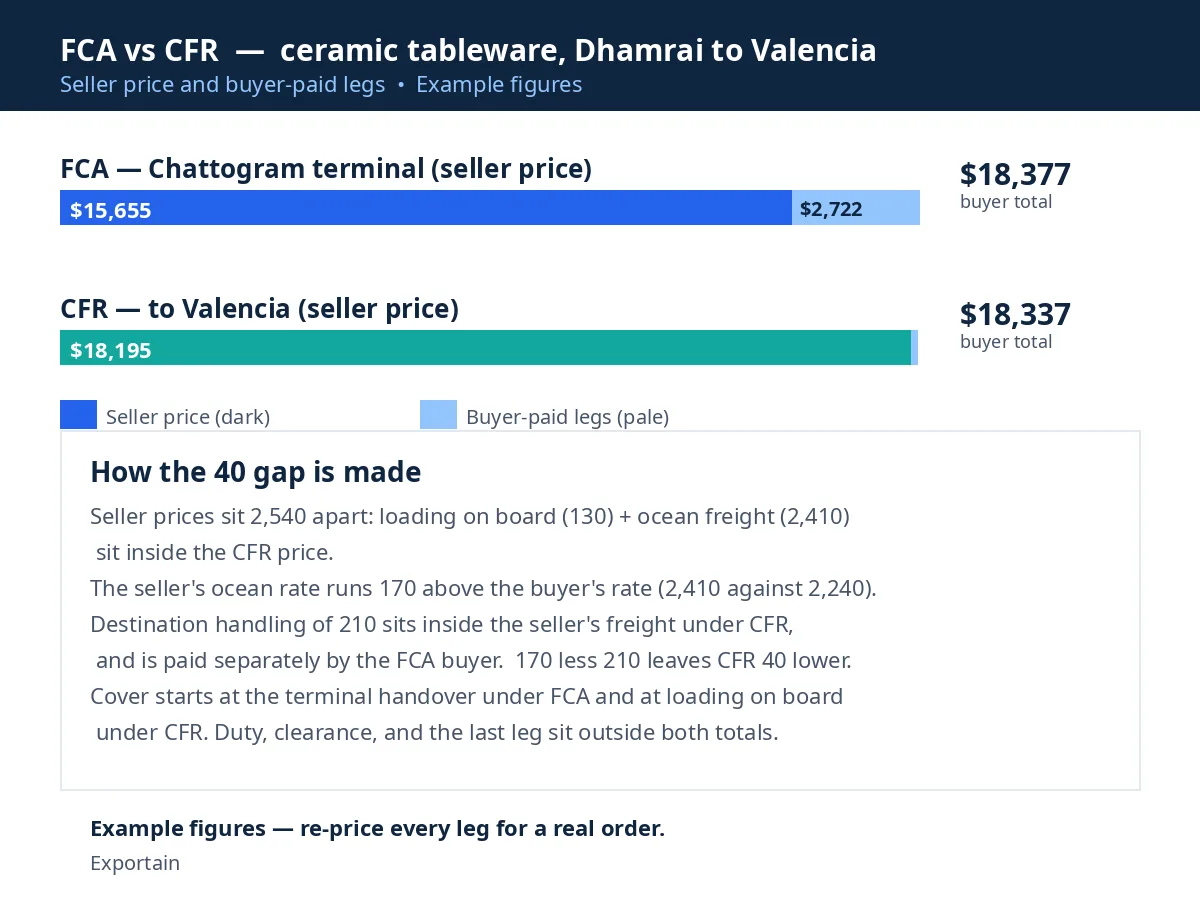
FCA: 15,655 plus 2,722 equals 18,377. CFR: 18,195 plus 142 equals 18,337. The seller prices sit 2,540 apart, and the buyer totals sit 40 apart: the seller's ocean rate runs 170 above the buyer's rate in this illustration, while the destination handling of 210 sits inside the seller's freight under CFR and is paid separately by the FCA buyer. The CFR total runs 40 below the FCA total on these figures, and another pair of freight rates could reverse that gap. Rank the quotations on the buyer totals, not on the seller prices, and only once the destination handling position is confirmed in writing for each column.
Neither total includes duty, import clearance, or carriage from Valencia to the buyer's warehouse. No duty percentage is stated, because no tariff schedule for Spain was opened for this article. Get the duty figure from a broker, then complete both totals with duty, the clearance charge, and the last leg before judging which quotation is lower. Both columns carry a 142 premium, but the cover starts at different moments: at the carrier handover under FCA, and at loading on board under CFR. Confirm with the insurer that each policy runs from the risk moment in its column, and that the CFR policy is live on the loading date shown on the bill of lading, not on the sailing date.
Choosing by cargo shape, carrier control, and cover
Start with the shape of the cargo and the handover the seller can actually perform. Goods that travel in a sealed container, on pallets, or across two or more modes fit FCA, because the rule fixes delivery at a carrier handover the parties can witness and date.3 Goods that can be delivered directly onto a vessel fit CFR: bulk loads, break-bulk crates, and raw materials the seller can place on board under its own arrangements at the load port.2 Ceramic crates in a break-bulk shed sit on the CFR side of that line only where the seller keeps them in its own chain until loading. The same crates, handed to the buyer's carrier at a terminal days before the vessel arrives, sit on the FCA side.
Next, weigh carrier control against freight convenience. Under FCA the buyer contracts the main carriage, picks the line and the sailing, and negotiates the rate directly. Under CFR the seller contracts and pays the freight, picks the vessel and the usual route, and the buyer takes the sailing the seller booked.2 A buyer with its own ocean rates, a consolidation plan across several Bangladesh orders, or a fixed sailing that stock depends on should price on FCA and keep the booking. A buyer without those relationships, or one ordering a single consignment where the seller's regular sailings beat anything the buyer can arrange alone, should price on CFR and judge the seller's timetable, transshipment plan, and destination handling position before signing.
Then check cover, before the crates move. CFR and FCA both leave insurance to the buyer, so the decision is not which term buys the policy. It is which start date the policy must carry, and whether the buyer holds a policy at all. A buyer with a voyage policy it can date from loading on board, and a seller whose loading notice arrives the same day, can run CFR with the gap closed. A buyer whose policy must also span a road leg and a terminal wait needs the FCA start date written into the policy, or a move to CIF where the seller buys Clause (C) cover inside the price.
Situation | Term that fits |
|---|---|
Containerized load or a load changing mode on the way | FCA |
Loose or crated cargo the seller itself puts on the vessel at the load port | CFR |
Buyer holds its own ocean rates and wants the carrier and sailing choice | FCA |
Buyer wants one seller price to the destination port and accepts the seller's vessel and timetable | CFR |
Buyer wants the seller to buy voyage insurance as well as freight | Neither; ask for CIF and check the clause letter |
Buyer has no carrier, forwarder, or broker arranged, and no policy in place | Neither term alone; arrange carriage, cover, and clearance help first |
Load travels by air, road, or rail for any leg | FCA; CFR cannot describe it |
Buyer wants the seller to answer for the goods until they reach the destination | Neither; a D rule fits that bargain |
Bangladesh checks: stuffing, sealing, the port name, and the notice channel
Spell the term out the way the port will read it. A CFR order needs the named port of destination in full, with the edition cited, and the port of shipment named beside it, so the loading point and the freight boundary are both fixed. An FCA order needs the place spelled out in full: the terminal name and address, the shed or gate, and the collection window the carrier can reach. A quotation that says only "FCA Bangladesh" or "CFR Spain" names no place at all, and no carrier, terminal crew, or vessel crew can act on it. Use one spelling of the place on every document: quotation, invoice, packing list, and transport document alike.
For break-bulk crates, settle stuffing, sealing, and the evidence each side keeps before the truck is booked. Confirm who crates and seals the goods, how the crates are marked, and what receipt the terminal gives when the crates arrive. Under FCA, the carrier receipt at the terminal is the evidence that the handover happened and risk passed; under CFR, the on-board notation on the bill of lading is the evidence that delivery happened and risk passed, and it also records the date the buyer's cover had to be live. Keep the receipt or the bill of lading number with the loading notice, in the same file as the order.
Confirm the export file before the truck leaves Dhamrai. The seller handles export formalities under both terms; the buyer should check the seller's papers against the goods as packed, with every document carrying the same term and the same place wording.2 3 Agree the loading-notice channel in advance under CFR: a named contact who sends the vessel's name, the loading day, and the bill of lading reference on the loading day itself, so the buyer's policy is live when risk passes.2 Book the broker and the onward carrier early, and have duty money ready before the vessel sails, since import clearance and duty stay with the buyer under either term.2
Questions buyers ask about FCA and CFR
Which quotation is cheaper, FCA or CFR, for the same crates?
Start from the buyer totals, not the seller prices. In the illustration above, CFR lands 40 dollars below FCA, at 18,337 against 18,377, because the destination handling sits inside the seller's freight under CFR while the seller's ocean rate runs 170 above the buyer's rate. Another consignment may land the other way, where the buyer's freight rate beats the seller's by more than the handling saving. Build each total the same way: seller price, plus every leg the buyer still pays, plus duty, clearance charges, destination handling where it is not already inside the freight, and the last leg, with the duty figure from a broker. A lower headline that leaves the loading, the freight, or the destination handling unbought is not lower. It is incomplete.
Which term is safer for a first-time importer ordering break-bulk cargo?
CFR lightens the first order's workload and sharpens its risk. The seller handles export clearance, moves the crates to the port, loads them, and pays the freight to the destination port, which removes the stages that delay a first shipment most.2 The buyer still takes the risk from loading on board, clears import, pays duty, arranges cover, and pursues the loading notice.2 For a first order, CFR with a broker booked before shipment, a policy checked before loading, the destination port written in full, and the destination handling position confirmed is the safer pairing. FCA suits a first order only for a buyer with a carrier and a forwarder already active in Bangladesh and a policy dated from the carrier handover.3
Can the term change after the purchase order is signed?
Yes, while the crates are still with the seller. Both sides agree the change in writing, agree a new price, and rewrite the paperwork set so every document carries the new term: order, quotation, invoice, packing list, and transport document, in that order of checking. Moving from CFR to FCA pulls delivery back to the place the parties agreed, moves the risk moment earlier to the carrier handover, and removes the loading and the ocean freight from the seller's price. The move the other way restores those two items to the seller's price and returns delivery to the vessel. A letter of credit that still carries the superseded term needs amending on its own, since the bank compares the documents with the credit, and the on-board date on the bill of lading is the date the bank checks against the latest shipment date.4 Settle the new price, the place or port, and the cover start date before dispatch, because risk that already moved on board stays moved.
Which term do Bangladeshi suppliers usually prefer, FCA or CFR?
Ask each seller, and put the answer in the request for quotation, because preference follows setup rather than any rule. A seller with its own freight desk, regular sailings, and direct access to the vessel can quote CFR routinely and hold the promised sailing under its own control. A maker that sells through an agent and holds no carrier contracts of its own may offer FCA alone. The request for quotation should settle the point directly: state the term wanted, the place the parties agreed or the destination port, and ask for freight, papers, handling, loading, and insurance on separate lines. Two quotations can be set side by side only when both show the same legs, and the cheapest headline may be the one with the most legs missing.
Next steps on Exportain
Place the pair among the eleven-rule chart that sets the sea-only rules beside the any-mode rules for shipments from Bangladesh, then see how a CIF price adds seller-bought cover to the CFR freight bargain before deciding who should buy the voyage policy. When the term and the named place or port are settled, ask suppliers to quote on them through the buying steps on Exportain that cover requesting a quotation on a chosen term.
Sources
- Incoterms 2020 Explained: All 11 Rules. Blue Ocean Academy (accessed )
- CFR & CIF Incoterms® 2020 explained: Key differences. ICC Academy (accessed )
- FCA & EXW Incoterms® 2020 explained: Key differences. ICC Academy (accessed )
- CFR Incoterm: Cost and Freight, Risk and Cost. Linbis (accessed )
- Incoterms® 2020 C rules vs D rules: Risk transfer explained. ICC Academy (accessed )
About the author
Sourcing from Bangladesh?
Post a request for quotation and suppliers on Exportain can send you their quotes directly.
Post an RFQ