

FAS Freight Cost: Who Pays and How It Is Calculated
Under FAS, the seller pays only to delivery alongside the vessel. The buyer pays ocean freight and destination charges. This guide shows how to estimate each line, compare quotes, and avoid paying a charge twice.
Short answer
Under FAS, the seller pays for the goods and for delivery alongside the nominated vessel at the named port of shipment, cleared for export. The buyer pays for loading, ocean freight and its surcharges, destination handling, import clearance and duty, and onward transport. Risk passes when the goods are placed alongside the vessel. Price every FAS quotation to your warehouse before you compare it with another Incoterms rule.
On this page
Key takeaways
Under FAS, the seller pays only to delivery alongside the nominated vessel, cleared for export; the buyer pays loading, ocean freight, and all destination costs.
Ocean freight is a base rate plus surcharges: BAF, CAF, THC, PSS, GRI, documentation and filing fees, and demurrage or detention where free time expires.
Name the payer for loading and origin terminal handling in the sales contract and the freight booking, or the same charge can be billed twice.
In the worked example, all figures are examples only: the buyer pays 8,170 of the 10,170 freight-related total, excluding the goods price and duty.
Confirm current Chattogram port and terminal charges in writing for your cargo type; container handling figures do not set bulk or break-bulk FAS charges.
An FAS price answers only part of the freight question. Under FAS (Free Alongside Ship), the seller pays for the goods and for getting them to the ship's side at the named port of shipment, cleared for export. The buyer pays for loading, ocean freight, and everything after arrival at the destination port. A buyer who budgets only the FAS price will understate the landed cost by the whole main carriage leg and the destination charges.
This guide separates the two cost blocks, explains how ocean freight is built from a base rate plus surcharges, and shows a worked example with figures labelled as examples, for buyers of bulk or break-bulk cargo from Bangladesh on FAS terms.
Why an FAS price can look low while the freight bill is high
FAS is one of the 11 Incoterms 2020 rules published by the International Chamber of Commerce (ICC), and it applies only to sea and inland waterway transport.1 Under FAS, the seller delivers the goods alongside the vessel nominated by the buyer at the port of shipment, and risk transfers from seller to buyer at that point.1 The seller is responsible for transporting the goods to the port and completing any export formalities.1
The buyer must then appoint the carrier and pay freight, cover loading costs at the port, and handle any import formalities and any required transit customs.1 That division is why an FAS quotation can look low next to a CIF or DAP quotation: the FAS figure contains no ocean freight, no destination handling, and no import duty. Comparing headline prices across rules without adding back the missing legs compares different journeys. Get an all-in freight quote before you accept the FAS price, not after the goods are ready at Chattogram. FAS also fits a narrow cargo profile: it suits bulk cargo such as minerals, cement, steel, grains, and vehicles delivered alongside the ship, while containerized goods delivered to a container terminal are better matched to the FCA rule.1 If your cargo will move in containers, ask whether FCA, CPT, or CIP describes the handover more accurately.
Who pays what under FAS: the cost split at the ship's side
Under FAS, the seller pays only up to delivery alongside the vessel: goods, export packaging, inland transport to the named port, export clearance, and delivery alongside the nominated vessel. The buyer must give timely notice of the vessel name and delivery point; late notice can shift risk and costs to the buyer.1
The buyer pays from the ship's side onward: loading, carriage and freight, surcharges, destination handling, import clearance and duty, and onward transport, and bears risk from delivery alongside the vessel. FAS does not oblige either party to buy insurance for the other, unlike CIF and CIP.2 Arrange cover from the risk point, or state who insures each leg in the contract.
Cost line | Seller under FAS | Buyer under FAS |
|---|---|---|
Goods and export packaging | Pays | Does not pay |
Inland transport to the named port | Pays | Does not pay |
Export clearance and export documents | Pays | Does not pay |
Delivery alongside the nominated vessel | Pays | Does not pay |
Loading onto the vessel | Does not pay | Pays |
Ocean freight and freight surcharges | Does not pay | Pays |
Origin terminal handling in the freight contract | Check the contract | Usually pays |
Bill of lading and carrier documentation fees | Does not pay | Pays |
Destination terminal handling | Does not pay | Pays |
Import clearance, duty, and taxes | Does not pay | Pays |
Onward transport to the warehouse | Does not pay | Pays |
Insurance for the buyer's leg | No obligation under FAS | Arranges and pays if cover is wanted |
Two lines need a written answer in every contract: origin terminal handling and loading. Terminal handling charges cover cargo handling at the port terminal, and the charge may be collected through the carrier, the freight forwarder, or a local agent, which makes the payer unclear on an invoice.3 Under FAS, the buyer contracts the carrier, so origin handling billed through that freight contract normally falls to the buyer, but a seller whose delivery price includes terminal handling may have already covered it. State the payer in the sales contract and again in the freight booking, or the same charge can be billed twice. Loading is placed with the buyer in express terms.1 Do not accept a quotation that leaves loading unassigned.
How ocean freight is built: base rate plus surcharges
Ocean freight under FAS is rarely one number. The buyer's freight quote is normally a base ocean rate plus surcharges, plus origin and destination charges billed through the carrier or forwarder. FCL surcharges are additional charges applied on top of the basic ocean freight rate, covering cost factors not always included in that base rate, such as fuel fluctuations, currency changes, port handling, equipment imbalance, peak season demand, security compliance, and administrative processing.3 Two quotes with the same ocean freight rate can produce very different total costs once surcharges are added.3
Charge | What it covers | Check before you accept |
|---|---|---|
Base ocean freight | Moving the cargo by sea, port to port | Is the rate port-to-port only |
Bunker Adjustment Factor (BAF) | Fuel price fluctuation; fuel is one of the main carrier operating costs3 | Inside the freight, or billed apart, and for which period |
Currency Adjustment Factor (CAF) | Exchange rate fluctuation between quote and cost currencies3 | Listed separately, built in, or replaced by another mechanism |
Terminal Handling Charge (THC) | Terminal handling, including loading, unloading, and movement within the terminal3 | Origin and destination THC named, with the payer for origin THC |
Peak Season Surcharge (PSS) | High demand and tight vessel space, often before retail seasons3 | Sailing covered and validity dates |
General Rate Increase (GRI) | Planned carrier rate increase; a quote valid today may not hold after it takes effect3 | Validity dates and the sailing covered |
Emergency Bunker / Low Sulfur Surcharge | Sudden fuel rises, and lower-sulfur fuel costs3 | Re-confirm at booking; treat as changeable |
Documentation and filing fees | Bill of lading, booking, manifest, and advance cargo filings such as AMS and ENS3 | Each fee listed; incorrect filing may cause delay or penalties3 |
Demurrage and detention | Containers held past free time, inside or outside the terminal3 | Free-time days confirmed in the booking |
Ask for each charge on its own line, with validity dates and the sailing covered. The test for a quote is not the ocean freight figure alone, but the all-in cost and which charges are included or excluded.3
Step-by-step: how to estimate FAS freight cost before you order
Estimate in the order the costs occur, from the factory gate to your warehouse, and keep the seller block and the buyer block in separate columns. A single total hides the split that FAS exists to define. The diagram below sets out the five steps in order. Work through it with the sales contract and a forwarder quote open beside it, and do not move to the next step until the current step has a named payer and a written figure or a stated exclusion.
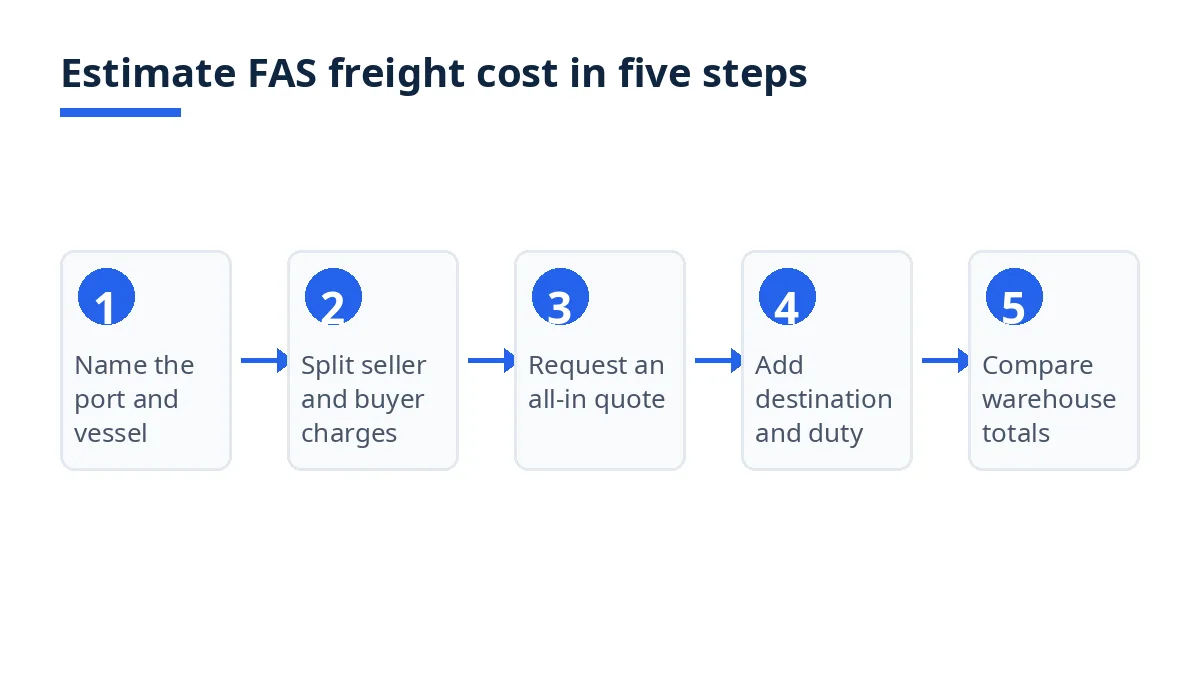
Name the port, vessel, and delivery point. Write "FAS Chattogram, Incoterms 2020". The buyer must notify the seller in time of the vessel name and delivery point.1 Record the vessel, berth, and delivery period.
Split every cost line into seller-paid and buyer-paid. Mark loading and origin terminal handling with an explicit payer. A line with no payer leaves the estimate incomplete.
Request an all-in freight quote. Ask for base freight, BAF, CAF, THC, PSS and GRI status, documentation and filing fees, and free-time days, each on its own line, with validity dates and the sailing covered. Compare two or more forwarders on the same sailing and terms.
Add the destination and duty blocks. Add destination THC, delivery order, broker, and onward transport, then duty separately on the destination customs value basis. Duty is not inside an FAS price.
Price every quotation to your warehouse and record the result. Record the exchange rate, validity, and surcharge period. A line a forwarder will not itemize is unconfirmed, not zero.
Worked example: one bulk shipment priced to the buyer's warehouse
Example figures: the shipment below is illustrative only. It shows the arithmetic of an FAS freight budget. It is not a market rate, a typical rate, or a quotation for any lane, cargo, or date. Freight rates, surcharges, and port charges change by lane, carrier, season, and sailing, and must be confirmed in a live quotation for your own shipment.
Example figures: a buyer purchases 40 tonnes of a bagged mineral product on FAS terms, FAS Chattogram, Incoterms 2020, for delivery alongside a nominated vessel at Chattogram, with onward carriage to Rotterdam and onward transport to the buyer's warehouse. The goods price is excluded so the freight split stays visible.
Cost line | Payer under FAS | Example figures (USD) |
|---|---|---|
Inland haulage, factory to Chattogram | Seller | 1,200 |
Export clearance and export documents | Seller | 300 |
Delivery alongside the vessel, quay handling | Seller | 500 |
Seller freight-related subtotal | Seller | 2,000 |
Loading onto the vessel | Buyer | 800 |
Base ocean freight, Chattogram to Rotterdam | Buyer | 4,600 |
Bunker Adjustment Factor (BAF) | Buyer | 700 |
Destination terminal handling, Rotterdam | Buyer | 450 |
Bill of lading and carrier documentation | Buyer | 120 |
Import clearance and broker fee | Buyer | 350 |
Onward transport to the warehouse | Buyer | 900 |
Cargo insurance for the buyer's leg, buyer arranged | Buyer | 250 |
Buyer freight-related subtotal | Buyer | 8,170 |
Total freight-related cost, excluding goods price and duty | Seller 2,000 + buyer 8,170 | 10,170 |
Example figures: the buyer pays 8,170 of the 10,170 total, while the seller pays 2,000. Under FAS, the buyer carries the main carriage leg, so the buyer block is normally larger. Duty is excluded because it depends on the HS code, value basis, and destination rate. Replace each example line with a live figure, keep the payer column, and keep duty on its own line. A missing BAF, destination THC, or loading line is an unpriced cost that will appear after sailing.
Costs, timelines, and documents that change the freight figure
What are the typical costs and timelines for an FAS shipment?
There is no typical FAS freight cost across lanes and seasons: base rate, BAF, CAF, PSS, and GRI status change by sailing, and surcharge structures vary by port, carrier, and lane.3 Timelines change the figure when notice is late, a GRI or PSS takes effect, or free time expires.1 3 Ask for an itemized quote with validity, sailing, and free-time days, and re-confirm surcharges at booking.
Which documents are needed to settle FAS freight charges?
The seller's export set is the Bill of Export with the commercial invoice, packing list, EXP form, and certificate of origin.4 The buyer's set is the carrier contract, bill of lading, freight invoice with surcharge lines, delivery order, and import declaration. Check each freight line against the payer column in the sales contract, and keep duty on its own line.
Bangladesh-specific charges and checks at Chattogram
Port charges at Chattogram also move. Revised tariffs enforced from midnight on 14 October, the first major revision in nearly four decades across 23 service categories, raised the 20-foot container handling fee by Tk 4,395, from Tk 11,849 to Tk 16,244, with export containers up Tk 3,045 and import containers up Tk 5,720; per-kilogram cargo handling rose from Tk 1.28 to Tk 1.75.5 Those are container handling charges reported in October 2025. They do not set bulk or break-bulk charges under FAS and must not be read as FAS freight rates. Confirm current charges in writing for your cargo type, and record who pays each terminal charge in the contract and the freight booking.
Waiting charges for delayed vessels were also revised sharply upward, with double charges after 12 hours, while piloting fees were fixed at 800 dollars per vessel and tugging charges rose to 6,830 dollars per tow.5 Carry the nomination date, delivery window, and delay-cost payer with the surcharge lines. Confirm the cargo profile: FAS suits bulk and break-bulk cargo at the ship's side at Chattogram or Mongla, and rarely describes container cargo at a terminal.1 If the cargo will be containerized, discuss FCA and rebuild the budget on the FCA handover point.
Mistakes that inflate FAS freight cost
What are the most common mistakes with FAS freight cost?
Comparing headline prices across rules, treating the base rate as the total, leaving loading and origin THC unassigned, using FAS for container cargo, nominating the vessel late, and mixing duty into the freight total. Name the payer for every line, confirm the cargo profile, and nominate the vessel in writing.
Treating the ocean freight rate as the freight total. BAF, CAF, THC, PSS, GRI, documentation, and filing fees can add a material block on top of the base rate.3 Ask for the all-in cost with each charge included or excluded in writing.
Leaving loading and origin terminal handling unassigned. Under FAS, the buyer pays loading, and origin handling billed through the buyer's freight contract normally falls to the buyer.1 3 Name the payer for each line, or the charge can be billed twice.
Using FAS for container cargo. Containers delivered to a terminal do not sit alongside the vessel, so the FAS delivery point does not describe the handover.1 Use FCA for container cargo.
Nominating the vessel late. Late notice can shift risk and costs to the buyer and miss the sailing covered by the freight quote.1 Nominate the vessel in writing, with the delivery window, and confirm receipt.
Budgeting duty inside the freight total. Duty is the buyer's cost under FAS, calculated on the destination customs value basis. Keep it on its own line.
Accepting a quote without validity dates or free-time terms. Record validity, sailing, free-time days, and surcharge period with the quote, so GRI, PSS, demurrage, and detention can be checked.3
Checklist: compare FAS freight quotes line by line
Before you accept an FAS price, every line below should carry a payer, a figure or a stated exclusion, and a source document.
Named port, vessel name, delivery point inside the port, and edition stated as "FAS [port], Incoterms 2020".
Seller block priced: goods, packaging, inland haulage, export clearance, and delivery alongside the vessel.
Buyer block priced: loading, base ocean freight, BAF, CAF, origin and destination THC, PSS and GRI status, documentation and filing fees.
Payer named in writing for loading, origin terminal handling, and the bill of lading fee.
Freight quote validity dates, sailing covered, and surcharge period recorded.
Free-time days for demurrage and detention confirmed in the freight booking.
Destination block priced: destination THC, delivery order and chassis fees where they apply, broker and import clearance fees, and onward transport.
Import duty and taxes calculated separately on the destination customs value basis for the HS code.
Insurance arranged from the risk point, or a written decision to carry the risk uninsured.
Cargo profile checked: FAS for bulk or break-bulk cargo at the ship's side, FCA discussed for container cargo.
Vessel nomination sent in writing and receipt confirmed, with the delivery window recorded.
How Exportain helps
On Exportain, post a request for quotation (RFQ) on the RFQ board stating the quantity and unit, destination, Incoterm, required certifications, and deadline, so suppliers in that category can quote against the same requirement.6 State "FAS Chattogram, Incoterms 2020" in the RFQ, with the named port and the delivery point, and ask each reply to separate the FAS price from any freight, loading, or terminal charge the seller has included. Compare quotations on the versioned terms Exportain records, including unit price, MOQ, lead time, Incoterm, payment terms, and validity, and counter-offer in the same thread before you accept.6
Read the badges for what they record. Badges such as Exportain Verified and Export Verified record which checks the Exportain team has reviewed, and a badge is not a capacity or quality guarantee.6 A badge does not price freight or settle who pays terminal handling; those points belong in the contract and the freight booking.
FAQs
What should I know first about FAS freight cost?
FAS freight cost is the buyer's block from the ship's side onward, not the seller's FAS price. The seller pays for the goods and delivery alongside the nominated vessel, cleared for export, and risk passes there.1 The buyer pays loading, freight and surcharges, destination handling, import clearance and duty, and onward transport. Budget the blocks separately and price every quotation to your warehouse.
What are the typical costs and timelines for an FAS shipment?
There is no typical FAS freight cost across lanes and seasons, because the base rate, BAF, CAF, PSS, and GRI status change by sailing, and surcharge structures vary by port, carrier, lane, and season.3 Timelines change the figure when vessel nomination is late, when a GRI or PSS takes effect between quotation and sailing, or when free time expires and demurrage or detention accrues.1 3 Ask for an itemized quote with validity dates, the sailing covered, and free-time days, and re-confirm surcharges at booking.
Which documents are needed to settle FAS freight charges?
The seller's export set is the Bill of Export with the commercial invoice, packing list, EXP form certified by authorized dealers, and certificate of origin, as required for export clearance in Bangladesh.4 The buyer's freight set is the carrier contract, the bill of lading,7 the freight invoice with its surcharge lines, the destination delivery order, and the import declaration. Check each freight invoice line against the payer column in the sales contract, and keep duty on its own line.
What are the most common mistakes with FAS freight cost?
The most common mistakes are comparing headline prices across different Incoterms rules, treating the base ocean rate as the freight total, leaving loading and origin terminal handling unassigned, using FAS for container cargo, nominating the vessel late, and mixing duty into the freight total. Each mistake moves a cost from the budget to the destination invoice. Name the payer for every line, confirm the cargo profile, and nominate the vessel in writing with the delivery window recorded.
Next steps on Exportain
Read the Incoterms guide for shipments from Bangladesh to check how FAS sits beside FOB, CFR, and CIF, and the CIF cost, insurance and freight guide to see what changes when the seller pays freight and insurance to destination. When you are ready to price a shipment, follow how to buy from Bangladesh to compare versioned quotations and record the FAS term, the named port, and the delivery point you accept.
Sources
- FOB & FAS Incoterms® 2020 explained: Key differences. ICC Academy (accessed )
- Incoterms® 2020. International Chamber of Commerce (ICC) (accessed )
- FCL Surcharges Explained: BAF, CAF, THC & Key Fees. EF & DP (accessed )
- Customs Clearance Procedures for Export. Bangladesh Customs, National Board of Revenue (accessed )
- Chittagong seaport finally enforces hiked tariffs from midnight Oct 14. The Financial Express, (accessed )
- How to source and buy from Bangladesh. Exportain (accessed )
- FAS Incoterm Explained: Sea Freight Risks & Duties. FreightAmigo, (accessed )
About the author
Sourcing from Bangladesh?
Post a request for quotation and suppliers on Exportain can send you their quotes directly.
Post an RFQ


