How Much Does Factory Audit Cost in Bangladesh?
Factory audit cost in Bangladesh explained: audit types, auditor days, travel, report and follow-up costs, with example figures and a buyer checklist.
Short answer
A factory audit in Bangladesh has no single market price. The total is built from auditor days, which move with audit type, workforce size and site complexity, plus travel, report writing, any program fee and follow-up. Compare quotes as totals for the same scope, and read the report for what it proves on the audit day.
On this page
Key takeaways
A factory audit assesses systems, documents, and site conditions, not finished goods. A product inspection is a separate check, and an audit pass is not a guarantee of product quality, capacity, or delivery.
There is no single Bangladesh market price for a factory audit. Compare totals for the same audit type, site, and workforce size, not day rates alone.
Auditor days are the core cost driver, set by scope and, for social audits, by workforce band, plus travel, report writing, interpreter time, any program fee, and follow-up.
SMETA is a methodology, not a certification, and amfori BSCI monitoring produces a rating, not a product certificate. Read the report against the grading rules of the program used.
Book the audit before the first order, agree the corrective-action plan with owners and deadlines, and insist on the full report rather than a summary.
A factory audit answers a different question from a product inspection, and that difference sets the price. An audit is an on-site assessment of a supplier's facility, systems, and records against a stated objective, whether capability, quality controls, labor standards, or a regulated requirement.1 A product inspection checks finished goods against a specification. One provider puts it plainly: a factory audit evaluates the supplier itself, while a product inspection evaluates the goods.2
There is no single Bangladesh market price for a factory audit, and no single timeline that applies to every site. The total moves with the audit type, the auditor days the scope requires, travel, report writing, any program fee, and follow-up work. This guide works through each line, so you can compare quotes that describe the same job.
An audit pass is not a guarantee. It records what the auditor saw, in the documents checked, the areas walked, and the workers interviewed, on the audit day. It does not certify that every future shipment will meet your specification or pass a later product inspection. For that check, read the pre-shipment inspection guide and the AQL guide.
Why this matters for buyers and sellers
For the buyer, an audit is the check before commitment. It tests whether the factory has the machinery, workforce, quality system, and capacity to make your product consistently, rather than whether one finished lot happens to look right.2 A supplier that passes one product inspection can still lack calibration records or a working corrective-action process, and those gaps show up in later orders.
For the seller, a clear scope protects the factory as well: when the objective, checklist, and scoring method are written down before the visit, the factory knows which records to prepare.2
Step-by-step: how it works
Work through these steps in order, keeping every answer in writing.
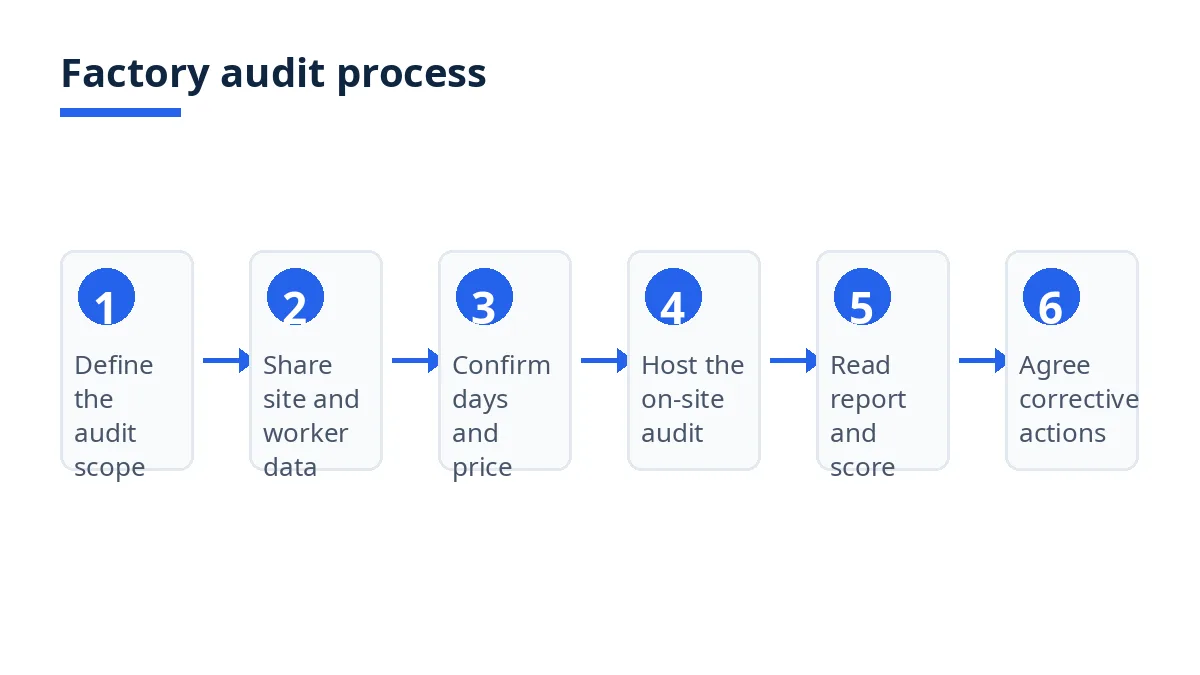
Write one sentence stating the audit objective. State whether you need a capability check, a quality-system review, a social compliance audit, an environmental audit, or a combination. That sentence forces every provider to price the same scope.1
Name the site, exactly. Give the factory address, the number of buildings, the production lines in scope, and whether any work is subcontracted. More lines, shifts, buildings, and subcontracting increase the evidence to check.1
State the workforce size and the product. Give the total worker count, the number of shifts, and the product type. Social audit day counts are set in part by workforce bands.
Send the document pack before the visit. Include business licenses and export permits, the quality manual or procedures, and any certificates held.
Confirm the quote in components, not one total. Require separate lines for auditor days, report writing, travel, interpreter time, any program fee, and follow-up terms.
Host the on-site audit. A typical sequence runs from an opening meeting, through a review of production areas, warehouses, and records, with worker interviews where required, to a closing meeting.2
Read the report, then agree corrective actions. Check each finding against its evidence, agree an owner and a deadline for each action, and record how verification will happen.
Costs, timelines and documents
Audit types, scope and scoring
One Bangladesh-based provider lists typical durations of one man-day for a capability audit and for a compliance audit, one and a half to two man-days for a social audit, and one to one and a half man-days for an environmental audit, with travel quoted separately.2 Treat those as that provider's durations, not as a market standard.
Capability audit (the most common type) evaluates machinery, workforce, quality systems, and capacity, reviewing production lines, maintenance records, quality-control procedures, raw material storage, and organization structure.2 Quality-system audit tests process controls: supplier qualification, incoming inspection, in-process control, final inspection, use of data to fix issues, and corrective action. ISO 9001 is the world's best-known standard for quality management systems, and its principles include customer focus, leadership, the process approach, and a commitment to continual improvement.3 A quality-system audit against ISO 9001 is not the same as ISO 9001 certification, a separate certification-body decision with staged audits and surveillance.1
Social compliance audit covers worker age verification, wage records, working hours, health and safety, freedom of association, and anti-discrimination policies, under frameworks that include SA8000, BSCI, SMETA, and WRAP.2 SMETA is a methodology, not a certification program: it results in a detailed audit report and a Corrective Action Plan Report shared through the Sedex platform, and Sedex does not issue certificates.4 A SMETA audit can be two-pillar (labor standards and health and safety) or four-pillar (adding extended environment and business ethics).4 Amfori BSCI monitoring is also not a product certificate: an approved partner assesses the producer against the amfori BSCI Code of Conduct, and the rating from A to E is shown on the amfori platform after the report is submitted.5 Environmental audit reviews waste management, water treatment, emissions control, chemical storage, energy efficiency, and local environmental compliance.2
What drives the auditor-day count
A man-day is one auditor on site for one working day, and most audit quotes use day rate multiplied by auditor days as the core.1 A capability check of one product area in one building needs less time than a social audit that must interview a sample of workers, review wage and hour records, and walk dormitories and canteens where they exist. Workforce size is the clearest driver for social audits. A published summary of SMETA guidance sets minimum on-site days by workforce band: one auditor day for 5 to 100 workers, two days for 101 to 500 workers, three days for 501 to 1,000 workers, four days for 1,001 to 2,000 workers, and four or more days above 2,000 workers, with a further half auditor-day for report writing.1 Travel time can add billed time, with the same guidance adding a half day for one to two hours of travel per audit day and a full day for three to four hours.1
What are the typical costs and timelines?
There is no single market rate for a factory audit in Bangladesh, and any guide that states one without naming its source should be treated with care. One audit cost guide reports published examples for a simple factory audit at around 188 dollars per man-day and a more extensive audit at around 238 dollars per man-day, a simple package at 220 dollars plus travel and an extensive package at 440 dollars plus travel, and an all-inclusive example at 398 dollars per man-day with no extra travel charge in key Asian regions.1 A Bangladesh-based provider states that its costs typically range from 300 to 600 dollars per man-day depending on country, scope, and complexity, with travel quoted separately.2 A third provider's own starting point in Asia is 280 dollars per man-day.1 Those are three providers' published figures, not a Bangladesh market rate.
Example figures: take a day rate of 280 dollars and a one-day capability audit with local travel included, and the base is 280 dollars. Add a half day of report writing at the same rate and the total becomes 420 dollars before travel or surcharges. For a social audit, take a factory with 300 workers: the SMETA minimum table above gives two on-site auditor days plus a half day of report writing, or 2.5 days in total. At the same example rate, that is 700 dollars, before travel, interpreter time, and any program fee. The same guide notes a fixed SMETA fee of 185 pounds charged by Sedex per audit, separate from the audit firm's invoice.1 For timelines, confirm three dates in writing: the audit date, the report delivery date, and the corrective-action deadline. Many providers turn reports around in one to three business days.1 Amfori BSCI reports are submitted through the amfori platform within ten business days after on-site monitoring, and a C, D, or E rating requires follow-up monitoring between two and twelve months later.5
Which documents are needed?
Send the factory name and address, buildings and lines, worker count and shift pattern, product type, and audit objective in one sentence, plus business licenses, quality procedures, calibration and maintenance records, and any certificates held.2 For a social audit, also prepare payroll and hours records, contracts, health and safety procedures, and worker interview access.4
How to read the report
Start with the scope: objective, site, date, auditor, and program. Then read each finding against its evidence. For a SMETA audit, the output is a report plus a Corrective Action Plan Report, shared through the Sedex platform, with the supplier deciding which buyers are granted access.4 For amfori BSCI, the rating from A to E is calculated after report submission, and a C, D, or E rating triggers follow-up monitoring within the two-to-twelve-month window.5
Bangladesh-specific rules and tips
Check working-hour records against the Labour Act, not only against the payroll summary. The Bangladesh Labour Act, 2006 sets the ordinary limit for an adult worker at eight hours in a day and forty-eight hours in a week, with overtime paid at twice the ordinary rate of basic wage and dearness allowance.6 An auditor will look for attendance, overtime, and pay records that reconcile. Where they do not, ask why before you accept the summary.
Ask which safety and labor monitoring already covers the factory. The RMG Sustainability Council is the largest alliance monitoring factory safety in Bangladesh's garment sector, formerly known as the Accord.7 It has expanded its mandate to investigate labor rights issues alongside safety, with a pilot covering 1,185 factories producing for 58 global brands, and with non-compliance notified to buyers.7 Confirm for your factory which programs currently cover it, rather than assuming one audit covers safety, labor, and environment together.
Price travel from the auditor's base, not from Dhaka by default. A factory in Chattogram, Gazipur, or Narayanganj may be local to one provider's auditor and a full travel day for another's. Ask which base the auditor travels from and whether travel time is billed as auditor days. Plan for language in the quote. Worker interviews in Bengali need interpreter time where the auditor does not work in the factory's language; state the interview and report languages in the quote.1
Do not let an audit substitute for a product check. A factory that passes a capability audit can still ship a lot that fails your specification. The purchase order should name both where both are required: the audit before placement, and the product inspection before shipment.
Mistakes and red flags
What are the most common mistakes?
Comparing day rates instead of totals. A lower day rate with more days, separate travel, a separate report charge, and a paid follow-up can exceed a higher all-inclusive rate.
Accepting a quote without a stated audit objective. Without one sentence stating the objective, two providers can quote different jobs under the same label.
Treating a SMETA report or a BSCI rating as a certificate. SMETA is not a certification program and Sedex does not issue certificates.4 Amfori BSCI monitoring produces a rating on a platform, not a product certificate.5
Booking the audit after the order is placed. An audit after placement can still find problems, but the buyer has already committed. The audit's value is highest before the first order, at annual review, after a major quality failure, or before a volume increase.2
Skipping the corrective-action plan. A report without owners, deadlines, and verification methods is a record, not a plan. Agree the plan in the closing meeting and in writing afterward, and record who pays for verification.
Using a summary instead of the full report. Where the supplier pays, define the scope in writing and ensure you receive the report directly rather than a summary version.1
Assuming one site covers the group. A factory group may operate several sites under one company name. An audit of one site says nothing about another site's systems, workforce, or safety record.
Checklist
Before you book, confirm every line in writing.
Audit objective in one sentence: capability, quality system, social, environmental, or a combination.
Site named exactly: address, buildings, lines, subcontracted work, and shift pattern.
Workforce size and product type stated, so social audit days can be estimated.
Quote in components: auditor days, report writing, travel, interpreter, program fee, and follow-up terms.
Totals compared on the same scope, not day rates alone.
Report language, contents, and delivery date confirmed in writing.
Corrective-action process agreed: owner, deadline, evidence, and verification method.
Follow-up payer and method agreed before the audit.
Audit report filed with the supplier record, separate from any product inspection report.
How Exportain helps
Exportain does not audit factories itself. Its supplier verification is a document and photo review by staff, not a factory inspection or a factory audit, and a badge is not a guarantee of production capacity, product quality, or delivery.
Post a free RFQ on Exportain and write the audit type, site scope, and report you expect into the request. For the audit itself, contract directly with the audit firm and read its report against the grading rules of the program used. Before you set product-check values, read the pre-shipment inspection guide and the AQL guide, since those describe the separate product inspection.
FAQs
What should I know first about factory audit cost?
Know the audit type before you ask for a price. Capability, quality-system, social, and environmental audits are different jobs, priced on auditor days, travel, report writing, and any program fee. There is no single Bangladesh market price, so compare totals for the same scope, site, and workforce size.
What are the typical costs and timelines?
There are no typical costs or timelines a guide can state as fact. Published figures range from around 188 dollars per man-day for a simple audit to 300 to 600 dollars per man-day from a Bangladesh-based provider.1 2 Timelines also vary: many providers deliver reports in one to three business days, while amfori BSCI reports are submitted within ten business days after on-site monitoring.1 5
Which documents are needed?
Send the factory address, building and line details, worker count and shift pattern, product type, and audit objective, plus business licenses, quality procedures, and calibration records.2 For a social audit, add payroll and hours records, contracts, and health and safety procedures, and confirm worker interview access.4
What are the most common mistakes?
The most common mistakes are comparing day rates instead of totals, accepting a quote without a stated audit objective, treating a SMETA report or a BSCI rating as a certificate, booking the audit after the order is placed, and accepting a summary instead of the full report.1 4 5
Next steps on Exportain
Start with the product check: read the pre-shipment inspection guide for how finished goods are sampled and judged, and the AQL guide for how acceptance limits are set. Then post a free RFQ on Exportain stating the audit type and report you expect.
Sources
- How Much Does a Factory Audit Cost?. QCadvisor (accessed )
- Factory Audit & Supplier Assessment. AQM BD (accessed )
- ISO 9000 family - Quality management standards including ISO 9001. International Organization for Standardization (accessed )
- SMETA Audit - Sedex Members Ethical Trade Audit. TÜV SÜD (accessed )
- BSCI Certification and Audit for Businesses. TÜV SÜD (accessed )
- THE BANGLADESH LABOUR ACT, 2006, CHAPTER IX. The Lawyers & Jurists (accessed )
- RMG Sustainability Council can now oversee labour issues too. The Business Standard, (accessed )
- supplier verification
- pre-shipment inspection
- quality control
- buyer guide
- Bangladesh sourcing
- Factory certification
About the author
Sourcing from Bangladesh?
Post a request for quotation and suppliers on Exportain can send you their quotes directly.
Post an RFQ