

How Much Does Fabric Inspection 4-Point System Cost in Bangladesh?
Fabric 4-point inspection scores rolls by defect size and converts the total to points per 100 square yards. This guide explains the scale, the calculation, Bangladesh cost drivers, and the written terms to agree before booking.
Short answer
Fabric inspection under the 4-point system scores each roll by defect size, then converts the total into points per 100 square yards or square metres, so a buyer can compare rolls of different lengths and widths on one scale. This guide explains the penalty scale, the roll calculation, what moves the inspection quote in Bangladesh, and what to agree in writing before the visit.

On this page
Key takeaways
The 4-point system scores each fabric roll by defect length, caps the score at 4 points per linear yard or metre, and converts each roll total into points per 100 square yards or square metres.
Agree the defect list, the hole rule, the roll share, and the acceptance figure for each roll and for the lot in the purchase specification before the visit, because a score without an agreed figure cannot decide a roll.
The inspection quote follows inspected length, roll share, defect load, inspector days and sites, machine availability, report detail, travel, and re-inspection terms, so compare itemised written quotes for the same scope.
Hold cutting of inspected rolls until the roll-by-roll report is received and each roll is cleared against the agreed figure, and segregate failed rolls from the shipment.
Fabric inspection under the 4-point system scores each roll by defect size, then converts the total into points per 100 square yards or square metres, so a buyer can compare rolls of different lengths and widths on one scale. This guide explains the penalty scale, the roll calculation, what moves the inspection quote in Bangladesh, and what to agree in writing before the visit.
The 4-point system is a fabric-roll method, not a finished-garment method. The roll runs over an inspection machine before cutting, and each defect earns penalty points by its length. One textile reference describes fabric as normally inspected in roll form before it is put into production, so faults are caught before cutting rather than in cut panels or finished garments.1 The standard most often named is ASTM D5430, and one inspection firm states that it usually follows ASTM D5430-13(2017), described as the American 4-point system, in which points are deducted for defects as penalties, with the most serious defects earning up to 4 points.2
Why this matters for buyers and sellers
For a buyer, the 4-point score turns a vague complaint about fabric quality into a number that can be checked roll by roll. A single lot average can hide a bad roll, and cutting a defective roll spreads its faults across many garments. For a seller or mill, a roll-by-roll record shows that the fabric was inspected against an agreed scale, rather than judged by impression after cutting.
Common fabric defects include broken yarns, holes, oil stains, shade variation between rolls, uneven dyeing, pick bars, reed marks, and dropped stitches, with shade inconsistency between dye lots among the most frequent issues.3
Keep neighbouring services apart, because each is quoted separately. A general third-party engagement covers the booking, scope, and reporting of an independent visit. Piece-by-piece sorting checks every unit in an agreed scope and segregates defective units one by one. Sample inspection judges approval samples before bulk work proceeds. Lab testing measures a sample in a laboratory. This guide covers only the roll-by-roll 4-point score.
Step-by-step: how it works
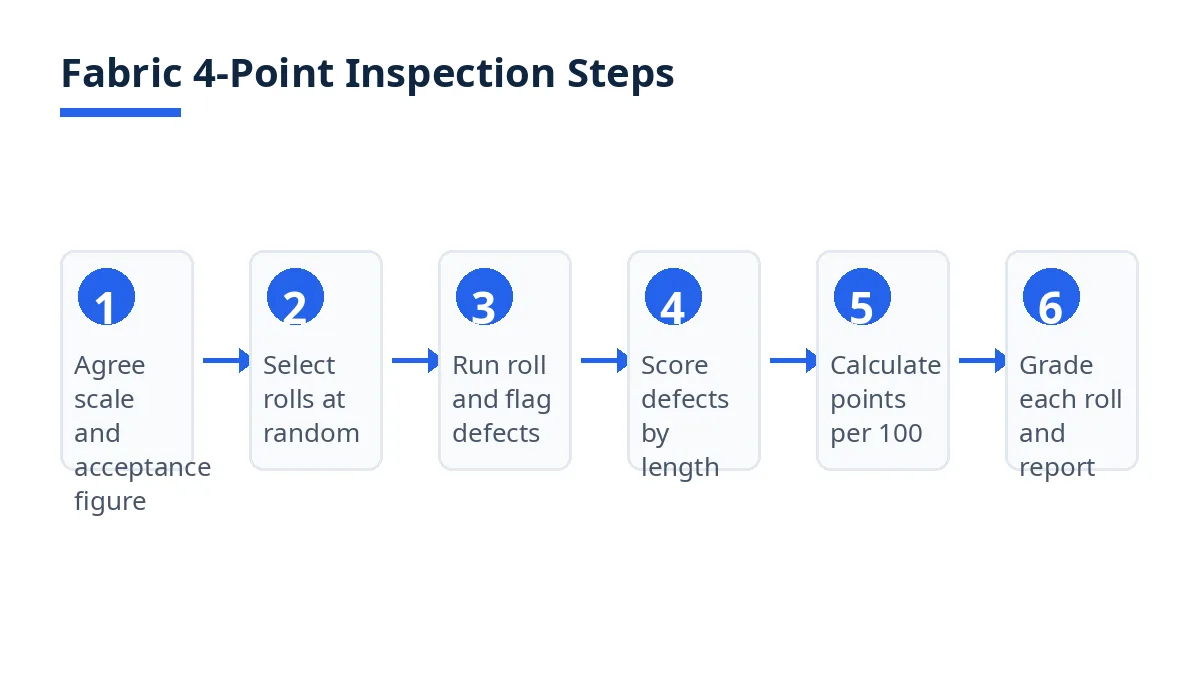
Agree the scale in the purchase specification. Write the fabric, colourway, width, roll share, defect list, and acceptance figure in points per 100 square yards or per 100 square metres. The acceptance figure is a commercial agreement between buyer and seller, not a number this guide sets, and one reference sets out different allowed points for different fabric groups.1
Select the rolls at random, and do not swap them. The inspector picks the rolls, and a roll once chosen is not replaced with a cleaner roll. One reference gives a sliding plan in which the smaller the lot, the larger the share inspected: 20 percent up to 2,500 yards, 10 percent from 2,501 to 5,000 yards, and 8 percent from 5,001 to 20,000 yards.1 Agree your own share in writing.
Set up the machine, the light, and the approved standard. The fabric passes over the inspection frame at an angle of 45 to 60 degrees to the inspector, under overhead cool white fluorescent light, with a backlight used when needed, and the approved bulk dye-lot standard should be on hand before starting.1 Check shade continuity within each roll: centre against selvedge, beginning, middle, and end.1
Run the roll and flag every defect. The inspector works through the selected roll, marks each defect on the fabric, and records its length and position. The frame runs at 20 plus or minus 5 yards per minute, or 18 plus or minus 5 metres per minute, in the reference that sets out the method.1 A faster run saves time and misses small faults.
Score each defect by the penalty scale. Faults are scored with penalty points of 1, 2, 3, and 4, according to their size and significance, and each defect is counted separately even when its nature is the same.1 The scale in that reference is:
Defect length
Penalty points
Up to 3 inches (up to 8 cm)
1
Over 3 inches up to 6 inches (over 8 cm up to 15 cm)
2
Over 6 inches up to 9 inches (over 15 cm up to 23 cm)
3
Over 9 inches (over 23 cm)
4
No more than 4 points can be assigned to any single defect, no linear yard or metre can contain more than 4 points, and a continuous defect over 9 inches earns 4 points for each yard or metre in which it appears.1 Each full-width defect earns 4 points, and obvious, noticeable, and severe defects earn 4 points for each yard or metre in which they occur.1 Hole treatment differs between published summaries, so write the hole rule into the defect list before the visit.
Calculate the roll score. The yard formula in one published summary is points per 100 square yards equal to total points multiplied by 36 and by 100, divided by roll length in yards multiplied by fabric width in inches.4 With new figures, a roll with 18 total points, 90 yards inspected, and a cuttable width of 58 inches gives (18 times 3600) divided by (90 times 58), or 12.41 points per 100 square yards. The metric form, from a second firm, is total points multiplied by 10000, divided by length in metres multiplied by cuttable width in centimetres.2
Grade each roll, then judge the lot. A roll whose score exceeds the agreed figure is removed from the shipment, and a shipment is rejected when its point total exceeds the allowable limit in that agreement.1 One published summary states that rolls containing 40 points per 100 square yards are normally accepted, while another firm applies its own house limits per 100 square metres, so treat 40 as an attributed example, not as a universal pass mark.4 Each inspected roll carries a tag, which nobody removes before cutting, and the report records the mill name, order and roll numbers, ticketed and actual lengths, cuttable width measured three times, total points, score, and comments.1
Costs, timelines and documents
No single fabric 4-point inspection fee applies across Bangladesh. A quote is built from inspected length, roll share, defect load, inspector days and sites, machine availability, report detail, travel, and re-inspection.
Pricing models: per man-day, per roll, or a mix
One pricing guide describes per man-day pricing as the most common model, in which a fixed rate covers one inspector working one full day at the factory, and per-piece pricing as used where every unit is checked rather than sampled.5 Fabric roll work is often quoted as a per man-day rate, a per-roll rate, or a man-day rate with a per-roll element above an agreed daily throughput. One firm states that it can check 1,500 to 2,000 metres in a man-day where the factory has a proper fabric inspection machine.2 Ask what the rate includes, including travel, the photo report, waiting time, a second site, weekend working, and re-inspection, before comparing quotes.
Example figures: how a quote adds up
Example figures only. Every money figure in this table is an Example figure, invented to show the arithmetic, not quoted from any firm and not a market rate. Confirm every figure in the firm's written quote.
Example case | Example figures arithmetic | Example figures total |
|---|---|---|
Example A: small lot, one day, machine available | Example figures: 1 man-day at 300 plus 20 rolls at 8 per roll | Example figures: 460 |
Example B: medium lot, two days, two sites | Example figures: 2 man-days at 300 plus 40 rolls at 8 per roll plus 60 travel | Example figures: 980 |
Example C: small lot plus re-inspection | Example figures: 1 man-day at 300 plus 20 rolls at 8 per roll plus 1 re-inspection day at 300 | Example figures: 760 |
Example A and Example C differ only in the re-inspection day, which is why a quote that leaves re-inspection out looks cheaper until a fail makes it necessary.
Example timeline only, not a promise
Example timeline only. This timeline is an illustration, not a promise and not a firm turnaround. Confirm every date in the firm's written booking confirmation. Agree the specification, roll share, defect list, and acceptance figure before booking, book once the rolls are ready and the machine is available, and receive the roll-by-roll report before cutting. Agree correction, replacement, or re-inspection for failed rolls before cutting them.
Documents to prepare
Send the firm a complete reference set before the visit: the purchase order with fabric, colourway, width, and quantity; the approved bulk dye-lot standard; the defect list with the penalty scale, hole rule, continuous-defect rule, and cuttable-width rule; the agreed acceptance figure, with roll and lot rules stated separately; the roll list; the cuttable width requirement; the report format; the payer, fail, and re-inspection terms; and a cutting hold instruction until each roll is cleared.
Bangladesh-specific rules and tips
The inspection visit happens inside a working mill or garment factory, not in a laboratory. Inspectors cover the main manufacturing zones, including Dhaka, Gazipur, Narayanganj, and Chittagong.6 Confirm the factory location, inspection machine, and working hours before booking, because a visit to a site without a working machine costs a day without producing a score. Dhaka traffic congestion can affect scheduling, and monsoon flooding from June to September can disrupt production and logistics in Bangladesh, so build a buffer day into the cutting schedule and confirm the factory calendar around holidays and closures.6
Shade and width need extra care in orders that mix dye lots. Shade variation between rolls and between dye lots is among the most frequent fabric issues, and a roll score alone does not capture a shade break across a lot.3 Ask the report to record shade continuity roll by roll, centre against selvedge and beginning against middle against end, so cutting can group matching rolls together. Ask the same for cuttable width, measured at the start, middle, and end of the roll.
For the service listing, note this caveat exactly: the Exportain inspection services page currently renders "No services published in this category yet", so use the link as a category page to watch rather than as a list of available providers. The link is inspection services with that caveat stated.
Mistakes and red flags
Accepting a lot average with no roll scores. Ask for the score of every inspected roll, and hold any roll whose score is missing.
Leaving the acceptance figure unwritten. Write the roll figure and the lot figure into the purchase specification before the visit.
Letting the factory choose the rolls. Insist on random selection by the inspector, with no swaps.
Scoring a continuous defect once for the whole roll. A continuous defect earns points for each yard or metre in which it appears.
Cutting before the report arrives. Hold cutting of inspected rolls until each roll is cleared in writing.
Red flags include a single lot score with no roll breakdown, photographs that cannot be matched to a roll number, a missing cuttable width, a missing length variance, and a pass statement with no acceptance figure beside it.
Checklist
[ ] Fabric, colourway, width, and quantity in the purchase specification
[ ] Defect list agreed, including the penalty scale, hole rule, and continuous-defect rule
[ ] Acceptance figure agreed for each roll and for the lot
[ ] Roll share agreed for each pattern, colourway, and print, with random selection by the inspector
[ ] Factory location, working hours, and calendar confirmed, with a buffer day in the cutting plan
[ ] Report format agreed: roll scores, defect photographs, length and width variances, inspector comments
[ ] Payer, fail terms, and re-inspection terms agreed in writing
[ ] Cutting hold in place until the report is received and each roll is checked
[ ] Report filed with the order and the cutting plan
How Exportain helps
Exportain connects international buyers with Bangladeshi sellers and service providers. Post a request that states the fabric, roll share, defect list, acceptance figure, sites, and report format, so replies arrive on a comparable scope, and confirm the payer, fail, and re-inspection terms in writing before booking.
For the service listing, note this caveat exactly: the Exportain inspection services page currently renders "No services published in this category yet", so treat the link as a category page to watch rather than as a list of available providers. The link is inspection services with that caveat stated. The pre-shipment inspection guide explains the finished-goods sampling inspection that follows fabric inspection. Exportain does not itself inspect fabric, and it does not set your acceptance figure.
FAQs
What should I know first about the fabric 4-point system?
Know three things first. The system scores fabric rolls by defect length, it caps the score at 4 points per linear yard or metre, and it converts each roll total into points per 100 square yards or square metres.
What are the typical costs and timelines?
There is no typical cost or timeline that holds for every fabric order in Bangladesh, because the total follows the inspected length, roll share, inspector days and sites, report detail, travel, and re-inspection terms. Compare itemised written quotes for the same scope, and confirm the report date in the booking confirmation.
Which documents are needed?
The purchase order with fabric, colourway, width, and quantity, the approved bulk dye-lot standard, the defect list with the penalty scale and hole rule, the agreed acceptance figure for each roll and for the lot, the roll list, the cuttable width requirement, the report format, and the payer, fail, and re-inspection terms. One sentence on a neighbouring method, for orientation only: AQL is a separate sampling decision for finished goods judged under ISO 2859-17, and it is not the same as a fabric roll score, so read the Acceptance Quality Limit guide before setting any finished-goods sampling plan.
What are the most common mistakes?
Leaving the acceptance figure unwritten, letting the factory choose the rolls, scoring a continuous defect once for a whole roll, cutting before the report arrives, and comparing quotes with different roll shares or report formats.
Next steps on Exportain
Start with the purchase specification, not with the booking. Write the fabric, defect list, roll share, and acceptance figure, then ask for itemised quotes on that exact scope. Read the pre-shipment inspection guide for the finished-goods inspection that follows fabric inspection.
Post a free RFQ on Exportain at https://exportain.com/rfqs with the fabric, roll share, defect list, acceptance figure, sites, and report format stated. Hold cutting of inspected rolls until the roll-by-roll report is received and each roll is cleared.
Sources
- Fabric Inspection and Terms. Textile School (accessed )
- Fabric Inspection: How It's Done. Sofeast (accessed )
- Fabric Inspection & Quality Control Services. Tetra Inspection (accessed )
- 4-Point Fabric Inspection System: Ensuring Fabric Quality. Silorga (accessed )
- How Much Does Product Inspection Cost? 2026 Pricing. Tetra Inspection (accessed )
- Quality Control in Bangladesh. Tetra Inspection (accessed )
- ISO 2859-1:2026 — Sampling procedures for inspection by attributes — Part 1: Sampling schemes indexed by acceptance quality limit (AQL) for lot-by-lot inspection. ISO (accessed )
About the author
Sourcing from Bangladesh?
Post a request for quotation and suppliers on Exportain can send you their quotes directly.
Post an RFQ


