Using Export Factoring When Buying From Bangladesh: Bank Rules and Tips
Export factoring for Bangladesh sourcing: how a seller sells its invoice for an advance, what the buyer pays and to whom, and the Bangladesh framework position.
Short answer
Export factoring means a Bangladeshi seller sells its invoice to a factor for an advance, and the factor collects from the buyer. For a buyer, the key points are which account to pay after a disclosed assignment, how disputes are handled, and that no fee, advance rate, or timeline in a guide replaces the factor written offer for the specific deal.
On this page
Key takeaways
Export factoring is the sale of a seller's invoice to a factor for an advance, with the factor collecting from the buyer; it is not a bank payment undertaking and not a held-funds arrangement.
In a disclosed two-factor deal the buyer pays the import factor's account as notified, and paying the seller instead may not discharge the debt.
No fee, advance rate, or timeline in this guide is universal: opened sources describe different advance ranges, so the factor's written offer for the specific deal governs.
The opened material gives no Bangladesh-specific factoring fee, rate, or timeline, and Exportain's live pages describe no factoring product; its funds holds are not factoring.
A Bangladeshi seller shipping on open account terms has done the work before it is paid. The goods leave, the invoice is issued, and the wait for payment begins. Export factoring finances that wait: the seller sells its receivables to a factor for an advance, and the factor collects from the buyer.
Export factoring, as the International Trade Administration describes it, combines working capital financing, credit protection, receivables bookkeeping, and collection services: a factor purchases the exporter's short-term foreign receivables for cash at a discount from face value, normally without recourse.1 A letter of credit is a bank undertaking to pay against compliant documents; a funds hold is money held until agreed conditions are met. Factoring is the sale of an invoice, after shipment, on open account terms.
Why this matters for buyers and sellers
For a seller, factoring turns a receivable into working capital without waiting for the buyer's payment date. The International Trade Administration notes it allows the exporter to offer open account terms and can be an alternative to export credit insurance or bank financing.1
For a buyer, the effects are concrete. In a disclosed arrangement, the buyer is told the receivable has been assigned and is asked to pay the factor instead of the seller. In an undisclosed arrangement, the buyer keeps paying the seller, which passes the money on. Either way, the buyer should know which account to pay and what happens to a disputed invoice.
Factoring suits a particular shape of trade: the International Trade Administration describes it as suited for continuous short-term export sales of consumer goods on open account terms, and generally unsuitable for a new-to-export company, because factors generally do not take on a client for a one-time deal.1 The same guide states it generally does not work with receivables over 180-day terms.1
Step-by-step: how it works
The two-factor structure involves four parties: seller, buyer, export factor, and import factor. The International Trade Administration describes the sequence: the exporter signs with the export factor, which selects an import factor; the import factor checks the buyer's credit; once approved, the buyer orders on open account; the exporter ships and submits the invoice; and the import factor collects and pays.1
FCI describes the same model: the export factor assigns the invoices to the import factor, which becomes the legal owner of the receivables and provides buyer risk coverage and a collection service.2 After receipt of the buyer's payment the import factor immediately remits the full payment to the export factor.2
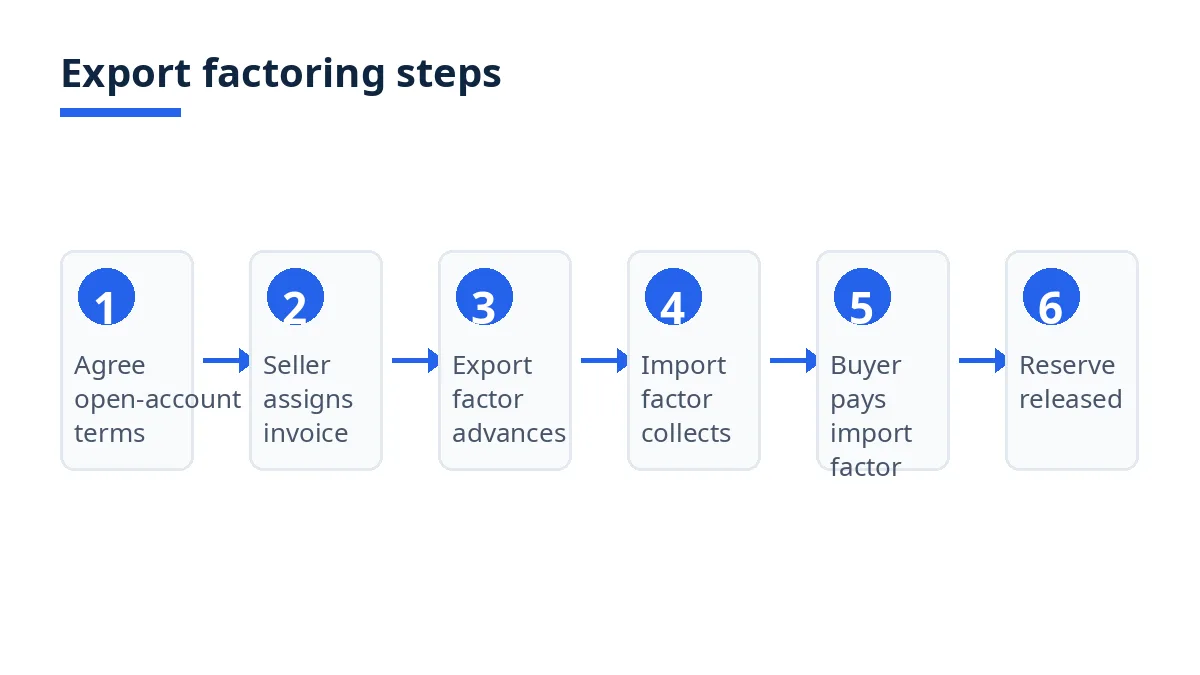
The seller signs a factoring agreement covering assigned receivables, disclosure, recourse, and disputed invoices. The buyer should ask for sale-contract confirmation that factored invoices will be identified.
The import factor approves a credit limit for the buyer, after investigating the buyer's credit standing locally before orders are placed on open account.1
The buyer orders and the seller ships on open account. No letter of credit is opened and no bank undertaking is issued. The sale contract, invoice, and factoring agreement govern the deal.
The seller assigns the invoice. In the FCI model, the import factor becomes the legal owner of the receivables.2 In a disclosed arrangement, the buyer is asked to pay only the import factor's account.2 Paying the seller instead may not discharge the debt.
The export factor advances a percentage of the invoice value to the seller, holding the balance as a reserve until the buyer pays. The exact percentage, reserve, and charges are set in the factoring agreement, and no figure here is any particular factor's figure.
The factor collects from the buyer at maturity. The import factor handles local collection and payment of the receivable.1 The buyer pays the account named in the assignment notice, by the invoice due date.
The reserve is released to the seller. After the buyer's payment, the import factor remits to the export factor,2 which pays the seller the balance minus its charges. In the FCI model, if the buyer cannot pay and the invoice is undisputed, the import factor is obliged to pay under approval 90 days after the due date.2 That is an FCI model feature, not a promise every factor gives.
The diagram below summarises the sequence.
Three variants change the picture. With recourse factoring, the exporter retains the risk of non-payment and must reimburse the factor if the buyer fails to pay.3 With non-recourse factoring, the factor assumes that risk.3 Non-recourse protects the seller; it does not change the buyer's duty to pay a valid invoice.
In disclosed factoring, the buyer is informed and pays the factor. In undisclosed factoring, the buyer is not notified, keeps paying the seller, and the seller informs the export factor about every payment received.2 FCI notes a disclosure period, usually 30 to 60 days after the due date, in the undisclosed model.2 A direct model has only one factor.2 Reverse factoring runs the other way: exporters receive early payment based on buyer-approved invoices, as described in reporting on Bangladesh Bank's framework.4
Costs, timelines and documents
No fee, discount rate, advance percentage, or timeline in this section is a universal figure. Every figure below is a description from an opened source, or an example figure labelled as such. The factor's written offer for the specific seller, buyer, country, and tenor is the only figure that governs a real transaction.
On the advance, opened sources describe ranges, not a single rate: usually 70 to 90 percent in one guide,3 80 to 90 percent in the FCI model,2 and generally limited to 80 percent in the International Trade Administration guide.1 They do not agree, which is the point: the advance depends on the factor, the buyer limit, and the agreement.
On cost structure, the International Trade Administration distinguishes two arrangements. In discount factoring, the cost is variable, depending on the time frame and amount advanced. In collection factoring, the cost is fixed, usually 1 to 4 percent, depending on destination, volume, and paperwork.1 The same guide adds, as a rule of thumb, that export factoring usually costs about twice as much as export credit insurance.1 Treat that as the guide's description, not a quote, and ask for an itemised breakdown.
Timelines also come only from the specific agreement and model: the FCI model's 90-day-after-due-date payment under approval where the buyer cannot pay and the invoice is undisputed,2 the undisclosed model's disclosure period of usually 30 to 60 days after the due date,2 and the 180-day tenor limit.1 Confirm the advance timing, due date, and reserve release timing in writing.
Documents are whatever the factoring agreement requires; confirm the set before shipment. One guide lists the assignment of receivables, export invoices, and agreements between exporter and factor.3 In a disclosed two-factor deal, add the assignment notification letter,2 the invoice showing the factor's payment account, and the shipping documents evidencing the sale. A disputed invoice can block collection.2 Raise disputes promptly, in writing, with evidence.
An example: all figures here are example figures only, not a quote or a market average. A buyer in Canada orders cotton terry towels from a Bangladeshi seller for USD 62,500, on 60-day open account terms, under a disclosed two-factor non-recourse arrangement. The export factor advances an example 80 percent, USD 50,000, and holds an example reserve of USD 12,500. The buyer pays the import factor on the due date, and the reserve is released less the agreement's charges.
Bangladesh-specific rules and tips
The opened material contains no Bangladesh-specific factoring fee, rate, advance percentage, or timeline, and this guide states none. No provider count, market size, or factoring law is asserted here, because no opened source stated one. What the material supports is narrower: Bangladesh's trade finance system is built around letters of credit, and its framework for alternatives, including factoring, is recent and partial.
Reporting on Bangladesh Bank's framework notes that letters of credit remain a cornerstone of Bangladesh's trade transactions, while global practice increasingly embraces complementary instruments such as open account trade, supply chain finance, and factoring.4 Letters of credit will continue as a key tool, particularly for higher-risk transactions or new relationships.4 For a first order with a new seller, factoring may not be available at all.
The framework, as reported, gives authorised dealer banks wider authority to facilitate alternative instruments, including reverse factoring against buyer-approved invoices.4 Banks intending to introduce supply chain finance products must obtain regulatory acknowledgment from Bangladesh Bank's Foreign Exchange Policy Department-1 before launching.4 Ask whether the seller's bank has been through that process.
A second strand of reporting describes a discounting route rather than full factoring. In October 2025, Bangladesh Bank was reported to be preparing to allow exporters to use global discounting platforms, selling receivables for early cash.5 The same report notes exporters often wait three to four months for payment, and many buyers demand 60 to 90-day deferred terms.5
An older analysis, from 2021, describes a Bangladesh Bank circular on export under open account terms against payment undertaking or payment risk coverage, with an early payment option on a non-recourse basis, and comments that the rule focuses mostly on recovering export proceeds rather than full factoring services.6 That history warns against treating a press report about a new framework as a finished factoring market.
Practical tips: ask the seller early whether it factors its receivables, and on what structure; ask which bank or factor is involved and whether it has a framework product; get the assignment notice procedure in writing; keep the letter-of-credit route in reserve for first orders, since the framework reporting itself says letters of credit continue for those cases.4 Do not quote a Bangladesh factoring fee, rate, or timeline from this guide, because none is given here.
Mistakes and red flags
The most common factoring mistakes are assignment mistakes. Paying the seller after a disclosed assignment notice directed payment to the factor is the costliest, because the buyer may have to pay twice. Changing payment accounts on an unverified email is the fraud-shaped version of the same mistake. Non-recourse protects the seller, not the buyer, and does not change the buyer's duty to pay a valid invoice. Where a valid dispute has been raised, the factor's payment under approval may not follow.
Red flags include a seller that cannot name its factor, a payment instruction that changes after shipment without a formal assignment notice, an invoice showing a factor's account but no notification letter, and a term longer than 180 days presented as factorable without written confirmation. Pause on any of these before shipping or paying. Factoring finances an invoice; it does not inspect goods or resolve disputes. Those matters still belong in the sale contract.
Checklist
Use this checklist before agreeing open account terms with a seller that may factor the invoice, and again when the first factored invoice arrives.
[ ] The sale contract states the payment term, currency, due date basis, and dispute procedure.
[ ] The seller has confirmed whether the receivable will be factored, and whether the arrangement is disclosed or undisclosed.
[ ] The recourse position is stated: with recourse, the seller reimburses the factor on buyer default; without recourse, the factor assumes the risk.
[ ] The factor model is known: two-factor, direct single-factor, or reverse factoring on buyer-approved invoices.
[ ] The buyer's credit limit with the import factor covers the planned order values.
[ ] The assignment notice procedure is written down: sender, buyer contact, form, and first shipment covered.
[ ] The payment account on each factored invoice matches the assignment notice, and any change is verified before payment.
[ ] The advance percentage, reserve, charges, and reserve release timing are stated in the factoring agreement.
[ ] The dispute route is agreed: prompt written notice, evidence, and the effect of a valid dispute.
[ ] The seller's bank or factor product has been checked against the framework acknowledgment described above.
[ ] A letter-of-credit alternative is kept in reserve for first orders.
How Exportain helps
Exportain connects buyers with Bangladeshi suppliers and providers. Payment for goods is settled directly between buyer and supplier on the terms in the accepted quotation, unless both sides agree to a funds hold, which the buyer may pay or decline. Those points are stated on Exportain's live buyer protection and payment terms pages. Neither page describes a factoring product, and this guide does not present funds holds as factoring: a funds hold is money held until agreed conditions are met, while factoring is the sale of an invoice for an advance.
Agree the payment term in the quotation record before either side approaches a factor or a bank: open account or not, whether the seller may factor the invoice, whether assignment will be disclosed, and which account the buyer must pay. Exportain does not issue factoring, act as a party to the goods contract, or guarantee payment, quality, or delivery.
FAQs
What should I know first about export factoring?
Know first that factoring is the sale of a seller's invoice to a factor for an advance, not a bank payment undertaking and not a held-funds arrangement.1 In a disclosed arrangement the buyer pays the factor's account as notified. Confirm recourse, disclosure, and factor model before the first factored shipment.
What are the typical costs and timelines?
There are no typical costs or timelines that can be quoted safely for every transaction. Opened sources describe advances of 70 to 90 percent in one guide,3 80 to 90 percent in the FCI model,2 and a general limit of 80 percent in the International Trade Administration guide.1 Collection factoring costs are described as usually 1 to 4 percent.1 FCI timelines include payment under approval 90 days after the due date where the buyer cannot pay and the invoice is undisputed.2 Confirm every figure with the factor.
Which documents are needed?
Only the documents the factoring agreement requires are needed. One guide lists the assignment of receivables, export invoices, and agreements between exporter and factor.3 In a disclosed two-factor deal, add the assignment notification letter,2 the invoice showing the factor's payment account, and the shipping documents evidencing the sale. Raise disputes promptly, in writing, with evidence.
What are the most common mistakes?
The most common mistakes are paying the seller after a disclosed assignment notice directed payment to the factor, changing payment accounts on an unverified email, assuming non-recourse protects the buyer, assuming factoring covers disputed invoices, and quoting a guide figure as if it were a factor's offer. Confirm the assignment notice, payment account, and written terms before shipment and before payment.
Next steps on Exportain
Start with LC meaning (Letter of Credit), then Exportain payment terms and Exportain buyer protection. When the factoring question is settled in principle, post an RFQ on Exportain and ask quoting suppliers to confirm whether they factor their invoices, on what structure, and which account a buyer must pay.
Sources
- Export Factoring. International Trade Administration, U.S. Department of Commerce (accessed )
- International Factoring - Products. FCI (accessed )
- Export Factoring. eCapital (accessed )
- BB unveils framework for alternative trade finance mechanisms. Bangladesh Pratidin, (accessed )
- How invoice discounting will help exporters get faster payments. The Business Standard, (accessed )
- Rules need further reforms for smooth global trade finance. The Daily Star, (accessed )
About the author
Sourcing from Bangladesh?
Post a request for quotation and suppliers on Exportain can send you their quotes directly.
Post an RFQ