

Electrical Cables Price in Bangladesh: FOB Cost Breakdown for Buyers
An FOB price for electrical cables covers production, packing, inland transport, export clearance and loading on board, but not ocean freight or insurance. Learn to read the itemized lines, check the documents, and compare suppliers on the same boundary.
Short answer
An FOB price for electrical cables from Bangladesh covers production and packing, inland transport to the port, export clearance and documentation, and port handling and loading on board the vessel you nominate. Risk passes to you once the goods are on board. Ocean freight, marine insurance, import clearance and destination transport sit outside the FOB price and stay with you as buyer. Compare quotations only on the same specification, port and included lines.
On this page
Key takeaways
An FOB price covers production and packing, inland transport, export clearance and documentation, and port handling and loading on board; ocean freight, insurance and destination costs sit outside it.
Risk passes to the buyer once the goods are on board the nominated vessel, and the buyer must nominate the vessel and loading point in time.
No single FOB figure holds across cable types: compare only quotations for the same specification, HS subheading, port and included lines.
Every figure in the worked example is labelled as example figures showing structure only, never a market price.
The Bill of Export, invoice, packing list, EXP form and certificate of origin must agree on the FOB value before shipment.
An FOB quotation for electrical cables from Bangladesh answers one narrow question: what does the seller charge to get the cable made, packed, cleared for export and loaded on board the vessel you nominate at the named port of shipment. Everything after loading, including ocean freight, marine insurance and import clearance, sits outside that price and stays with you. When two quotations differ, the difference is usually in what each seller counted inside that boundary, not in the cable alone.
This guide shows how to read an FOB quotation line by line, so you can compare suppliers on the same basis and ask for missing lines in writing before you confirm.
What an FOB price for electrical cables actually includes
Under the Incoterms 2020 rules, FOB means Free On Board: the seller delivers the goods loaded on board the vessel nominated by the buyer at the port of shipment, and at that point the risk of loss or damage transfers to the buyer.1 The seller transports the goods to the port, loads them on board and completes export formalities.1 The buyer designates the carrier, pays freight to the destination port, and handles import and any transit customs formalities.1
That boundary is the whole point of an FOB price: it is neither a delivered price nor a factory-gate price.
FOB applies only to sea or inland waterway transport.1 Where goods are containerised, the seller typically delivers them to a terminal rather than on board, and containers may stay there for days before loading. In such cases FCA (Free Carrier) is the more appropriate rule.1 Ask your supplier and forwarder which rule matches the handover, and write it into the purchase order.
What should I know first about electrical cables?
For customs purposes, electrical cables fall under heading 8544: insulated wire, cable and other electric conductors, whether or not fitted with connectors, and optical fibre cables made up of individually sheathed fibres.2 The subheadings split by construction: copper winding wire at 8544.11, coaxial cable at 8544.20, wiring sets for vehicles, aircraft or ships at 8544.30, conductors up to 1,000 volts fitted with connectors at 8544.42 and without connectors at 8544.49, conductors above 1,000 volts at 8544.60, and optical fibre cables at 8544.70.2
That split matters because each subheading describes a different product, differing in conductor metal, insulation, sheathing, armouring, packing and testing, and each difference moves the price. State the subheading, conductor, voltage, cores, cross-section, insulation and sheath, length per drum or coil, and whether connectors are fitted. Without that specification, two FOB quotations can price different cables.
Ask the supplier to name, in writing, the standard the cable is made and tested to, and to supply the batch test certificate. This guide names no single standard for all cable types, because the applicable standard depends on the construction and your destination market. A supplier that cannot name the standard has not answered the specification question.
Why this matters for buyers and sellers
For the buyer, the FOB boundary decides how much of the landed cost you control: under FOB you choose the carrier and negotiate ocean freight. The trade-off is that risk passes to you once the goods are on board,1 so insurance and import documents must be arranged before loading.
For the seller, the FOB price must absorb every cost up to loading. A seller that under-prices any line either recovers the gap later or delivers a thinner specification. Compare only the lowest figure for the same specification, port, packing and included lines.
Step-by-step: how it works
Write one specification sheet and send it to every candidate. State the cable type, conductor, voltage, cores, cross-section, insulation and sheath, length per drum or coil, packing, expected HS subheading,2 standard and test certificate required.
Ask for the FOB price itemized, not as a single figure. Ask for production and packing, inland transport, export clearance and documentation, port handling, and loading as separate lines, with the port named.
Name the port and the vessel process in writing. Under FOB, the buyer must inform the seller in time of the vessel name and loading point within the port.1 Confirm who nominates the vessel and by what date: if the seller cannot load because no vessel is available, the buyer bears the risk and cost of port storage until it arrives.1
Approve a sample and the test evidence before bulk production. Ask for a sample in the actual conductor, insulation and sheath specified, and the matching test certificate. Record approval or corrections in writing.
Confirm the document set against the FOB value. The export declaration and the invoice carry the FOB value, so their figures must match the accepted quotation. Confirm the document list before shipment, not at the port.
Compare quotations only on the same boundary. Convert every reply to the same port, specification and included lines before ranking them. A quotation excluding loading is not comparable with one including it.
Costs, timelines and documents
What are the typical costs and timelines?
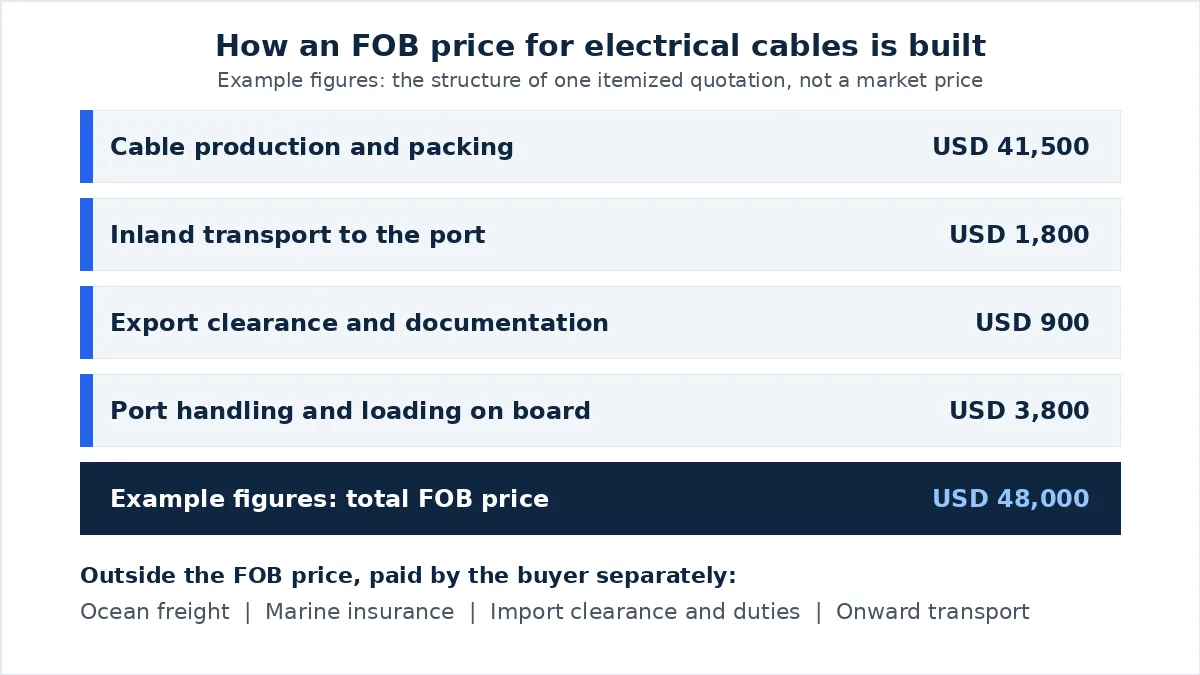
There are no typical FOB costs or timelines that hold for all electrical cables, because specification, order length, packing and port all move the figure. Require the structure instead, and judge each supplier on its own itemized lines. The example below shows that structure only. Example figures: the table illustrates how an FOB total is built, not a market price or a quotation for any cable type.
FOB cost line | Example figures | What to check |
|---|---|---|
Cable production and packing | USD 41,500 | Specification, drums or coils, marking |
Inland transport to the port | USD 1,800 | Named port of shipment |
Export clearance and documentation handling | USD 900 | Document list agreed before shipment |
Port handling and loading on board | USD 3,800 | Loading included, not alongside only |
Example figures: total FOB price | USD 48,000 | Sum of the four lines above |
Costs outside the FOB price, which you arrange separately, include ocean freight, marine insurance, import clearance and any duties or taxes at destination, and onward transport. No duty rate is stated here, because it depends on the destination tariff schedule for the exact HS subheading. Ask your forwarder or broker to confirm it first, and keep it apart from the FOB quotation.
For timelines, ask for sampling, production, inspection, port delivery and loading as separate dates, not a single delivery week. Production depends on material and drum availability and test scheduling, and loading on the vessel you nominate. If the vessel is delayed, the buyer bears the risk and cost of port storage until it arrives.1
Which documents are needed?
For export clearance in Bangladesh, goods shall not be loaded or shipped for export unless an export declaration, the Bill of Export or Shipping Bill, is submitted to Customs in the prescribed format and approved, with the description of goods, value, exporter, foreign buyer and transport operator specified.3 Enclosed documents include the export letter of credit, or where there is none, the export contract, purchase order or export guarantee approved by the negotiating bank, the commercial invoice signed by the exporter, the packing list, the EXP form certified by Authorized Dealers, the certificate of origin issued by the Export Promotion Bureau or a Chamber of Commerce and Industry, the VAT registration certificate, and the Taxpayer Identification Number.3
For the buyer, the working set is the specification sheet, the itemized quotation, the purchase order naming the Incoterm and port, the sample approval, the batch test certificate, the invoice, the packing list, the Bill of Export copy and the bill of lading showing the goods on board. Bangladesh Bank's consolidated circular sets out the EXP form as the statutory declaration furnished before shipment, with fields for commodity, destination, quantity, currency, Incoterm used and the invoice value split into FOB, insurance and freight.4 Check that the FOB value on the EXP form and invoice matches your quotation: a mismatch surfaces at the bank or at destination customs, not at the factory.
Bangladesh-specific rules and tips
Keep the FOB value consistent across every paper. The Bill of Export carries the description, value, exporter and buyer,3 and the EXP form carries the FOB value alongside the Incoterm used.4 If the papers differ, ask the supplier to correct them before loading.
Confirm the vessel nomination process early. Under FOB, the buyer informs the seller of the vessel name and loading point in time,1 and late notice can shift risk and costs to the buyer even before loading, where the goods cannot be loaded as a result.1 Agree the nomination deadline, the fallback if the vessel changes, and who pays port storage.
Check the destination rules separately from the Bangladesh export set. The export documents prove the goods left in order; they do not prove the cable meets your market's safety, marking or certification rules. Confirm with your broker or testing body whether a separate certificate is needed on arrival, and ask for any unverified point in writing rather than treating the FOB price as evidence of compliance.
Do not compare FOB with CIF or EXW as if they were the same price. CIF adds freight and insurance to the destination port, while EXW stops at the seller's premises, and under FOB the seller completes export formalities while the buyer contracts the carrier.1 Convert every quotation to the same term and port first, and read the guide on the best Incoterm for importing electrical products from Bangladesh before choosing a term for a containerised shipment.
Mistakes and red flags
What are the most common mistakes?
Accepting a single-figure FOB price. A headline figure hides whether loading, port handling or documentation are included. Ask for the itemized lines and the named port first.
Comparing cables on different specifications. A lower price on a thinner conductor, lower voltage rating, unarmoured construction where armouring was specified, or different packing is a different product. Compare only replies to the same specification sheet and HS subheading.2
Assuming FOB covers freight or insurance. Under FOB the buyer contracts the carrier and pays freight,1 and arranges insurance. If a quotation appears to include freight, ask the supplier to restate it on one term.
Using FOB for a container handed to a terminal. Where the seller delivers to a terminal days before loading, the goods sit outside the seller's control while risk under FOB still runs to loading.1 Ask whether FCA fits the handover better, and record the agreed rule in writing.
Treating a profile or a badge as proof of cable capability. A profile is a starting point for enquiries. It does not test whether a factory can make your construction to the standard named. Sample approval and the batch test certificate answer that question.
Confirming the order before the document set is agreed. The Bill of Export, invoice, packing list, EXP form and certificate of origin must agree,3 4 and the bill of lading must show the goods on board. Agree the list and the FOB value on each paper before shipment.
Checklist
Before you confirm, every line should be answered in writing.
Specification sheet sent: cable type, conductor, voltage, cores, cross-section, insulation, sheath, length per drum or coil, packing, expected HS subheading.2
FOB price itemized: production and packing, inland transport, export clearance and documentation, port handling, loading, with the port named.
Delivery term written as FOB plus the named port and the Incoterms 2020 rules, with the vessel nomination deadline agreed.1
Sample approved in writing, and the batch test certificate requested.
Document list agreed: purchase order, invoice, packing list, Bill of Export, EXP form with matching FOB value, certificate of origin, bill of lading.3 4
Costs outside FOB priced separately: freight, insurance, destination clearance and duties, onward transport.
Destination-market requirements confirmed with your broker or testing body.
Quotations compared only on the same specification, port and included lines.
How Exportain helps
On Exportain, browse suppliers and post a request for quotation (RFQ) on the RFQ board with your specification sheet, expected HS subheading, port of shipment and the FOB lines you want itemized, so suppliers quote against the same boundary. Ask each reply to state the port, the loading line, the document list, the standard and the batch test certificate.
Read the badges for what they record. Verification is a document and photo review, not a factory inspection, and membership plans are a separate product and never grant a trust badge.5 Verification is free, and Exportain staff review every submission.5 Sample approval and batch testing stay with you, because a badge does not test a cable construction. See how supplier verification works on Exportain and the MOQ definition guide.
FAQs
What should I know first about electrical cables?
Start with the specification, not the price. Electrical cables sit under HS heading 8544, split into winding wire, coaxial cable, conductors up to and above 1,000 volts with or without connectors, and optical fibre cables.2 State the conductor, voltage, cores, cross-section, insulation, sheath and packing, and ask for the standard and batch test certificate.
What are the typical costs and timelines?
There are no typical FOB figures across cable types, because specification, order length, packing and port move the price. Require the price itemized into production and packing, inland transport, export clearance and documentation, and port handling and loading, and treat worked figures here as example figures showing structure only. Ask for sampling, production, inspection, port delivery and loading as separate dates.
Which documents are needed?
The Bangladesh export set enclosed with the Bill of Export includes the export contract or purchase order where there is no letter of credit, the invoice, the packing list, the EXP form certified by an Authorized Dealer, the certificate of origin, the VAT certificate and the Taxpayer Identification Number.3 Add your specification sheet, sample approval, batch test certificate and the bill of lading showing the goods on board.
What are the most common mistakes?
The most common mistakes are accepting a single-figure FOB price, comparing different specifications or delivery terms as if they were the same offer, assuming FOB covers freight or insurance, using FOB for container cargo handed to a terminal, and treating a badge as proof of capability. Each is avoided by the same discipline: one specification, one named port, itemized lines, and every agreement in writing.1
Next steps on Exportain
Browse suppliers, then post your specification sheet, expected HS subheading and the FOB lines you want itemized on the RFQ board so suppliers quote on the same boundary. Before you confirm, read how to import electrical cables from Bangladesh and the HS code for electrical cables guide, and check the electrical cables quality control checklist for the sample and batch checks to agree in writing.
Sources
- FOB & FAS Incoterms® 2020 explained: Key differences. ICC Academy (accessed )
- Classification Detail — HS 2017 Code 8544: Insulated wire, cable and other electric conductors. United Nations Statistics Division (UNSD) (accessed )
- Customs Clearance Procedures for Export. Bangladesh Customs, National Board of Revenue (accessed )
- Consolidated circular on foreign exchange regulations — export trade transactions (FEPD-1 Circular No. 26, July 30, 2026). Bangladesh Bank (accessed )
- Supplier verification: Earn trust badges buyers can see. Exportain (accessed )
- landed cost
- export documents
- fob
- supplier verification
- buyer guide
- Bangladesh sourcing
- Electrical products
About the author
Sourcing from Bangladesh?
Post a request for quotation and suppliers on Exportain can send you their quotes directly.
Post an RFQ


