Duvet Covers Exporters in Bangladesh: Verified Supplier Checklist
A ten-block checklist for vetting duvet cover exporters in Bangladesh for repeat programmes: documents, capacity, fabric route, closure and tie evidence, samples, terms, labels, shipment documents and re-qualification triggers.
Short answer
Vet a duvet cover exporter in Bangladesh for a repeat programme by checking identity and export registration, producer type and bed-linen capability, capacity across your drop calendar, fabric and dye route, closure and corner-tie evidence, samples and change control, repeat pricing, labels and certificates, shipment documents, and re-qualification triggers, with every fact filed as evidence before the first drop ships.
On this page
Key takeaways
A repeat programme needs a different test from a first order: the same cover must survive later dye lots, seasonal peaks and fabric-source changes.
File one evidence record per exporter covering documents, producer type, capacity, fabric route, construction evidence, samples, terms and re-qualification triggers.
Ask for closure, corner-tie and insert-spread evidence per drop, and treat any unapproved change to fabric, closure, tie or dye house as a failed drop.
Exportain badges record a document and photo review, not a factory inspection or a guarantee, and they never replace your own checks.
If you buy duvet covers from Bangladesh on a repeat programme, the question changes. A first order tests whether one exporter can make one cover. A repeat programme tests whether the same exporter can make the same cover again, in a later dye lot, at a seasonal peak, after a fabric source changes, without the closure, shade or fit drifting.
Product inspection has its own place. This article checks the exporter and the evidence behind each drop, and defers piece-by-piece inspection to the duvet covers quality control checklist.
Why this checklist matters
A duvet programme fails in ways a single order rarely shows. The first drop matches the sample, the second arrives a shade lighter, the third uses a different closure supplier, and by the fourth the corner ties are shorter and the insert bunches.
Repeat buying concentrates exposure: one exporter, one fabric route and one closure source carry every drop. Checking documents, capacity, fabric supply, construction evidence, samples, terms and re-qualification as one file turns a supplier list into a programme you can defend.
Before you start
Write one programme specification and send it unchanged to every candidate: sizes against your own insert sizes, fibre composition, weave and weight, closure type and position, corner ties, print or colour, labelling and packing, quantities per drop and destination markets.
Open one evidence file per exporter before you shortlist. If a fact is not in the file, treat it as unchecked. Agree the label plan now: under Regulation (EU) No 1007/2011, a textile product shall be labelled with the name and percentage by weight of all constituent fibres in descending order.1 ISO 3758 establishes a system of graphic symbols for care labelling.2
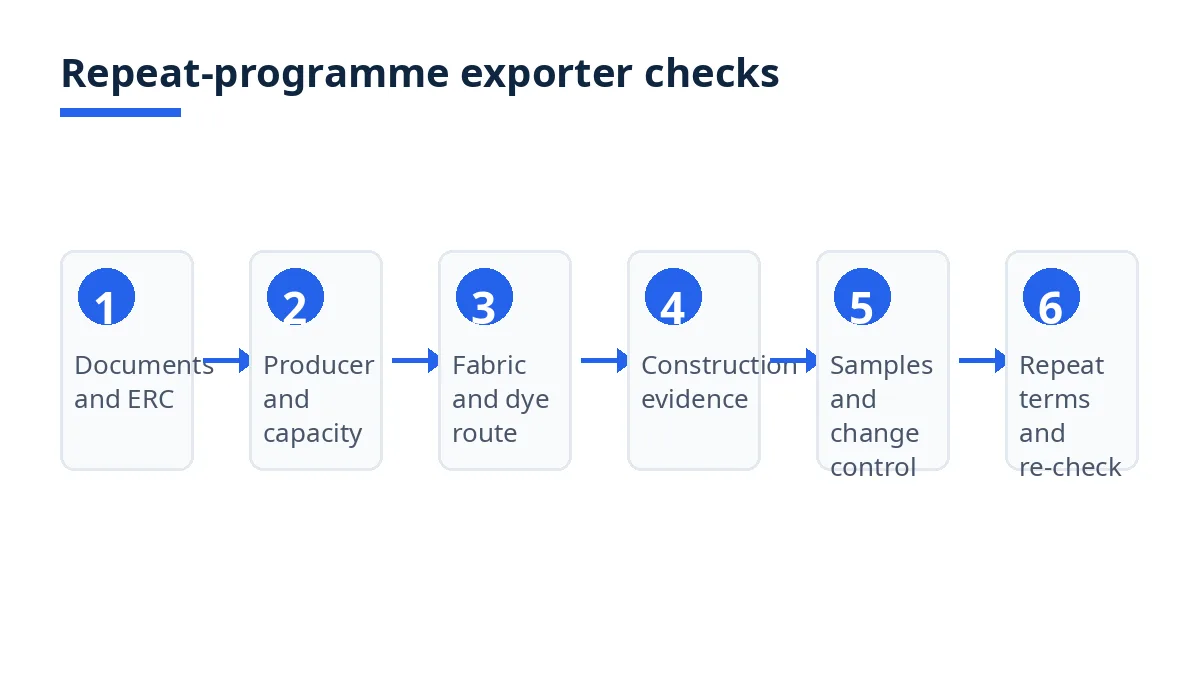
The full checklist (numbered, printable)
Work through the ten blocks in order.
Identity and export registration
Ask for the trade licence and, where provided, tax and incorporation documents. Names must agree across the licence, quotation, invoice and payment account.
Ask for the Export Registration Certificate (ERC): its number, expiry and holder. Match the holder to check 1.
Record what Exportain badges the profile shows, and what each covers. Exportain verification is a document review, not a factory inspection, and a badge is not a guarantee of capacity, quality or delivery.3 Verification is free, staff review every submission, and membership plans never grant a badge.4
Producer type and bed-linen capability
Ask who will actually make the covers and where: in-house, bought-in sheeting sewn in-house, or a trading company placing the order elsewhere. Record it in writing.
Ask for bed-linen evidence, not garment evidence: sheeting width, long-seam sewing, closure fitting and large-panel cutting. A garment reference does not prove a cover programme.
Where a woven-garment association membership is claimed, confirm it with the association, not from a website logo. The Bangladesh Garment Manufacturers and Exporters Association represents the woven, knitwear and sweater sub-sectors.5
Repeat-programme capacity and seasonality
Ask for capacity stated for your programme: covers per month at your size mix, and which drop would slip first.
Ask how many repeat drops the exporter already runs, and how long the longest has run.
Ask for the contingency: a second fabric source and closure supplier, and the plan if a dye lot is rejected.
Fabric, dyeing and printing supply
Ask where the sheeting comes from, who dyes or prints it, and whether the route is fixed for the programme.
Ask for the dye-lot record: lot numbers per drop, retained fabric per lot, and sorting that keeps one carton to one lot.
Ask what changes require your written approval: fabric mill, dye house, print house, fibre blend, finish.
Duvet construction evidence: closure, corner ties and insert spread
Ask for closure evidence per closure type: flap depth, button spacing, snap hold, or zipper travel, measured against the approved sample.
Ask for corner-tie evidence: tie position, length and material at every corner required, with stitching that holds when the insert is pulled.
Ask for insert-spread evidence: a cover fitted over the named insert, ties fastened, the insert shaken out, and the spread checked corner to corner. This fill-distribution evidence shows whether the insert stays spread.
Ask for the construction record kept per drop: closure supplier, tie tape source, and any change since the previous drop.
Samples, counter-samples and change control
Approve a pre-production sample in the actual production fabric, colour and finish, with the production closure and ties fitted, and keep one sealed counter-sample.
Ask for dimensional-change evidence on the production fabric where required. ISO 5077 specifies a method for determining dimensional change in washing and drying.6 Every report must name the bulk fabric, colour and lot.
Agree the change-control rule in writing: no change to fabric, closure, tie, dye house or packing without your written approval and a fresh sample where fit or shade changes.
Quotations and repeat-order terms
Compare quotations only on one specification, drop calendar and delivery term. Ask for an itemized price: fabric, dyeing, sewing, closure, finishing and packing.
Ask how repeat pricing works: which elements are fixed across drops, which move with fabric or dye costs, and how a change is notified. Example figures: holding fabric for two drops while re-pricing dyeing per drop differs sharply from a fixed annual price.
Ask for minimums per drop, per design and per colour, and for the cost of a top-up drop.
Labels, claims and certificates
Check the label plan against each destination market before bulk labels are printed: fibre names and percentages under Regulation (EU) No 1007/2011,1 care symbols under ISO 3758,2 and size and origin marking.
Check every claim against its certificate scope. Under OEKO-TEX STANDARD 100, the label is awarded only if all components meet the criteria.7
Ask for certificate expiry dates in the evidence file, with a named owner for renewal checks.
Shipment readiness and origin documents
Agree the inspection arrangement for every drop before the first drop ships: who inspects, against the approved sample, under what sampling plan, and what happens on rejection. ISO 2859-1 specifies an acceptance sampling system indexed by the acceptance quality limit (AQL) for lot-by-lot inspection, with switching rules for a continuing series of lots.8 Read the pre-shipment inspection guide and the AQL acceptance quality limit explainer first.
Check the document set for each drop against the purchase order: invoice, packing list, export filing and certificate of origin where required.
Ask how origin evidence is kept per drop, where a preference is claimed. Preference depends on origin paperwork for that shipment.
Re-qualification triggers
Write the re-qualification triggers into the agreement: producer change, fabric or dye-house change, payment account change, two failed drops, or a lapsed certificate.
Review the programme file once per season, even when drops pass: confirm the ERC is valid and the counter-sample still matches bulk.
Common failures and how to fix them
Shade drift is the most common repeat failure, usually from mixed dye lots at packing or an unapproved dye-house change. Fix: enforce the lot record from check 11 and re-sort complete sets before packing.
Closure and tie drift comes next: a different closure supplier or shorter tie tape, introduced without a fresh sample. Fix: hold bulk sewing until the check 16 record is signed off.
Silent producer change is harder to spot: the named factory subcontracts a drop without telling you. Fix: the check 4 producer statement, plus the check 29 trigger.
Capacity overcommit at the peak shows as late drops or rushed sewing. Fix: the check 7 peak-capacity answer, agreed before the programme starts.
Reading a badge as a programme approval is the quietest failure. A badge records which documents and photos were reviewed.3 Fix: keep this checklist as your own work.
Downloadable template / summary table
Copy the checklist into your programme file and record a result per exporter.
Block | Ask for | Keep |
|---|---|---|
Identity and registration | Licence, ERC number, expiry | Copies matching the payment account |
Producer and capability | Producer statement, bed-linen evidence | Statement, product record |
Capacity and seasonality | Monthly capacity, peak plan | Capacity answer, slip order |
Fabric and dye route | Mill, dye house, lot records | Route statement, lot record |
Construction evidence | Closure, tie, insert-spread evidence | Evidence per closure type |
Samples and change control | Pre-production sample, change rule | Written approval, counter-sample |
Quotations and terms | Itemized price, repeat pricing, top-ups | Versioned quotation, drop terms |
Labels and certificates | Label plan, certificate scope, expiry | Label approval, certificates |
Shipment and origin | Inspection plan, document set, origin file | Inspection record, document set |
Re-qualification | Trigger list, seasonal review | Trigger log, review note |
How Exportain helps
Exportain is a B2B marketplace connecting buyers with Bangladeshi suppliers, so these checks can start at the enquiry stage: compare profiles, ask for the documents behind checks 1 to 3, and agree the specification before any quotation. Browse suppliers, read the seller verification page and the trust center, and read how to import duvet covers from Bangladesh for ordering, shipping and duty. Profiles show which document and photo checks have been recorded, not factory inspections. Exportain is not a party to the goods contract.
FAQs
When should this checklist be used?
Use it before committing a repeat programme, and again whenever the producer, fabric source, dye house, closure supplier or payment account changes. Run document checks at shortlist stage and shipment checks before every drop.
Who should complete it?
The buyer completes it. The person who signs the programme agreement should own the evidence file. An agent or inspector can gather evidence, but the document checks and choice of exporter stay with the buyer.
What are the most common failures?
Shade drift, closure and tie drift, an undisclosed producer change, capacity overcommit at the peak, and a badge read as a programme approval. Each failure is a skipped check. Return to it, close it in writing, and only then move forward.
Can a third party do it?
Yes, in part. An inspector you appoint can inspect each drop against your approved sample under a sampling plan agreed in advance, such as the AQL-indexed lot-by-lot system in ISO 2859-1.8 The document checks and choice of exporter stay with you.
Next steps on Exportain
Start with suppliers, open one evidence file per exporter, and work the ten blocks in order. Then read the duvet covers quality control checklist, and post your programme as a free RFQ via RFQs.
Sources
- Regulation (EU) No 1007/2011 on textile fibre names and related labelling and marking of the fibre composition of textile products. European Union, (accessed )
- ISO 3758:2023 - Textiles — Care labelling code using symbols. International Organization for Standardization (accessed )
- Trust & Safety Center. Exportain (accessed )
- Supplier verification: Earn trust badges buyers can see. Exportain (accessed )
- Bangladesh Garment Manufacturers and Exporters Association (BGMEA). Devex (accessed )
- ISO 5077:2007 - Textiles — Determination of dimensional change in washing and drying. International Organization for Standardization (accessed )
- OEKO-TEX STANDARD 100 for textiles tested for harmful substances. Hohenstein (accessed )
- ISO 2859-1:1999 - Sampling procedures for inspection by attributes — Part 1: Sampling schemes indexed by acceptance quality limit (AQL) for lot-by-lot inspection. International Organization for Standardization (accessed )
- export documents
- supplier verification
- woven garments
- Bangladesh home textiles
- Duvet covers
- Repeat orders
About the author
Sourcing from Bangladesh?
Post a request for quotation and suppliers on Exportain can send you their quotes directly.
Post an RFQ