

How to Compare DPU Quotations From Bangladeshi Suppliers
Compare DPU quotations from Bangladeshi suppliers at one unloaded point: check unloading inclusion and the named unloading point, split carriage from insurance, strip out import services, and rank by comparable total per unit.
Short answer
To compare DPU quotations, fix one named place of destination with its unloading point, one specification, and one quantity, then reprice every quotation to that same unloaded point. Check whether unloading is included in each price and where it happens, split carriage from insurance, strip out any import service, add the same buyer-side costs, and rank by comparable total per unit.
On this page
Key takeaways
A DPU comparison starts with one named place of destination plus its exact unloading point, one specification, and one quantity: the unloading point is where delivery happens, so quotations to different points do not cover the same work.
Test unloading inclusion before ranking: under DPU the seller unloads at the named place at its own cost and risk, so a quotation that excludes unloading or prices it to a different point is not comparable until repriced.
Split carriage from insurance and strip out any import service before ranking: DPU imposes no insurance obligation, and import clearance, duties, and taxes stay with the buyer.
Add the same buyer-side import, broker, and onward costs to every quotation, then rank by comparable total per unit, not by headline price.
A DPU price promises one thing a DAP price does not: the goods arrive unloaded. That promise is only worth comparing when every quotation names the same unloading point and includes the unloading work in the price. One supplier may price unloading to a named bay, another only to a site gate, and a third may fold an import service into the same total. Until those three differences are separated, the headline prices describe different deliveries.
To compare DPU quotations from Bangladeshi suppliers, fix one named place of destination with its unloading point, one specification, and one quantity, then reprice every quotation to that same unloaded point. Check whether unloading is included in each price and where it happens, split carriage from insurance, strip out any import service, add the same buyer-side costs, and rank by comparable total per unit. The deciding variable is unloading inclusion plus named-place precision: a quotation to a vague place, or one leaving unloading out, is not comparable until repriced.
This guide is a comparison method, not a price list: every money figure in the worked example is an example figure, for arithmetic only.
Why this matters for buyers and sellers
DPU is the only Incoterms 2020 rule that requires the seller to unload the goods at destination.1 Under DPU, Delivered at Place Unloaded, the seller delivers when the goods, unloaded from the arriving means of transport, are placed at the buyer's disposal at the named place of destination, and the seller bears the unloading cost and risk.2 The rule replaced DAT, Delivered at Terminal, so the named place need not be a terminal: it can be any place the parties agree, such as a warehouse, a yard, or a site.2 DPU works for any mode of transport, including multimodal shipments.2
The rest of the split is fixed. The seller arranges and pays carriage to the named place, handles export formalities and any transit procedures, and bears transport cost and risk until the goods are unloaded and delivered.2 1 The buyer completes import formalities, pays import duties and taxes, and arranges onward transport beyond the named place.2 3 The seller should assess before agreeing whether it can safely unload at the agreed place and point; if it cannot, DAP is the more fitting rule.2
DPU carries no insurance obligation on either party.1 CIP obliges the seller to arrange insurance for the buyer, and CIF obliges the seller to arrange insurance too.2 Keep insurance as a separate line in every DPU comparison.
Step-by-step: how it works
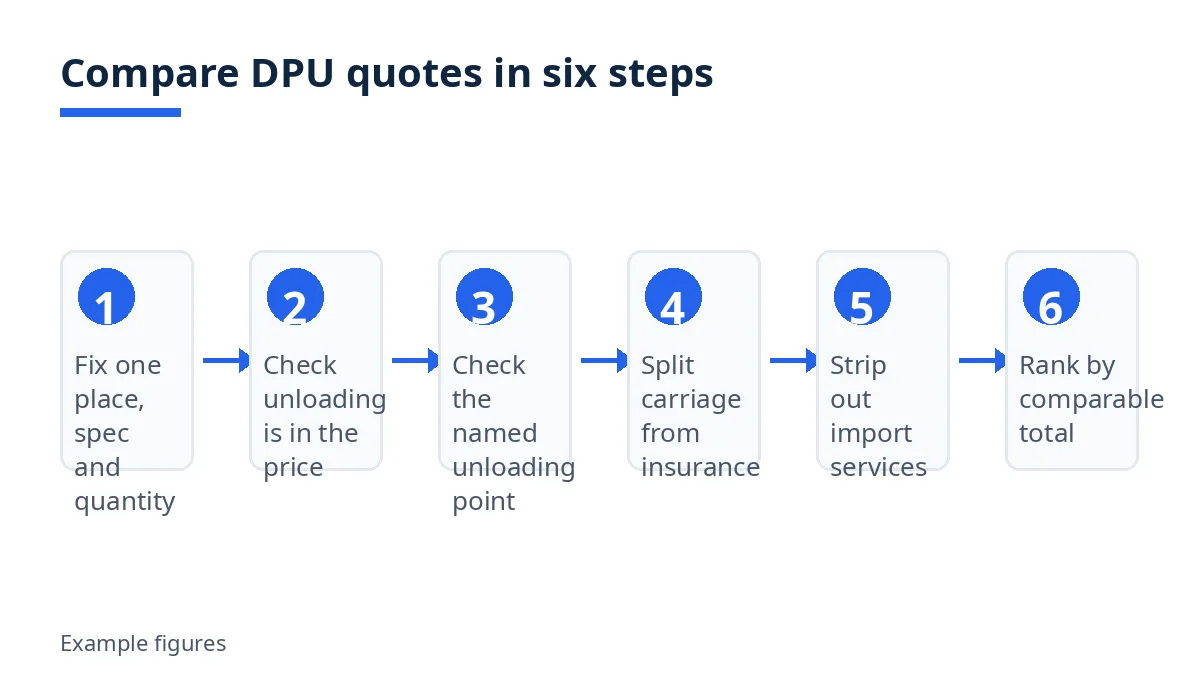
Work through the steps in order, and do not rank until step seven.
Fix one named place and one unloading point. Write the full warehouse address plus the exact unloading point, such as a bay, dock, or yard area, and use that exact place and point for every quotation. DPU delivery and destination are the same place, and risk passes only once the goods are unloaded there.1
Fix one specification and one quantity. Use the same product, material, size, packing, and quantity for every supplier. A change in packing or weight changes the unloading work.
Ask each supplier for the same unloading statement. Ask for the DPU price, the named place and unloading point as written, the edition, confirmation that unloading at that point is included, who will carry out the unloading, and what equipment it needs.
Test each quotation against the rule. A quotation that excludes unloading, or prices it to a different point, fails the DPU test. Ask the supplier to reprice as a true DPU quotation to the fixed unloading point, or record the missing unloading cost as a separate added line.
Split carriage from insurance. Record the carriage element where stated, and record insurance separately, because DPU imposes no insurance obligation.1 An insured and an uninsured quotation are not like for like until that line is shown.
Strip out any import service. DPU leaves import clearance, duties, and taxes with the buyer.3 Any quotation bundling clearance, broker work, or duty handling into the headline price must be restated without that service before ranking. Keep the bundled service visible as its own line.
Add the same buyer-side costs and rank. Add the same import clearance, duty, broker, and onward-transport lines to every quotation, then divide by the same quantity for a comparable total per unit. Rank by that total, not by the headline price.
Costs, timelines and documents
A DPU price covers goods, export clearance, carriage to the named place, and unloading at that place.2 3 The seller bears export and transit costs, the cost of concluding the carriage contract, and transport cost until the goods are unloaded and delivered.1 The buyer bears import formalities, duties, taxes, and onward transport from the named place.3 Charges outside the carriage arrangement sit outside the DPU price unless stated otherwise.
Timelines are quotation-specific, not rule-specific. The rule fixes where delivery happens, not how many days carriage takes. Ask each supplier for an arrival window tied to the named unloading point, the arrival-notice method, and what happens if the buyer cannot receive the goods at the agreed point on arrival. Compare windows only when they end at the same unloading point.
For documents, ask each supplier to confirm the set it will provide and the set the broker will need. The seller delivers the goods with a commercial invoice in conformity with the contract and other related documents, and provides the buyer, at its own expense, with the documents needed to take over the goods.1 The seller also assists the buyer, at the buyer's request, risk, and cost, in obtaining documents needed for transit and import clearance.1 The import declaration, classification, and compliance checks sit with the buyer and its broker.1
A worked example shows why the unloading test decides the ranking. All names, places, figures, and order numbers below are example figures only.
Example. A buyer compares three DPU quotations for 750 cartons of organic cotton bath towels, order EX-9418, delivered to Example Retail GmbH, Hall 4, Bay 2, Nordkai Logistics Park, Hamburg, Germany, Incoterms 2020. Supplier A quotes USD 41,700 with the full address and Bay 2 named and unloading at Bay 2 included in the price. Supplier B quotes USD 40,900 with only "DPU Hamburg site" as the named place, unloading excluded, and no import service bundled. Supplier C quotes USD 42,300 with the full address and Bay 2 named, unloading at Bay 2 included, and an import service fee of USD 720 bundled in.
Supplier | DPU price as quoted (example) | Named place and unloading point as written | Unloading treatment (example) | Import service in headline | Buyer-side import and broker total (example) | Comparable total (example) |
|---|---|---|---|---|---|---|
A | USD 41,700 | Full address, Hall 4, Bay 2 | Included in price | None | USD 3,900 | USD 45,600 |
B | USD 40,900 plus USD 980 unloading | "DPU Hamburg site" only | Excluded, added back | None | USD 3,900 | USD 45,780 |
C | USD 42,300 less USD 720 service, giving USD 41,580 | Full address, Hall 4, Bay 2 | Included in price | USD 720, separated | USD 3,900 | USD 45,480 |
Insurance is shown separately from these totals, because DPU imposes no insurance obligation.1 In this example, Supplier A offers an add-on of USD 420, Supplier B offers USD 460, and Supplier C offers none, so the buyer would arrange its own cover. Those add-on figures are example figures only, and they are not added into the comparable totals.
The ranking reverses the headline order. Supplier B has the lowest headline price, but once the USD 980 unloading work it left out is added, its total of USD 45,780 sits above Supplier A's USD 45,600. Supplier C has the highest headline price, yet once its bundled import service is stripped out, its total of USD 45,480 is the lowest. The buyer also still needs a written correction from Supplier B, because "DPU Hamburg site" does not name the hall or bay, and delivery under DPU happens only when the goods are unloaded at the agreed place and point.2
Bangladesh-specific rules and tips
No separate Bangladesh rule changes the DPU split: export clearance stays with the seller, import clearance and duty stay with the buyer, and unloading at the named place stays with the seller.2 1 The Bangladesh-specific work is about proving the unloading point is real.
First, confirm the seller can actually unload at the named point: who carries out the unloading, what equipment is needed for the packing and weight in the quotation, and who pays if the vehicle waits because the bay is not free. The seller should ensure it can organise unloading at the place specified in the contract.1 Second, confirm the carriage price runs all the way to that bay, not to an earlier terminal or gate. Third, confirm currency, validity, and payment terms separately, because DPU does not set price, payment, or ownership. Fourth, confirm the arrival-notice contact and method before shipment.
Mistakes and red flags
Ranking headline prices without testing unloading inclusion. A DPU price that leaves unloading out prices less work. Test unloading first, then rank.
Accepting a site or city as the named place. Delivery under DPU happens at the agreed place and point, once unloaded.2 "DPU Hamburg site" alone leaves the hall, bay, and unloading crew open to dispute.
Treating a DPU price as duty-paid. DPU leaves import clearance, duties, and taxes with the buyer.3 A quotation promising duty handling inside a DPU price must be separated out as its own service, or the term reconsidered.
Assuming every supplier can unload at the named point. The seller should ensure it can organise unloading at the place specified.1 If a supplier cannot unload heavy or bulky packing at the named bay, the quotation is not a deliverable DPU price for that bay.
Assuming insurance is included. DPU imposes no obligation to make a contract of insurance.1 If cover matters, agree who buys it, for whose benefit, for what period, and at what price, shown separately.
Comparing an insured price with an uninsured price as if equal. State the insurance position for every quotation, even when no cover is offered.
Ignoring charges between the gate and the bay. Ask which terminal, handling, storage, and onward charges the price includes. A price ending at the gate is not a price ending at the bay.
Leaving the edition out of the quotation. Write "DPU (named place and unloading point) Incoterms 2020" in full wherever the term repeats. Without the edition, the governing rules are not fixed.
Accepting a bundled import service without a price. If a supplier bundles clearance or broker work into a DPU headline price, ask for that service priced separately, then rank on the stripped price.
Checklist
Use this checklist on every DPU quotation before accepting it.
Named place in full: warehouse address plus hall or bay, identical across quotations.
Term written as "DPU (named place and unloading point) Incoterms 2020" on the quotation and the order.
Specification, packing, quantity, and order number identical across quotations.
Unloading statement in writing: unloading at the named point included, who unloads, and what equipment is needed.
Carriage inclusions and exclusions listed, including charges between the gate and the bay.
Insurance position stated: no obligation under DPU, plus any agreed add-on priced separately.1
Import clearance, duty, and taxes as buyer costs, with any bundled import service priced separately and stripped out.
Arrival window, arrival-notice method and contact, and proof of unloading stated.
Currency, validity, payment terms, and document set confirmed in writing.
Comparable total per unit on the same buyer-side costs, then ranked.
How Exportain helps
Exportain lets buyers post a sourcing request stating quantity, specification, destination place, unloading point, and Incoterm, and lets suppliers quote against that same request. When a quotation arrives, use the checklist above to ask for the breakdown in the same format.
Exportain is not a party to the goods contract, and it does not inspect goods, book freight, or clear customs.
FAQs
What should I know first about DPU?
DPU stands for Delivered at Place Unloaded. Under Incoterms 2020, DPU works for any mode of transport, including multimodal shipments.2 The seller delivers the goods and transfers risk at the named place of destination, once the goods are unloaded from the arriving means of transport and placed at the buyer's disposal.2 The seller bears export clearance, carriage, and unloading cost and risk to that point, while the buyer clears import, pays duty and taxes, and arranges onward transport.2 3 DPU replaced DAT, so the named place need not be a terminal.2 No insurance obligation applies to either party under DPU unless cover is agreed separately.1
What are the typical costs and timelines?
No typical DPU cost or transit time applies across suppliers, routes, and quantities, so this guide states none as fact. A DPU price covers goods, export clearance, carriage to the named place, and unloading at that place, while import clearance, duty, taxes, onward transport, and warehousing after unloading sit with the buyer unless stated otherwise.2 3 Timelines depend on the route, mode, and carriage arrangement for that order, so compare arrival windows only when they end at the same unloading point.
Which documents are needed?
The seller provides the commercial invoice in conformity with the contract and the other documents needed for the buyer to take over the goods, and assists the buyer, at the buyer's request, risk, and cost, in obtaining documents needed for transit and import clearance.1 The buyer and its broker handle the import declaration, classification, and compliance checks at destination.1 Confirm the full set with supplier and broker before the goods move.
What are the most common mistakes?
The most common mistakes are ranking headline prices without testing unloading inclusion, accepting a site or city as the named place, treating a DPU price as duty-paid, assuming every supplier can unload at the named point, assuming insurance is included, and accepting a bundled import service without a separate price. Each hides work, a cost, or a risk inside a single total. The fix in every case: name the place and unloading point in full, confirm unloading inclusion, split carriage from insurance, separate import services, add the same buyer costs, and rank by the comparable total.
Next steps on Exportain
Read the Incoterms guide for shipments from Bangladesh to place DPU beside the other ten rules, and the CIF guide to weigh a sea-only insured term against an unloaded arrival term. When ready to buy, read how to buy from Bangladesh, then Post a free RFQ on Exportain stating quantity, specification, named place, unloading point, and Incoterm.
Sources
- Incoterms 2020 DPU. ShipHub (accessed )
- DAP & DPU Incoterms 2020 explained: Key differences. ICC Academy, (accessed )
- DPU Shipping Terms: Duties, Costs and Customs. Eurosender (accessed )
About the author
Sourcing from Bangladesh?
Post a request for quotation and suppliers on Exportain can send you their quotes directly.
Post an RFQ


