

Quality Control Checklist for Detergents From Bangladesh
A numbered QC checklist for detergents from Bangladesh: active matter, pH, dissolving, foaming, caking, granule size, bar hardness, liquid dosing, surfactant labels and moisture-barrier packing, with fixes for common failures.
Short answer
Use this detergents quality control checklist to check active matter, pH, dissolving, foaming, caking, granule size, bar hardness, liquid dosing, surfactant labelling and moisture-barrier packing on powder, liquid and bar detergents from Bangladesh before shipment. Agree ranges, test methods and acceptance numbers in the purchase order.

On this page
Key takeaways
Agree the sample, formula sheet, ranges, test methods and acceptance numbers before inspection, and draw the sample randomly across lots and fragrances.
Check active matter, pH and water content by named lab methods per lot, and record measured values rather than pass marks alone.
Test the product itself: dissolving, foaming, rinsing, granule size, caking, bar hardness, liquid viscosity and dosing, not only the carton count.
Check surfactant declarations and pack seals against the formula sheet and destination rules, and protect powder with a real moisture barrier.
If you buy detergents from Bangladesh, this detergents quality control checklist is a practical way to check powder, liquid and bar detergents before shipment. A detergent fails in ways a buyer can see and measure: powder that cakes, liquid that will not pour cleanly, a bar that crumbles, or a label naming the wrong surfactant range. Check the product itself, not only the carton count, and agree acceptance numbers in the purchase order first.
Why this checklist matters
Detergents are chemical products, so a fault is rarely only cosmetic. Active matter decides cleaning strength: a short batch washes weakly even when the pack looks right. Moisture decides whether powder stays free-flowing or sets into lumps in transit. Labelling decides whether goods can be sold in the destination market, where surfactant declarations and hazard information are regulated.
A written checklist also stops disputes. Each point is checked against the approved sample, formula sheet and pack specification, and recorded as pass, fail or not applicable. Under Regulation (EC) No 648/2004, a detergent is any substance or mixture containing soaps and/or other surfactants intended for washing and cleaning, in any form, including liquid, powder, paste, bar or moulded piece.1
Before you start
Do not begin until the references are complete: an approved sample per form and fragrance variant, the purchase order and pack specification, the formula sheet with agreed active matter and pH ranges, and label artwork. Agree the sampling plan in advance, and draw the sample randomly across lots and fragrances.
For sampling method, ISO 2859-1 specifies an acceptance sampling system for inspection by attributes, indexed by the acceptance quality limit (AQL).2 For laundry powder from Bangladesh, ask for the current BDS 1445 specification for synthetic detergent powder.3 Bangladesh dish-wash standards distinguish bar, paste and powder types and require secure packing and marking.4 Set acceptance numbers per defect class in the purchase order, and record measured values, not pass marks alone.
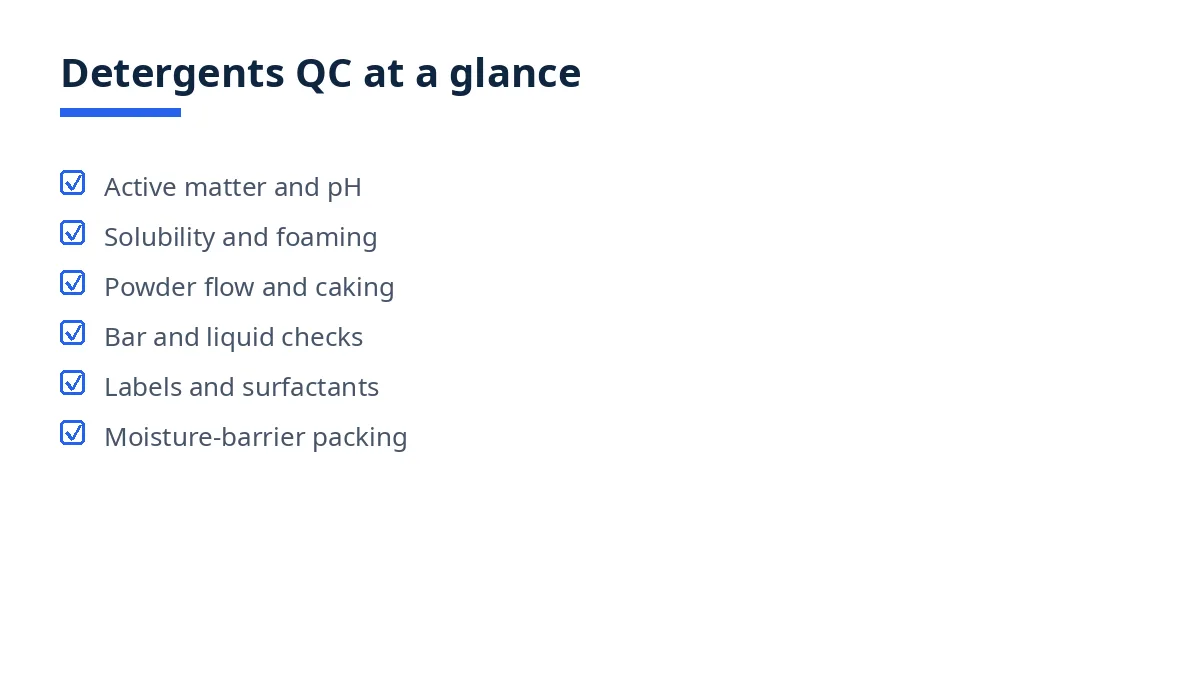
The full checklist (numbered, printable)
Form and content
Confirm the form matches the order: laundry powder or liquid, dishwash powder, liquid, bar or paste.
Check powder: even color, no dark spots, no foreign particles, no unmixed lumps.
Check liquid: even color and clarity, no sediment, no floating particles, no separation.
Check bars: even shape and color, no cracks, no soft spots, no unexpected surface bloom.
Weigh sample packs against the declared weight or volume, including short fills at run start and end.
Check every pack carries the same name, variant and fragrance as the order, with no mixed variants per carton.
Active matter
Check lot active matter against the formula-sheet range. For anionic content, ISO 2271 specifies a direct two-phase titration, not applicable if cationic agents are present.5
Confirm the lab result names product, lot, method and date, and belongs to this lot.
Check pH of a prepared solution against the agreed range, using the stated dilution and method.
Check water content where a limit is set. ISO 4317 specifies a Karl Fischer method for detergents, applicable to powders and pastes.6
Check builder and filler evidence where named, such as phosphate, phosphonate, carbonate, silicate or zeolite, against the range.
Check no ingredient was substituted in bulk without a revised formula sheet.
Check bleach, enzyme and brightener claims against the formula sheet, and record unsupported claims as failures. Lab testing commonly covers active substance, pH, density, viscosity, moisture and water-insoluble matter.7
Dissolving and rinsing
Dissolve a measured powder dose at the stated temperature and hardness, and check full dissolving within the agreed time, with no gritty residue.
Dissolve a measured liquid or paste dose the same way, and check for gel, lumps or oily film.
Check foaming at the stated dose: foam height and stability for hand-wash products, controlled low foam for machine products.
Rinse a washed test cloth as directed and check for residue, stiffness or white deposits.
Where a cleaning check is required, wash standard soiled cloths at the same dose, temperature, hardness and method for sample and bulk.
Where color care is claimed, wash a colored cloth and check dye loss or transfer against the agreed result.
Powder and bar checks
Check granule size and uniformity: no excess fines creating dust, no oversize granules.
Check powder flow: pour a sample and confirm free flow, with no caking, bridging or rat-holing.
Check caking directly: open packs from pallet top, middle and bottom and press the powder.
Check dust at opening and pouring, since excess dust points to over-dried powder or excess fines.
Check bar hardness and breakage by press and drop tests, and check for bars that crumble, snap or dent.
Check bar weight, dimensions and shape against the specification, including any embossed mark.
Liquids and dosing
Check liquid viscosity against the agreed range: a thin liquid suggests dilution, a thick liquid a formula or temperature problem.
Check cap, pump, spout or dosing cap: it fits, seals, opens and closes, dispenses the stated dose, and does not leak inverted.
Check dosing directions against the formula sheet: dose per wash, hardness bands and machine type.
Check leakage directly: invert and squeeze sample packs, and inspect carton interiors for damp patches or stains.
Packs and barriers
Check the primary pack material: a moisture barrier for powder, a chemical-resistant pack for liquids, a wrap holding bar shape.
Check seals on every sampled pack: heat seals complete and even, with no channels or weak spots.
Check printed pack information: batch or lot code, production date where required, and best-before or expiry information where carried.
Check inner packs, sachets or refill pouches in a multipack match the declared count.
Labels and rules
Check the ingredient declaration against the formula sheet and destination rules. Under Regulation (EC) No 648/2004, Annex VII sets ranges of under 5 percent, 5 to under 15 percent, 15 to under 30 percent, and 30 percent and more, for constituents above 0.2 percent by weight, including phosphates, phosphonates and all four surfactant types.1
Check surfactant types on the label against the formula: anionic, non-ionic, cationic or amphoteric, in the declared range, with none omitted or added.
Check biodegradability claims against surfactant evidence. Under Regulation (EC) No 648/2004, surfactants meeting the Annex III ultimate aerobic biodegradation criteria face no further biodegradability limitations.1
Check phosphate limits for the destination market, since the Regulation limits phosphorus compounds in domestic laundry and dishwasher detergents.1
Check hazard, precaution and first-aid information against the safety data sheet for the exact product, including eye and skin warnings.
Check language, legibility and placement: the label is in the destination language, firmly fixed, and readable without opening the pack.
Check fragrance, enzyme, disinfectant and brightener listings against destination rules, including required allergen naming.
Cartons and storage
Check carton count, product mix and batch mix against the packing list, with no mixed lots in single-lot cartons.
Check carton strength and closure: no crushing, damp or tears, tape complete, and no staining on liquid cartons.
Check carton markings: product name, variant, quantity, batch code, and gross and net weight.
Check warehouse storage: powder dry and off the floor, liquids upright and within the temperature range.
Check pallet build: stable stacking, no overhang crushing lower cartons, and wrap that holds without crushing packs.
Check finished cartons after palletising, since strapping and handling damage shows only then.
Common failures and how to fix them
The most frequent failure is caked powder, usually because moisture entered during production, packing or storage, or because the pack barrier is weak for humid transit. Stop, test moisture and check seals on the affected lot, and restart packing only once the source is found. Next is low active matter, tracing to dosing error or a substituted surfactant: re-test a retained sample from the same lot first.
Poor dissolving usually points to oversize granules, excess binder or a changed spray-drying setting: re-check granule size and run a fresh dissolve test. Excess foam in a machine product usually points to the wrong surfactant balance: re-check the batch record. Leaking liquids usually point to a cap or seal fault, not the formula: change the closure setting and re-test inverted packs.
Above the agreed acceptance level, options are re-inspection after sorting or rework, documented partial acceptance, or rejection. Rework needs a revised batch record, not a quiet re-pack.
Downloadable template / summary table
Copy the checklist into your inspection sheet, add agreed ranges and acceptance numbers, and record a result per check.
Section | Checks |
|---|---|
Form and content | Form, appearance, net content |
Active matter | Anionic content, pH, water, builders |
Performance | Dissolving, foaming, rinsing |
Physical checks | Granule size, caking, bar hardness |
Liquids and dosing | Viscosity, caps, dose, leakage |
Packs and barriers | Material, seals, batch codes |
Labels and rules | Surfactant ranges, claims, hazards |
Cartons and storage | Counts, markings, pallet build |
How Exportain helps
Exportain is a B2B marketplace connecting buyers with Bangladeshi suppliers of detergents and household chemicals, so the specifications behind this checklist can be agreed at the enquiry stage. Browse suppliers, use inspection services when you plan the check, and read the pre-shipment inspection guide. Supplier profiles show recorded document and photo checks, not factory inspections. Exportain is not a party to the goods contract and does not inspect goods.
FAQs
When should this checklist be used?
Use it at final inspection, when goods are finished, sealed and largely packed. For larger and first orders, also use it during production, while corrections are still possible.
Who should complete it?
The buyer, a local agent or an independent inspector can complete it, using the approved sample, formula sheet and label artwork.
What are the most common failures?
Caked powder, low active matter, slow dissolving, excess foam in machine products, leaking liquids, weak seals and wrong surfactant declarations are the failures buyers find most often.
Can a third party do it?
Yes, if you share the approved sample, formula sheet, agreed ranges, label artwork and acceptance levels first. Name the lab test methods in advance, since a result without its method cannot be compared.
Next steps on Exportain
Before production starts, agree your formula sheet, active matter and pH ranges, test methods and label wording, then read the AQL acceptance quality limit explainer and the pre-shipment inspection guide, and plan the check with inspection services. You can also post a free RFQ via RFQs and compare quotes.
Sources
- Regulation (EC) No 648/2004 of the European Parliament and of the Council of 31 March 2004 on detergents. European Union (accessed )
- ISO 2859-1:1999 - Sampling procedures for inspection by attributes — Part 1: Sampling schemes indexed by acceptance quality limit (AQL) for lot-by-lot inspection. International Organization for Standardization (accessed )
- BSTI Standard - BDS 1445:2019 Synthetic detergent powder (2nd revision) listing. Academia.edu (accessed )
- BDS standard for scouring products for utensil cleaning (dish wash bar, powder and paste). Bangladesh Standards and Testing Institution (accessed )
- ISO 2271:1989 - Surface active agents - Detergents - Determination of anionic-active matter by manual or mechanical direct two-phase titration procedure. International Organization for Standardization (accessed )
- ISO 4317:1991 - Surface-active agents and detergents - Determination of water content - Karl Fischer method. International Organization for Standardization (accessed )
- Detergent Tests. Belge (accessed )
About the author
Sourcing from Bangladesh?
Post a request for quotation and suppliers on Exportain can send you their quotes directly.
Post an RFQ


