

Top Denim Jackets Manufacturers in Bangladesh: How to Find and Verify Them
Denim jackets are supplied from Bangladesh by cloth mills, wash-led makers, construction specialists and traders. This guide sorts nine types by what each controls, explains jacket weight, weave, wash, hardware and lining choices, and sets out checks to run before payment.
Short answer
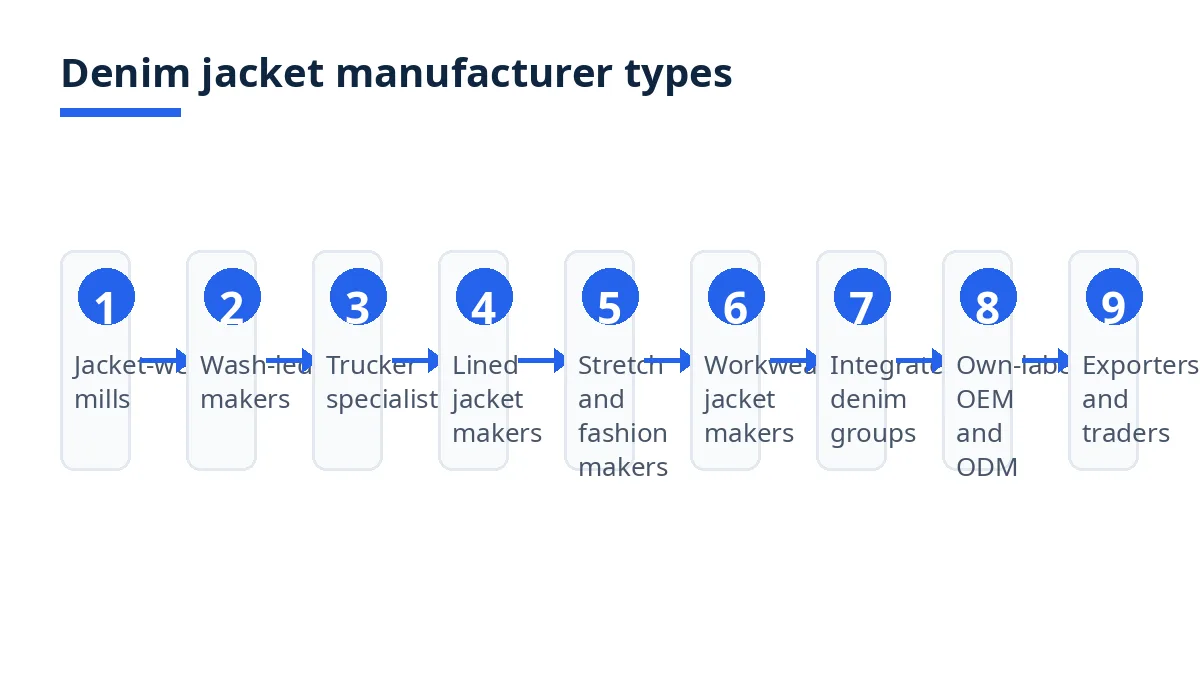
Denim jackets manufacturers in Bangladesh fall into nine types: jacket-weight denim mills, wash and laundry-led makers, trucker and classic construction specialists, lined and quilted makers, stretch and fashion makers, workwear makers, integrated denim groups, private-label OEM and ODM suppliers, and exporters and trading companies. Match the type to your jacket weight, wash, hardware and lining needs, then check membership, documents, a washed production sample and inspection terms before paying.
On this page
Key takeaways
A denim jacket is a structured garment: large panels show shade variation, thickness stacks at collar and cuffs, hardware must survive the wash, and lining must shrink with the shell.
Jacket cloth is specified by weight and weave: a classic trucker commonly uses 10 to 13 ounces in 3/1 twill, workwear commonly uses 12 to 16 ounces, and soft fashion jackets commonly use 8 to 11 ounces in 2/1 twill.
The wash decides the finished jacket: rinse wash is the most stable baseline, enzyme washing softens hand feel, and heavy or distressed washing trades fabric strength for look, so recipes need bulk trials before approval.
Lined jackets must be tested as a complete system, because shell and lining shrink differently, and stretch jackets need recovery and growth tests so elbows do not bag out.
Exportain badges record document and photo checks reviewed by the Exportain team; they are not factory inspections or quality guarantees.
A denim jacket is a structured garment, and that structure is what makes sourcing it different from sourcing jeans or a shirt. The back panel, yoke, sleeves and collar stand are large, visible surfaces, so shade variation between panels shows at once. Thickness stacks up at the collar, cuffs and front placket, raising the risk of needle lines and puckering. Buttons, rivets, zips and snaps must survive the same wash as the cloth, and any lining must shrink at the same rate as the shell or the jacket will hang crooked after washing.
Bangladesh is a practical place to look for this work because woven garment production is a large part of its garment trade. Woven garments earned US$4.614 billion in the first quarter of fiscal 2026-27, up 5.11 per cent year on year, within ready-made garment exports of US$10.578 billion, according to Export Promotion Bureau (EPB) data.1 The question is which type of supplier already controls the cloth, wash and construction your jacket needs, and what you must check before payment.
The list: denim jackets manufacturers in Bangladesh by type
The nine types below describe how denim jackets are actually supplied from Bangladesh. No company is named or ranked here, because the type tells you more than a name does: it tells you which stages the supplier controls, where a jacket order usually goes wrong, and which check matters most for that type.
Price and minimum order quantity (MOQ) follow the jacket specification, not the supplier type alone. Fabric weight and weave, wash complexity, hardware choice, lining, size range, quantity and packing each move the quote, and each style and colour carries its own MOQ. Ask every shortlisted supplier to quote the same specification, delivery term and packing. For how MOQ works, read the guide to MOQ in the supply chain.
1. Jacket-weight denim mills and cloth-led suppliers
These suppliers sell denim cloth, or make jackets from cloth woven in their own mill. Their strength is fabric control: weight, weave, yarn and dye method are set at the mill rather than bought in. A classic trucker jacket commonly uses 10 to 13 ounces per square yard in a 3/1 twill, a workwear jacket commonly uses 12 to 16 ounces, and a soft fashion jacket commonly uses 8 to 11 ounces in a 2/1 twill.2 Weight is the first decision in a jacket program, because it sets structure, warmth and sewing difficulty at once.
A cloth-led supplier suits a buyer who wants to lock the fabric first. The risk is assuming cloth expertise covers sewing and washing. Ask for usable width rather than nominal width, a shrinkage target measured after the agreed wash, and a shade-band rule that bars mixing shade bands in one garment. Confirm who sews and washes the jacket, in writing.
2. Wash and laundry-led jacket makers
These suppliers are built around the laundry: the wash recipe that turns rigid indigo cloth into the finished look. Rinse wash is the most stable baseline for a commercial program, enzyme washing softens the hand feel, and heavy or distressed washing creates a worn look at the cost of fabric strength.2 The wash also decides shrinkage, skew and colourfastness, so a jacket approved before washing is not yet an approved jacket.
A laundry-led maker suits fashion and vintage programs where the wash is the selling point. Approve the recipe only after trials on bulk cloth, with post-wash measurements, crocking results and a physical appearance standard to judge against.2 For distressed effects, ask how the effect is created and what compliance evidence covers the method, since some older distressing methods carry documented worker-safety risks.
3. Trucker and classic jacket construction specialists
These factories specialise in the classic button-front jacket: pointed yoke, flap chest pockets, button cuffs and an adjustable button waist. Their skill is pattern and construction rather than cloth or wash. Jackets stress elbows, armholes, pocket corners and hem edges, and those are the points where stitching, bar tacks and reinforcement decide whether a jacket survives wear.2 A regular, slim or oversized trucker each needs its own shoulder, armhole and body measurements.
This type suits retail programs built around one proven silhouette. Judge the supplier on a proto jacket made in production cloth and washed by the production method, not on an unwashed sample or a photograph. Measure the washed proto against your size chart, open and close every button and pocket, and check the collar stand and yoke for puckering where layers stack. A proto made in a different cloth or wash from bulk proves nothing.
4. Lined and quilted jacket makers
These suppliers make jackets with an inner layer: sherpa fleece, quilted padding or a smooth body lining. The lining changes every specification around it. Outer denim and inner lining shrink and relax at different rates, and when the shell shrinks more than the lining, ripples appear along the front placket and sleeve seams.2 Thickness also stacks at the collar stand, cuffs and hem, where needle lines and seam puckering show first.
A lined-jacket maker suits autumn and winter ranges and any program where the jacket must look as clean inside as outside. The check is a washed sample tested as a complete jacket system, outer plus lining together, rather than cloth tests alone.2 Use a shrink-controlled shell, confirm the lining batch has been pre-relaxed where needed, and set the pattern allowance for your wash method rather than the factory wash method. Reject a lined sample approved unwashed.
5. Stretch, soft and fashion jacket makers
These suppliers work with lighter, softer denim for fashion silhouettes: cropped, oversized and draped jackets where comfort and movement matter more than rigid structure. The cloth is commonly 8 to 11 ounces in a 2/1 twill, sometimes blended with lyocell for softness or given a small amount of elastane, commonly 1 to 2 per cent, for comfort stretch.2 With stretch, recovery matters more than the stretch amount itself: a jacket that stretches at the elbows and never returns loses its shape, and that failure only shows after wear and washing.
This type suits seasonal fashion ranges and any program where drape and hand feel carry the design. The check is a recovery and growth test after repeated wear or wash cycles, agreed in the specification before sampling.2 Wide fashion panels show shade variation more plainly than narrow panels, so set a tighter lot-mix rule and approve panel matching on a washed sample.
6. Workwear denim jacket makers
These suppliers make jackets for site, plant and field use, where the jacket is judged on survival rather than fade. The cloth is heavier, commonly 12 to 16 ounces, often in 3/1 or broken twill, with coarser yarn and defined targets for tear strength and abrasion resistance.2 Repeated laundering, tool-belt abrasion and seam stress at pockets, underarms and elbows are the normal conditions, not exceptions. Heavy weight combined with an aggressive wash can reduce strength faster than either factor alone, so the wash look and the lifespan must be decided together.2
This type suits uniform programs and industrial workwear. The check is performance in writing: tear, abrasion and dimensional-stability targets with the test method named, measured after the wash and laundering cycle the wearer will actually use. Do not accept a workwear jacket whose only evidence is an unwashed cloth swatch.
7. Integrated denim groups
These groups control several stages inside one company: spinning or weaving, dyeing, sewing and laundry. The advantage is coordination across stages, so a shade or shrinkage problem can be traced inside one organisation rather than argued between three suppliers. For jackets, that coordination is valuable precisely because cloth, wash and construction interact: a change in finishing changes shrinkage, and a change in shrinkage changes the washed fit.
This type suits larger, repeat programs where the same jacket must come back season after season with the same look and measurements. The check is a stage-by-stage question, asked in writing: which stages are in-house for jackets, and which are subcontracted. A group that weaves denim but sends jacket laundry or hardware sourcing out is not integrated for your order in the parts that matter most. Confirm the producing sewing line and laundry by name, and judge the group on a washed jacket from that line.
8. Private-label OEM and ODM jacket suppliers
These suppliers make jackets under the buyer's label. An original equipment manufacturer (OEM) produces to your tech pack, while an original design manufacturer (ODM) offers its own patterns and styles for you to label. The distinction matters for jackets because the pattern, hardware selection and wash recipe are the product: an OEM jacket is only as good as the tech pack behind it, and an ODM jacket is only as good as the pattern and wash the supplier already runs.
This type suits brands and retailers that need their own labels, size sets, packaging and barcodes, and importers that want a ready jacket range without developing every pattern. For OEM work, send a complete tech pack covering cloth weight and weave, wash recipe, hardware type and placement, lining, measurements and packing, and judge the counter-sample against it line by line. For ODM work, confirm the offered styles are the supplier's own, and agree who owns patterns and grading files before production starts.
9. Exporters and trading companies
These companies sell jackets made in partner factories rather than on their own sewing lines. They aggregate capacity across several factories, handle export documentation for the buyer, and can combine jackets with other products in one order. That aggregation is useful when your quantities are mixed, when you need several jacket styles at once, or when no single factory covers your whole range.
The risk is distance from production: the trading company's export record does not tell you which sewing line and laundry make your jackets, and a jacket problem is a factory problem even when the contract sits elsewhere. Start with the Bangladesh Garment Manufacturers and Exporters Association (BGMEA) member search to confirm the producing factory's registration, since BGMEA runs a member search on its own site.3 Ask which factory will sew and wash each style, get the factory named in the order terms before you pay a deposit, and check the producing factory rather than the trading office alone.
Summary table
Type | Best for | Main check |
|---|---|---|
Denim mills | Cloth first | Width, shrinkage, shade rule |
Wash-led makers | Wash-driven looks | Recipe after bulk trials |
Trucker specialists | Classic silhouettes | Washed proto, measured |
Lined makers | Winter jackets | Washed shell-plus-lining sample |
Stretch and fashion makers | Draped jackets | Recovery after wash cycles |
Workwear makers | Uniform programs | Tear and laundering targets |
Integrated groups | Repeat programs | Stages truly in-house |
Private-label OEM / ODM | Own-label brands | Tech pack, pattern ownership |
Exporters and traders | Mixed orders | Factory named in writing |
How Exportain helps
Use the marketplace as a shortlist tool, not a verdict: search denim jacket suppliers, narrow by the Exportain Verified badge and by sample or OEM/ODM capability, and open each profile for its verification level, location, main products and declared certifications.4 Post an RFQ only once the shortlist is set, with quantity, target price, destination, Incoterm and required certification spelled out.
Use the badges as a starting filter, not a conclusion. Verification on Exportain is a document and photo review by the Exportain team, not a factory inspection, and membership plans never grant a badge.5 Set the inspection standard in the order before production: ISO 2859-1 specifies sampling schemes indexed by acceptance quality limit (AQL) for lot-by-lot inspection, so an inspector can accept or reject a shipment against a published rule instead of an opinion.6 If a supplier asks for a funds hold, you can pay it or decline it, and a paid hold stays until export clearance is filed and you confirm the trade is complete.4
FAQs
What is the biggest mistake?
Approving a denim jacket from an unwashed sample, or from a specification copied from jeans. A jeans specification does not cover jacket panel shade, collar and cuff thickness, hardware wash survival, or shell-to-lining shrinkage, and an unwashed sample hides shrinkage, skew, crocking and panel mismatch.
How can I avoid it?
Write one specification covering cloth weight and weave, wash recipe, hardware type and placement, lining, size range, labels and packing, and send the identical document to every supplier you quote. Require a proto in production cloth, washed by the production method, and measure it against your size chart. Name the producing factory and laundry in the order terms, and set the AQL inspection level in writing before production starts.
Who is responsible?
Jacket-making accountability falls on two different desks. The factory answers for building jackets to the specification and the approved washed sample, while the buyer answers for writing a specification that can actually be checked and for inspecting against it before the goods leave.
Where can I get help?
Start with the BGMEA member search for factory registration, and the frameworks BGMEA lists for factory assessment, including BSCI, WRAP, SMETA, ICS, the Higg Index, ZDHC, GOTS and OEKO-TEX.3 Check any audit or fibre certificate with the issuing body, confirming the factory address, scope and expiry date. On Exportain, read what each profile badge covers before relying on it, and message the supplier through its profile so your questions and answers stay in one thread.5
Next steps on Exportain
Filter the supplier directory to denim jacket listings by badge, MOQ and OEM or ODM capability, and check the verification guide so you know exactly what a badge certifies. Then raise a free RFQ with the jacket specification, quantity, destination and Incoterm, and judge the versioned quotations on identical terms.
Sources
- Merchandise exports rise 6.34pc to $13.09b in Q1 FY27: EPB. The Financial Express, (accessed )
- Denim Jacket Fabric Specifications: Weight, Weave Guide. Fabric Supplier (accessed )
- BGMEA | Home. Bangladesh Garment Manufacturers and Exporters Association (BGMEA) (accessed )
- How to source and buy from Bangladesh. Exportain (accessed )
- Supplier verification: Earn trust badges buyers can see. Exportain (accessed )
- ISO 2859-1:2026 — Sampling for Inspection by AQL. American National Standards Institute (ANSI) (accessed )
About the author
Sourcing from Bangladesh?
Post a request for quotation and suppliers on Exportain can send you their quotes directly.
Post an RFQ


