Shipping DDP From Bangladesh: How It Works, Costs and Pitfalls
A DDP shipment from Bangladesh puts export clearance, carriage, import clearance, and duty on the seller. This guide follows the route stage by stage, with a worked example in example figures and a pre-shipment check.
Short answer
Under DDP shipping from Bangladesh, the seller carries goods from the factory gate to a named place abroad, completes export and import clearance, pays duty and taxes, and places the goods at your disposal ready for unloading. You unload and arrange onward transport. Before agreeing DDP, confirm the seller can clear the goods for import at destination, name the broker, and get the duty basis in writing.
On this page
Key takeaways
Under DDP the seller arranges carriage, handles both customs clearances, and settles duty and taxes, delivering at the named place ready for unloading; the buyer unloads and arranges onward transport.
The sea and inland waterway group has four members: FAS, FOB, CFR, CIF. DDP belongs with the any-mode rules, alongside DPU and CPT.
A foreign seller may be unable to clear goods for import abroad. Name the destination broker and confirm the import registration route before shipment, or use DAP.
No rate or timeline in this guide is a market figure. Costs and time follow the stages, and only a broker's duty calculation and a forwarder's schedule state them for your order.
With ddp shipping from bangladesh, one seller carries your order from a factory gate in Bangladesh to a place you name abroad, handling customs work at both ends and settling the duty and taxes that import brings. The price arrives as one number. The work behind it crosses two customs borders, two sets of documents, and one handover where the seller's job ends and yours begins.
Start at the factory gate, not at the port
The letters stand for Delivered Duty Paid. They belong to Incoterms® 2020, the trade-terms set from the International Chamber of Commerce (ICC) that fixes where delivery happens, who pays which costs, and who carries the risk of loss or damage at each stage.1 Under DDP, the seller takes the widest share of that work: carriage to the named place, export and import formalities, and duty and taxes at destination, with delivery complete when the goods stand at your disposal, ready for unloading from the arriving vehicle.2
In Bangladesh, goods must not be loaded or stuffed into containers or a ship for export until an export declaration, known as a Bill of Export or Shipping Bill, has been submitted to Customs and approved, specifying the description of the goods, their value, the exporter, the foreign buyer, and the transport operator.3 The full list of papers enclosed with the declaration is set out in the documents section below. Product-specific certificates apply for some categories, such as an ERC for jute, jute goods, and tea.3
The gateway follows the mode and the destination, not habit. Sea freight leaves through Chattogram or Mongla, and air freight leaves through Dhaka airport. Confirm the gateway with the forwarder in writing before the order is packed. DDP works for any mode of transport, including a combination of modes.4 Four rules only belong to sea and inland waterway transport: FAS, FOB, CFR, CIF. The any-mode group includes CPT, DPU and DDP.4
DDP shipping from Bangladesh: the route in seven stages
Read the route as a chain of handovers, each needing its act done before the next starts.
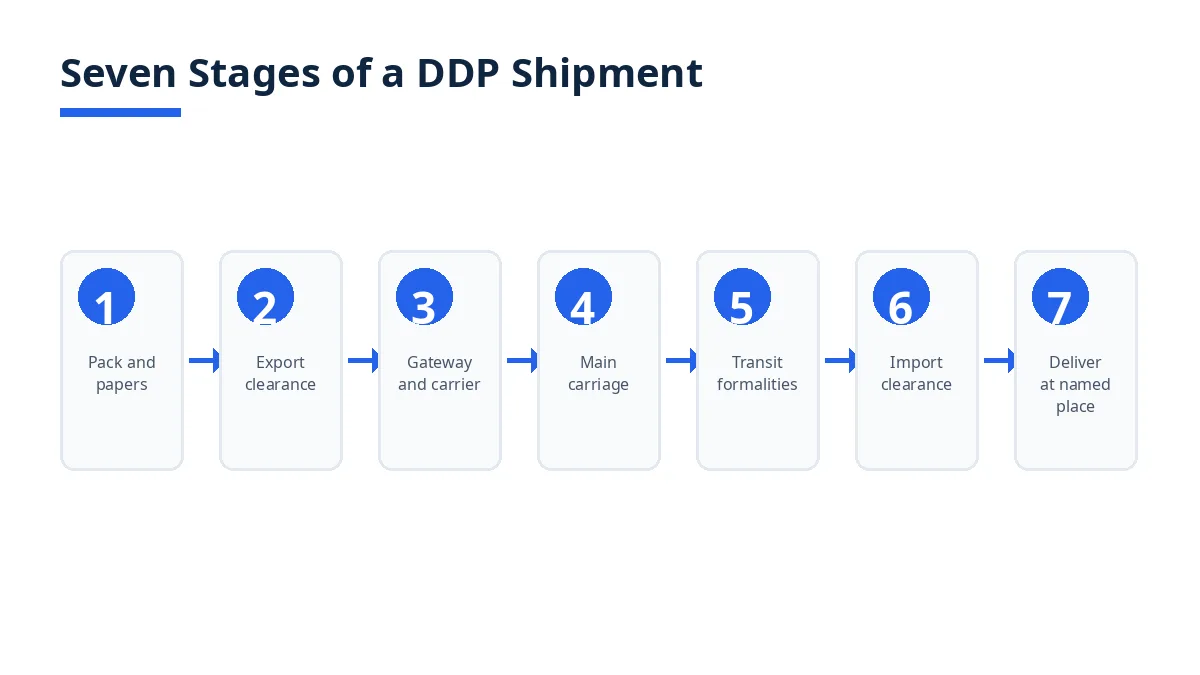
Pack and prepare the papers. The seller packs the goods for the modes the journey will use and prepares the invoice, packing list, and other papers the Bill of Export requires.3
Clear the goods for export. The seller, or the agent acting for the seller, files the export declaration and obtains Customs approval before loading or stuffing. Export is complete when the vessel, truck, or aircraft leaves the port.3
Move the goods to the gateway. The seller arranges inland transport to Chattogram, Mongla, or Dhaka airport and hands the goods to the carrier under the carriage contract the seller has arranged and paid for.2
Run the main carriage. The seller contracts and pays for transport by road, rail, air, sea, or inland waterway, or a combination of modes, to the named place.2 Under the D rules, delivery and destination coincide at the named place, and risk passes there.4
Complete any transit formalities. Where the route crosses a third country, the seller handles and pays for the customs formalities that transit requires.2
Clear the goods for import and pay duty and taxes. The seller carries out and pays for import clearance at destination, through the appointed broker.2 You must help with any papers the import authorities ask for, but the seller remains responsible for clearance.2
Deliver at the named place. The seller gives notice of arrival, and delivery is made when the goods stand at your disposal, ready for unloading from the arriving vehicle.2 You unload at your own risk and cost, and arrange onward transport.2
The named place decides how much of this chain the price covers. A city name does not fix a delivery point: a port, a terminal, a rail depot, and a warehouse in the same city are different delivery points. Write the full address or terminal and point, with the Incoterms® 2020 version, into the contract. The ICC Academy case names One Bowerman Drive, Beaverton, Oregon, not a city.4
Two borders, two different jobs
A DDP shipment has two clearance jobs, and they are not done by the same hands by default. On the Bangladesh side, the seller's clearance route files the export declaration and obtains approval before loading.3 On the destination side, a broker files the import declaration, settles duty and taxes on the seller's behalf, and secures release. A freight forwarder who books the carriage in Bangladesh is not automatically the broker who files the import declaration abroad. One firm may hold both appointments, but only where it has been appointed at both ends, in writing, for this shipment. Ask for both names before the goods sail, and ask who instructs and pays each firm. Where the seller answers with a single company name and no destination broker, treat the import leg as unarranged.
The documents must also agree across both borders: the invoice, packing list, transport document, and import declaration should carry the same parties, description, quantities, and values. Ask the destination broker to check the export papers against the import declaration before departure.
When the seller has to act as the importer abroad
This is where DDP deals most often stall. DDP puts import clearance on the seller, yet some import customs authorities impose legal restrictions or regulations that require the local importer to carry out import clearance, and in those cases DDP cannot be used and DAP is the appropriate rule.2 In other destinations, a foreign seller can clear the goods only by standing in a local importer role it does not yet hold. Barriers, or even an outright prohibition, can make it difficult for a foreign seller to handle import formalities, and the seller remains responsible for the clearance and any associated challenges.4
In the European Union, an EORI number is a unique number issued by the competent authorities that allows customs to identify economic operators, and third-country operators register in the first Member State where they lodge a customs declaration.5 Economic operators must quote an EORI number on customs declarations.5 Who stands as declarant, and whose EORI number the declaration carries, is a question for the destination broker, answered in writing before shipment. In the United Kingdom, you need an EORI number that starts with GB to import goods into England, Wales, or Scotland, and a number starting with XI may be needed for movements involving Northern Ireland.6
In the United States, a Dhaka seller delivering two containers of apparel to Beaverton, Oregon, carries out and pays the import formalities with United States Customs, and where the seller has no entity or presence there, the seller may need to be established as a Foreign Importer of Record.4 Confirm the current requirements with a licensed customs broker before booking, in writing. A seller who cannot name a broker or a registration should not be selling on DDP terms to that destination.
Ask the broker, in writing, who bears import VAT or sales tax and whether any of it can be recovered, by whom, and on what evidence.
What the money is made of, stage by stage
A DDP price is a build-up of stages. No rate appears here: freight, duty, and broker charges move with the goods, the route, and the destination schedule, and only a quotation for your goods, plus a broker's duty calculation, states them.
Stage | What it covers | Who pays |
|---|---|---|
Origin handling and export clearance | Packing, inland transport, export declaration | Seller |
Main carriage | Freight to the named place | Seller |
Import clearance and broker | Import declaration, broker fee, release | Seller |
Duty and taxes at import | Duty, import taxes, import-related charges | Seller |
Insurance for the buyer | Cover that pays the buyer directly | No duty on the seller; agree separately |
Unloading | Unloading from the arriving vehicle | Buyer, unless the carriage contract says the seller pays |
Onward transport | Transport after the named place | Buyer |
DDP does not oblige the seller to buy insurance in the buyer's favour, although the seller carries the risk as far as the named place.2 On unloading, the charges fall to the seller only where the carriage contract says so; otherwise they fall to you, while the risk stays with you either way.2 Under DPU, by contrast, the seller delivers the goods unloaded and bears the unloading cost and risk.4
Worked example: leather sandals from Chattogram to a Jebel Ali warehouse
Example figures only; none is a market rate. The duty line is an allowance for the broker to confirm. The order is 3,000 pairs of leather sandals from Chattogram to a warehouse in Jebel Ali, Dubai, on DDP terms.
Line | Example figures |
|---|---|
Goods: 3,000 pairs at $9.00 | $27,000 |
Export packing and export clearance | $520 |
Inland move and port handling | $480 |
Sea freight, Chattogram to Jebel Ali | $1,950 |
Seller's own cargo cover | $160 |
Destination broker and clearance | $290 |
Duty and taxes, broker allowance | $2,100 |
DDP price | $32,500 |
The first five lines total $30,110; with the last two, the total is $32,500, or $10.83 per pair. The cover line appears only because this seller insured its own risk.2 Unloading sits outside the $32,500 unless the carriage contract includes it.
Time is stages, not a promise
A DDP timeline has no fixed length in this guide: schedules change, clearance checks vary, and a document query at either border adds a stage of its own. The sequence is fixed: export approval, gateway handling, main carriage, import clearance, and delivery. Export approval follows a documentary check and physical verification.3 Import clearance can pause for examination, document queries, or duty assessment. Ask the forwarder for the current schedule and the broker for the clearance sequence, in writing, for your goods and your destination. Where the goods are time-sensitive, agree in the contract what happens if a stage slips: who notifies whom, and who bears storage or detention charges.
Six places a DDP deal quietly breaks
No import route. The quotation says the seller handles everything, but no destination broker is named and no duty basis is shown. Ask for the broker's name and the written duty estimate. Where the seller cannot produce either, change the term to DAP, under which you clear the goods and pay duty and taxes.2
A city, not a place. A citation that reads DDP Dubai names no delivery point. Write the full address or terminal, with the Incoterms® 2020 version, into the contract.4
A duty figure with no broker behind it. An allowance copied from a previous order is not a calculation. Get the broker's calculation, with its basis, before you accept the price.
Insurance assumed, not agreed. DDP lays no insurance duty on the seller for the buyer, and cover the seller buys for itself need not pay you.2 Put cover in your favour in the contract before the goods move.
Unloading assumed to be the seller's job. Under DDP, unloading is your job, at your risk and typically your cost, unless the carriage contract includes the unloading charges for the seller.2 The rule that puts unloading on the seller is DPU, not DDP.4
Documents that disagree. Papers that describe, count, or value the goods differently will stop a shipment at the second border. Ask the broker to reconcile them before departure.
Before you agree DDP: the pre-shipment check
Run this check on every Bangladesh-origin DDP order.
The named place is written in full, and the citation reads DDP, the place, Incoterms® 2020.
The seller has confirmed in writing that it can complete import clearance in the destination country, and has named the destination broker.
The broker has seen the export papers and has given a duty and tax estimate in writing, with its basis.
The seller has stated in writing whether unloading charges are included in the carriage contract.
Insurance that pays you directly is agreed in writing, or you have priced the absence of it.
The invoice, packing list, transport document, and import declaration agree on parties, description, quantity, and value.
The forwarder has confirmed the gateway, carrier, and current schedule in writing, and the seller has confirmed the export papers your goods need.3
What should I know first about DDP?
DDP is the trade term under which the seller carries the goods to a place you name, completes export, transit, and import formalities, pays duty and taxes at destination, and hands the goods over ready for unloading.2 The seller carries the cost and the risk until that point, and you take over at unloading. Confirm the import route, the destination broker, and the duty basis in writing before agreeing it.
What are the typical costs and timelines?
There are no typical costs or timelines that hold across goods, routes, and destinations, and this guide states none. Costs follow the stages in the table above, with unloading and onward transport usually sitting with you. Timelines follow the same stages. Ask the forwarder for the current schedule and the broker for the duty calculation and clearance sequence, and treat any figure without a broker or a schedule behind it as unconfirmed.
Which documents are needed?
On the Bangladesh side, the export declaration requires the export letter of credit or contract, purchase order, or export guarantee, the commercial invoice, the packing list, the EXP form, the certificate of origin, the VAT registration certificate, and the taxpayer identification number, plus any product-specific certificate.3 On the destination side, the broker files the import declaration, and you help the seller with any papers the import authorities ask for.2 Keep one set of papers that agrees across both borders, and have the broker reconcile them before departure.
What are the most common mistakes?
The common mistakes are agreeing DDP with a seller who has no destination import route, naming a city instead of an exact place, accepting a duty figure with no broker calculation behind it, assuming insurance and unloading are included, and letting the papers disagree. Put the named place, broker, duty basis, unloading, and insurance positions in writing before the goods leave Bangladesh.
Next steps on Exportain
When you ask suppliers for a DDP quotation, require the named place in full, the destination broker named, and the duty basis shown, then check it with a broker. See the Incoterms guide for shipments from Bangladesh for the full set of eleven rules, and the CIF cost, insurance and freight guide. Use post a free RFQ to get quotes from verified Bangladeshi suppliers on Exportain, and read the how to buy guide before you place the order.
Sources
- Incoterms® rules. International Chamber of Commerce (ICC) (accessed )
- DAP & DDP Incoterms 2020 explained: Key differences. ICC Academy (accessed )
- Customs Clearance Procedures for Export. Bangladesh Customs, National Board of Revenue (accessed )
- Incoterms® 2020 C rules vs D rules: Risk transfer explained. ICC Academy (accessed )
- Using the EORI number. German Customs (Zoll) (accessed )
- Get UK customs clearance when importing goods into the UK: step by step. GOV.UK (accessed )
About the author
Sourcing from Bangladesh?
Post a request for quotation and suppliers on Exportain can send you their quotes directly.
Post an RFQ