Custom Leather Gloves Manufacturer in Bangladesh: OEM Process From Tech Pack to Bulk
Carry your own glove design from tech pack to bulk in Bangladesh: what the pack must contain, how patterns, grading, and sample gates work, and the checks that hold a bulk lot to the approved pair.
Short answer
A custom leather gloves manufacturer in Bangladesh builds a glove to the buyer's own design, starting from a versioned tech pack with measurements, tolerances, materials, and construction. The factory cuts a new pattern, proves it through proto, fit, and size set samples, and seals an approved pre-production pair as the bulk reference. Buyers must settle pattern and design ownership in writing, agree grading and inspection terms, and run a trial lot before bulk.
On this page
Key takeaways
Custom means the glove is built to your drawing, measurements, and materials, with a new pattern cut for it; a factory catalogue glove carrying your brand is a different order.
Send one versioned tech pack with flats, tolerances, graded chart, materials, construction, and labels, and never sample from two versions at once.
Approve the physical pre-production pair and seal it as the bulk reference; bulk cutting starts only after that sign-off, with a counter pair held at the factory.
A tannery audit covers the tannery, not the finished glove; require lot laboratory evidence separately, and settle design, pattern, and tooling ownership in writing before sampling.
A custom leather gloves manufacturer bangladesh order starts with a drawing that leaves your desk, not with a glove already in a catalogue. You supply the design, measurements, materials, and construction. The factory turns the drawing into a pattern, then samples, then bulk pairs.
Did the glove exist before you arrived?
Ask one question first: did the drawing leave your desk, or was the glove already sewn? Under an OEM arrangement, the customer provides the design and specifications, and the manufacturer builds the product on its existing production line, often with custom tooling or new development work.1 Under contract manufacturing, the customer provides all designs and specifications and the supplier builds to those details.1 If the factory already sews the glove and you only add your name, that is the private label route. If finger length, panel layout, thumb shape, lining, or closure comes from your drawing, the factory must cut a pattern it has not cut before. That is custom work.
Catalogue glove, your brand | Glove built to your drawing | |
|---|---|---|
Starting point | A glove the factory already sews | Your drawing and materials |
Your handover | Brand assets, label artwork | A full tech pack |
In OEM work the supplier often holds rights to some components or innovations, which can complicate a move to a new manufacturer.1 In contract manufacturing the customer holds the design and tooling rights.1 Sending a drawing does not prove ownership. The agreement must say who owns the design, the pattern, and any tooling.
What the tech pack must carry before a pattern exists
A tech pack is a complete technical specification document that communicates every detail of a product to a manufacturer, and the more complete it is, the closer the first sample lands to the design.2 A glove tech pack must carry, each part filled in and versioned: flat sketches (front/back, thumb, closure, stitching details); points of measure, each with target and tolerance; a graded chart for every size; a bill of materials (leather by animal, tannage, finish, thickness; lining, thread, trims; colour codes); construction notes (seam type, density, allowance, finish); colourways; labels and packaging (wording, position, attachment, artwork); quality standards; and a revision log, with old versions withdrawn.
Set a tolerance for each glove point of measure yourself; one guide's garment example of plus or minus 0.5 inches is not a glove tolerance.2
From drawing to pattern, and from pattern to a glove you can wear
A pattern is full size: the cutter's template for cutting the leather.3 A pattern is developed in a base size, then sewn and checked for fit.4
A glove pattern is a set of pieces: the trank, the main hand panel covering the back of the glove and the fronts of the fingers; the fourchettes, narrow strips between the fingers that form the finger gussets; the quirks, small pieces at the base of each finger that give depth for movement; and the thumb, a saddle-shaped piece with its own stretch direction.5 Lay each piece along the leather's direction of greatest stretch.5
The first pattern is sewn in the base size and checked for fit and appearance, in the same or a similar leather to the production leather, and any area that does not fit is corrected in the pattern and sewn again.4 Before the sewn glove goes on a hand, it is measured against the prototype point-of-measure page, and every point must sit inside its tolerance.4 Revise pack, pattern, and prototype together.3
Size grading: where a good glove becomes a wrong size run
Grading turns one approved base-size pattern into the full size range. Grading starts only once fitting is finished and the prototype pattern is fit-approved, using the grade rules supplied.4
One glove maker's sizing guide states that glove size follows palm circumference in inches: tape the palm at its widest point below the knuckles, thumb excluded, dominant hand: sizes 7 to 11 for 6.5 to 7, 7.5 to 8, 8.5 to 9, 9.5 to 10, and 10.5 to 11 inches.6 Your factory's own chart governs your order; write it into the tech pack, then check the whole run with a size set sample before the pre-production sample.7
The approval ladder: proto, fit, size set, and the sealed pre-production pair
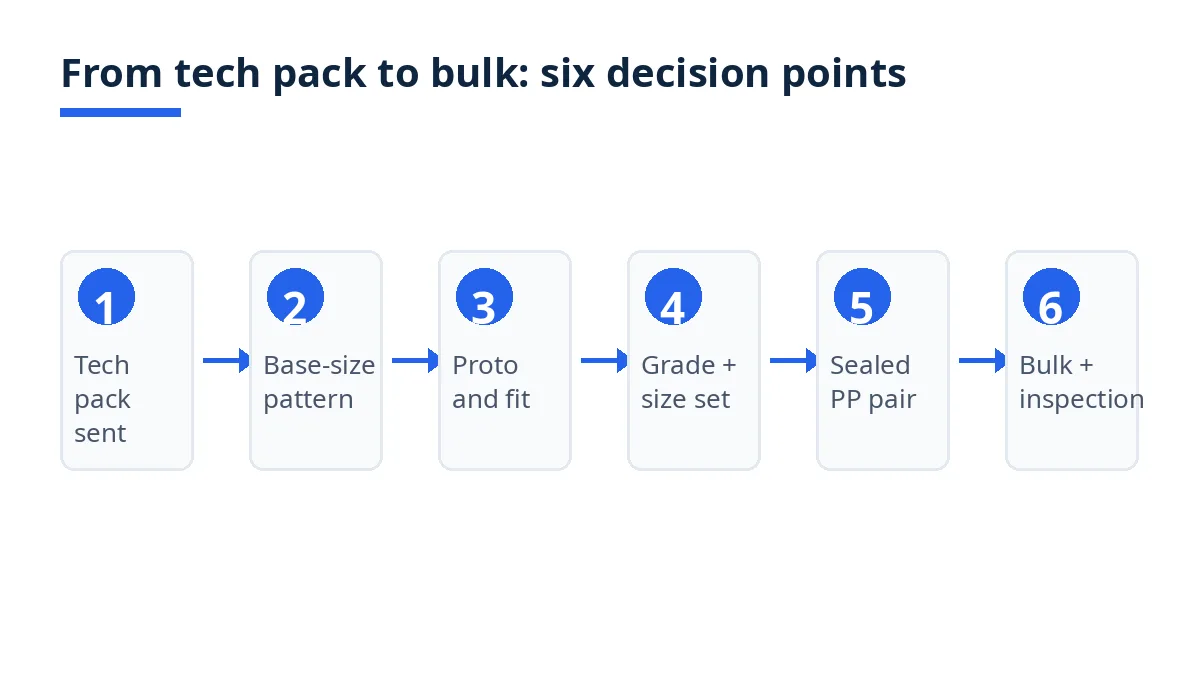
The proto sample, usually in substitute leather, is judged on design, proportions, and workmanship, not colour; expect a revised proto.7 The fit sample checks fit and measurements point by point on a form in the standard size.7 The size set, one pair per size, checks grade rules across the range.7 The pre-production sample uses actual bulk leather, trims, labels, and packing, with nothing substituted.7
The factory keeps the approved sample's counterpart, the counter sample, tagged and used to judge running production.7 The sealed, signed pre-production sample is the reference in any later dispute over shade, measurement, workmanship, or trims.7 Bulk cutting cannot start without pre-production approval.7 Record each approval in writing: signer, date, tech pack version, conditions, pair judged.
The diagram below shows the path from tech pack to bulk, with the decision at each step.
Choosing the skin, the lining, and the way the glove closes
One glove maker calls hair-sheep sheepskin smooth, soft, and light, with a supple grain and extreme tensile strength; wool sheep leather is less smooth, weaker against abrasion, and cheaper.8 Cowhide combines stretch, softness, smooth finish, and durability, with less stretch than sheep and deer. Goatskin, widely used for value and durability, is close to sheep and deer in strength at a lower cost, with a grainier look than cowhide.8 Pigskin is the lowest cost option, generally suited to lower price points but not the strongest for durability and soft hand feel.8 Common thickness is 0.7 to 1.0 millimetres: thinner sheepskin for a golf glove, cowhide of 0.8 to 1.0 millimetres for motor sports gloves.8
Record animal, tannage, finish, thickness range, colour reference, and grade term. Then name the lining, its material, and its attachment, and ask in writing whether the lining changes any pattern measurement. Assembly joins fourchettes to finger sections, attaches the thumb, then joins the halves and lining.5 Name the closure too: buttons, snaps, buckles, or elastic are fitted at finishing, after the glove is drawn over a hand-shaped last and pressed to set the seams.5
When protection is the job: what EN 388 can and cannot promise
Most leather gloves carry no protective standard. When a glove is sold as protection against mechanical risks, EN 388:2016+A1:2018 covers the requirements, tests, marking, and user information for gloves that protect against mechanical risks: abrasion, blade cut, tear, puncture, and impact where claimed.9 Results appear as a pictogram in fixed order: abrasion, cut, tear, puncture, straight cut letter, X for untested, P for impact.9 Abrasion: Level 1, 100 cycles, to Level 4, 8,000. Tear: 10 to 75 newtons. Puncture: 20 to 150. Straight cut: Level A, 2 to 5 newtons, to Level F, over 30.9
EN 388 levels describe palm material tested in a laboratory, not the whole glove in use, and a fashion glove carries no EN 388 pictogram. If protection is claimed, require the laboratory report that identifies the glove, the standard, the test method, and the result, and check that label levels match the report. No pictogram should appear on a glove that was never tested.
What moves the price, and what moves the calendar
This guide states no price: no price source for a custom glove order was opened. Cost drivers, each as its own quotation line where possible: pattern and cutting setup, sample rounds charged per round, leather grade and thickness, lining, labelling and packaging complexity, and order size. Pattern setup is a fixed cost, so its weight per pair falls as the order grows. Example figures only: a pattern charge of USD 400 over 500 pairs adds USD 0.80 per pair; over 5,000 pairs it adds USD 0.08. Each extra proto or fit round adds its own charge, and a late change after grading can force the pattern, size set, and pre-production sample to be remade. Compare quotations only on one identical specification.
The calendar follows the approval ladder, with a date and owner per stage. No day count is stated here, because no timeline source was opened. Agree each gate date before sampling starts, and treat every restart as a new stage with its own date.
Bangladesh notes: tanneries, the trade body, and the checks that are not inspections
No factory location, capacity, or company name is stated as fact here. Ask each factory for the producing site, and check the name and address agree on the quotation, invoice, and packing list.
Tanneries moved from Hazaribagh to Savar in 2017; the Savar effluent treatment plant remains incomplete, which exporters cite as the biggest hurdle to Leather Working Group certification, and leather exports fell from USD 397 million in fiscal 2013-14 to USD 142.54 million in fiscal 2023-24.10 LFMEAB is the trade body for Bangladesh's leather-product, footwear, synthetic, and allied factories.11
The Leather Working Group audit is a tannery audit. It rates 17 sections, including water, energy, chemicals, waste, and effluent treatment, scored out of 100: Gold 85, Silver 75, Bronze 65, Audited 50, with the medal required in every section; certification is valid for 24 months.12 It is not a glove certificate, a restricted-substance guarantee, or a legal compliance assessment.12 Require lot laboratory evidence separately from audit evidence.
Badges on Exportain record document and photo reviews by staff: Exportain Verified covers identity, phone, email, and business registration, Export Verified covers the Export Registration Certificate, and Factory Verified covers reviewed photos of the factory.13 Verification is a document review, not a factory inspection, and a badge guarantees nothing about capacity, quality, or delivery.13 Request the establishment listing and export registration papers yourself. A glove minimum counts across style, colour, lining, and related splits; agree the counting basis in writing, as the MOQ guide explains.14
Ownership in writing: design, patterns, tooling, and the factory's own know-how
Settle ownership before the first pattern is cut, in writing, signed by both sides. The agreement must answer, each in a sentence the factory has signed: who owns the tech pack, drawings, and pattern, including any pattern the factory builds from your drawing; who owns cutting forms, dies, and tooling, who pays for them, and what happens to them when the order ends; what the factory may do with your design beyond your order; what stays with the factory: its existing patterns and know-how; and who owns development changes.
OEM ownership is often mixed; contract manufacturing gives the customer the design and tooling rights.1 Send drawings only under a written confidentiality term.
Seven slips that send a custom order back to the start
A tech pack with measurements but no tolerances, so inspection has no pass line.
Approving bulk from a photograph, which cannot show stretch, shade, or closure hold.
Leaving design and pattern ownership unwritten, so the first successful order becomes the dispute.
Assuming grade rules instead of specifying them.
Mixing a catalogue glove and a custom glove in one purchase order.
Judging a substitute-leather proto as if it were bulk leather.
Copying a size chart from another market without the factory's chart.
Before you sign: the custom-order file, checked line by line
Tech pack version confirmed received, with flats, tolerances, graded chart, materials, construction, labels, and revision log.
Pattern and tooling ownership and confidentiality settled in writing.
Base-size fit signed off in writing from the physical fit sample.
Grade rules and the factory's size chart agreed, with the mapping to your market's letter sizes.
Size set approved across the full range, pair by pair, from physical pairs.
Pre-production pair approved in writing, sealed as the bulk reference, counter pair held at the factory.
Leather, lining, closure specified: animal, tannage, finish, thickness, lining, closure type.
Protective evidence, where claimed: lab report for the glove, standard, method, result; label levels matching.
Exclusivity and non-use of your design and pattern settled in writing.
Inspection plan agreed in writing: standard, level, acceptable quality limit per defect class, accept/reject numbers. ISO 2859-1 is a sampling system indexed by acceptable quality limit: the worst tolerable long-run proportion of defectives.15 Name the defect classes, critical, major, and minor, before inspection, not during it.
Trial lot completed through the full process, record kept, before bulk is booked.
Gate dates agreed with an owner each; bulk stays unbooked until pre-production sign-off.
What should I know first about a custom leather glove order?
Know first that you are ordering a design, not a glove from a shelf. Send a versioned tech pack, settle design and pattern ownership in writing, and climb the sample ladder before bulk is cut.2 7
What drives the cost and the calendar of an OEM glove order?
Costs are driven by pattern and cutting setup, sample rounds, leather grade and thickness, lining, labelling and packaging complexity, and order size, each priced as its own quotation line. The calendar is driven by the gates, and each restart adds a stage.
Which documents carry a custom glove order?
The documents are the versioned tech pack, the pattern and grading records, the gate approvals and sealed pre-production pair, the quotation with the counting basis for the minimum and the inspection plan, the protective laboratory report where protection is claimed, the ownership agreement, and the invoice and packing list repeating the glove description, tech pack version, and size range.7 15
Where does a first custom glove order usually go wrong?
A first custom glove order usually goes wrong at a gate skipped or approved from the wrong evidence: a tech pack without tolerances, a bulk approval from a photograph, ownership left unwritten, grade rules assumed, or a catalogue glove and a custom glove mixed in one purchase order. Fix each in writing before the gate it affects.
Next steps on Exportain
Start at Bangladeshi suppliers, then open Exportain verification explained and the MOQ guide before you write the tech pack. Then post a free RFQ with your tech pack version, glove job, specification, size range, markets, and inspection basis. Post a free RFQ on Exportain and get quotes from verified Bangladeshi suppliers → https://exportain.com/rfqs
Sources
- What is OEM vs Contract Manufacturing?. Komaspec (accessed )
- Tech Pack Clothing: What It Is And How To Create One (2026). Maker's Row (accessed )
- Demystifying Pattern-Making. Maker's Row, (accessed )
- Pattern Development Process. Apparel Pattern Making (accessed )
- How Are Deerskin Gloves Cut and Sewn? Manufacturing Explained. MotoGearRater, (accessed )
- How to measure glove size. Ansell (accessed )
- Types of samples in garment industry: 10 samples explained. Textile Merchandising (accessed )
- Glove Company Tips: What's the Best Glove Leather?. Olympia Gloves, (accessed )
- The EN 388 glove standard. SATRA (accessed )
- Bangladesh's leather exports drop 64% in 10 yrs as CETP not complete. Fibre2Fashion, (accessed )
- President's Message - LFMEAB. Leathergoods and Footwear Manufacturers and Exporters Association of Bangladesh (LFMEAB) (accessed )
- Certification - Leather Working Group. Leather Working Group (accessed )
- How Supplier Verification Works on Exportain. Exportain, (accessed )
- MOQ Meaning (Minimum Order Quantity). Exportain (accessed )
- ISO 2859 Sampling Plans. TextileTuts (accessed )
About the author
Sourcing from Bangladesh?
Post a request for quotation and suppliers on Exportain can send you their quotes directly.
Post an RFQ