UAE Live Crab Imports From Bangladesh: Municipality Gate Guide
Live crabs from Bangladesh to the UAE pass a municipality gate first: FIRS or FIEMIS registration, a MOCCAE veterinary answer in writing, 0306.33 at 0% duty, 5% VAT on CIF, and airline acceptance before booking.
Short answer
To import live crabs from Bangladesh to the UAE, clear the municipality gate first: register supplier, product, and label through FIRS in Dubai or FIEMIS in Abu Dhabi, get the MOCCAE veterinary and quarantine answer in writing, and classify the consignment on line 0306.33.00, shown at 0 percent duty in the 2022 GCC Tariff Book. Charge VAT at 5 percent on the CIF value, secure airline acceptance in writing, run a trial lot, and price on surviving weight.
On this page
Key takeaways
The entry emirate decides the file: Dubai works through FIRS with label assessment, Abu Dhabi through FIEMIS with pre-arrival release, and the channel, local sale, transfer, or re-export, must be fixed before ordering.
MOCCAE must answer the veterinary, quarantine, and wildlife questions in writing for the exact species; no quarantine period, certificate model, or failure outcome is stated from an opened source.
Line 0306.33.00 for live, fresh or chilled crabs is shown at 0 percent in the 2022 GCC Tariff Book; the broker must confirm the line and rate for the entry emirate and date.
VAT is 5 percent on the CIF value inclusive of duty, which is the CIF value where duty is nil; non-registered importers pay before clearing through VAT301, registered importers pay at filing.
No typical MOQ, transit time, temperature, oxygen level, or survival figure is stated; agree quantity, price basis, packing numbers, and the count method in writing, and run a trial lot first.
To import live crabs from Bangladesh to UAE, clear the municipality gate before you agree a price or a packing date. The emirate of entry decides which food system registers the consignment, which office inspects it, and which file releases it, and a live consignment adds a veterinary and quarantine question on top of the food file. This guide works that gate first, then classification, duty, VAT, supplier checks, live-air acceptance, delivery terms, and a landed-cost example. Steps no opened source settles are marked for written confirmation.
Put the municipality gate ahead of the price discussion
Dubai Municipality lists the services framing the Dubai gate: registering and assessing a food item, releasing imported consignments for local sale, transferring consignments to and from other emirates, and approving release for re-export.1 MOCCAE lists release of imported agricultural consignments among its most used services, alongside a veterinary health certificate service for exporting or re-exporting animal and fish products, an import permit service for live animals and birds, and a CITES import service.2
Food registration and release sit with the emirate food authority; veterinary, quarantine, and wildlife questions sit with MOCCAE. Get both answers in writing, for the exact species, form, and entry emirate, before production or packing begins.
Name the entry emirate and the onward channel before anything ships
Fix the entry emirate first: Dubai and Abu Dhabi run different food systems, and a file built for one does not transfer to the other. Fix the channel second: local sale, inter-emirate transfer, free zone or designated zone movement, or re-export. Dubai Municipality lists separate services for release, transfer, and re-export, so the channel is a service choice.1 Fix the port or airport of entry third, with the onward route and clearing party named.
The UAE portal states that government tariffs range from 0 to 5 percent, that Harmonized System codes run to six digits with GCC or national extensions, that the Dubai tariff runs at 5 percent of CIF value, alcohol and cigarettes excepted, and that the UAE ranks third worldwide and first in the Arab world for re-exporting.3 That Dubai figure is the general rate, not the crab rate.
Entry emirate | Food system to build | Release question to settle first |
|---|---|---|
Dubai | Food Import Re-export Service (FIRS) | Registration, label assessment, release |
Abu Dhabi | Food Import and Export Management Information System (FIEMIS) | Registration, pre-arrival release |
Another emirate | That emirate's food authority | Transfer papers from the entry emirate |
Work the Dubai file through FIRS, or the Abu Dhabi file through FIEMIS
Company guidance describes the Food Safety Department as regulating food registration on the FIRS portal, with the supplier first registered as an authorized foodstuff supplier, and new products registered in detail first, with packaging and label details.4 Build the file in this sequence: supplier registration, product registration, label assessment, then the consignment application. Guidance puts approval near 10 working days where nothing is queried: a planning allowance to confirm with the municipality or broker.4
The labeling list decides carton artwork. It runs: brand name, ingredients in descending order, dates, maker, packer, distributor, or importer, weight, barcode and lot number, Arabic language, allergen information, storage conditions, instructions where required, nutrition information, halal marking, genetically modified marking, and origin as the specific country.4 Arabic is the official verification language, mandatory information must always appear in Arabic, and stickers may translate a label into Arabic.4 Common rejection reasons include labels that cannot be read, banned ingredients, a barcode used twice, wrongly declared ingredients, and ingredients written in a language that is neither Arabic nor English.4
A second company account adds the inspection sequence: requests go through FIRS online before arrival, the consignment is retained until cleared, and documents must be ready to avoid detention and export.5 It lists a health certificate and packing list among key documents, then inspection, possible sampling, release on satisfactory results, and, for non-compliance, rejection with detention and export to origin.5
For Abu Dhabi, ADAFSA states that FIEMIS, launched in June 2022, is a single window that releases shipments before arrival at the port, with risk-based field operations.6 Build the FIEMIS file for an Abu Dhabi entry.
Ask MOCCAE for the veterinary and quarantine answer in writing
Live crabs sit in two files at once, food and live animal, and MOCCAE must answer the second. Its service list includes release of imported agricultural consignments, veterinary health certificate services for exporting or re-exporting live animals and animal and fish products, an import permit service for live animals and birds, and a CITES import service.2 Note the direction: framed for export and re-export. Ask in writing which permit, certificate, or release step applies to a commercial import of live crabs, who issues it in Bangladesh, and what wording and validity it must carry. No opened UAE source states a quarantine period, certificate model, or failure outcome for live crabs, so none is stated here.
Ask four questions through the broker before ordering: is an import permit required; what veterinary certificate or quarantine inspection applies on arrival, and who issues or endorses it; what happens on failure, and who bears each cost; and whether any CITES document applies to the exact species.
Put the halal question in the same request. The labeling guidance lists halal marking among mandatory items, and the food-trading account lists a halal certificate among key documents.4 5 Neither states that live crabs require halal certification. Ask in writing whether any halal certificate or mark applies.
Read the border outcome before you book
Price and contract the border outcome before the flight, since a live consignment cannot wait out a dispute. The company account describes retention until release, inspection, sampling where required, release on satisfactory results, and, for non-compliance, rejection with detention and export to origin.5 The order must state who pays for holding, sampling, re-export, or destruction on refusal. Keep originals accessible at arrival: health certificate, invoice, packing list, certificate of origin, airway bill, and registration and label approvals. For an inter-emirate transfer, Dubai Municipality lists a transfer service, and the account describes a no-objection document from the receiving authority plus proof of arrival to close the case.1 5 Agree transfer papers before the flight.
Classify the consignment on 0306.33 and check the 0 percent schedule line
Heading 0306 covers crustaceans in shell or out, live, fresh, chilled, frozen, dried, salted, brined, smoked, and shell-cooked.7 The GCC Tariff Book published by Abu Dhabi Customs separates frozen (0306.10), live, fresh or chilled (0306.30), and other crustaceans (0306.90), and lists crabs at line 0306.33.00 at 0 percent of value.7 Frozen crabs sit on line 0306.14.00, also shown at 0 percent, and must not be borrowed for a live consignment.7 Read the classification guide at https://exportain.com/blog/hs-code-for-live-crabs alongside the tariff book, and confirm the full GCC line with the broker for the exact form.
The 0 percent figure is the rate shown for line 0306.33.00 in the 2022 GCC Tariff Book, and the broker must confirm that the line and rate still apply for the entry emirate and date before quoting.7 The general Dubai tariff of 5 percent of CIF value does not override a line-specific schedule rate, and no preference, exemption, or reduced rate beyond the schedule line is claimed.3
Charge VAT at 5 percent on the CIF value when duty is nil
Value added tax (VAT) runs at 5 percent, introduced on 1 January 2018, with mandatory registration above AED 375,000 a year of taxable supplies and imports, optional registration above AED 187,500, and special rules for designated zones.8 The Federal Tax Authority guide gives the import rule: VAT is worked out on a value that includes any customs duty and excise tax due.9 With duty at 0 percent and no excise tax stated for live crabs, the VAT base below is the CIF value, charged at 5 percent. The tax adviser must confirm the base and any relief.
Payment depends on registration. Importers who are not registered pay before clearing, through the VAT301 form on the FTA e-Services portal, paying through the e-Dirham gateway.9 VAT-registered importers on mainland imports pay at filing, while duty-suspension and designated-zone movements run under separate scenarios, including an e-guarantee equal to the VAT due.9 Settle who holds the tax registration number, who files, and whose cash pays at the border, before the flight.
Identify the crab by species and lot, and settle the wildlife question
Name the crab with its scientific name, lot identity, and the grade and size the price covers, and require the same names on invoice, packing list, health certificate, and label. The supply here is mud crab of the genus Scylla, and the exact species must be written into the order, since the border file, label, and wildlife check all run on the named animal. Lot identity is the harvest or fattening lot. The labeling guidance requires origin as the specific country, the lot number, and allergen information, all matching across every document.4
The wildlife check is written, not assumed. MOCCAE lists a service for importing a species listed in the CITES Appendices.2 Ask in writing whether the exact species is listed, whether any CITES document applies, and which office issues it. This guide asserts no CITES status for any Scylla species, since no opened species page supports such a claim.
What Bangladesh mud-crab supply looks like, and what to test in it
FAO AGRIS research describes mud crab aquaculture in the south-west Sundarbans region as an important livelihood option for coastal fisher households, with wild-harvested crabs traditionally fattened in pens placed in tidal rivers, ghers, and earthen ponds, studied in Bagerhat, Satkhira, and Khulna, fattening crabs of 100 to 180 grams.10 Ask, lot by lot and in writing: wild-caught, fattened, or pond-grown; how long held; what fed; how graded. No availability, seasonality, or price figure is stated here. Test supply on the trial lot: a supplier who describes the holding setup, names the lot, and produces matching documents has given something checkable.
Supplier checks that start from the municipality record
Work outward from the record the municipality will inspect. First, registration: supplier and product registered in the entry emirate's system, FIRS for Dubai or FIEMIS for Abu Dhabi, with label assessment in the file before production.4 6 Second, consistency: invoice, packing list, health certificate, certificate of origin, and label describe one product, species, lot, and weight basis. Third, traceability: the lot traces to its source, with the lot number on carton, packing list, and label.4 Fourth, live handling: how crabs are held, graded, counted, and packed, with the count method agreed in writing. Fifth, responsiveness: answers with documents, and a named contact who can act in transit.
Use the quality control checklist at https://exportain.com/blog/live-crabs-quality-control-checklist for packing and arrival checks, and read the MOQ discussion at https://exportain.com/blog/live-crabs-moq-bangladesh before fixing a quantity. Do not rank suppliers by price until the five checks are met.
Agree quantity, price basis, and a trial lot before the first full order
No typical minimum order quantity is stated here. Agree each shipment's quantity in writing, in kilograms, on a stated basis: live weight shipped, live weight at handover, or surviving live weight at arrival. The price basis follows the same choice, and the order must state which applies, how dead or weak crabs are counted, and who bears the loss between handover and arrival. Agree grade, size, count method, and weighing point in writing.
Run a trial lot first, on the full border file, before any full order. It tests registration, label, health certificate, airline acceptance, border inspection, and the count method in one live run, at a quantity the buyer can absorb if it fails. Price it on the same basis, record survival against shipped count, and feed the result into quantity, packing, and delivery terms.
Pack for a live arrival and secure airline acceptance in writing
Live animals shipped by air fall under the IATA Live Animals Regulations, which anyone shipping animals by air must follow.11 IATA lists the booking checks: species and handling needs, container rules, carrier rules, destination rules, country rules, direct routing allowed by the importing country, container fit in the hold, and shipment date.11 Ahead of preparation, verify the routing and facilities, weigh or measure the container, label it, put the shipper and consignee names plus a 24-hour emergency contact on it, fix duplicate care instructions to the outside, and note any medication.11
IATA names three minimum documents: the Shipper's Certificate, health certification, and the import permit, with a separate air waybill carrying a 24-hour emergency contact, a Shipper's Certification in duplicate, and a Live Animal Acceptance Checklist completed in full before acceptance or rejection.11 Carriers accept only animals appearing in good condition and health, with documentation in order.11 Confirm with the operating carrier in writing whether it accepts live crabs as live-animal cargo or another category, which container requirement applies, and what inspection it will run. Book no flight until that acceptance exists.
Agree packing numbers in writing: pack type, crabs per carton, moisture method, oxygen arrangement where used, holding condition, and maximum time from packing to flight. No transit time, temperature, oxygen level, or survival figure is stated here, since no opened source settles those figures for a Dhaka to UAE movement. Count at handover and arrival, photographed and signed at both points.
Choose air-suited delivery terms: FCA, CIP, and DAP
Incoterms 2020 has 11 rules: seven suit any mode of transport, while four, FAS, FOB, CFR, and CIF, are meant only for sea and inland waterway port-to-port shipments.12 Use an any-mode rule for live air cargo. The ICC page confirms the insurance split: CIF, reserved for maritime trade, carries Clauses (C) as the default, while CIP requires Clauses (A), the higher cover.13 In every rule risk passes at delivery, and the seller must insure the buyer's risk only under CIP and CIF.12 In all rules but EXW the seller handles export formalities; in all rules but DDP the buyer handles import formalities.12
Term | Fit for live air cargo |
|---|---|
FCA (Free Carrier) | Any-mode rule. Seller delivers to the buyer's named carrier; buyer arranges flight and import file. |
CIP (Carriage and Insurance Paid To) | Any-mode rule. Seller contracts carriage and insurance at Clauses (A). |
DAP (Delivered at Place) | Any-mode rule. Seller delivers at the named place; buyer unloads, handles import file. |
CIF (Cost, Insurance and Freight) | Sea-only rule. Do not use for air cargo. |
Agree FCA, CIP, or DAP, with the named place, delivery point, and insurance position in the contract. Avoid DDP unless the seller confirms in writing that it can clear the municipality and MOCCAE file. Settle mortality, refusal, and holding costs separately in writing. The former DAT rule is now DPU, where the seller unloads, distinct from DAP.13
Landed cost example in UAE dirhams, on surviving weight
All figures here are example figures; rework them with broker-confirmed figures before ordering. The example uses 500 kilograms shipped at AED 55.00 per kilogram, freight and insurance of AED 9.00 per kilogram, duty at 0 percent on line 0306.33.00, VAT at 5 percent on the CIF value inclusive of duty, clearance of AED 1,200, and delivery of AED 800.7 8 9 The loss assumption is explicit: 5 percent does not survive to sale, leaving 475 kilograms.
Line | Calculation | AED |
|---|---|---|
Product, 500 kg shipped | 500 x 55.00 | 27,500.00 |
Air freight and insurance | 500 x 9.00 | 4,500.00 |
CIF value | 27,500.00 + 4,500.00 | 32,000.00 |
Duty at 0 percent | 0 percent x 32,000.00 | 0.00 |
VAT at 5 percent | 5 percent x 32,000.00 | 1,600.00 |
Clearance handling | Example figure | 1,200.00 |
Delivery to cold store | Example figure | 800.00 |
Total landed cost | 32,000.00 + 0.00 + 1,600.00 + 1,200.00 + 800.00 | 35,600.00 |
Cost per kilogram shipped | 35,600.00 / 500 | 71.20 |
Cost per surviving kilogram, 475 kg | 35,600.00 / 475 | 74.95 |
The surviving-kilogram figure is rounded to AED 74.95: 475 kilograms at that rate is AED 35,601.25, AED 1.25 above the total through rounding. The gap between AED 71.20 shipped and AED 74.95 surviving comes entirely from the assumed loss. Read the landed-cost method at https://exportain.com/blog/landed-cost-imports-from-bangladesh before quoting on these figures.
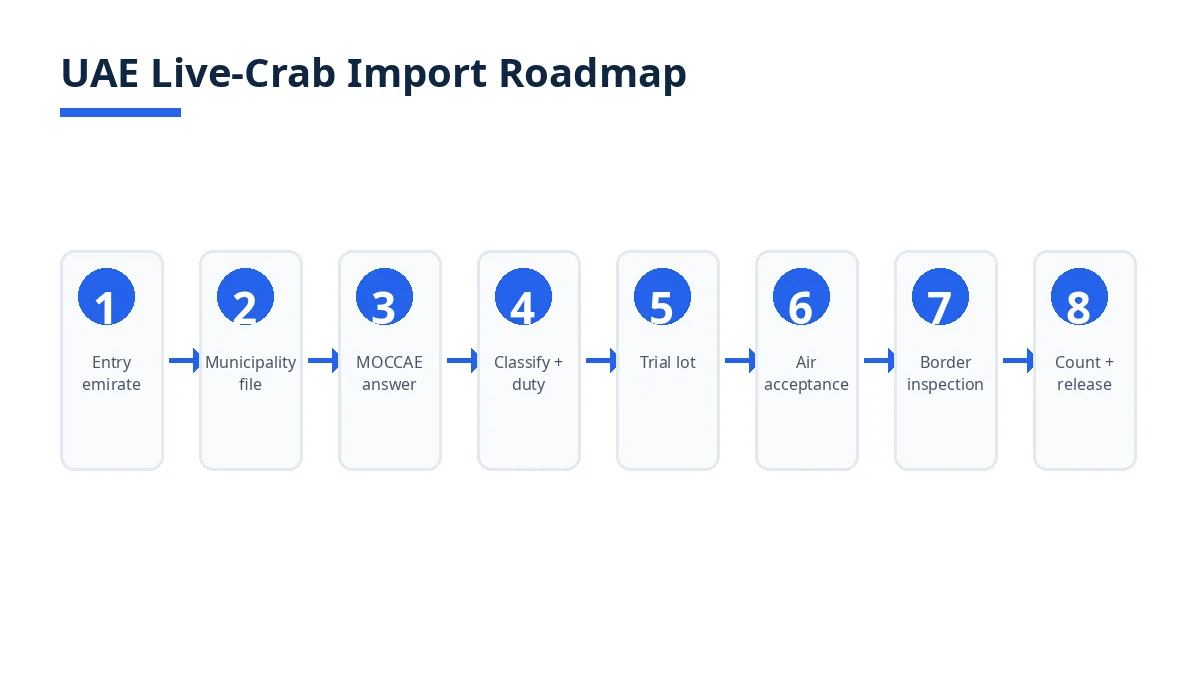
The UAE live-crab run, in order
Name the entry emirate, channel, and port or airport of entry, with onward route and clearing party recorded.
Build the municipality file: FIRS registration and label assessment for Dubai, or the FIEMIS file for Abu Dhabi.
Ask MOCCAE in writing for the veterinary, quarantine, and wildlife answers for the exact species.
Classify on line 0306.33.00 and have the broker confirm the duty rate for the entry emirate and date.
Settle the VAT route: registration position, VAT301 or return filing, and who pays at the border.
Check the supplier against the municipality record, consistency, traceability, live handling, and responsiveness.
Agree quantity, price basis, grade, and count method in writing, then run the trial lot on the full border file.
Secure airline acceptance in writing, agree packing numbers, and book only after acceptance.
Present the consignment with originals accessible, complete inspection and sampling, and record the outcome.
Count at arrival, reconcile surviving against shipped weight, settle payment, and archive everything.
What is the typical MOQ for live crabs from Bangladesh?
This guide gives no figure for a typical minimum order quantity. Agree each shipment's quantity in writing, in kilograms, on a stated weight basis, and test it on a trial lot through the full border file before scaling.
How long does shipping take?
This guide states no transit time, since no opened source states a flight or door-to-door time for live crabs from Bangladesh to the UAE. Agree routing, flight, handover window, and arrival count window in writing, and confirm airline acceptance before booking.
What import duty applies?
The opened GCC Tariff Book shows line 0306.33.00, crabs, live, fresh or chilled, at 0 percent of value.7 Have the broker confirm that line and rate for the entry emirate and date before quoting, since the book is the 2022 edition.3 VAT is charged separately at 5 percent on the CIF value inclusive of duty.8 9
How do I verify a supplier?
Check a supplier against the municipality record, not a sales presentation. Confirm FIRS or FIEMIS registration, consistent documents for one species, lot, and weight basis, traceability from lot number to source, live-handling evidence with an agreed count method, and written answers to the MOCCAE, labeling, and packing questions.4 6 Then run a trial lot and judge the supplier on its documents, border outcome, and survival count.
Next steps on Exportain
Begin with the general import method in how to import from Bangladesh, then compare suppliers and confirm the buying steps in how to buy. Post a free RFQ on Exportain and get quotes from verified Bangladeshi suppliers → https://exportain.com/rfqs
Sources
- Our Services. Dubai Municipality (accessed )
- UAE Ministry of Climate Change and Environment. Ministry of Climate Change and Environment (accessed )
- Customs duty and tariff. UAE Government (accessed )
- How do I register food products for import into the UAE under Dubai Municipality?. Pro Partner Group (accessed )
- How food imports is taking place if you do food trading business in Dubai. UAE Consultants, (accessed )
- Abu Dhabi Agriculture and Food Safety Authority - Food Security. Abu Dhabi Agriculture and Food Safety Authority (accessed )
- GCC Tariff Book 2022. Abu Dhabi Customs (accessed )
- Register for VAT. The Official Portal of the UAE Government (accessed )
- VAT Import Declaration User Guide. UAE Federal Tax Authority (accessed )
- Mud Crab (Scylla spp.) Aquaculture in the South-West Sundarbans Region of Bangladesh. FAO AGRIS (accessed )
- Questions and Answers for Shipping Live Animals by Air. International Air Transport Association (accessed )
- Insider thoughts: Bob Ronai on Incoterms 2020 Rules; What are they about?. International Chamber of Commerce (accessed )
- Incoterms® 2020. International Chamber of Commerce (ICC) (accessed )
About the author
Sourcing from Bangladesh?
Post a request for quotation and suppliers on Exportain can send you their quotes directly.
Post an RFQ