Australia Live Crab Imports From Bangladesh: Biosecurity Gate First
Live crabs from Bangladesh to Australia on a biosecurity-first file: the BICON and Live Import List gates, supplier checks, air acceptance, Free duty on 0306.33.00, GST to confirm, and a worked landed-cost example.
Short answer
To import live crabs from Bangladesh to Australia, run the DAFF BICON case and the Live Import List check for the exact species before ordering, agree the species specification, trial lot, price basis and failure plan in writing, get carrier acceptance for the live consignment, classify on subheading 0306.33.00 at the Free rate shown in the Australian schedule, and have the broker confirm GST treatment before pricing.
On this page
Key takeaways
Run the BICON case for the live scenario and the Live Import List check for the exact species before ordering: no completed live-crab condition set was opened for this guide, so both answers must be held in writing.
The Australian Border Force Working Tariff lists subheading 0306.33.00, crabs, live, fresh or chilled, at a Free rate; have the broker confirm the line and statistical code for the exact consignment.
GST on a taxable importation is 10 percent of the value of the taxable importation; whether live crabs fall within GST-free basic-food treatment must be confirmed by the broker and tax adviser.
Get carrier acceptance in writing under the IATA Live Animals Regulations before packing, and use air-suited Incoterms rules such as FCA, CIP or DAP, never CIF for air cargo.
Agree quantity, price basis, trial lot, live-arrival count and failure plan in writing, and price on surviving weight using example figures reworked with broker-confirmed numbers.
To import live crabs from Bangladesh to Australia as a commercial buyer, start with biosecurity, not with a supplier list. A live animal is not a frozen carton that can be re-routed after it lands. Australian controls decide, before shipment, whether the species, the state of the goods, and the end use may enter at all, and a failure at the border can end in export or destruction at the importer's expense. Where this guide could not open an Australian condition set in full, it says so plainly and tells you who must confirm the point in writing.
Start where Australia starts: biosecurity clearance before a commercial order
The Department of Agriculture, Fisheries and Forestry (DAFF) runs the Biosecurity Import Conditions system, known as BICON. DAFF advises importers to check BICON before applying for a permit, because the system shows whether a permit is required and what information a permit application should contain.1
The BICON material opened for this guide showed the scenario table for seafood, excluding finfish, for human consumption, with crustacean branches split by product type, personal or commercial use, and state, including frozen, fresh chilled without shell, and other states.2 It did not display a completed live-crab condition set for a commercial consignment from Bangladesh. Do not read a frozen-product branch, or a branch for dead product, as permission for live animals. Run the BICON case for the live scenario, save the conditions it returns, and ask DAFF or your broker to confirm in writing that the case matches the shipment you intend to make.
A second gate sits with the environment portfolio. The Department of Climate Change, Energy, the Environment and Water states that plant and animal specimens considered suitable for live import are listed on the Live Import List, that a live specimen not on the list cannot be imported, and that a specimen on Part 2 of the list needs a permit.3 If a specimen is not on the list, the list must be amended before it can be imported, and amendments can take several years.3 Check the list for the exact scientific name and get the answer in writing. Food inspection follows biosecurity: the Imported Food Inspection Scheme inspects and tests imported food intended for sale, refers surveillance food at 5 percent of consignments, and gives every inspected consignment a visual and label assessment.4
When a live consignment fails at the border: export, treatment or destruction
Plan for failure before you plan for delivery, because the cost of failure falls on the importer. DAFF advises against exporting products that require a permit to Australia until a valid import permit is held, noting that permit conditions often require government certification that generally cannot be obtained once goods have left the country of export.1 Goods imported without a valid import permit, or goods that cannot meet Australian import permit conditions, must be re-exported or destroyed at the importer's expense.1
The same outcome logic appears in the food scheme. If food fails inspection, it cannot be released, and the importer will need to relabel the imports if labelling issues were found, or destroy or re-export the food under the supervision of an authorised officer.4
Name the animal precisely before you ask anyone for a ruling
Every Australian check in this guide turns on identity. A ruling for one species does not cover another, and a ruling for a farmed lot does not necessarily cover a wild-caught lot. Before approaching DAFF, a broker, or a carrier, fix these points in a single written specification and use the same wording everywhere: the scientific name, agreed with the supplier, with no reliance on a trade name alone; whether each lot was wild-caught or farmed, lot by lot, with no single description covering a mixed lot; the state on arrival, live, as distinct from chilled, frozen, cooked, or any other state; the end use, human consumption sold as food; and the size and sex grading the buyer will accept, with the method for checking it.
Bangladesh mud crabs are commonly described under the genus Scylla, which contains more than one species, so a bare label such as mud crab is not precise enough for a ruling. This guide asserts no wildlife-listing status for any crab species, because no CITES species page was opened in full during this research. The International Air Transport Association (IATA) notes that a listed species needs its CITES document to travel with the specimen.5
Why buyers still look to Bangladesh for live crabs, and what to test first
Buyers consider Bangladesh for live crabs for reasons they should test rather than assume. Does the supplier hold the crabs, grade them, pack them, and hand them to the carrier, or does it buy from collectors and pass the lot onward?
Ask about continuity of supply across the year. Live-crab availability changes with season, weather, and fishing or harvest cycles, and a price quoted in one month may not hold in the next. Ask about packing practice for live movement: how the supplier keeps crabs moist and separated, and how it labels the consignment for the carrier.
Supplier checks that answer the biosecurity file, not the catalogue
Judge a supplier by the file it can build, not by the catalogue it sends. Ask for the supplier's legal name, registered address, export registration details, and the name of the person who will sign export documents. Check that the name on the quotation, the name on the invoice, and the name on any certificate are the same legal entity.
Ask the supplier to confirm, in writing, that it will supply the species name, the wild-caught or farmed status, and the end use in the exact wording of your specification, and that it will obtain any government certification the Australian conditions require before the goods leave Bangladesh. Ask how it handles a small first shipment, whether it will accept a trial lot on full paperwork, and what remedy it offers if a high share arrives dead.
Agree the commercial terms in writing: quantity, price basis, and a trial lot
No typical minimum order quantity, price, or transit time is stated in this guide, because no such figure was opened in an Australian or supplier source for this commodity. Agree every commercial figure per supplier and per shipment, in writing, and run a trial shipment first.
State the quantity in kilograms of live weight and in cartons, and state whether the count is by weight, by number, or by both, with a tolerance for short weight or short count and a rule for pricing a short shipment. State the currency, the price per kilogram, and the weight the price follows. In particular, state whether the price follows the weight shipped from Bangladesh or the weight alive at arrival in Australia, and who bears the loss for crabs that die in transit.
Agree a trial lot on the same paperwork as a full order, with the same specification, packing, and carrier acceptance.
Quality, packing and the live-arrival count
Quality control for live crabs is a count, a look, and a record, repeated at three points: at packing, at handover to the carrier, and on arrival in Australia. Agree the method for each point before shipment, and name the person who will carry it out.
At packing, check that the lot matches the specification: the species name on the documents, the grading agreed, and no mixing of lots with different wild-caught or farmed status. At handover, check the count and weight against the packing list, and check that the labels on the cartons match the documents.
On arrival, count promptly, in the presence of the broker or handler where possible, and record the number alive, the number dead, and the weight of each group. Agree in advance who counts, where the count happens, and how quickly it must happen after landing.
Air acceptance: the carrier decides whether the crabs fly
Live crabs travel by air, and the carrier's acceptance decision is a gate of its own. IATA states that anyone shipping animals by air must follow the Live Animals Regulations for purposes that include life science, agricultural, zoological, and other shipments.5 Before booking, IATA points to these checks: handling needs for the species, container rules, the carrier's own species rules, the destination, the importing country's species rules, the best direct routing the importing country allows, hold fit for the container, and the shipment date.5
Acceptance is a verification exercise. IATA lists what must be checked before the animal is prepared for travel: routing and facilities confirmed, container weight and size in compliance, labelling correct, shipper and consignee names, addresses and phone numbers on the container, a 24-hour emergency contact, care instructions in duplicate outside the container, and medication noted on the container.5 Carriers should only accept live animals that appear to be in good condition and health, and should verify documentation, container design, marking and labelling, and reservation and routing, with all acceptance checklist criteria cleared before acceptance.5
For international animal shipments, IATA names three minimum documents from shippers: the import permit, health certification, and shipper's certificate.5 Every shipment needs a Shipper's Certification for Live Animals, signed in duplicate, and live animals go on their own air waybill, separate from other items, carrying a 24-hour emergency contact among the handling details.5 Containers must carry at least one IATA-compliant live animals label.5
Delivery terms for live air cargo: use air-suited rules
Incoterms 2020 rules allocate delivery, risk, cost, and customs duties between seller and buyer. Choose a rule that fits air movement of live animals, and write the rule, the named place, and the Incoterms version into the contract.
The mode split is the point most often got wrong. Seven Incoterms rules do not mention the mode of transport and can be any one or more of road, rail, air, and sea, while four rules, FAS, FOB, CFR, and CIF, are only intended for port-to-port shipments and are not suitable for container shipments in their current form.6 The four sea and inland-waterway rules are FAS, FOB, CFR, and CIF. CPT, DPU, and DDP are any-mode rules, not sea-only rules, and belong in the seven-rule group with EXW, FCA, CIP, and DAP.
For live air cargo, prefer FCA, CIP, or DAP. Under FCA, the seller delivers the goods to the carrier, and risk passes at that handover. Under CIP, the seller also contracts carriage and provides insurance for the buyer's risk. Under DAP, the seller delivers at the named destination, ready for unloading, and bears the risk during the main carriage. Whatever rule is chosen, settle two points separately, in writing: the live-arrival count and the remedy for dead on arrival, and the biosecurity failure plan, because no Incoterms rule allocates the cost of re-export or destruction ordered at the border.
Duty, GST and the papers that travel with the crabs
Classification comes first, and the Australian schedule is clear on the line. The Australian Border Force Working Tariff, Schedule 3, Chapter 3, lists subheading 0306.33.00, crabs, live, fresh or chilled, under the live, fresh or chilled group, with statistical code 03, unit kilograms, and rate Free.7 Use that line for live crabs in the live, fresh or chilled group, and have the broker confirm the statistical code and the entry details for the exact consignment.
GST needs a broker and tax-adviser check, not an assumption. GST is payable on most goods imported into Australia, and the Australian Taxation Office states that GST payable on a taxable importation is 10 percent of the value of the taxable importation, made up of the customs value, any customs duty payable, transport to the place of consignment in Australia, insurance for that transport, and any wine tax payable.8 The Australian Border Force states the same 10 percent rate and formula, and notes that goods that would have been treated as GST-free if supplied within Australia, including basic food, are not subject to GST on importation, subject to the definitions and criteria in the GST legislation.9 Whether live crabs for human consumption fall within that basic-food treatment for a particular consignment is for the broker and tax adviser to decide, on the exact goods and entry.
The papers should describe one consignment: invoice, packing list, air waybill, any certificate the BICON conditions require, any CITES document, and the import declaration. Goods are entered for home consumption by completing an import declaration and submitting it to Home Affairs, with customs duty and GST paid before Home Affairs releases the goods for use in Australia.8
Landed cost example in Australian dollars
All figures in this section are example figures. They are chosen to show the arithmetic, not to predict a price. Rework every line with broker-confirmed figures before ordering. Duty is shown at the Free rate from the schedule opened for this guide. GST is shown at 10 percent of the value of the taxable importation as a working figure only, pending the broker and tax-adviser answer described above. The loss assumption is stated explicitly and is not a promise about survival.
Cost line | Example figure (AUD) | Basis |
|---|---|---|
Goods, 100 kg shipped at AUD 22.00 per kg | 2,200.00 | Example figure |
International transport and insurance to Australia | 900.00 | Example figure |
Customs duty at the Free rate on 0306.33.00 | 0.00 | Schedule rate opened for this guide |
Value of the taxable importation | 3,100.00 | Customs value plus duty plus transport and insurance |
GST at 10 percent, working figure only | 310.00 | 10 percent of the value of the taxable importation, if taxable |
Broker and handling | 250.00 | Example figure, outside the GST value |
Total cash outlay | 3,660.00 | Sum of the lines above |
Cost per kg shipped, 100 kg | 36.60 | Total divided by shipped weight |
Cost per kg surviving, 95 kg at an assumed 5 percent loss | 38.53 | Total divided by surviving weight |
The arithmetic is: 2,200.00 plus 900.00 plus 0.00 gives 3,100.00. Ten percent of 3,100.00 is 310.00. Adding 250.00 gives 3,660.00. Dividing 3,660.00 by 100 kg gives 36.60 per kg shipped, and dividing by 95 kg gives 38.53 per surviving kg at the assumed 5 percent loss. If the GST answer is that the importation is not taxable, remove the 310.00 line and rework the totals.
The Australia import run, in order
Work this run in order. Do not start a later step until the written confirmation for the earlier step is in the file. The diagram below shows the same run in one view.
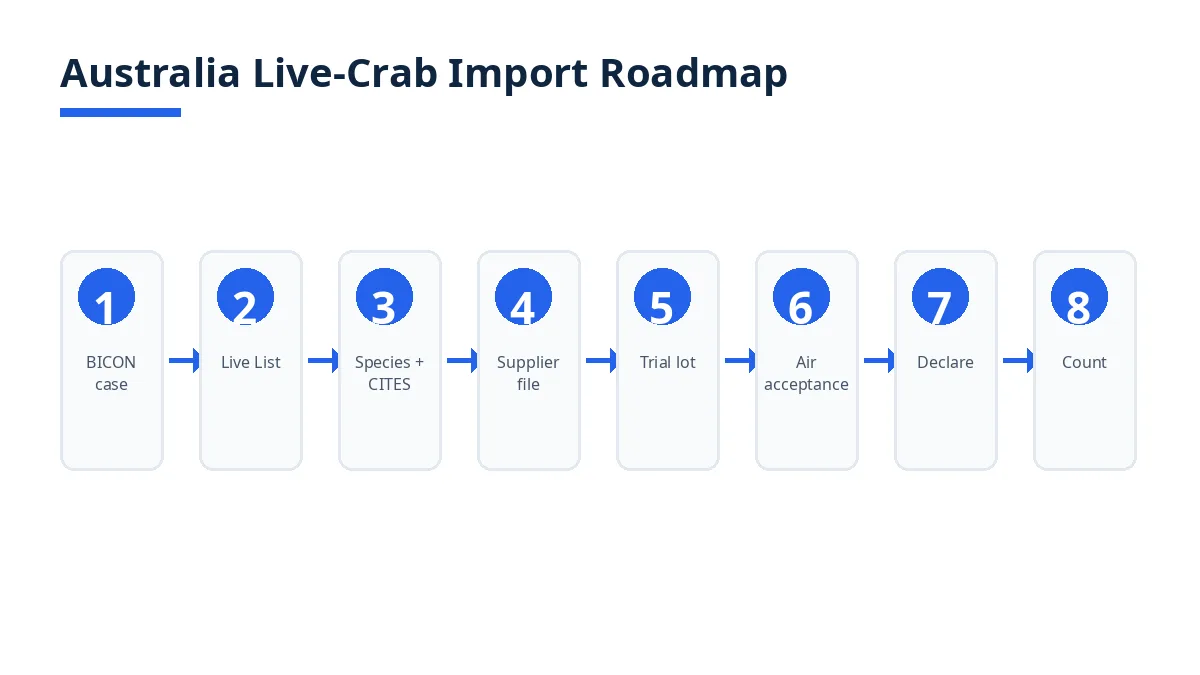
Fix the specification: scientific name, wild-caught or farmed status, live state, human-consumption end use, grading, and count method, in one document.
Run the BICON case for the live scenario and save the conditions. Ask DAFF or the broker to confirm the case matches the intended shipment.
Check the Live Import List for the exact species and get the position in writing, including whether a Part 2 permit is needed.
Check the CITES position for the exact species and confirm whether a CITES document must travel with the shipment.
Shortlist suppliers against the biosecurity file, using the checks in the supplier section, and record each answer.
Agree quantity, price basis, trial lot, payment triggers, live-arrival count, and failure plan in writing.
Obtain any government certification the Australian conditions require, before the goods leave Bangladesh, and check that the certificate wording matches the specification.
Book the carrier, secure acceptance in writing covering the species, container, and routing, and confirm the container, labelling, and 24-hour emergency contact.
Pack, photograph, count, and hand over, with the packing list, invoice, and certificates describing the same consignment.
Declare, present for biosecurity and food inspection, count on arrival, and keep the import declaration and receipt in the file.
What is the typical MOQ for live crabs from Bangladesh?
A typical minimum cannot be quoted in this guide. No minimum figure was opened in an Australian source for this commodity, and a catalogue figure would describe one supplier, not the market. Agree the minimum for each supplier and each shipment in writing, in kilograms of live weight and in cartons, with a tolerance for short weight or short count. Run a trial lot first, on full paperwork, and use it to test whether the agreed minimum works for the supplier, the carrier, and the border file.
How long does shipping take?
There is no transit figure in this guide. No transit figure was opened in an Australian source for this commodity, and the time from packing in Bangladesh to arrival in Australia depends on routing, carrier acceptance, connections, and inspection. Ask the carrier for the routing and the scheduled times in writing, and ask the broker how long biosecurity and food inspection may add at the Australian airport. Plan the trial lot around the longest realistic time, not the shortest quoted time.
What import duty applies?
The schedule opened for this guide shows subheading 0306.33.00, crabs, live, fresh or chilled, at a Free rate.7 Have the broker confirm that line, the statistical code, and the entry details for the exact consignment before ordering. GST is separate from duty. The GST rate on a taxable importation is 10 percent of the value of the taxable importation, made up of customs value, duty, transport, and insurance.8 Whether a particular live-crab importation is taxable, or falls within the GST-free treatment for basic food, must be confirmed by the broker and tax adviser in writing.9
How do I verify a supplier?
Judge a supplier on the Australian file, not on a price list. Check identity and standing, biosecurity readiness, packing evidence, trial-lot behaviour, and checkable references, and record each answer as passed, failed, or unanswered. Require the supplier to confirm the species name, wild-caught or farmed status, and end use in the exact wording of your specification, and to obtain any government certification the Australian conditions require before shipment. Run a trial lot on full paperwork and count live arrival by the method agreed in advance.
Next steps on Exportain
Start with the general guide to importing from Bangladesh, then work the guide to landed cost for Bangladesh imports with your own broker-confirmed figures in place of the example figures used here. Search suppliers and use the how to buy pages to run supplier checks and RFQs with the specification from this guide attached. Post a free RFQ on Exportain and get quotes from verified Bangladeshi suppliers → https://exportain.com/rfqs
Sources
- Applications to import biosecurity risk materials. Department of Agriculture, Fisheries and Forestry (accessed )
- Seafood (excluding finfish) for human consumption - Biosecurity Import Conditions. Department of Agriculture, Fisheries and Forestry (accessed )
- Live Import List. Department of Climate Change, Energy, the Environment and Water (accessed )
- Imported Food Inspection Scheme. Department of Agriculture, Fisheries and Forestry (accessed )
- Questions and Answers for Shipping Live Animals by Air. International Air Transport Association (accessed )
- Insider thoughts: Bob Ronai on Incoterms 2020 Rules; What are they about?. International Chamber of Commerce (accessed )
- Chapter 3: Fish and crustaceans, molluscs and other aquatic invertebrates, Australian Customs Tariff. Australian Border Force (accessed )
- GST and imported goods. Australian Taxation Office (accessed )
- GST and other taxes when importing. Australian Border Force (accessed )
About the author
Sourcing from Bangladesh?
Post a request for quotation and suppliers on Exportain can send you their quotes directly.
Post an RFQ