When Does Risk Transfer Under DDP? A Visual Guide for Importers
Definition
DDP risk transfer happens at one point only: when the seller places the goods at the buyer's disposal at the named place of destination, cleared for import with duty and taxes paid, and ready for unloading. Until that moment the seller bears the risk, including carriage and import clearance. After delivery, the buyer bears the risk, starting with unloading. DDP is an any-mode Incoterms 2020 rule, and it places the maximum obligation on the seller.
Published 7 min read
On this page
Key takeaways
Risk passes only at the named place, when the goods stand cleared for import, duty and taxes paid, and ready for unloading. Shipment, carriage and border crossing do not move the risk.
DDP places the maximum obligation on the seller of all eleven Incoterms 2020 rules: carriage, export and import clearance, and duty and taxes all sit with the seller.
DDP imposes no duty to insure for the buyer. Agree cover that pays the buyer directly in writing before shipment, or the seller's own policy is the only cover.
Name the place in full, not a city. The full address is the delivery point, the risk point, and the end of the seller's carriage duty.
A DDP quotation can read as the simplest deal in trade: one price, goods at your door, duty paid. It holds only if both parties agree where the seller's duty ends. This guide marks that point on one Chattogram to Hamburg shipment.
Quick answer
DDP risk transfer happens at a single point: when the seller places the goods at the buyer's disposal at the named place of destination, cleared for import, duty and taxes paid, ready for unloading. Until then the seller bears the risk of loss or damage, including carriage and import clearance. From delivery the buyer bears the risk, starting with unloading, and must assist with documents the import authorities require.1
DDP in everyday terms: one delivery, one risk point
Delivery and risk pass at a single moment, at the named place, when goods stand ready for unloading, cleared for import, duty and taxes settled. DDP, short for Delivered Duty Paid, is one of eleven Incoterms 2020 rules the International Chamber of Commerce (ICC) maintains. No rule burdens the seller more: import formalities, duty and taxes, then carriage and export formalities.1
Write the term in full, as in DDP Hamburg warehouse, 14 Hafenstrasse, Incoterms 2020. A city name alone leaves the delivery point open to argument. Under DDP, delivery and destination are the same concept: the named destination is where the goods are delivered and where risk transfers.1 DDP works for any mode. The sea and inland waterway only rules are four: FAS, FOB, CFR and CIF. CPT, DPU and DDP are any mode rules.2
Where DDP risk transfer sits on the timeline
The diagram marks the transfer at delivery.
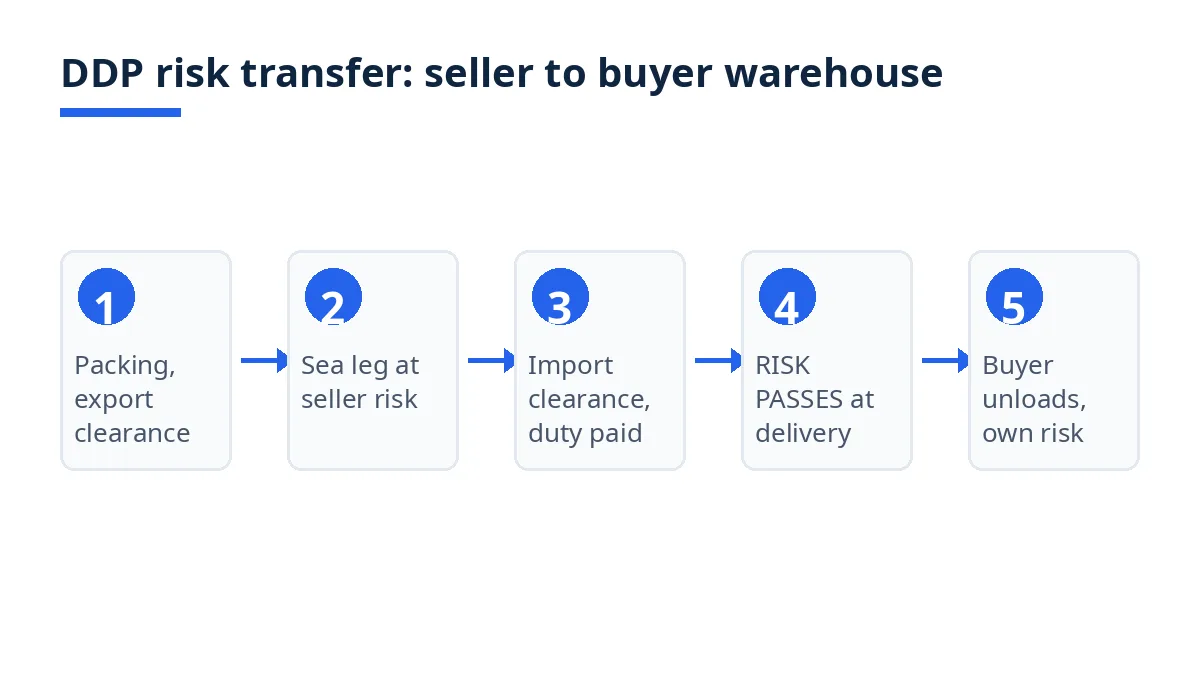
Agree the term, named place and version. Record DDP, the full address, and Incoterms 2020. State which duties and taxes the price covers.
The seller packs and clears for export. Packing and export formalities sit with the seller. Delivery under DDP happens at destination, not at shipment.1
Carriage runs at the seller's risk. The seller contracts and pays for transport to the named place, by any mode or combination of modes. Damage in transit falls on the seller.1
The seller clears for import and pays duty and taxes. The seller handles and pays for export, transit and import formalities. The buyer must assist with import documents, but the seller remains responsible for clearance.1 Where local rules prevent a foreign seller from clearing goods, DAP is more suitable.1
The seller gives notice and delivers. The seller must notify the buyer in good time of arrival. Delivery is complete when the goods stand at the buyer's disposal, cleared for import, on the arriving vehicle, ready for unloading.1
The buyer unloads at its own risk and cost, unless the carriage contract includes unloading for the seller, and pays for transport after the named place.1
The division of duties: seller, buyer, and the border
The seller carries DDP liability for almost the whole journey; the buyer takes delivery, unloads, and assists with import documents.
Task or cost | Seller | Buyer |
|---|---|---|
Packing and export clearance | Pays and arranges | No |
Carriage to the named place | Contracts and pays | No |
Risk during carriage | Bears the risk | No |
Insurance for the buyer | No obligation | Agree cover separately |
Import clearance | Pays and arranges | Assists with documents |
Duty and taxes | Pays | No |
Unloading | If contract says so | Pays and bears the risk |
Onward transport | No | Pays and arranges |
DDP imposes no duty on the seller to insure for the buyer, even though the seller bears the risk to the named place.1 A seller's own policy does not automatically pay the buyer. Agree cover that pays you directly in writing before shipment.
A Chattogram to Hamburg shipment, priced in example figures
Example figures only; duty and taxes are a broker calculation. A buyer agrees DDP at a Hamburg warehouse, Incoterms 2020, for 6,000 cotton towels from Chattogram.
Element of the example DDP price | Example figure (USD) |
|---|---|
Goods: 6,000 towels at USD 3.10 | 18,600 |
Export packing and clearance | 730 |
Inland transport and port handling | 640 |
Ocean freight, Chattogram to Hamburg | 3,150 |
Import entry and broker charge | 410 |
Seller's own-risk insurance | 190 |
Broker-calculated duty and import taxes | 3,280 |
DDP total | 27,000 |
USD 18,600 + 730 + 640 + 3,150 + 410 + 190 + 3,280 = USD 27,000, or USD 4.50 per towel. The insurance line covers only this seller's own risk. Unloading (USD 220) stays outside the total.
Three claim scenarios turn on one question: had delivery happened yet.
Water damage during the sea leg. Seawater soaks two pallets on the voyage. Delivery had not happened: the goods had not reached the warehouse cleared for import. The loss sits with the seller.1
Damage while held at import customs. Cartons are damaged in the examination warehouse before clearance is complete. Delivery had still not happened. The risk and duty payment remain the seller's; the buyer must supply promptly any document requested.1
Damage during unloading. The goods arrive cleared, the seller gives notice, and the buyer's forklift team drops a pallet during unloading. Delivery had happened when the goods stood ready for unloading, so the risk sits with the buyer.
DDP against DAP, DPU and CIF: four different endings
DAP is the closest neighbour. Under DAP the seller also delivers at the named place, ready for unloading, and bears the journey risk. The single difference is the border: under DAP the buyer clears for import and pays duty and taxes, while under DDP the seller does.1 The two prices can be compared only after the import lines are shown separately.
DPU differs on unloading: the seller delivers the goods unloaded, bearing the risk and cost of unloading, while the buyer still clears for import.2 If the bargain is that the seller unloads, DPU records it; DDP does not. CIP and CIF differ on risk and insurance: CIP risk passes at handover to the first carrier, with Clause A cover; CIF risk passes on loading on board, with minimum Clause C cover.2
Term | Where risk passes | Import clearance and duty | Unloading | Seller must insure |
|---|---|---|---|---|
DDP | Named place, ready for unloading | Seller | Buyer | No |
DAP | Named place, ready for unloading | Buyer | Buyer | No |
DPU | Named place, after unloading | Buyer | Seller | No |
CIP | Handover to the first carrier | Buyer | Buyer | Yes, Clause A |
CIF | On board at shipment port | Buyer | Buyer | Yes, Clause C minimum |
Six errors that move the loss onto the wrong party
Naming a city instead of a place. DDP Hamburg names no warehouse or dock. Name the full address and unloading point.1
Assuming the seller unloads. Under DDP the buyer unloads, bearing the risk and usually the cost. For seller unloading, write it in the contract or choose DPU.1
Must I insure? DDP puts no insurance duty on the buyer. The seller's own policy pays the seller alone. Agree separate buyer cover in writing.1
Agreeing DDP with no import plan. Ask who files the declaration and which broker acts. If the seller cannot clear goods in your country, choose DAP.1
Reading risk transfer as payment or title transfer. Incoterms 2020 rules allocate cost, risk and customs duty. They do not transfer title, set price, define payment or fix disputes.2
Assuming the price covers everything after delivery. Unloading and onward transport fall to the buyer unless the contract says otherwise. State in writing who bears a post-delivery duty reassessment.
Next steps on Exportain
Read the Incoterms guide for shipments from Bangladesh, the sea only CIF cost, insurance and freight guide, and the how to buy guide.
Post a free RFQ on Exportain and get quotes from verified Bangladeshi suppliers → https://exportain.com/rfqs
What is DDP?
For the buyer, DDP means goods reach the named place cleared for import, duty and taxes settled. The buyer only unloads, then pays for onward transport. The letters stand for Delivered Duty Paid, an Incoterms 2020 rule. Risk moves to the buyer when the goods stand ready for unloading, awaiting collection. The seller shoulders the journey's cost and risk until then.1
How does DDP work in practice?
The seller packs, clears for export, arranges and pays for carriage, clears for import, pays duty and taxes, and gives notice on arrival.1 The buyer assists with import documents, unloads at its own risk, and arranges onward transport.
Is DDP used for shipments from Bangladesh?
Yes. DDP is a standard Incoterms rule, usable for a shipment leaving Bangladesh by any mode, provided the named place is stated in full.1 2 It suits a shipment only if the seller can clear for import and pay duty at destination.1
What are common mistakes with DDP?
Naming only a city, assuming the seller unloads or insures the goods, agreeing DDP with no workable import plan, reading risk transfer as a payment or title term, and assuming the price covers unloading and onward transport. Name the place in full, state unloading, insurance and duty in writing, and confirm the import plan.
Sources
- DAP & DDP Incoterms 2020 explained: Key differences. ICC Academy (accessed )
- What Is Incoterms in 2026? All 11 Codes Explained. GoFreight (accessed )
Reviewed by Naim Islam
About the author
Sourcing from Bangladesh?
Post a request for quotation and suppliers on Exportain can send you their quotes directly.
Post an RFQ