How to Choose the Named Place for DDP Correctly
The DDP named place is where delivery, risk and the seller import-clearance duty all end. Name it as a full receiving address, test the seller import route for that place, and price the warehouse and terminal options side by side before signing.
Short answer
Under DDP, choose the named place as the full receiving address where the goods will stand ready for unloading, import-cleared, with duty and taxes paid. Name the exact warehouse, terminal or airport cargo point, with its street address, and confirm the seller can act as importer there. A city, port area or airport name alone leaves the delivery point undecided.
On this page
Key takeaways
Under DDP the seller brings the goods to the named place with import clearance done and the duty and tax bill settled, ready for unloading; the buyer unloads and bears the unloading risk.
Only four Incoterms rules are confined to sea and inland waterway carriage; DDP is an any-mode rule, and it is the one where the seller clears import and pays duty.
Name the place as a full street address, terminal or warehouse, with gate or bay; a city, port area or airport name leaves the delivery point open.
Prove the import route for the destination country first: importer name, registration and broker, confirmed by the broker, before the price is ranked.
Price the warehouse place and the terminal place on the same goods and date, with duty and taxes on a broker-confirmed basis, and compare the two like for like.
A DDP named place is the address where a DDP sale is finished: the point where the seller's carriage ends, where import clearance must already be complete, and where risk moves to the buyer. Choose it well and the price, the delivery date and the customs file all line up on one point. Choose it loosely, a city, a port area or an airport name, and each of those can point somewhere else. This guide covers the kind of place, the checks that prove the seller can clear goods there, and the wording that locks the choice in.
Under DDP, Delivered Duty Paid, the seller must bring the goods to the named place of destination with import clearance complete, duty and taxes settled, and the goods ready for unloading from the arriving means of transport.1 The buyer then unloads, bearing the unloading risk and cost, unless that cost already sits in the seller's transport contract, and must help the seller obtain the documents the destination authority requires, with clearance remaining the seller's responsibility.1
What the named place settles before the goods move
The named place fixes the delivery point. Under the D rules, delivery and destination are the same point, unlike the C rules, where delivery happens at shipment.1
The named place fixes where risk passes. Loss or damage stays with the seller until the goods stand at that place, ready for unloading.1
The named place fixes the end of the seller's carriage bill. Carriage beyond it, and storage after arrival there, falls outside the DDP price unless the contract says otherwise.
The named place fixes the customs territory the seller must be able to clear goods in. A seller unable to act as importer in that country cannot perform DDP there.2
The named place fixes what the buyer must have ready on arrival day: unloading labour and equipment, a receiving contact, and space to put the goods.
The named place is the contract, not the postcode
A town name is not a delivery point. The ICC Academy guidance warns against a vague term such as a town and state alone, because it leaves the seller free to choose the delivery point inside that town that suits the seller.2 The same warning applies to a port area with several terminals: goods delivered to one terminal can leave the buyer paying land transport or storage it never budgeted for. Name the street address, the terminal or warehouse, and the gate or bay the goods must reach.
Under DDP, the named place also decides the import job. Under DDP the seller must complete every customs formality: export, import, and any in transit.1 If the named place sits in a country where a foreign seller cannot complete import formalities, the term fails at the first customs counter.
Four rules are limited to sea and inland waterway carriage: FAS, FOB, CFR and CIF. CPT, DPU and DDP can be used for any mode of transport, alone or combined.1 DDP is the one under which the seller handles import clearance, settles duty and taxes, and presents the goods ready for unloading, leaving unloading to the buyer; under DPU the seller also unloads and the buyer handles import clearance.1 A DDP named place is a receiving point at destination, not a port of shipment, and it can be inland, at an airport, or at a land border just as well as at a seaport.
Pick the kind of place first: warehouse, terminal, airport or border
Start from where the goods need to end up. Four kinds of place cover most DDP orders from Bangladesh.
Kind of place | Delivery is complete when | What the buyer still handles after delivery |
|---|---|---|
Buyer's warehouse or address | Goods stand at the stated address, import-cleared, ready for unloading | Unloading and put-away |
Destination port terminal | Goods stand at the named terminal, import-cleared, ready for unloading | Collection, onward carriage, and unloading at the buyer's site |
Airport cargo terminal | Goods stand at the named cargo terminal, import-cleared, ready for unloading | Collection, onward carriage, and unloading at the buyer's site |
Land border crossing | Goods stand at the named crossing point, import-cleared, ready for unloading | Onward carriage past the border, and unloading at the buyer's site |
A warehouse address gives the buyer the shortest remainder: one unloading job at its own door. It also gives the seller the longest carriage leg, so compare it against a terminal place on the same goods. A terminal place suits a buyer that runs its own onward transport. An airport cargo terminal suits urgent, light goods, where the buyer can collect quickly. A border crossing suits road or rail movement into a neighbouring country. A warehouse delivery needs a receiving contact and the means to unload; a terminal delivery needs a collection booking.
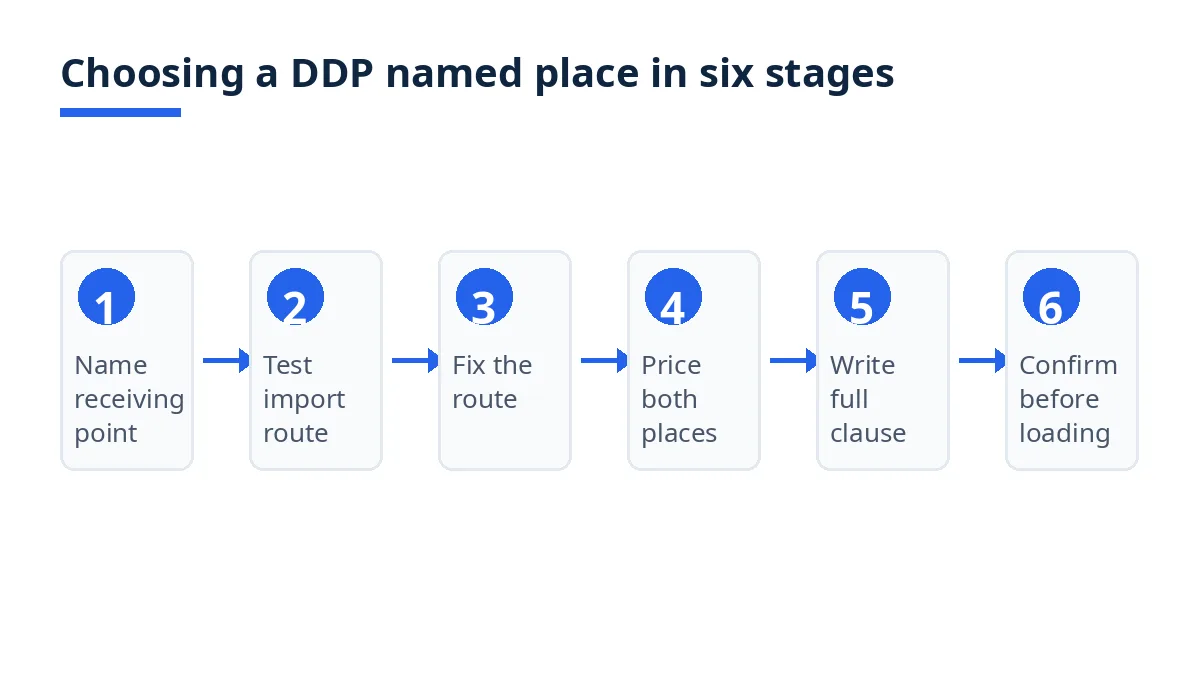
Work the choice in six stages
A place printed on a quotation is the seller's suggestion until the buyer has tested it.
Name the receiving point. Write the full street address, terminal or warehouse name, and gate or bay. Add receiving hours and a delivery-day contact.
Test the import route for that country. Ask who will stand as importer at destination, under what registration, and through which broker. In the United States, the importer identity is established through CBP Form 5106, which assigns an importer number and must be filed before a party can act as importer of record.3 In the United Kingdom, an EORI number starting with GB is needed for imports into England, Wales or Scotland.4 In the European Union, registration comes from the member state where the operator first lodges a customs declaration.5
Fix the mode and the route to that place. Sea, air, road, rail or a combination must be able to reach the place named. A warehouse far inland needs a road leg after the port or airport.
Price the warehouse place and the terminal place side by side. Ask for both figures on the same goods, quantity and validity date, with the import lines shown separately.
Write the clause in full. Record the term as DDP, the full place, and Incoterms® 2020, with unloading and arrival notice stated in the same clause.
Confirm before loading. Ask the destination broker to confirm, in writing, the importer name, the registration, the place as written, and the duty and tax basis.
Cost, time and papers: read the quote against the place
A DDP quotation is only comparable with another quotation that names the same place. Two quotations for the same goods, one to a port terminal and one to a warehouse, are quotations for two different jobs. Split each one into the goods value, the carriage charge, the two clearance charges, and the duty and tax lines, and ask the broker to confirm the duty and tax basis before signing. This guide states no duty rate: duty depends on the goods, their classification and the destination country.
Time follows the same rule. A delivery date means little without the place it applies to, because the date for a terminal arrival and the date for a warehouse arrival are different dates on the same journey. Ask for a dated window for each leg, the receiving hours, and how long the goods can stand at a terminal before storage charges start.
The papers follow the place too. Ask the seller to confirm which documents will travel with the goods, and which details the buyer must supply for the import filing at that place. The usual file is the transport document, the commercial invoice, the packing list, and any origin evidence the entry relies on. The buyer must assist the seller in obtaining documents and information the destination authority asks for, under article B7, with clearance remaining the seller's responsibility.1
All figures below are example figures, and duty and taxes are left out until the broker confirms them.
Line | To the port terminal | To the warehouse |
|---|---|---|
Goods: 500 cartons of jute bags at $19.20 per carton | $9,600 | $9,600 |
Carriage to the named place | $1,850 | $2,170 |
Export clearance | $140 | $140 |
Import clearance | $210 | $210 |
Unloading at the named place | Buyer, not in the price | $90 |
Subtotal, excluding duty and taxes | $11,800 | $12,210 |
Per carton, excluding duty and taxes | $23.60 | $24.42 |
The arithmetic is 9,600 + 1,850 + 140 + 210 = 11,800, and 11,800 divided by 500 is 23.60. For the warehouse place, carriage rises by 320 to 2,170, and unloading of 90 is included, giving 12,210, or 24.42 per carton: 410 more, or 0.82 per carton. Insert the broker-confirmed duty and tax figure into both columns before signing, on the same basis.
Bangladesh departure points that shape the choice
The DDP named place is at destination, so no Bangladesh port or airport name belongs in the DDP term itself. Bangladesh departure points still shape the choice: they decide which modes and routes can reach the place named. The port of Chattogram, on the Karnaphuli River, is the main seaport of Bangladesh, operated by the Chittagong Port Authority.6 A sea shipment from Bangladesh will normally be booked through Chattogram: the vessel leg ends at a destination port, and the onward leg runs from there to the named place.
For an air shipment, the departure airport is named in the transport booking, not in the DDP term, and the DDP named place is the airport cargo terminal or the warehouse the goods move on to. For road or rail movement into India, Benapole land port, at Benapole in Jessore district, faces Petrapole in West Bengal, and is operated by the Bangladesh Land Port Authority.7 A DDP term naming a place across that border needs a seller that can clear goods for import in India and a route that crosses at Benapole and Petrapole.
Five place errors that strand a DDP shipment
A city, port area or airport name alone. The seller can choose whichever point inside that area costs it least, and the buyer pays the rest of the journey. With only a vague place named, the seller picks the delivery point that suits it best.2 Name the terminal, warehouse and gate.
A port name that covers several terminals. The land transport between terminals is not free, and a port city name leaves the seller free to choose the cheapest nearby point.8 Name the terminal.
A place the seller cannot clear goods into. The import route must be proven for the country of the named place, with the importer name, registration and broker confirmed by the broker. Where local rules bar a foreign seller from import formalities, DAP, with the same place, is the honest alternative.2
A warehouse with no receiving plan. Receiving hours, a contact, unloading labour and equipment, and space for the goods must be agreed before the truck arrives.
A place copied from another order. A named place that suited a previous shipment, a different buyer, or a different mode does not suit this one by default. Check the address, mode, import route and receiving plan again for each order.
The place-check, in one pass
Run this check on the contract draft, and get each answer in writing.
The term reads DDP, the full place, and Incoterms® 2020, with no abbreviation of the place.
The place names a street address and a terminal or warehouse, with gate or bay where the site has more than one.
Receiving hours, delivery days, a named contact, and the arrival notice are stated.
The importer name, registration and destination broker are named, and the broker has confirmed them.
The duty and tax basis is stated, with the broker's figure.
Unloading is allocated: who unloads, who bears the risk, and whether the cost sits inside the transport contract.
The price split shows the goods value, carriage, both clearance charges, and duty and taxes separately.
The mode and route can reach the place named.
Insurance for the buyer's interest, if wanted, is agreed separately, since DDP sets no insurance duty for either party.1
What should I settle first about the named place under DDP?
Settle the exact receiving point, the seller's import route for the country it sits in, and the unloading plan, before any price is ranked. The receiving point must be a precise address: street, terminal or warehouse, never only a town or port area, because delivery and risk transfer happen at that point.1 The import route must show the importer name, registration, and broker, confirmed by that broker.
How does the DDP named place change cost and timing?
The named place changes cost by changing the length of the seller's carriage leg and the unloading and terminal work included in the price. A warehouse place adds onward carriage and unloading to a terminal figure, while a terminal place leaves onward carriage and unloading with the buyer. In the worked example above, the warehouse place added 410 in example figures, or 0.82 per carton. Timing changes the same way: ask for a dated window for each leg and the receiving hours.
Which papers follow the named place choice?
The papers follow the import filing at the place, so ask the seller to list the documents that will travel with the goods and the details the buyer must supply for that filing. The file normally holds the transport document, the commercial invoice, the packing list, and any origin evidence the entry relies on. Keep the buyer details ready before shipment, and check that names, addresses and product descriptions match across every document.
What is the most common named-place mistake under DDP?
The most common mistake is naming a place that means more than one point: a city, a port area, or an airport name with several terminals. Delivery lands at a point inside the named area, the buyer expected a different point, and the difference is paid in onward carriage, storage or delay. The ICC Academy guidance warns that a vague description of the place of delivery can lead to disputes over delays or over the delivery location itself.8 Write the terminal, warehouse and gate.
Next steps on Exportain
Read the full set of Incoterms 2020 rules explained for Bangladesh shipments before choosing between DDP and its neighbours, and compare with what CIF covers on a sea leg from Bangladesh. Then check how buying through Exportain works, and ask every supplier to quote the same goods to the same full named place, with the import lines shown separately.
Post a free RFQ on Exportain and get quotes from verified Bangladeshi suppliers
Sources
- Incoterms® 2020 C rules vs D rules: Risk transfer explained. ICC Academy (accessed )
- DDP & EXW Incoterms® 2020 explained: Key differences. ICC Academy (accessed )
- CBP Form 5106 - Create/Update Importer Identity Form. U.S. Customs and Border Protection (accessed )
- Get UK customs clearance when importing goods into the UK: step by step. GOV.UK (accessed )
- Using the EORI number. German Customs (Zoll) (accessed )
- Port of Chittagong. Wikipedia (accessed )
- Land Ports in a Brief. Bangladesh Trade Portal (accessed )
- Place of delivery & risk transfer in trade contracts. ICC Academy (accessed )
About the author
Sourcing from Bangladesh?
Post a request for quotation and suppliers on Exportain can send you their quotes directly.
Post an RFQ