DDP Freight Cost: Who Pays and How It Is Calculated
Under DDP the seller pays origin charges, main carriage, destination charges, duty and taxes. This guide splits the freight charge into buckets, prices each on its own driver, and works one container order to a per-set total.
Short answer
Under DDP the seller pays the freight charge in full: origin charges, main carriage and destination charges, plus import duty and taxes, delivering the goods cleared for import at a named place ready for unloading. The buyer pays only unloading, where the carriage contract leaves it with the buyer. Estimate the charge by splitting the quotation into buckets, pricing each on its driver, adding duty on a broker-confirmed basis, and allowing for hold time.
On this page
Key takeaways
DDP puts origin charges, main carriage, destination charges, duty and taxes on the seller; the buyer pays unloading only where the carriage contract leaves it there.
Duty and taxes are a fiscal line, not a freight line: they follow customs value and classification, so confirm the basis with a broker.
Estimate in six passes: split the quote, price each bucket on its driver, add duty, allow for hold time, compare at one named place, and lock inclusions in writing.
Time-based charges run by the day after free days expire, so name the hold-charge payer and the free days in the contract.
A DDP freight cost quotation looks like one number, and that is the trap in it. It bundles the seller's spending at origin, the main carriage, the spending at destination, and the duty and taxes settled at the border. This article pulls those parts apart and gives a six-pass method for estimating the total.
Read a DDP freight charge as three buckets, not one price
DDP is short for Delivered Duty Paid. It counts among the eleven rules in the ICC trade-terms set, Incoterms® 2020. Under DDP the seller must take the goods to a named place, having finished import clearance and settled duty and taxes, and must bear the cost of the journey and the risk of loss or damage until the goods stand ready for unloading.1 The buyer unloads, and pays for unloading unless the seller's transport contract already carries that cost.1
FAS, FOB, CFR and CIF form the sea and inland waterway group, four rules in total. CPT, DPU and DDP belong with the rules that work on any mode, and DDP stands apart within that group because import clearance and duty sit with the seller while unloading sits with the buyer.2
Split every DDP freight charge into three buckets, keeping duty and taxes on a line of their own. Origin charges cover the move to the departing carrier and the export formalities. Main carriage covers the long leg. Destination charges cover the arrival terminal, import formalities, and the final move. Duty and taxes move on the customs value and classification, not on container weight.
Bucket | What sits in it | Who pays under DDP | What moves the amount |
|---|---|---|---|
Origin charges | Inland haul, terminal handling, export clearance | Seller | Factory-to-port distance, stuffing point, shared or full load |
Main carriage | Ocean, air or road carriage | Seller | Route, mode, space, surcharges |
Destination charges | Terminal handling, import clearance, final delivery | Seller | Port, broker route, distance to the named place, hold time |
Duty and taxes | Import duty and import taxes | Seller | Customs value, classification, origin evidence |
Unloading | Taking goods off the arriving transport | Buyer, unless the carriage contract says otherwise | Labour and equipment at the named place |
Under the D rules the seller must arrange carriage, at its own cost, as far as the named place, and must carry out every customs formality under DDP: export, import and any transit formality.2 Ask for the bucket split, test each bucket against its own driver, and compare quotations when both name the same place and the same mode.
Origin charges: what the seller spends before the vessel sails
Origin charges start at the factory gate: the seller moves the goods to the port or airport and loads them onto the departing carrier, paying every step under DDP.3 Inland haul is the first line, driven by distance to the departure point. The second is terminal handling: receiving the container, storage inside free time, and loading. The third is export clearance and its papers. The fourth is packing and checking, at the seller's cost under the D rules.2
Bangladesh law bars loading or stuffing for export until the export declaration has been submitted and approved. That declaration is the Bill of Export, also called the shipping bill.4 Filed with it, for every export consignment, are the seller's VAT and taxpayer registrations, the EXP form certified for proceeds control by an authorised dealer bank, origin evidence, and the invoice and packing list describing the goods.4 A late paper set holds the container at origin.
Main carriage: the leg that moves most with route and space
Main carriage is the long leg, and the bucket that swings most. The seller arranges and pays for it, chooses the carrier and route, and bears the risk until the named place.3
Four drivers decide this line: mode, the charged unit, the route, and the surcharges inside the freight contract. DDP works on any mode, so a container by sea and a carton by air will not resemble each other in price. The charged unit may be a full container, a share of a container, chargeable weight, or volume. Surcharges, such as fuel-related and peak-period charges, are contract terms, not rule terms.
Test the line with three questions. What mode and route does the price assume? What unit is it charged on, and does it match your load as packed? Which surcharges are inside the figure, and how long does it hold? A figure with no validity date is a snapshot, not a promise.
Destination charges: terminal, clearance and delivery after arrival
Destination charges begin when the carrier arrives. Under DDP the seller completes import clearance, pays duty and taxes, and funds carriage as far as the named place.2 3 The buyer takes delivery when the goods stand ready for unloading.3
The lines are terminal handling, import clearance, and final delivery. Terminal charges follow the port and container type. Broker work follows the entry's complexity: classification, valuation, origin evidence, and any licence needed.
Duty and taxes sit beside these lines, not inside them. The seller pays them under DDP,3 but the amount follows the customs value and classification, so ask for the basis in writing. State no duty rate unless a broker has confirmed it for your goods in your country on an opened tariff schedule. Where the basis is unconfirmed, carry duty and taxes as a separate broker-to-confirm line.
Unloading is the one line the buyer may still owe. Unloading charges fall on the seller only when the carriage contract assigns them there; otherwise the buyer pays them, while the unloading risk stays with the buyer in either case.2 Check the carriage wording, not the quotation headline.
Estimate the DDP freight cost in six passes
Work the six passes in order, keeping the bucket split visible. A DDP price is built from the goods price, transport, insurance where the seller has taken it for its own account, export costs, duties and taxes, and import clearance fees.5
Split the quote into origin charges, main carriage, destination charges, and duty and taxes, with unloading stated separately.
Price each bucket on its driver: haul distance and stuffing point, mode, unit and surcharges, and port, broker route and final distance.
Add duty and taxes on the broker basis, using the confirmed customs value and classification, kept separate from freight.
Allow for hold time, priced from the carrier's free days and daily rate.
Compare at one named place, restating every quotation to the same full address, mode and validity date.
Lock inclusions in writing: named place, mode, bucket split, surcharge position, duty basis, unloading position and validity date.
The diagram below follows the same six passes. Use it as a checklist when a quotation arrives.
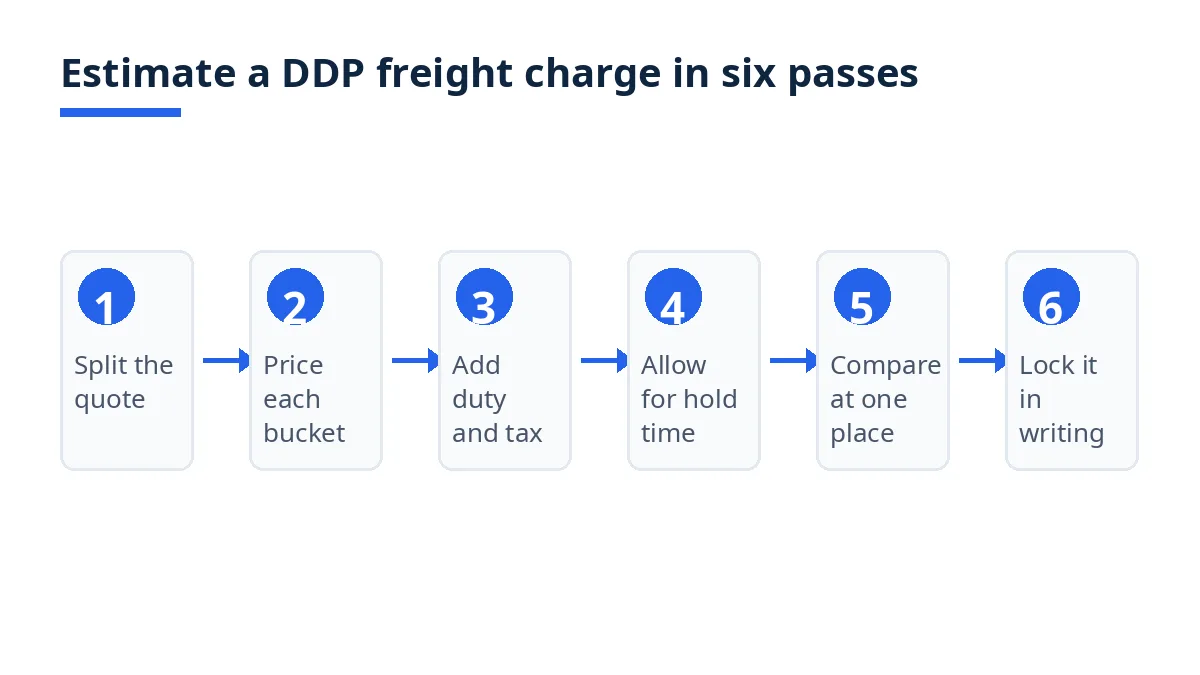
A failed first pass is a total with no working behind it.
A worked estimate: bed linen in one container, Chattogram to Birmingham
Example figures only; confirm every figure against a live quotation and through a broker. The order is 1,800 sets of cotton bed linen, in one container from Chattogram to a named warehouse in Birmingham, United Kingdom, on DDP terms to that address. No duty rate is stated: the duty line is an illustrative amount on a broker-confirmed basis.
Line | Example figure (USD) | Bucket |
|---|---|---|
Goods: 1,800 sets at $12.00 | 21,600 | Goods price |
Inland haul, factory to Chattogram | 380 | Origin charges |
Terminal and export handling at origin | 340 | Origin charges |
Export clearance and documents | 200 | Origin charges |
Main carriage, Chattogram to the United Kingdom | 2,750 | Main carriage |
Terminal handling at destination | 260 | Destination charges |
Import clearance and broker work | 250 | Destination charges |
Final delivery to the Birmingham warehouse | 200 | Destination charges |
Duty and taxes, illustrative amount | 2,430 | Duty and taxes |
DDP total | 28,410 | — |
Origin charges total $920; destination charges total $710. The DDP total is $21,600 + $920 + $2,750 + $710 + $2,430 = $28,410, or $15.78 per set ($28,410 / 1,800 = $15.7833). Unloading is outside this total; price it separately where the carriage contract leaves it with the buyer.
Test the sensitivity. If main carriage rises by 10 percent, the increase is $2,750 x 0.10 = $275, and the total becomes $28,685, or $15.94 per set. If destination charges rise by $150 through an extra examination, the total becomes $28,560, or $15.87 per set. The goods line does not move with either change. A seller who raises the total without naming the bucket that moved has not explained the change.
Charges that appear after the quote: time, storage and re-checks
Time-based charges are priced by the day and start without a new quotation. Demurrage is the charge for a full container that stays at the destination terminal beyond the allowed free days. Detention, also called a per diem fee, is the charge for a container not returned empty within the agreed free days after leaving the terminal.6 Some carriers merge the two into one combined period, from discharge until return of the empty container.6
The method is the same in each case: days held, minus free days, multiplied by the daily rate.6 Take the case the carrier method illustrates: four free days, discharge on 1 June, pickup on 7 June, seven days counted, three chargeable days, at an example rate of $100 per day, giving $300.6 Partial days count as full days there.6 Example figures only; your contract's free days and rate decide the real charge.
Examination holds create the same exposure by a different route: customs selects a container, it sits past free time, and daily charges accrue. Under the D rules the seller bears costs incurred before delivery, but a quotation silent on hold charges has not allocated them. Name the payer for hold charges in the contract, state the free days allowed, and require notice the day a hold begins.
Bangladesh departure points that change the origin bucket
Three departure points move the origin bucket: the stuffing point, the export paper position, and the departure point itself. Goods stuffed at the factory travel as a sealed container; goods stuffed at the port travel loose and are packed there. The Bill of Export must be approved before loading,4 and a seller who cannot name the filing date has not yet priced this bucket. Chattogram and the inland depots that feed it are not the same haul.
Ask three origin questions, in writing. Where will the goods be stuffed? On what date will the export declaration be filed, and which enclosures are already held? Which departure point does the haul line assume?
Quote checks before you accept a DDP freight figure
Run this check on every quotation. Each check maps to one bucket, so a failed check names the bucket that needs work.
Check | Ask for | Why it matters |
|---|---|---|
Named place | Full warehouse address, not a city | The named place fixes where delivery and risk transfer happen, and a vague place lets the seller choose the point inside that city.7 |
Mode and route | Mode, route, transshipment | A price without a route cannot be tested |
Bucket split | Origin, main carriage, destination, duty and taxes, unloading separately | Without the split, no change can be traced |
Surcharge position | Surcharges inside the figure, validity date | Surcharges and validity decide whether the figure holds at booking |
Duty basis | Customs value, classification, origin evidence, broker name | An unconfirmed basis is an unpriced line |
Importer position | Who stands as importer, through which broker | The seller must be able to complete import clearance for DDP to work.1 |
Unloading | Carriage wording on unloading cost | Unloading cost follows the carriage contract; risk stays with the buyer.2 |
Time charges | Free days, daily rate, merged or separate periods, hold-charge payer | Time charges start without a new quotation.6 |
Insurance | Whether any cover pays the buyer, on what sum and wording | DDP imposes no duty to insure for the buyer.2 |
A quotation that answers all nine checks is ready to compare.
What does a DDP freight charge cover from the factory gate onward?
A DDP freight charge covers the seller's spending from the factory gate to the named place, plus duty and taxes settled at the border, where the contract says so. Origin, main carriage and destination charges sit with the seller, who carries cost and risk until the goods stand ready for unloading.1 3 Unloading and insurance for the buyer need separate written agreement.2
How do I estimate DDP freight charges when the seller quotes one total?
Work six passes: split the quote, price each bucket on its driver, add duty and taxes on the broker-confirmed basis, allow for hold time, restate every quotation to the same named place and validity date, and lock the inclusions in writing.5 6 Use the worked estimate above as the shape of the working, with your live figures.
Which papers affect DDP freight charges at origin and destination?
At origin, the export declaration and its enclosures decide whether the container can load on time, and a late filing adds holding cost.4 With the declaration go the invoice and packing list, the EXP form, the origin certificate, and the seller's VAT registration and taxpayer identification number, for every export consignment.4 At destination, the import declaration and the classification, valuation and origin papers decide whether clearance runs on time, and a query adds time-based charges.6 Ask for the paper set at both ends, and match names, values and weights across it.
What freight-charge errors should I watch for in a DDP quote?
Watch for four errors: a total with no bucket split; a named place given as a city, which leaves the delivery point open;7 a duty line borrowed from another product or country; and a freight figure with no validity date or surcharge position. Each has the same repair: ask for the missing line in writing, restate the quotation onto the six-pass table, and compare only quotations that answer the same questions.
Next steps on Exportain
Start with the guide that sets out every Incoterms® 2020 rule for Bangladesh shipments, then read the CIF explanation, where the seller's freight and insurance duties end. Follow the eight-step buying path on Exportain to put the named place and Incoterm in your RFQ, and ask each seller for the bucket split this article sets out.
Post a free RFQ on Exportain and get quotes from verified Bangladeshi suppliers → https://exportain.com/rfqs
Sources
- DDP & EXW Incoterms® 2020 explained: Key differences. ICC Academy (accessed )
- Incoterms® 2020 C rules vs D rules: Risk transfer explained. ICC Academy (accessed )
- DDP Incoterms® 2020: Meaning, Costs and Responsibilities. Crane Worldwide Logistics (accessed )
- Customs Clearance Procedures for Export. Bangladesh Customs, National Board of Revenue (accessed )
- Incoterm DDP. When should you use it?. Across Logistics (accessed )
- The Basics of D&D: Demurrage Calculation & More. VIZION (accessed )
- Place of delivery & risk transfer in trade contracts. ICC Academy (accessed )
About the author
Sourcing from Bangladesh?
Post a request for quotation and suppliers on Exportain can send you their quotes directly.
Post an RFQ