7 Costly DDP Mistakes Importers Make (and How to Avoid Them)
A DDP price can hide importer-number risk, unrecoverable import VAT, later duty demands and hold charges. These seven mistakes, each with a written fix, keep the delivered price whole.
Short answer
DDP common mistakes cost importers most when the buyer lends the seller its importer number, treats import VAT as recoverable, or leaves later duty demands, delivery dates, hold charges, compliance and payment timing unwritten. Under DDP the seller clears the goods for import and pays the duty, while the buyer unloads. Each mistake below has a written fix to agree before the goods leave Bangladesh.
On this page
Key takeaways
DDP moves import clearance and duty payment to the seller, but the named importer still carries legal responsibility for the declaration.
Import VAT paid under DDP is not automatically recoverable, so the VAT treatment needs a written answer before shipment.
Payment timing, delivery dates and later duty demands need contract wording of their own.
A DDP price is only complete when the VAT line, the hold-charge position and the compliance position are stated in writing.
DDP common mistakes rarely look like mistakes when the quotation arrives. The price is a single figure and the seller promises to handle the border. The trouble surfaces later: a declaration filed in your name that you never saw, import VAT that nobody can reclaim, a further duty demand months after delivery, or a container gathering charges while customs examines it. Each item below gives the written fix to agree before the goods leave Bangladesh.
This article is for buyers who import from Bangladesh on Delivered Duty Paid terms, and it uses example figures wherever a number illustrates a point. Confirm every rate and procedure with a broker for the country of import.
The pattern behind all seven mistakes
The seven mistakes share one pattern: the buyer treats the DDP label as if it settled every question about the import. Under DDP the seller carries the goods to the named place, clears them for import and pays the duty, and risk passes when the goods stand ready for unloading there. The buyer still has to unload, and to give the seller the documents and information the import authorities ask for.1
The Incoterms® 2020 rules also leave several questions to the contract of sale. They do not transfer ownership, set payment terms, fix remedies for breach, or cover regulatory compliance requirements.2 A DDP quotation silent on VAT recovery, later duty demands, delivery dates, hold charges, product compliance or payment timing leaves all of those questions open.
The sea and inland-waterway-only rules are four: FAS, FOB, CFR and CIF. CPT is an any-mode rule, DPU is an any-mode rule, and DDP is an any-mode rule under which the seller clears the goods for import and pays the duty. DDP differs from DPU on the import side, while under both rules the buyer unloads the goods at the named place.1
DDP moves import clearance and duty payment to the seller, but the named importer still carries legal responsibility for the declaration.
Import VAT paid under DDP is not automatically recoverable, so the VAT treatment needs a written answer before shipment.
Payment timing, delivery dates and later duty demands need contract wording of their own.
A DDP price is only complete when the VAT line, the hold-charge position and the compliance position are stated in writing.
Seven DDP common mistakes, in the order they cost money
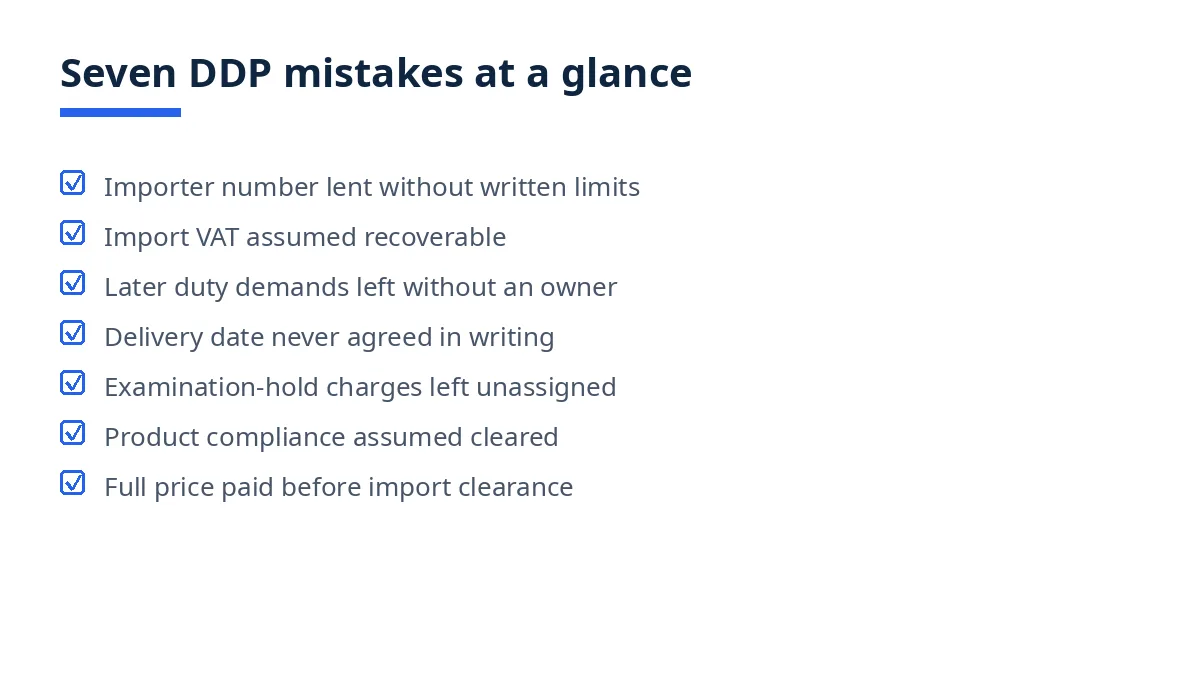
The first two mistakes decide who the customs authorities hold responsible and who absorbs the tax. The middle three decide what happens when the shipment is late, held or revisited. The last two decide whether the goods may be sold at destination and whether the buyer keeps any bargaining power while the import job is unfinished.
1. Lending the seller your importer number with no written limits
A broker acting for the seller files the import declaration using the buyer's importer number, EORI number or tax identification number. The buyer learns about the entry only when a question or a demand for further duty arrives.
That costs money because the importer of record is a legal status, not a payment arrangement. The party named on the declaration answers for the accuracy of the classification and value, the duty and import VAT due, and the records behind the entry.3 In the United Kingdom, a buyer whose supplier arranges the import must agree in writing how import VAT is to be accounted for, and must give the supplier its EORI number, so the person filing the entry can be given written instructions before the declaration is made.4 Within the European Union, import is a customs operation that requires an EORI number.5
Fix it with a written authority naming the representative, limited to one shipment and one value ceiling, requiring a copy of the filed entry and the duty receipts within an agreed number of days. Where the seller can file under its own registration, through an indirect representative established in the destination country, prefer that route. Ask the destination broker, before shipment, who will be named as importer.
2. Counting import VAT in the DDP price as tax you will recover
The buyer reads the DDP price as a tax-inclusive total and assumes the import VAT inside it will come back through a VAT return. The seller pays the VAT at the border, and neither party can reclaim it.
Duty is a cost once paid, while import VAT recovery depends on the rules of the destination country.3 Recovery generally depends on holding a VAT registration in the country of import, or on qualifying for a refund procedure open to non-established businesses.3 In the United Kingdom, postponed VAT accounting is available only where the goods are for business use, the buyer has the right to dispose of them, and the buyer's VAT registration number appears on the import declaration.4
Fix it by agreeing the VAT treatment in writing before the goods move, and by showing the VAT as a separate line in the quotation. Ask the broker or tax adviser who will be named on the declaration and whether the VAT is recoverable by anyone. If no party can recover it, price the order with the VAT as a cost. The full comparison of all eleven rules shows where DAP leaves the import side with the buyer instead.
Example figures: goods value $24,000, freight $2,400, duty at an assumed example rate of 10 percent on the goods value, $2,400. The VAT base is $28,800, and at an assumed example VAT rate of 20 percent the import VAT is $5,760, giving an example DDP total of $34,560. If nobody can recover the $5,760, it is a cost on the order. The rates here are invented for illustration only; confirm the real rates with a broker.
3. Leaving later duty demands without an owner
The goods arrive and the order feels closed. Months later, customs revisits the entry over classification, value or origin, and raises a further demand. The contract says nothing about who pays it.
An entry can be audited after release. In the United States, entry records must be kept for five years from the date of entry, covering invoices, classification and valuation support, origin documentation and related correspondence.6 The importer of record carries the duty of reasonable care for the entry even when a broker files the paperwork.6 A buyer who holds no copy of the entry cannot show that the figures were checked.
Fix it with a short clause covering demands raised after delivery: name the payer, set a time limit for passing the demand on, and require the seller to send the buyer a copy of the filed entry, the duty receipts and the classification used, kept for the full retention period at destination.
4. Treating a DDP price as a promise about the delivery date
The buyer plans around an arrival date mentioned in an email, and the goods arrive two weeks later. DDP names a place, not a date, and no delivery window was agreed.
The Incoterms® 2020 rules fix the delivery point and the risk point, but they do not cover remedies for breach of contract.2 A date in a quotation, without binding wording, gives the buyer little to rely on when the shipment slips. The seller's obligation under DDP is to deliver at the named place, cleared for import and ready for unloading, and the buyer must assist with the documents and information the import authorities require.1
Fix it by putting dates in the contract, not only in emails: a shipment window, a delivery window, a notice duty when either is at risk, and the consequence of a missed window.
5. Leaving examination-hold charges to be argued over at the port
Customs selects the container for examination. It sits past its free time while the examination runs, and demurrage, detention or storage charges accrue. The seller says the charges arose after arrival, the buyer says they arose from the seller's import job, and the container stays put until someone pays.
Demurrage applies while a full container stays inside the port or terminal beyond the allowed free time, detention while the container is held outside the terminal beyond free time, and storage covers the use of terminal or yard space.7 Free time commonly runs from three to seven days at busy container ports, and liability can shift with the contract terms.7
Fix it by naming the payer for examination holds before the goods sail: who pays demurrage, detention and storage, how many free days apply, and who reports daily while the hold runs. Ask the seller to confirm the free-time position with the carrier at booking. Keep the gate timestamps, the examination notice and the invoices together, since a waiver request needs evidence and a prompt dispute.7
6. Assuming import clearance settles product compliance
The goods clear customs, and the buyer discovers that a licence, a product standard, a label or an EU responsible person was still missing. The goods cannot be placed on the market until the gap is closed.
Customs clearance and product compliance are separate jobs, and the Incoterms® 2020 rules do not cover regulatory compliance requirements.2 Under the EU General Product Safety Regulation, which applies from 13 December 2024, a product placed on the EU market needs an EU-based economic operator to act as the responsible person where the manufacturer is not based in the EU, identified on the product, its packaging or an accompanying document.8 That person acts as the contact point for market surveillance authorities and checks the product documentation and safety information.8
Fix it with a compliance check before the order is placed: licences, standards and test evidence, labelling, and the responsible person or authorised representative where the destination requires one. Name the owner of each item in the contract, and require the evidence before shipment. The sea-only rule where risk passes on board is a reminder that the carriage term never answers the compliance question on its own.
7. Paying the whole DDP price before the import job is done
The buyer pays the full DDP price on shipment, or even on order. The seller then faces a problem at import, the goods sit uncleared, and the buyer has no unpaid amount left to bring the seller back to the table. The buyer pays a second time, to a broker or carrier, to free goods sold as delivered duty paid.
Payment terms sit outside the Incoterms® 2020 rules, which do not cover the method or terms of payment.2 Under DDP the seller's hardest job, import clearance in a foreign country, happens last, after the goods have travelled furthest from the seller.1
Fix it by staging the payment against evidence: a deposit on order, a portion on shipment against the transport document, and the balance on cleared delivery, evidenced by the filed entry and the delivery note. Where a letter of credit or funds hold is used, match its documents to the DDP delivery evidence, so the payment trigger and the delivery point describe the same event.
Summary table: the mistake, what it costs, the fix
Mistake | What it costs | The fix in one line |
|---|---|---|
Importer number lent without limits | Liability for an entry you never checked | Written authority, one shipment, one value ceiling, entry copy to you |
Import VAT assumed recoverable | VAT becomes a dead cost inside the price | Agree the VAT treatment and show it as a separate line |
Later duty demands without an owner | A demand after delivery with nobody named to pay it | Clause naming the payer, plus the entry file kept |
Delivery date never agreed | Delay with no agreed consequence | Shipment and delivery windows, notice duty and consequence in the contract |
Examination-hold charges unassigned | Demurrage, detention and storage during a hold | Named payer and free days agreed before sailing |
Product compliance assumed cleared | Goods that cannot be placed on the market | Compliance check and named owner for each item before the order |
Full price paid before clearance | No unpaid amount left when the import job stalls | Staged payment tied to entry and delivery evidence |
Questions buyers ask about DDP mistakes
What is the most expensive DDP mistake an importer can make?
Lending the seller your importer identity without written limits is usually the most expensive, because it attaches legal responsibility for the entry to you while the seller controls the filing. The VAT mistake runs close behind it. Settle both in writing before shipment.
How can I avoid DDP mistakes before the goods leave Bangladesh?
Work through the seven items as a pre-shipment checklist, and get each answer in writing: the named importer, the VAT treatment, the payer of later duty demands and hold charges, the delivery window, the compliance owner, and the payment stages. Ask the destination broker to confirm the import route and the duty basis.
Who is responsible for import clearance and duty under DDP?
The seller is responsible for carrying out and paying for import clearance, including the duty and taxes the rule allocates, and the buyer must assist with the documents and information the import authorities require.1 The buyer unloads the goods at the named place.1 Where the destination authorities require the local buyer to handle clearance itself, DDP is unavailable and the buyer should use DAP instead.1
Where can I get help checking a DDP quotation for a Bangladesh order?
Start with the quotation and the destination broker. Ask the supplier to restate the quotation with the named place, the import lines shown separately, the VAT treatment and the delivery window, and ask the broker to confirm the import route and the named importer. The eight-step buying sequence on Exportain sets out the enquiry, quotation and order steps.
Next steps on Exportain
Check the DDP quotation against the seven fixes line by line, and raise any gap with the supplier before the goods move. Use the full comparison of all eleven rules to check DDP is the right rule, and the eight-step buying sequence on Exportain to run the enquiry and order.
Sources
- DAP & DDP Incoterms 2020 explained: Key differences. ICC Academy (accessed )
- Incoterms 2020: A Comprehensive Guide. TT Club (accessed )
- DDP vs DAP explained: who pays import VAT and duty. Quaderno (accessed )
- Check when you can account for import VAT on your VAT Return. GOV.UK (accessed )
- Economic Operators Registration and Identification number (EORI). European Commission, Taxation and Customs Union (accessed )
- Import Compliance Checklist for U.S. Importers. Reidel Law Firm (accessed )
- Demurrage vs Detention vs Storage: Shipping Charges Explained. BRF Logistics, (accessed )
- Navigating compliance with the General Product Safety Regulation: Key obligations for manufacturers. Brodies, (accessed )
About the author
Sourcing from Bangladesh?
Post a request for quotation and suppliers on Exportain can send you their quotes directly.
Post an RFQ