

DDP Shipping From Bangladesh to Australia: Costs, Steps and Timeline
DDP shipping from Bangladesh to Australia: who acts as importer, how the 10% GST and duty are worked out, biosecurity checks in BICON, and the documents for a delivered-duty-paid order.
Short answer
Under DDP shipping from Bangladesh to Australia, the seller arranges the whole journey and pays the Australian import charges, delivering the goods cleared for import and ready for unloading at the named place in Australia. The Incoterms 2020 rules give a clear allocation of cost, risk and obligations for each rule, and DDP is the rule under which the seller also clears import customs and pays import duty.
On this page
Key takeaways
Under DDP the seller delivers goods cleared for import, with duty and taxes paid, ready for unloading at the named place in Australia, and bears cost and risk until that point.
The importer-of-record question decides the GST position: a buyer that is not the importer on the Australian entry cannot assume it can claim a GST credit for the import GST.
GST is 10% of the value of the taxable importation, built from customs value, duty and international transport and insurance; eligible importers may defer it through the monthly BAS, but duty is still paid before release.
Check biosecurity conditions in BICON for the goods and their packaging before ordering, and confirm the Bangladesh export set and the Australian broker and gateway in writing before shipment.
Under DDP shipping from Bangladesh to Australia, the seller arranges the whole journey and pays the Australian import charges, delivering the goods cleared for import and ready for unloading at the named place in Australia. The Incoterms 2020 rules give a clear allocation of cost, risk and obligations for each rule,1 and DDP is the rule under which the seller also clears import customs and pays import duty. That single delivered price is the appeal, and it is also where the questions in this guide matter: who acts as importer in Australia, how the 10% GST is worked out, and what happens when biosecurity rules apply to the goods.
Why this matters for buyers and sellers
What should I know first about DDP?
DDP stands for Delivered Duty Paid. The seller bears the cost and risk of getting the goods to the named place, cleared for import, with duty and taxes paid, and delivery happens when the goods are ready for unloading there. The buyer takes delivery and unloads, unless the contract says otherwise. No other Incoterms 2020 rule puts import clearance and import duty on the seller.
For a Bangladesh-to-Australia order, the named place does most of the work. Name the full delivery address, not only a city, and state whether the price covers delivery to a Sydney, Melbourne or Brisbane warehouse or to a different inland address. The gateway changes the inland leg and the broker handling the entry, so a DDP price naming no gateway cannot be compared with one that does.
DDP is not risk-free for the buyer. The buyer still owns the specification: a wrong description, classification or missing permit is built from the buyer's product information and can hold the shipment. The buyer also keeps Australian product-compliance duties, such as labeling and safety rules, because a shipping term does not transfer those duties. And the buyer gives up direct control of the entry: the seller or its broker chooses the classification, valuation and declaration details.
The sharpest Australia-specific point is the importer of record and GST. Under DDP the seller side normally acts as importer, so the buyer is not the importer named on the Australian entry. A GST-registered buyer that is not the importer cannot simply assume it can claim a GST credit for the import GST as a buyer that imported the goods itself could. Settle this in writing before shipment: who is named as importer, who pays GST at the border or under deferral, and what entry documents the buyer receives.
For the seller, DDP means building an Australian import route before quoting: a licensed customs broker, a way to pay duty and GST, and a check of biosecurity conditions. A seller without that route is quoting a price it cannot perform. For the buyer, DDP suits a single delivered price with one accountable party; it is the wrong choice when the buyer needs to control classification, claim GST credits directly or manage biosecurity itself.
Step-by-step: how it works
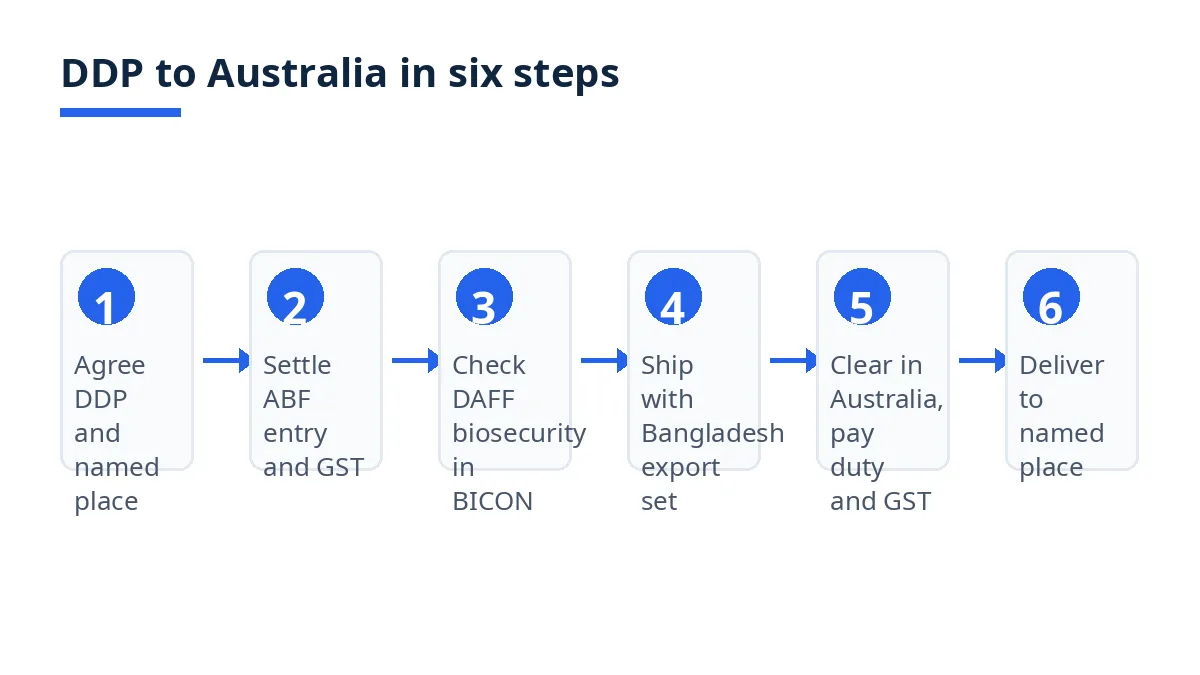
Agree DDP and the named place in writing. Write "DDP [full delivery address], Incoterms 2020" in the quotation and purchase order, with goods, quantity, unit price, currency and validity. Record who unloads and who pays any charge not named in the price.
Complete Bangladesh export clearance. The seller prepares the export set and the Bill of Export is submitted and approved by Customs before the goods are loaded.2
Ship the goods to the Australian gateway. The seller arranges the main carriage to the named gateway, with cargo insurance at the cover level agreed in the contract.
Clear the Australian entry. The seller side, through its Australian broker, lodges the import declaration,3 pays import duty and GST at the border or under deferral where eligible,4 5 and meets any biosecurity conditions for the goods and their packaging.6
Deliver to the named place. The seller delivers the goods cleared for import, ready for unloading at the full delivery address, and the buyer checks quantity, condition and marks against the packing list.
A note on deferred GST, because it changes who pays what at the border. The deferred GST scheme allows eligible importers to pay GST on taxable imports through the monthly Business Activity Statement rather than to the Australian Border Force at importation.5 Eligibility requires an Australian Business Number, GST registration, monthly BAS lodgment online with electronic payment, and goods for home consumption.5 A foreign seller with no Australian Business Number and no GST registration cannot use deferral, and a buyer that is not the importer cannot use its own approval for an entry made in the seller's name. Duty is still payable before release even where deferral applies.4
Costs, timelines and documents
What are the typical costs and timelines?
A DDP price should contain product cost, Bangladesh origin costs and export clearance, international freight, cargo insurance where agreed, Australian destination charges, import duty, GST treatment, broker fees and inland delivery to the named place. Ask for those lines separately, even when the headline is one DDP figure: a single figure hides the two lines most likely to move, duty and GST.4
Cost line | Who pays under DDP | Check before you confirm |
|---|---|---|
Product cost | Seller, in the DDP price | Quantity, specification, currency |
Bangladesh export clearance | Seller | Bill of Export and export set complete2 |
International freight | Seller | Gateway and inland leg included |
Cargo insurance | As agreed in the contract | Cover level and risk point, in writing |
Australian destination charges | Seller | Which terminal charges are included |
Import duty | Seller | Classification and customs value, confirmed by the broker |
GST on importation | Seller at the border, or deferred by an eligible importer | 10% of the value of the taxable importation4 |
Broker fees | Seller | Entry, extra tariff lines, examination charges |
Inland delivery to the named place | Seller | Full address, unloading responsibility |
Example figures: the table below shows structure only. These are not market prices, freight rates or charges for any product or route. A buyer orders goods with a customs value of AUD 20,000, international transport and insurance of AUD 2,300, and no duty payable on the classification used in this example. The value of the taxable importation is AUD 22,300, and GST at 10% is AUD 2,230.4 The example shows how the GST line is built from customs value, duty and transport and insurance, not a prediction for any real shipment.
Example figures line | Amount |
|---|---|
Customs value | AUD 20,000 |
Import duty in this example | AUD 0 |
International transport and insurance | AUD 2,300 |
Value of the taxable importation | AUD 22,300 |
GST at 10% | AUD 2,230 |
For timelines, this guide states no fixed transit time, because route, mode, gateway and any inspection or biosecurity step change the total. Price the timeline by stage instead: production and Bangladesh export clearance, main carriage to the Australian gateway, Australian entry and any biosecurity inspection, and inland delivery. Ask the seller and broker for the current timing of each stage, and build a margin for inspection into the stock plan.
Which documents are needed?
The Bangladesh export set is the Bill of Export with the export contract or purchase order, commercial invoice, packing list, EXP form certified by an authorized dealer, certificate of origin, VAT registration certificate and Taxpayer Identification Number, with product-specific certificates where required.2 The Australian entry set is built from the same commercial papers plus the bill of lading or air waybill and any permit the goods require.3 The import declaration records goods, importer, transport, classification and customs value,3 so every document must agree on description, quantity, value and names. Goods valued at AUD 1,000 or less arriving by air or sea cargo may instead use a Self-Assessed Clearance declaration, unless a permit is required.3
Bangladesh-specific rules and tips
Confirm the export declaration is approved before loading, because goods may not be loaded or stuffed for export until the Bill of Export is submitted and approved by Customs.2 Keep one legal name across the trade licence, quotation, proforma invoice, export declaration and payment account, since the declaration names the exporter and the foreign buyer.2 Where the goods need a product-specific certificate, such as a phytosanitary certificate for agricultural goods, obtain it before the goods leave Bangladesh.2
Ask the seller which inputs are imported for the order and whether any input changes the export timeline. For the Australian side, ask the seller to name the Australian broker and gateway in the quotation: a DDP price naming neither has not yet priced the Australian entry. Do not copy a duty rate from another product or destination, since duty follows the classification and customs value of the actual goods, confirmed by the broker before shipment. See the Incoterms for shipments from Bangladesh guide for how DDP sits among the 11 rules, and the landed cost guide for converting any quotation to a warehouse-to-warehouse comparison.
Mistakes and red flags
What are the most common mistakes?
Naming a city instead of a place. "DDP Sydney" leaves the inland leg, the unloading point and the end of the seller's risk open. Name the full delivery address and the unloading responsibility.
Assuming DDP removes all buyer duties. DDP moves transport, import clearance and import charges to the seller. It does not remove the buyer's duties for product specification, product compliance in Australia or accurate product information, nor give the buyer a GST credit it is not entitled to as a non-importer.
Checking biosecurity after shipment. Biosecurity conditions vary by goods and by country of origin,6 and a requirement found at the Australian border costs far more than one found in BICON before ordering. Check the packaging as well as the product, since timber and bamboo packaging carries its own conditions.6
Comparing a DDP price with an FOB price. The two prices contain different journeys. Convert every quotation to the same finish line, goods cleared and delivered to the named place, before comparing.
Accepting a DDP price from a seller with no Australian import route. If the seller cannot name an Australian broker, explain who acts as importer and state how duty and GST will be paid, the price is not yet a working DDP offer. Ask for those three answers in writing.
Treating a profile or a badge as a guarantee. A supplier profile is a starting point for enquiries. A badge records a document and photo review, not a factory inspection, and it is not a guarantee of capacity, quality or delivery.7
Checklist
Before you confirm a DDP order to Australia, every line should be answered in writing.
DDP term, full named place and edition written in the quotation and purchase order.
Importer of record named, with the Australian broker and gateway identified.
GST treatment stated: paid at the border, or deferred by an eligible importer, with entry documents to the buyer.4 5
Duty basis stated: classification and customs value confirmed by the broker.
Biosecurity conditions checked in BICON for the goods and the packaging.6
Bangladesh export set agreed: Bill of Export, invoice, packing list, EXP form, certificate of origin.2
Declaration type confirmed: Import Declaration or Self-Assessed Clearance, with permit requirements checked.3
Insurance cover and risk point agreed, with the unloading responsibility stated.
Timeline given by stage, with a margin for Australian inspection.
Delivery check agreed: quantity, condition and marks checked against the packing list at the named place.
How Exportain helps
On Exportain, browse suppliers and post a request for quotation on the RFQ board with the goods, quantity, full Australian delivery address and the term "DDP, Incoterms 2020", so sellers quote against the same named place. Ask each reply to name its Australian broker, its importer arrangement and its GST treatment, and to confirm the biosecurity check. When you accept a quotation, Exportain creates one order and issues one proforma invoice from the accepted terms.7
Read the badges for what they record. Exportain Verified means Exportain has checked the seller's identity, phone, email and business registration, and Export Verified means it has checked the Export Registration Certificate.7 Factory Verified means it has reviewed photos of the manufacturer's factory, while Trading Company Verified means it has reviewed photos of the trading company's office or warehouse.7 Verification is a document review by staff, free, and never granted by membership plans.8 It is not a factory inspection,7 8 so sample approval, specification checks and Australian entry checks stay with you.
FAQs
What should I know first about DDP?
DDP means the seller delivers the goods cleared for import, with duty and taxes paid, ready for unloading at the named place in Australia, and bears cost and risk until that point. The Incoterms 2020 rules allocate cost, risk and obligations for each rule,1 and DDP is the only rule that puts import clearance and import duty on the seller. Before confirming, settle the named place, importer of record, GST treatment and biosecurity check.
What are the typical costs and timelines?
There are no typical costs a guide can state as fact for every product and route. The lines are product cost, export clearance, freight, insurance where agreed, destination charges, duty, GST, broker fees and inland delivery. GST is 10% of the value of the taxable importation, built from customs value, duty and international transport and insurance.4 Timelines should be quoted by stage, with a margin for Australian inspection.
Which documents are needed?
The Bangladesh export set is the Bill of Export with the export contract or purchase order, commercial invoice, packing list, EXP form certified by an authorized dealer, certificate of origin, VAT registration certificate and Taxpayer Identification Number, with product-specific certificates where required.2 The Australian entry set is built from the same commercial papers plus the bill of lading or air waybill and any permit the goods require.3 The import declaration records goods, importer, transport, classification and customs value,3 so every document must agree on description, quantity, value and names.
What are the most common mistakes?
The most common mistakes are naming a city instead of a full delivery address, assuming DDP removes the buyer's product-compliance and GST-credit questions, checking biosecurity after shipment, comparing a DDP price with an FOB price, and accepting a DDP offer from a seller that cannot name its Australian broker or importer arrangement.
Next steps on Exportain
Browse suppliers, then post the goods, quantity and full Australian delivery address on the RFQ board so sellers quote DDP against the same named place. Before you confirm, work through the landed cost guide to convert each quotation to the same delivered finish line.
Sources
- Incoterms® 2020. International Chamber of Commerce (ICC) (accessed )
- Customs Clearance Procedures for Export. Bangladesh Customs, National Board of Revenue (accessed )
- Import declarations. Australian Border Force (accessed )
- GST and other taxes when importing. Australian Border Force (accessed )
- Deferred GST scheme. Australian Taxation Office (accessed )
- Importing goods. Department of Agriculture, Fisheries and Forestry (accessed )
- Trust & Safety Center. Exportain (accessed )
- Supplier verification: Earn trust badges buyers can see. Exportain (accessed )
About the author
Sourcing from Bangladesh?
Post a request for quotation and suppliers on Exportain can send you their quotes directly.
Post an RFQ


