

DAP Shipping From Bangladesh to USA: Costs, Steps and Timeline
DAP shipping from Bangladesh to the USA: what the seller delivers, what the buyer clears and pays as importer of record, and how to cost the order without a duty surprise.
Short answer
Under DAP shipping from Bangladesh to the USA, the seller delivers the goods to your named US place, ready for unloading, while you as buyer act as importer of record, clear US customs and pay US duties. Confirm the full delivery address, your broker and ISF roles before loading, and keep the broker duty estimate beside the DAP price so the landed cost holds no surprise.
On this page
Key takeaways
Under DAP, the seller delivers to your named place in the USA, ready for unloading, while you as buyer act as importer of record, clear US customs and pay US duties.
DAP is not DDP: under DDP the seller clears and pays duties, while under DAP the buyer does, so never budget a DAP price as duty-paid.
For ocean cargo, most ISF elements are due no later than 24 hours before loading at the foreign port, so agree ISF roles and send the data before loading.
The landed cost is the DAP price plus the buyer entry duties and destination charges, so keep the broker duty estimate beside the DAP price.
Name the full delivery address, confirm the gateway and onward leg, and match seller and buyer names across the Bangladesh and USA document sets.
Under Delivered at Place (DAP), the Bangladeshi seller arranges carriage and delivers the goods to a named place in the United States, ready for unloading. The buyer, as importer of record, handles US import clearance and pays US duties and any applicable import charges. That split is the whole point of DAP, and it is also where most first-time USA orders go wrong.
The Incoterms 2020 rules set out 11 rules with a clear allocation of cost, risk and obligations.1 Under DAP, the seller does not unload the goods, a point the rules draw out by contrast with Delivered at Place Unloaded (DPU), where the seller does unload.1 A DAP quotation covers delivery to the named place, not cleared delivery to your warehouse shelf, and not duty-paid delivery. Delivered Duty Paid (DDP) is the rule that puts import clearance and duty payment on the seller. If your quotation says DAP and you budgeted as though it said DDP, the duty bill at the US border will come as a surprise.
Why this matters for buyers and sellers
For the buyer, DAP keeps control of the US side. You choose your customs broker, hold the importer of record role, and see the duty assessment on your own entry rather than inside a seller-priced lump sum. That control matters when a duty rate changes the landed cost, or when a partner government agency regulates your product type.
For the seller, DAP stops at a defined point. The seller quotes carriage to the named place and does not take on US customs entry, US duty payment or US import compliance. That boundary lets the seller price carriage without guessing your duty rate. A seller quoting DAP and DDP side by side is pricing two different obligations, so the two prices should never be compared as though one were the other with a margin added.
The boundary also decides who fixes a problem. If the goods arrive but the entry is not ready, the delay sits on the buyer side. If the goods do not reach the named place, the problem sits on the seller side.
Step-by-step: how it works
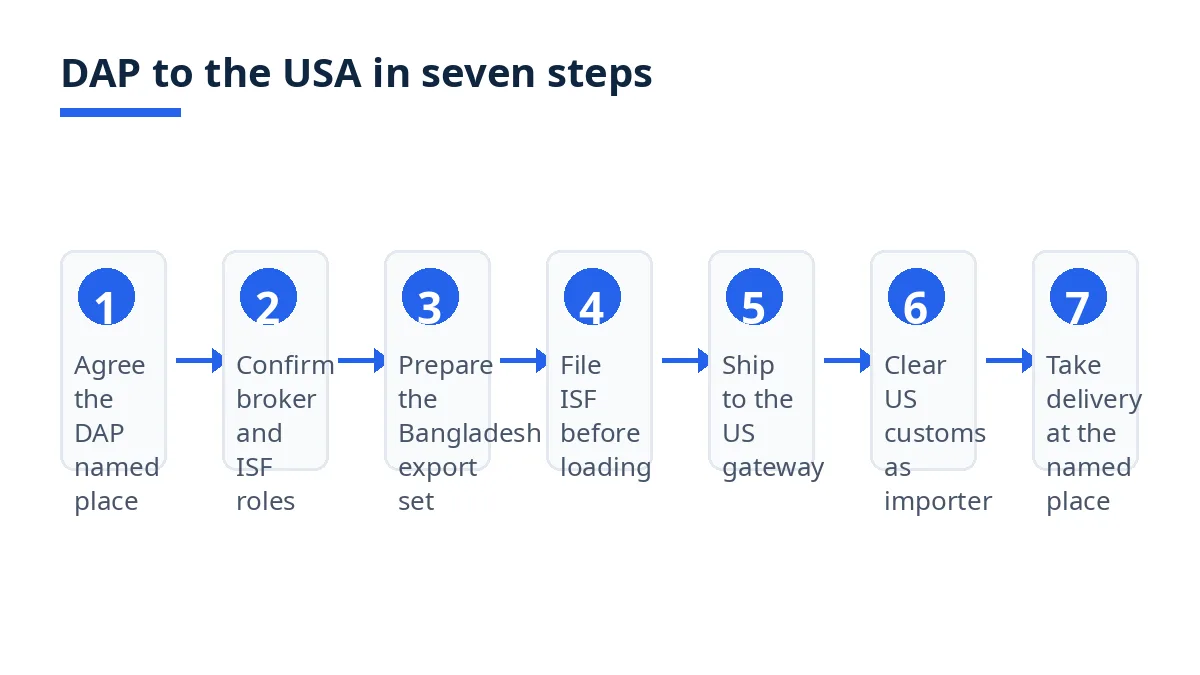
Agree the DAP named place in writing. State the full delivery address, the Incoterm as DAP plus the named place, and who unloads the goods on arrival. DAP delivery happens before unloading, so unloading labor and equipment are buyer-side items unless agreed otherwise in writing.1
Confirm the US-side roles before the goods ship. Name your customs broker, confirm who acts as importer of record, and confirm who supplies the data for the Importer Security Filing (ISF). The ISF rule applies to import cargo arriving in the United States by vessel, and failure to comply can result in monetary penalties, increased inspections and delay of cargo.2 CBP publishes a general importing guide for new importers.3
Get the Bangladesh export set right. The seller prepares the export documents for Bangladesh customs clearance, covered below, and books carriage from Chattogram to the agreed US gateway.
File the ISF on time. For ocean cargo, most ISF elements must be submitted no later than 24 hours before the cargo is laden aboard the vessel at the foreign port, and the container stuffing location and consolidator elements as early as possible and no later than 24 hours before arrival at a US port.4 Send the seller, buyer, manufacturer, ship-to party, country of origin and commodity code details early enough to meet that deadline.
Ship and track to the US gateway. Common USA gateways for Bangladesh-origin container cargo include the Port of New York and New Jersey for East Coast delivery, Savannah for the Southeast, and Los Angeles for the West Coast. Choose the gateway by the final delivery address and the onward leg, and confirm the onward carriage in the quotation.
Clear US customs as importer of record. Your broker files the entry with US Customs and Border Protection (CBP), using the Harmonized Tariff Schedule of the United States (HTS) classification for your goods. The HTS sets out the tariff rates and statistical categories for all merchandise imported into the United States.5 You pay the duties and charges assessed on that entry.
Take delivery and check the goods at the named place. Inspect against the packing list and commercial invoice on arrival, note any shortage or damage in writing at once, and keep the entry, invoice and delivery records together.
Costs, timelines and documents
What are the typical costs and timelines?
There are no typical DAP costs a guide can state as fact, because carriage, duty and the onward leg each move with the product, the gateway and the season. The split below shows who pays what, which is the part that does not change.
Cost item | Paid by | Notes |
|---|---|---|
Goods and Bangladesh export clearance | Seller under DAP | Inside the DAP price |
Ocean carriage to the US gateway | Seller under DAP | Inside the DAP price |
Onward carriage to the named place | Seller under DAP, if inland | Confirm in the quotation |
US import duties | Buyer | Assessed on the buyer entry |
Broker, examination, storage and port charges | Buyer, unless agreed otherwise | Ask for separate lines |
Unloading at the named place | Buyer | DAP delivery is before unloading1 |
Example figures: a buyer importing cotton tote bags to a warehouse in Edison, New Jersey agrees a DAP price of 42,000 US dollars, with duties of 3,150 US dollars and broker and destination charges of 640 US dollars assessed on the buyer entry, giving a landed total of 45,790 US dollars. A second example: a buyer importing ceramic tableware near Los Angeles agrees a DAP price of 28,500 US dollars, with duties of 2,280 US dollars and destination charges of 580 US dollars, giving a landed total of 31,360 US dollars. These are example figures only, built to show the arithmetic.
For timelines, work in phases rather than a single transit figure: the Bangladesh phase covers production, export clearance and loading; the ocean phase covers the sailing to the chosen gateway and varies by route and transshipment; the US phase covers arrival, entry, any examination, release and the onward leg. Ask the seller for the loading date and the forwarder for the arrival window as separate lines, and ask your broker to prepare the entry before the vessel arrives.
Which documents are needed?
The Bangladesh export set comes from Bangladesh Customs. Goods may not be loaded unless an export declaration, the Bill of Export or Shipping Bill, is submitted to Customs and approved.6 Enclosed documents include the export contract or purchase order where there is no export letter of credit, the commercial invoice, the packing list, the EXP form certified by an authorized dealer, and a certificate of origin issued by the Export Promotion Bureau or a Chamber of Commerce and Industry.6 Ask the seller to confirm which apply to your product type, since some categories need product-specific certificates in addition.
The USA import set is the buyer side: the commercial invoice and packing list from the seller, the bill of lading from the carrier, the ISF data for ocean cargo,2 the HTS classification for the goods,5 and the entry documents your broker files with CBP. Where a partner government agency regulates your product, add that agency paperwork before the goods sail, since a missing document can leave a container at the gateway while storage charges accrue.
Bangladesh-specific rules and tips
Match one legal name across every paper. The Bangladesh export declaration names the exporter and the foreign buyer,6 so the seller name on the quotation, proforma invoice, commercial invoice and bill of lading should match, and the buyer name should match the name on your US entry. A mismatch can hold up both ends of the order.
Confirm the gateway and the onward leg together. A quotation that names a port but leaves the leg to your inland warehouse unpriced is not a complete DAP price to your named place. Ask the seller to state the named place, the gateway and the onward carriage in one line, and whether destination port charges sit inside that price or outside it.
Send ISF data before the loading deadline, not with the invoice. The ISF clock runs from loading at the foreign port,4 so an invoice sent after loading is too late to fix an ISF gap. Put a data checklist in your purchase order: seller, buyer, manufacturer, ship-to party, country of origin and HTS code, each supplied before the container is stuffed.
Check product-specific Bangladesh certificates early. Bangladesh Customs notes that some categories need additional certification or documents,6 so a jute, tea or agricultural shipment may need a certificate that a garment shipment does not. Ask the seller at quotation stage which papers apply, and get them named on the proforma invoice.
Keep the duty question on the buyer side. Under DAP the seller does not pay US duties, so a seller estimate of US duty is an estimate only. Run the HTS classification past your broker before you confirm, and keep the broker duty estimate beside the DAP price when you compare quotations.
Mistakes and red flags
What are the most common mistakes?
Treating DAP as duty-paid. The most expensive mistake in a USA DAP order is budgeting as though the seller clears US customs and pays duties. Under DAP the buyer clears and pays, and under DDP the seller clears and pays.1 If a quotation is vague on this point, get the rule and the named place restated in writing before you pay a deposit.
Leaving the named place vague. A place written as a city, a port or a region leaves the delivery point open to dispute. Name the full address, and state who unloads and who pays destination charges there.
Filing the ISF late or with placeholder data. The ISF elements have fixed transmission times tied to loading and arrival,4 and CBP warns that non-compliance can bring penalties, inspections and delay.2 Placeholder data never updated is a filing gap, not a shortcut.
Using the seller HTS code without a broker check. The HTS sets the tariff rates for merchandise imported into the United States,5 so a wrong code changes the duty on the whole entry. The code on the invoice is a starting point for your broker, not the entry itself.
Forgetting partner agency paperwork. A clean CBP entry can still stall when another agency regulates the product. Identify every regulating agency at quotation stage, and add its paperwork before sailing.
Accepting destination charges as a surprise. Port, examination and storage charges at the US gateway are buyer-side items unless your contract says otherwise. Ask for them as estimated lines in writing.
Red flags in a quotation. A single all-in price including US duties that still calls itself DAP, a seller who cannot name the Bangladesh export documents for your product, or a forwarder who cannot say who files the ISF are each reasons to pause and clarify before confirming.
Checklist
Before you confirm a DAP order from Bangladesh to the USA, every line should be answered in writing.
DAP named place as a full address, with unloading agreed.
DAP price states the gateway, the onward leg and whether destination charges are inside or outside the price.
Seller confirms the Bangladesh export set: Bill of Export, invoice, packing list, EXP form and certificate of origin.6
Broker named, importer of record confirmed, ISF roles agreed before loading.
ISF checklist sent: seller, buyer, manufacturer, ship-to party, country of origin and HTS code.4
HTS classification checked by your broker.5
Partner agency paperwork added to the document set.
Broker duty estimate kept beside the DAP price.
Unloading, storage and examination responsibilities agreed.
Entry, invoice, bill of lading and delivery records filed together.
How Exportain helps
On Exportain, browse suppliers and post a request for quotation (RFQ) on the RFQ board with your product specification, quantity and DAP named place, so suppliers quote against the same delivery point.
Read the badges for what they record. Exportain Verified means Exportain has checked identity, phone, email and business registration, and Export Verified means it has checked the Export Registration Certificate (ERC).7 Factory Verified means it has reviewed photos of the manufacturer factory, while Trading Company Verified means it has reviewed photos of the trading company office or warehouse.7 Verification is a document review by staff, free, and never granted by membership plans, and it is not a factory inspection,7 so sample approval and inspection stay with you. See how supplier verification works on Exportain.
FAQs
What should I know first about DAP?
Under DAP, the seller delivers the goods to your named place in the USA, ready for unloading, and you as buyer handle US import clearance and pay US duties.1 DAP differs from DDP precisely on clearance and duties: under DDP the seller clears and pays, while under DAP the buyer does. Name the full delivery address in the contract, and confirm your broker and importer of record role before the goods ship.
What are the typical costs and timelines?
There are no typical DAP costs or transit times a guide can state as fact, because carriage, duty and destination charges move with the product, gateway and season. The stable part is the split: the seller pays carriage to the named place, and the buyer pays US duties and destination charges on the buyer entry. Work in phases, Bangladesh clearance and loading, the ocean leg, and US entry, release and onward delivery.
Which documents are needed?
The Bangladesh set is the Bill of Export, commercial invoice, packing list, EXP form certified by an authorized dealer, and certificate of origin issued by the Export Promotion Bureau or a Chamber of Commerce and Industry, plus any product-specific certificates.6 The USA set is the commercial invoice, packing list, bill of lading, ISF data for ocean cargo,2 the HTS classification,5 and the entry your broker files with CBP.
What are the most common mistakes?
The most common mistakes are treating DAP as duty-paid, leaving the named place vague, filing the ISF late or with placeholder data,4 accepting the seller HTS code without a broker check,5 and forgetting partner agency paperwork. Fix each in writing before the goods sail: restate the rule and named place, agree ISF roles and deadlines, and get the broker duty estimate beside the DAP price.
Next steps on Exportain
Browse suppliers, then post your product specification, quantity and DAP named place as an RFQ so suppliers quote against the same delivery point. Before you confirm, read the Incoterms for shipments from Bangladesh guide and the landed cost for imports from Bangladesh guide to compare the DAP price against your landed cost.
Sources
- Incoterms® 2020. International Chamber of Commerce (ICC) (accessed )
- Importer Security Filing '10+2'. U.S. Customs and Border Protection (accessed )
- Importing into the United States. U.S. Customs and Border Protection (accessed )
- 19 CFR 149.2 - Importer security filing, requirement, time of transmission. Cornell Law Institute (accessed )
- Harmonized Tariff Schedule (HTS search). United States International Trade Commission (USITC) (accessed )
- Customs Clearance Procedures for Export. Bangladesh Customs, National Board of Revenue (accessed )
- Trust & Safety Center. Exportain (accessed )
About the author
Sourcing from Bangladesh?
Post a request for quotation and suppliers on Exportain can send you their quotes directly.
Post an RFQ


