Custom Leather Jackets Manufacturer in Bangladesh: OEM Process From Tech Pack to Bulk
A custom leather jacket order is proved before bulk is cut: one versioned tech pack, a sample ladder ending in a sealed pre-production jacket, and shade, zip and lining checks on the worn jacket. Costs, papers and release gates, with example figures.
Short answer
A custom OEM leather jacket order in Bangladesh runs from one version-numbered tech pack through a sample ladder, proto, fit, size set and pre-production, to bulk production held to a sealed sample. The buyer fixes the leather lot, size run, shade standard and delivery term in writing. Each sample decides one question and is judged worn and zipped. Bulk is released only when the inspection plan, lab evidence and export file are complete.
On this page
Key takeaways
An OEM jacket is built to the buyer's version-numbered tech pack, not to a maker's range: flats, bill of materials, grading, construction, shade standard, labels, packing and a revision log.
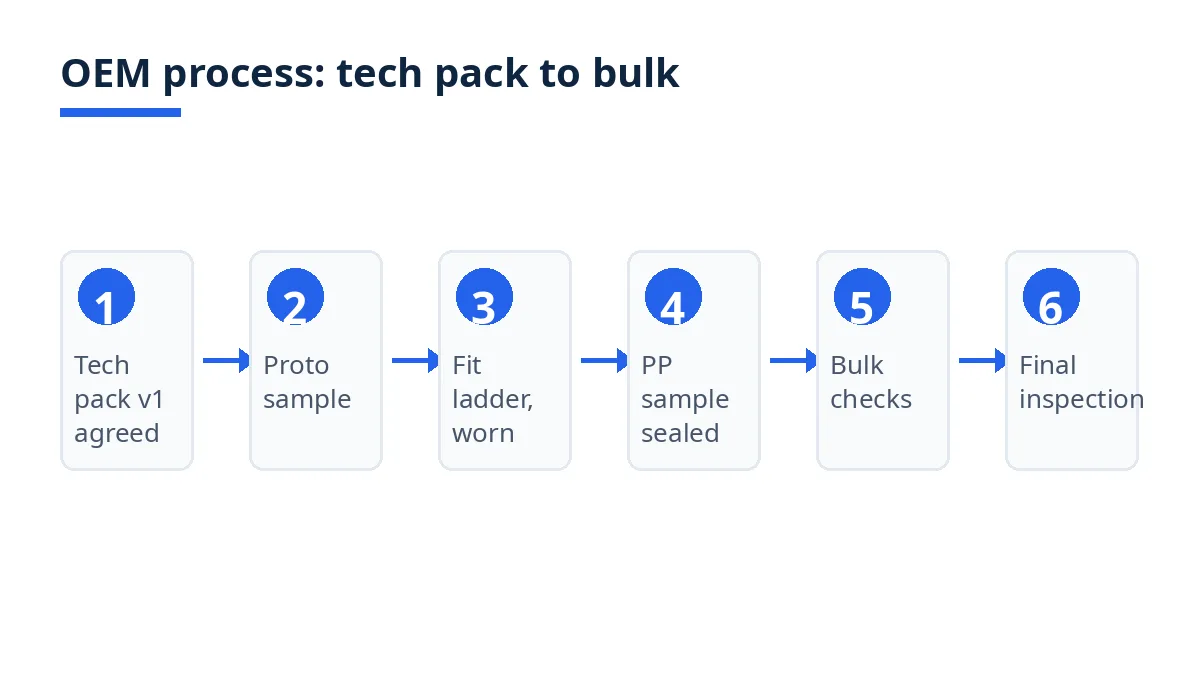
The sample ladder decides one question per rung: proto for construction, fit worn and zipped at the smallest, middle and end sizes, size set for grading, and a sealed pre-production sample as the bulk standard.
Shade is held panel by panel under an agreed light, with a natural-mark grading rule agreed before cutting and every later change returning the order to a new tech pack version.
Costs split into set-up work paid once and a per-piece jacket price; example figures in this guide total 27,515 USD for 600 jackets, with no standard price or lead time stated.
Bulk is released only when classification, chromium VI lab evidence, badge checks, the inspection plan and the approved Bill of Export file are all in writing.
A jacket can pass every flat measurement and still fail the first time it is worn. The front pulls at the shoulder once it is zipped, one sleeve hangs a fraction longer than the other, the zip catches at the lapel curve, and the sleeve lining twists when an arm goes through it. None of those faults shows on a table. An OEM order exists to catch them before bulk cutting, by proving the jacket on a body, in the production leather, at every size, before the lot is cut.
When you brief a custom leather jackets manufacturer in Bangladesh, you are not buying a finished style and adding a label. You supply the design and the specification, and the maker produces to it. This guide follows that journey from tech pack to bulk for buyers in the United States, the United Kingdom, the European Union and the United Arab Emirates: what the tech pack must fix, what each sample decides, how shade and change control are held through bulk, and what costs, time and papers the order carries. Every figure in this guide is an example figure. No factory name, capacity or certificate is stated as a fact.
Start from the worn jacket: what OEM decides before anything is cut
OEM, original equipment manufacturing, means the maker builds your jacket to your specification rather than selling you its own range. That decides who answers each question in the order. You answer the leather type and grain, the panel layout, the collar and pocket shapes, the zip and hardware set, the lining, the stitching and edge finish, the labels and the packing. The maker answers how those decisions are cut, stitched and finished at quantity, and flags any decision it cannot repeat in bulk.
Three decisions must be settled before sampling starts, because each one changes the others: the leather, type, grain, thickness, color and tannery, with evidence naming that tannery and leather; the size run and how measurements grade to its ends; and the wearing standard, the jacket judged worn and zipped, under an agreed light, by one measurement method used for every sample and bulk check. Grain and shade must stay consistent across the front panels, back panel and both sleeves, and between jackets in the same color, under the agreed light.1
Fix the delivery term at the same stage. Incoterms 2020 provides 11 rules with a clear allocation of cost, risk and obligations, and collects all costs for a rule in article A9/B9 of that rule.2 Write the rule, the named place or port and the edition into the contract, and price every quotation on the same term. Under DAP the seller does not unload the goods, while under the renamed DPU rule the seller does, and that unloading is the sole difference between the two.2 Only CIF and CIP oblige the seller to buy insurance for the buyer, at different levels of cover.2
Write the jacket down: the tech pack as the order
A tech pack, short for technical package, is the specification document that tells a manufacturer exactly how to produce a garment: flat sketches, measurements, materials, construction notes and cost data in one place.3 A spec sheet is not a tech pack: it covers measurements only, while a tech pack covers the full production picture.3 For a leather jacket, the tech pack is the order. Anything left out of it is decided by the maker, to the maker's defaults.
A complete tech pack contains seven core components: a cover page with style information, technical flat sketches, a bill of materials, measurement specifications with a grading chart, construction notes and stitching details, a cost sheet, and a revision history and version log.3 The table below states each component in jacket terms.
Tech pack component | What it must fix for a leather jacket |
|---|---|
Cover and style information | Style name and number, season, colorways, size range, date and version number |
Flat sketches | Front, back and side views, flat, with callouts for every seam, pocket, collar, lapel, closure and hardware placement |
Bill of materials | Leather type, grain, thickness and tannery; body and sleeve lining; interlining; thread; zip, snaps, buttons and rivets; labels, hang tags and packing |
Measurements and grading | Every point of measure at base size with tolerances, grading rules across the size run, and the how-to-measure condition: zipped or unzipped, flat or on a hanger |
Construction notes | Seam types, stitch count, edge treatment, skiving at seam bulk, reinforcement at shoulders, armholes and pocket corners |
Colorways and shade | Color reference per colorway, the shade standard, the agreed light source, and the natural-mark grading rule by position and size |
Labels, artwork and packing | Label content, spelling and position per market, artwork files, hanging packing: hanger, garment bag, tissue, polybag and carton |
Revision log | Every change with what changed, when, and who approved it, so no one builds to a superseded version |
Flat sketches are engineering drawings, not fashion illustrations: they show the garment front, back and side, drawn flat, with callout lines pointing to every seam, pocket, stitching detail and hardware placement.3 Every measurement point needs a labeled callout on the flat sketch, so there is no ambiguity about where the maker measures from.3 The bill of materials lists every component in the garment, each with its color reference and supplier reference where one exists.3 A missing bill of materials transfers material sourcing decisions to the maker, which then chooses on availability rather than on your specification.3
Version discipline is the part buyers skip and then pay for. A tech pack without a version number creates the risk that a maker builds to an older iteration without either party knowing.3 The revision log records every spec change, what changed, when it changed and who approved it, specifically to prevent a maker building to the wrong version.3 Send one version-numbered tech pack to every maker, so every quotation prices the same jacket. When a sample comment changes the spec, update the tech pack first, raise the version, and reissue it.
The sample ladder: proto, fit, size set, pre-production
Samples are checkpoints, not previews. Each rung of the ladder decides one question, and a sample that was made to answer a different question cannot answer it. Garment samples bridge the gap between design concepts and final products, and serve as checkpoints that ensure quality, fit and market readiness before full-scale production.4 The ladder for a jacket order runs proto, fit, size set, pre-production, and then a top-of-production check inside bulk.
The proto sample tests whether the design can be made: silhouette, panel construction and the construction route, usually in substitute material or available leather. It cannot approve fit, shade or bulk leather, because it was not made in them. The fit sample tests sizing, proportion and comfort, and is often tested on a human model to check accurate fit, sizing and proportions before production.4 For a jacket, judge the fit sample worn and zipped: shoulders seam to seam, chest below the armholes, waist at the closing line, back length from the collar base to the hem, and both sleeve lengths from the shoulder point to the cuff, measured by the one agreed method. Approve fit at the smallest, middle and end sizes of the run, tried on and zipped, not on the base size alone.
The size set sample checks grading across the full range, so the desired fit is achieved across every size before production.4 The pre-production sample is the final sample before mass production, made using bulk fabric, trims and accessories to ensure the production process will match the intended quality and specifications.4 An approved pre-production sample, sometimes called a gold seal sample, is sealed by the buyer and serves as the official reference for quality and specifications, and only after its approval does bulk production commence.4 Seal one approved jacket as the bulk standard, photograph it under the agreed light, and hold it where bulk checks can reach it.
The salesman sample belongs to selling, not to approval. Salesman samples are used to showcase the product to buyers and retailers.4 Do not let one stand in for the pre-production sample: it may be made before fit is locked. Inside bulk, the top of production sample is taken from the first batch of the production run and serves as a benchmark for quality control.4 Compare it against the sealed sample, worn and zipped, before the rest of the lot is released.
From sealed sample to bulk: cutting, assembly, shade and change control
Bulk production is where a jacket stops being one sample and becomes a lot. Cutting comes first. Leather is bought by area and cut from hides that carry natural marks, so panel layout decides how much usable leather each jacket takes and where each mark lands. Natural marks such as scars, insect holes, blood veins and growth wrinkles are inherent, and the inspection goal is grading by position and size rather than zero defects.1 Agree that grading rule in the tech pack before cutting. Grain and shade must hold across the panels of one jacket and between jackets in the same color, under the agreed light.1
Assembly follows the construction notes, not the sample room's habits. Join the panels, set the sleeves and collar, fit the pockets, install the zip and hardware, then build the lining as a separate assembly and attach it so it sits flat with no pulling, bunching or loose threads, and the sleeve lining stays free of twist.1 Hardware must operate smoothly, sit firmly attached, keep a consistent finish and show no rust or scratches.1 Run the front zip fully several times on every checked jacket: smooth, no catching, no skipped teeth, teeth meeting evenly, tape lying flat with no wave or pull at the lapel curve.1 Stitching must run straight at a consistent density with reinforced stress points, and edge finishing must stay smooth and free of cracks.1
Inline checks catch drift while it is still cheap. Check the first jackets off the line against the sealed sample for panel shade, measurements, zip run, collar symmetry and lining, and stop the line when a fault repeats. A repeated fault is a process fault, and sorting finished cartons will not fix it.
Change control is the rule that protects all of it. Any change after pre-production approval, a different leather lot, a new zip finish, a revised label, a different lining color, returns the order to the tech pack: raise the version, record the change and who approved it, reissue the pack, and re-approve the affected check before cutting resumes. A leather lot change is a shade change until a new panel approval proves otherwise. If a change is not in the version log, it did not happen.
Costs, time and papers on one page
There is no standard OEM jacket price or lead time to quote. Costs move with the leather lot, the lining and hardware, the construction, the quantity per variant and the packing. Time follows the gates in order: each gate waits for its written record, and a missed record holds bulk. Price the order as two parts, the set-up work that is paid once and the jacket price that repeats per piece, so a repeat order can be priced from the same lines.
Example figures only, for one style in two colors and four sizes, 600 jackets in total. They are not a quotation or a market price.
Order line | Example figure (USD) |
|---|---|
Pattern, grading and markers, one-time | 380 |
Sample rounds, proto and fit | 285 |
Pre-production sample and size set | 210 |
Lab tests, 2 methods | 240 |
Set-up subtotal, paid once | 1,115 |
Jacket unit price, 600 jackets at 44.00 | 26,400 |
Order total before freight, duty and taxes | 27,515 |
Arithmetic: 380 + 285 + 210 + 240 = 1,115; 600 x 44.00 = 26,400; 26,400 + 1,115 = 27,515. The label run sits outside this table because it is counted per label, not per jacket. Agree who pays for pattern, plates and samples as separate lines, who owns them, and whether the set-up serves the repeat order, before sampling starts. A smaller order usually costs more per piece, through a surcharge or a set-up charged apart from the unit price, and a supplier may state in a quotation that an order below the quoted quantity will carry an upcharge.5
The minimum quantity is counted, not assumed. A minimum order quantity is the smallest quantity a supplier will accept for a product on its normal terms, counted per order, per style or per color as the supplier states, and a supplier can combine a quantity minimum with a minimum order value.5 There is no standard minimum for Bangladesh or for garments that can safely be assumed.5 Material, trims and variety drive the minimum: custom leather brings the tannery lot into the calculation, and every extra color or size adds changeovers.5 State quantity per style, per color and the size breakdown in the request for quotation, and have the maker confirm the arithmetic in the quotation itself.
The papers travel with the order, not behind it. Keep one order file holding the version-numbered tech pack, every sample approval with its version, the lab reports naming your leather, color and lot, the inspection plan, the accepted quotation version, and the export file. Each Exportain quotation states unit price, MOQ, lead time, Incoterm, payment terms and validity.5 Confirm the inspection standard, level and AQL values per defect class in writing before production. AQL stands for Acceptance Quality Limit, the maximum average percentage of defective items considered acceptable during random sampling, and ISO 2859-1:2026 defines a system of acceptance sampling plans indexed by AQL for lot-by-lot inspection.6 AQL values are buyer-agreed values written into the order, not universal mandates.
Bangladesh checks that belong in the OEM file
Four checks belong in every jacket OEM file, and each one is confirmed before bulk, not after shipment. The first is classification. The indicative heading is 4203, articles of apparel and clothing accessories, of leather or of composition leather, and the indicative subheading for a leather jacket is 4203.10, articles of apparel.7 8 Only the first six digits are shared internationally, so the full national extension must be read in the destination tariff for the exact jacket: the United States schedule splits the apparel line nationally between reptile leather and other leather, the European Union line is 4203 10 00, and the United Kingdom code is 4203 10 00 00.8 The outer surface decides whether heading 4203 applies at all, and a jacket whose outer surface is textile is not a leather jacket for classification even when the finish imitates leather, while a quilted lining changes nothing and a furskin lining, or furskin outside beyond mere trimming, removes the garment from Chapter 42.8 Have the broker confirm the code on the exact jacket before pricing is fixed, and keep the jacket description identical across the invoice, packing list and labels.
The second is chemical evidence for the market. Under the REACH restriction in Annex XVII entry 47, leather articles coming into contact with the skin shall not be placed on the market where they contain chromium VI at or above 3 mg/kg of the total dry weight of the leather, and the same limit applies to leather parts coming into contact with the skin.9 The EN ISO 17075 standard method is the only internationally recognized analytical method to detect chromium VI in leather, with a determination limit of 3 mg/kg.9 Require lab reports naming your product, your leather, your color and the method, and retest when the leather or tannery changes. Tannery evidence supports that file but never replaces it. The Leather Working Group audit, first launched in 2005, assesses a tannery across 17 sections, with minimum thresholds of 85 percent for Gold, 75 percent for Silver, 65 percent for Bronze and 50 percent for Audited, and the final medal is the lowest category achieved.10 Certification lasts 24 months for manufacturing facilities and 12 months for part-processed material traders, and certification does not guarantee no restricted substance failures in a final product.10 Read any evidence for the leather, tannery, scope and expiry it names, and confirm it with the issuing body.
The third is naming. For the United States, the composition rule is strict in form: it is deceptive to use the unqualified term "leather" to describe a product unless the product is composed in all substantial parts of leather, imitation or simulated leather must be disclosed as such, and bonded, reconstituted or similar leather must carry the percentage of leather fibers and non-leather substances where the bonded-leather term is used.11 A jacket whose panels are bonded or reconstituted material must not be ordered, labeled or sold as plain leather. Approve every label proof word for word, per destination market, before the label run.
The fourth is the export file and the supplier record. Goods must not be loaded or stuffed in containers or a ship for export unless an export declaration, known as a Bill of Export or Shipping Bill, has been submitted to Customs in the prescribed format and approved by the Customs authority.12 Enclosures include the export letter of credit or equivalent export contract, signed invoice, packing list, EXP form certified by Authorised Dealer banks, certificate of origin, VAT certificate and taxpayer identification number.12 The product-specific line in that list covers an Export Registration Certificate for jute, jute goods and tea, which does not apply to leather jackets.12 Read each badge for the checks its exact name records: Exportain Verified for identity, phone, email and business registration; Export Verified for the Export Registration Certificate; Factory Verified for reviewed factory photos; Trading Company Verified for reviewed office or warehouse photos; and Trusted Trader for completed orders on Exportain with no disputes.13 Verification is a document and photo review by Exportain staff: not a factory inspection, not a check against any government database, and a badge is not a guarantee of capacity, quality or delivery.13 Check the company name and address across the trade licence, the ERC, the quotation and the invoice, and request the documents yourself.
Seven holds that send a jacket back to sampling
Treat each of these as a hold on bulk, not as a comment to fix later.
Approving bulk from a photograph. A photograph cannot show a zip catching, a sleeve pair out of step, or a lining that twists. Judge every sample worn and zipped, in hand.
Approving fit in one size only. Grading errors show at the ends of the run. The fit ladder is smallest, middle and end sizes, or the run is unapproved.
Sampling in different leather, color or hardware than bulk. A sample in substitute leather approves a jacket you are not buying. The pre-production sample is made in bulk leather, bulk trims and bulk labels.4
Working without a shade standard. Grain and shade judged without an agreed light and a sealed reference turn every reorder into an argument about color. Seal the standard under the agreed light.1
Changing the lot without a new version. A new leather lot, a new zip finish or a revised label without a raised tech pack version and a fresh approval is an unapproved jacket.
Releasing bulk before the lab report names your lot. A report for another lot, color or season proves nothing about the jackets in the cartons. Hold bulk until your lot's report is filed, with the method named.9
Paying a deposit before the file is written. The tech pack version, the counting basis, the inspection plan and the delivery term belong in writing before money moves. A deposit paid on messages alone buys the maker's defaults.3 5
Release checklist: sign bulk only when every line is written
Work through this list with the order file open. Bulk is released only when every line is marked pass, with the evidence held and the signer named.
Line | Record to hold | Signed by |
|---|---|---|
Tech pack | Version-numbered pack: flats, bill of materials, grading, construction, shade standard, labels, packing, revision log | Buyer |
Fit ladder | Proto, fit and size set approvals; worn and zipped at smallest, middle and end sizes | Buyer |
Sealed sample | Pre-production sample sealed, photographed under the agreed light, counter sample with the maker | Buyer and maker |
Leather and hardware lots | Leather type, grain, tannery and lot; zip and hardware type and finish; lab reports naming lot and method | Buyer |
Minimum and price | Counting basis in writing per style and color, price tiers, validity, set-up ownership | Buyer and maker |
Inspection | Standard, level and AQL values per defect class, action on a failed lot, inspector named | Buyer |
Classification and labels | Indicative 4203.10 confirmed by the broker, label proofs approved per market | Broker and buyer |
Terms and file | Delivery term with named place and edition, payment terms, export file enclosures agreed | Buyer and maker |
What should I know first about leather jackets?
Know the jacket as a worn garment before you know it as a product. A custom OEM order is built to your tech pack, proved on a sample ladder that ends in a sealed pre-production jacket, and judged worn and zipped at the smallest, middle and end sizes.4 1 Fix the leather lot, the size run, the shade standard and the delivery term in writing before sampling, and treat every later change as a new tech pack version with a fresh approval.
What are the typical costs and timelines?
There are no typical costs or timelines for a custom leather jacket order: no rule fixes either. Costs split into set-up work paid once, pattern, samples and lab tests, and the jacket unit price that repeats per piece, with example figures only in this guide.5 Timelines follow the gates in order, proto, fit, size set, pre-production and top of production, and each gate waits for its written record.4 Agree a date for each record, and treat a missing record as a hold on bulk.
Which documents are needed?
The order file holds the version-numbered tech pack, every sample approval with its version, the sealed-sample photograph, leather and tannery evidence, and lab reports naming your lot and method.3 10 The commercial file holds the accepted quotation version stating unit price, minimum quantity counted per style and color, lead time, delivery term, payment terms and validity.5 The export file holds the approved Bill of Export with the export letter of credit or approved contract, signed commercial invoice, packing list, EXP form, certificate of origin, VAT certificate and taxpayer identification number.12 Keep the jacket description identical across every document.
What are the most common mistakes?
The most common mistakes are approving bulk from a photograph, approving fit in one size only, sampling in different leather or hardware than bulk, working without a shade standard, changing the lot without a new tech pack version, releasing bulk before the lab report names your lot, and paying a deposit before the tech pack, counting basis, inspection plan and delivery term are written. Each is fixed in writing before cutting, with the evidence held in the order file.
Next steps on Exportain
Browse Bangladeshi suppliers and open each profile's trust and verification checklist before shortlisting, checking what each badge actually records. When the tech pack version, size run, leather lot and delivery term are written down, post a free RFQ stating the jacket, the leather type, the quantities per style and color, and the delivery term in full, and compare quotations on identical lines. Read the verification guide before relying on a badge, the MOQ guide before fixing quantities, and how to buy for the eight-step buying process. Exportain is a B2B marketplace where buyers find Bangladeshi suppliers and post requests for quotation. It is not a party to the contract for the goods, and it does not inspect goods, book freight or clear customs.
Sources
- Quality Control Checklist for Leather Jackets. Exportain, (accessed )
- Incoterms® 2020. International Chamber of Commerce (ICC) (accessed )
- What Is a Tech Pack? The Complete Fashion Guide [2026]. TechPacker (accessed )
- The Types of Garment Samples in Apparel Production. Uphance (accessed )
- MOQ Meaning (Minimum Order Quantity). Exportain (accessed )
- ISO 2859-1:2026 - Sampling procedures for inspection by attributes — Part 1: Sampling schemes indexed by acceptance quality limit (AQL) for lot-by-lot inspection. ISO (accessed )
- Classification Detail: HS, 2017, Code 4203. United Nations Statistics Division (accessed )
- HS Code for Leather Jackets: Classification Guide for Importers. Exportain, (accessed )
- Commission Regulation (EU) No 301/2014 amending Annex XVII to Regulation (EC) No 1907/2006 (REACH) as regards chromium VI compounds. European Union, (accessed )
- Certification - Leather Working Group. Leather Working Group (accessed )
- 16 CFR § 24.2 - Deception as to composition. Legal Information Institute, Cornell Law School (accessed )
- Customs Clearance Procedures for Export. Bangladesh Customs, National Board of Revenue (accessed )
- How Supplier Verification Works on Exportain. Exportain, (accessed )
About the author
Sourcing from Bangladesh?
Post a request for quotation and suppliers on Exportain can send you their quotes directly.
Post an RFQ