

Custom Leather Belts Manufacturer in Bangladesh: OEM Process From Tech Pack to Bulk
Custom leather belts made to order in Bangladesh: the OEM gates from tech pack to bulk release, the documents that sign off each gate, and example costs for a first belt order.
Short answer
To order custom leather belts from a manufacturer in Bangladesh, send one version-numbered tech pack per belt, approve a fit sample for the hole run and buckle, approve the strap leather and buckle lots separately, and release bulk only on a signed pre-production approval naming the lots and the tech pack version, with final inspection against the sealed counter-sample.
On this page
Key takeaways
Decide the belt as one system: wearing lengths, hole count and spacing, strap, buckle, and keeper are fixed together in one tech pack before sampling.
Write one version-numbered tech pack per belt, with a tolerance and a measuring condition for every length, and keep one current version only.
Approve the fit sample for the hole run and buckle function, the strap leather and buckle lots separately, and the pre-production sample in production materials.
Bulk production starts only on a signed bulk-release note naming the approved lots and the tech pack version; final inspection checks packed goods against the sealed counter-sample.
Belts and bandoliers of leather or of composition leather fall under subheading 4203.30; confirm the full national code with a broker before pricing.
The sample belt fastened cleanly at every hole. The bulk belts did not. The buckle looked the same. What had changed was the buckle lot: a new delivery, fitted without a fresh approval, with a prong a fraction shorter than the approved sample. The belt failed at the waist because one gate was skipped.
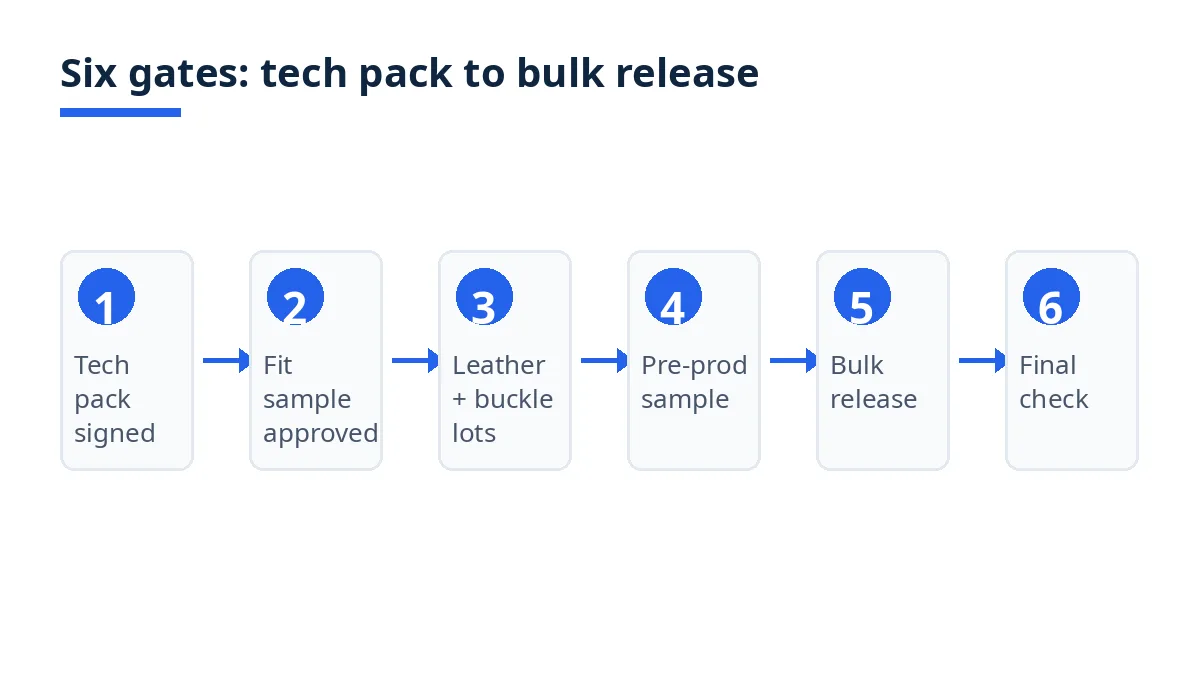
This guide follows a custom leather belt order from a manufacturer in Bangladesh through six gates, from the tech pack to bulk release. In this guide, OEM means the buyer supplies the design and specification and the factory makes the belt to that specification. The tech pack is the single version-numbered specification document for one belt. Bulk cutting starts only when the last sample gate is signed.
Decide the belt as one system: strap, holes, buckle, keeper
A belt is one long strap worn under tension, judged at the waist on hole spacing, buckle seating, keeper hold, and edge finish. Decide those four parts together: each one changes the others.
A belt size is a wearing length, measured from the buckle to each hole, with the strap flat, uncoiled, and relaxed.1 Agree the size run, hole count, spacing, and distance from the last hole to the tip before you ask for a price, with a tolerance for each length. Then fix the strap (type, grain, thickness, width, edge finish, lining) and the buckle and keeper as a pair (frame, finish, prong, attachment, keeper width and travel).1 Tested together, the prong must seat in each hole, the keeper must hold the tip, and the tip must lie flat through the keeper.1
The belt tech pack: one document, one version, every gate
One belt has one tech pack, in one document, with one version number and one date. When anything changes, issue a new version, date it, list the change, and withdraw the old version in writing.
A complete belt tech pack contains the belt identity; a flat drawing with strap, holes, buckle, keeper, tip, and labels marked; the hole plan (each hole numbered from the buckle, with distance and spacing); the bill of materials, each item with exact ordering wording; construction notes; the brand mark (position, size, method, artwork file and version); labels and packing; and the approval record (approver, form, and pass meaning for each sample). Give every measurement a tolerance and a test, name the hole-run template, keep the approved buckle as the physical reference, and state the light source for color checks.1
Count the order in the tech pack. A minimum order quantity is the smallest quantity a supplier will accept on its normal terms, counted per order, per style, or per color, sometimes with a minimum order value.2 Ask whether the belt minimum counts per style, per color, per buckle finish, or per size group, and write the basis into the pack.
What moves between buyer and factory at each gate?
Each gate moves paper both ways: the buyer sends the specification and approval, the factory sends the sample, evidence, or report.
Gate | Buyer sends | Factory returns | Approval document |
|---|---|---|---|
1. Tech pack | Tech pack, artwork files | Questions, assumptions, charges | Signed tech pack |
2. Fit sample | Written fit comments | Fit sample, test results | Fit approval or correction list |
3. Material lots | Shade standard, lot rules | Swatches, buckle set, evidence | Lot notes; swatches and set kept |
4. Pre-production sample | Approval form naming lots, pack version | Sample in production materials | Bulk-release approval; counter-sample sealed |
5. Bulk release | Release note naming lots, pack version | First straps for check | Release note signed by both sides |
6. Final inspection | Sampling plan, defect classes | Inspection report, counts, photographs | Signed inspection report |
Name the approver for each gate in the tech pack and keep every approval with the order file.
The sample ladder: fit, appearance, then bulk release
The ladder has three rungs, each approved or rejected in writing against the current tech pack version. The fit sample asks whether the belt fastens and wears as specified: check the hole run at the first, middle, and last holes, prong seating, keeper travel, and wearing lengths flat and relaxed.1 It may use substitute leather; its hole run and buckle function are the point.
The salesman sample shows the belt as it will look when sold, in production leather and color, with the brand mark applied. Check shade, grain, edge finish, and the mark at arm's length. It releases selling, photography, and customer approval, not bulk production: record that limit in the approval note.
The pre-production sample releases bulk: production leather, lining, thread, and buckle, on the production pattern, with the production punch and edge finish. Check it line by line, run every function test at the first, middle, and last hole, and keep one sealed counter-sample. Note the leather and buckle lots on the approval: bulk must use the approved lots, or be re-approved. Approve the physical sample: a photograph cannot show prong seating, keeper tension, or edge smoothness.
Why approve the strap leather and the buckle as separate lots?
The strap leather, lining, thread, and buckle lots each need their own approval, against their own standard, before bulk cutting.
For the strap leather, approve a physical swatch, not a shade name. Keep it with the tech pack, state thickness, finish, and shade standard in the same note, and check the first bulk straps against the swatch along the full length, under the agreed light. Grade defects by position and size, and photograph borderline cases.1
Ask for tannery evidence naming your leather, and confirm certificates with the issuing body. The Leather Working Group audit covers 17 sections, including water and energy use, chemical management, waste and effluent treatment, and health and safety, with medal thresholds of 85 percent for Gold, 75 percent for Silver, 65 percent for Bronze, and 50 percent for Audited in each section.3 A manufacturer must reach its medal rating in every category or be certified at its lowest, certification is valid for 24 months for manufacturing facilities, it does not guarantee no restricted-substance failures, and for Gold and Silver, chromium VI must stay below 3 mg/kg, with any higher level an automatic failure.3
For the buckle, approve finish and function separately: it must operate smoothly, sit firmly attached, show a consistent finish, and show no rust, scratches, or burrs.1 Keep one approved set with the counter-sample, and re-approve whenever any lot changes.
From bulk release to the cutting table and the hole punch
Check the first cut straps against the pattern, width, and swatch before the full cut proceeds. Check thickness along the strap, including at folds and joins.1 Punch the hole run from the approved template, then measure buckle to each hole on the first punched straps, flat and relaxed, before the run continues.1 Check hole shape, alignment along the strap center, and edge distance, so holes do not tear out.1 Hold earlier straps when the template is corrected, and re-measure them.
Assemble to the construction notes: lining fitted flat, stitch lines straight and even on each edge, stitching reinforced at the buckle fold, keeper, and tip, buckle attached as specified.1 Check the edge finish against the pre-production sample, and inspect the first finished belts against the counter-sample during the run.
Final inspection, coiling, and the export papers
Final inspection checks the finished, packed lot against the counter-sample, the tech pack, and the sampling plan agreed before bulk production: how many belts are checked, how defects are classed, and what happens to a failed lot, with sampling values as buyer-agreed values, not mandates. Agree the sampling basis and AQL in writing, as the verification guide advises.4 Coil each belt at the specified diameter so the strap does not crease or take a buckle mark.1
Under the export clearance procedures published by Bangladesh Customs, goods are not loaded unless a Bill of Export (shipping bill) is submitted and approved, with the export letter of credit or, where there is none, the contract, purchase order, or export guarantee approved by the negotiating bank, the signed commercial invoice, the packing list, the EXP form certified by authorized dealers, the certificate of origin, the VAT registration certificate, and the taxpayer identification number enclosed.5 Keep the belt description identical on the invoice, packing list, and Bill of Export.
Agree the delivery term with the rule, named place or port, and edition in full, for example FOB Chattogram, Incoterms 2020. Incoterms 2020 provides 11 rules allocating cost, risk, and obligations, used since 1936 and updated in 2020.6 CIF is maritime-only, with Clauses (C) as default cover and Clauses (A) for CIP; DAP and DPU differ only on unloading.6 An FOB unit price covers goods up to loading at the named port; freight beyond it is not in the unit price.2
Costs, timelines, and documents: example figures for one belt order
There is no single typical price or timeline for a custom leather belt from Bangladesh. The figures below are example figures only, for one dress belt order of 1,800 belts in three colors, one buckle finish, and one size run. Replace every line with a confirmed figure for the exact belt, leather, quantity, and delivery term.
Cost line | Example figure | How to obtain your figure |
|---|---|---|
Fit sample, per style | $85 | Factory sample quotation |
Pre-production sample, per style | $70 | Factory sample quotation |
Dies and punch template, one-off | $280 | Factory quotation |
Unit price, per belt | $6.20 | Pro forma invoice |
Goods total, 1,800 belts | $11,160 | Unit price × quantity |
Order total before freight and duty | $11,595 | Goods + samples + tooling |
The minimum counts per color here: 600 per color across three colors is 1,800 belts, not 600. A quotation stating only a piece count, without per style, per color, or per size group, has not answered the question.2 Freight, insurance, duty, and delivery sit outside that total; confirm the duty line with your broker. The example timeline is 11 working weeks from a signed tech pack: 1, 2, 2, 2, 3, and 1 across the six stages.
Agree the full order-file list before bulk release.5
Which Bangladesh checks settle classification and leather evidence?
Belts and bandoliers of leather or of composition leather sit at subheading 4203.30, under heading 4203, articles of apparel and clothing accessories of leather or of composition leather.7 Confirm the full national code in the destination tariff: only the first six digits are shared.8 A strap made to hold a watch is excluded from heading 4203 and falls under heading 9113, belting leather and technical straps sit in heading 4205, and a textile or plastics strap is outside heading 4203 even when its finish imitates leather.8 The United States lists the line as 4203.30.00, a United States line only, and the United Kingdom splits 4203.30 into hand-made and other.8 For a borderline belt, seek a binding decision before shipping.8
Check documents, current production, leather lots held, and capacity for your quantity, plus a factory check, by video or in person, for a first order. On Exportain, a supplier can hold up to five trust badges, each naming exactly what was checked: Exportain Verified (identity, phone, email, business registration), Export Verified (Export Registration Certificate), Factory Verified (reviewed factory photos), Trading Company Verified (reviewed office or warehouse photos), and Trusted Trader (completed orders on Exportain with no disputes).4 Verification is a review of documents and photos by Exportain staff: not a factory visit, not a check against a government database, and not a guarantee of capacity, quality, or delivery.4 Exportain is not a party to the trade, does not inspect goods, book freight, or clear customs, and holds money only when both parties agree to a funds hold.4
Mistakes that send a belt order back to the first sample
Approving a sample from a photograph alone is the first. Sampling in a substitute leather and treating it as a material approval is the second. Changing one material without re-running the related test is the third. Leaving the hole plan to the sample stage is the fourth: hole count, spacing, and wearing lengths belong in the tech pack, with tolerances, before any sample is punched. Starting bulk cutting before the pre-production sample is signed is the fifth.
Bulk-release checklist: sign every line before cutting
Do not release bulk until every line is signed. Keep the signed checklist with the order file.
Tech pack current, signed, changes listed, old version withdrawn.
Belt fixed as one system: sizes, holes, tip, strap, buckle, keeper.
Hole plan complete: holes numbered, with distance, spacing, tolerance, condition.
Fit sample approved in writing, with hole-run tests recorded.
Leather, lining, thread, and buckle lots approved separately, with swatches and a buckle set kept.
Pre-production sample approved in writing, with a sealed counter-sample kept.
Brand mark approved on production leather, with artwork version named.
Label wording, coil size, sleeve, polybag, and carton marks agreed.
Sampling plan and defect classes agreed, with the failed-lot action stated.
Order, invoice, delivery term, and counting basis agree with the tech pack.
What should I know first about custom leather belts?
Know the belt as one system before the leather. Fix the wearing lengths, hole spacing, buckle, and keeper together, and pass each gate in writing before bulk release.
What are the typical costs and timelines for a custom belt order?
There is no single typical price or timeline. Example figures for 1,800 dress belts: $85 fit sample, $70 pre-production sample, $280 dies and template, $6.20 per belt, 11 working weeks. Replace every line with a confirmed figure.
Which documents are needed for a custom leather belt order?
The order file holds the tech pack, sample approvals, lot notes, purchase order, pro forma invoice, release note, inspection report, commercial invoice, packing list, EXP form, certificate of origin, and shipping document. Bulk starts only on the signed release note naming the lots and tech pack version, and the Bill of Export must be approved before loading.5
What are the most common mistakes with custom leather belts?
Approving a sample from a photograph, treating a substitute-leather sample as a material approval, changing one material without re-running the related test, leaving the hole plan to the sample stage, and starting bulk cutting before the pre-production sample is signed.
Next steps on Exportain
Browse Bangladeshi suppliers against your tech pack, starting with the supplier verification guide. Check the MOQ guide, the HS code guide for leather belts, and the quality control checklist for leather belts. When the tech pack is signed, post a free RFQ and compare quotes on the same tech pack version, gates, and delivery term.
Sources
- Quality Control Checklist for Leather Belts. Exportain, (accessed )
- MOQ Meaning (Minimum Order Quantity). Exportain (accessed )
- Certification - Leather Working Group. Leather Working Group (accessed )
- How Supplier Verification Works on Exportain. Exportain, (accessed )
- Customs Clearance Procedures for Export. Bangladesh Customs, National Board of Revenue (accessed )
- Incoterms® 2020. International Chamber of Commerce (ICC) (accessed )
- Classification Detail: HS, 2017, Code 4203. United Nations Statistics Division (accessed )
- HS Code for Leather Belts: Classification Guide for Importers. Exportain, (accessed )
About the author
Sourcing from Bangladesh?
Post a request for quotation and suppliers on Exportain can send you their quotes directly.
Post an RFQ


