

Custom Leather Bags Manufacturer in Bangladesh: OEM Process From Tech Pack to Bulk
Follow a custom leather bag from tech pack to bulk: a versioned specification, the proto, salesman, and pre-production sample ladder, lot-based leather and hardware approval, bulk gates, and change control in Bangladesh.
Short answer
Custom leather bag OEM manufacturing in Bangladesh means a factory makes a bag to your design and specification, working from a versioned tech pack through proto, salesman, and pre-production samples, with leather and hardware approved as lots. You control the design, leather, hardware, and construction decisions. Each stage ends with a written approval, and the pre-production sample in production materials is the bulk release gate.

On this page
Key takeaways
OEM means the factory makes the bag to your design and specification, under a versioned tech pack, while you keep control of design, leather, hardware, and construction decisions.
The sample ladder proves construction, sales presentation, and bulk readiness in stages, and the pre-production sample in production materials is the bulk release gate.
Approve leather and hardware as lots, with the tannery, lot number, shade standard, and test evidence on file for the lots that ship.
Any change after pre-production approval needs a new tech pack version, and a new sample where it affects leather, hardware, dimensions, construction, artwork, labels, or packing.
A trust badge records document and photo checks only, not a factory inspection, so sample approval, lot evidence, and inspection stay with you.
Two panels cut for the same bag order can arrive in different shades. Both are leather, both came from the same tannery, and the difference is still enough for a buyer to reject the shipment. That gap is a process problem: the leather lot, the shade standard, and the approval record were never fixed before bulk cutting started. This guide follows a custom leather bag order in Bangladesh from the tech pack to bulk, with the approvals that stop that gap.
Custom work here means OEM work. The buyer supplies the design and the specification, and the factory makes the bag to that specification. Every gate ends with a written approval, and the pre-production sample is the gate that releases bulk.
Settle the model before you write anything
OEM, ODM, and private label answer different questions, and the answer decides who owns what. In OEM production, a company produces items based on designs and specifications provided by the client, and the client keeps full control over the design, material selection, and product development.1 In ODM production, the manufacturer is responsible for both the design and production, and the brand can choose from existing designs provided by the manufacturer or work with the manufacturer to develop new designs.1 Private label sits beside both models: it is about whose brand, labels, and packing appear on the finished bag, not about who wrote the specification.
Settle four points before sampling starts, in writing: who owns the design, pattern, cutting dies, and embossing plates; whether the factory may make the same bag for another buyer; who selects the tannery and hardware supplier, and whether substitution needs a new approval; and who approves each sample, by name. Under OEM, the buyer must state the leather, thickness range, finish, and shade standard. Under ODM, the factory proposes those points. Either way, write them down: leather varies by hide, lot, and finish.
What goes in a leather bag tech pack
A tech pack is a structured specification document that gives a manufacturer every instruction needed to produce an item accurately, covering technical flat sketches, measurement specifications, the full bill of materials, construction methods, and cost data in a single document.2 A complete tech pack contains a cover page, flat sketches, a bill of materials, measurement specifications with a grading chart, construction notes, a cost sheet, and a revision log.2 Build one tech pack per style, and give every version a number and a date. Without a version number, a factory can build to an older iteration without either party knowing.2
Tech pack section | What it must state for a leather bag |
|---|---|
Flats and views | Front, back, side, base, interior, and hardware positions |
Dimensions and tolerances | Finished dimensions at each point of measure, with the tolerance held |
Leather specification | Leather type, tannage as claimed by the tannery, thickness range, finish, and shade standard |
Bill of materials | Every material by name, source, colour, and lot basis |
Hardware specification | Each fitting by type, size, finish, and plating, with its approval sample |
Construction notes | Panel order, skiving, edge treatment, stitching, reinforcement, and closure fitting |
Artwork | Emboss, print, or deboss artwork, position, size, and depth, with its plate |
Colour and size plan | Every colourway and size, with the quantity split the quotation must price |
Packing | Folding, stuffing, polybag, tissue, carton, and carton marking |
Dimensions need tolerances because leather stretches and relaxes. State the finished dimension, the tolerance, and how it is measured: laid flat, stuffed, or hanging. For artwork, state the file, the plate, and the position from a fixed edge, and approve the emboss on the production leather, not on a paper proof alone.
The sample ladder: proto, salesman, pre-production
Work the sample ladder in order. Each sample proves one thing, and no sample proves everything. The diagram below sets out the ladder and the approval each stage needs.
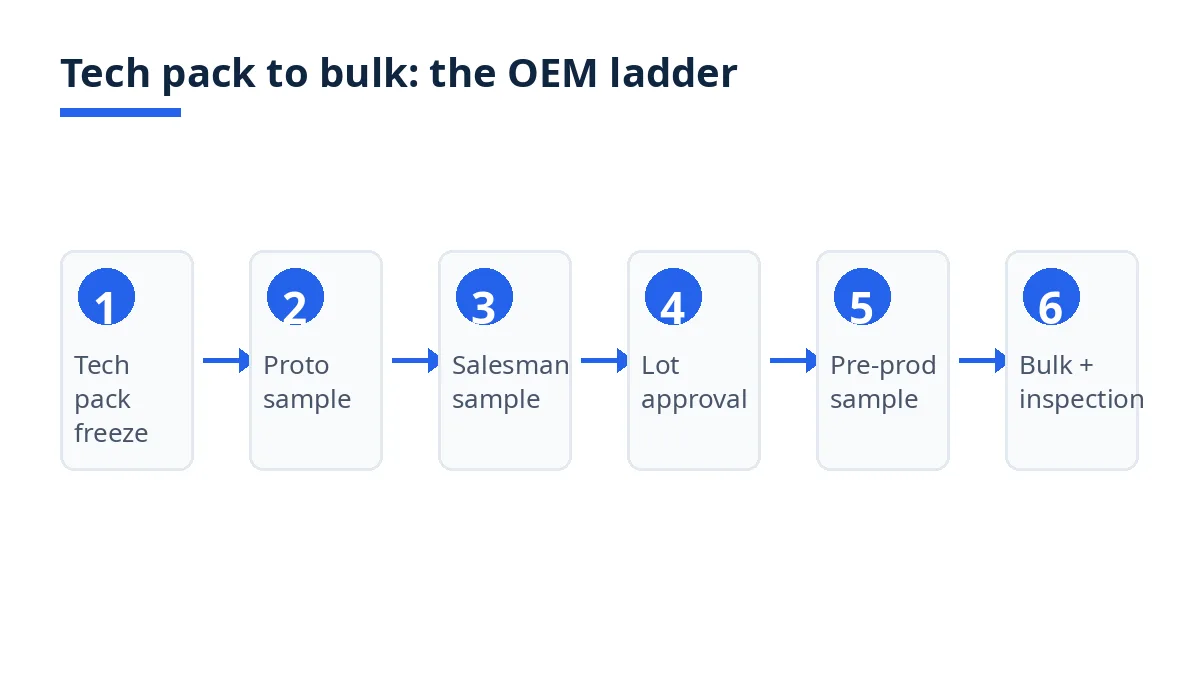
The proto sample proves construction: panel shapes, pocket positions, handle attachment, closure operation, and edge work. It need not be in the production leather, but the tech pack version it was built to must be recorded, and every correction photographed and written into a revised version.
The salesman sample proves the selling story. Made in the production leather, hardware, and lining, with finished labels and packing, it lets a buyer show the bag and take orders. Treat it as a sales tool, not as a bulk approval: it is usually made before the full bulk lot is bought, so it cannot prove the shade, grain, or finish of the lot that will ship. Record that limit on the approval.
The pre-production sample is the bulk release gate. Order it in the production leather lot, hardware lot, lining, labels, and packing. Measure it against the tech pack, check every closure by hand, and check shade across panels under one light source. Approve it in writing, with the tech pack version and lot numbers named, and keep one sealed sample as the shipment reference. Each correction round needs a corrected sample or page, a new tech pack version where the specification changed, and a written re-approval.
Approve leather and hardware as lots
Leather approval is lot approval. A lot is one batch of leather finished together, and shade, grain, and hand feel can shift between lots even when the tannery, the colour name, and the finish name stay the same. Approve the lot that will ship: ask for the tannery name, the lot number, the colour standard, and the test evidence for that lot, and check shade across panels cut from different hides in the lot, under the same light, before cutting starts.
Panel grading is part of lot approval. Hides carry natural marks and thickness variation, so state in the tech pack which parts use the best panels, which may use marked panels, and which marks are rejected outright. Without a grading rule, grading becomes a negotiation at the cutting table, after the leather is bought.
Approve each fitting as a lot: finish, plating colour, size, and operation. Check zips, snaps, turn locks, and rivets on the pre-production sample by hand, keep the approved fitting as a physical reference, and approve hardware against the leather, not apart from it.
Chemical evidence belongs with the lot, not with the tannery in general. The Leather Working Group audit covers 17 sections: Gold requires 85 percent, Silver 75 percent, Bronze 65 percent, and Audited 50 percent, with the medal level achieved across all scored sections, and certification is valid for 24 months for leather manufacturing facilities, commissioning manufacturers and subcontractors.3 For Gold and Silver, chromium VI must be below 3 mg/kg, and any level above results in automatic failure; leather is classified as chrome-free below 1,000 mg/kg of total chromium, dry weight, under BS EN 15987.3 An LWG audit does not guarantee that no restricted-substance failure will occur in a given lot, because leather is processed in batches.3
For the European market, the limit is a market rule. Under Commission Regulation (EU) No 301/2014, leather articles and leather parts coming into contact with the skin must not be placed on the market where they contain chromium VI at 3 mg/kg (0.0003 percent by weight) or more of the total dry weight of the leather.4 Confirm destination rules with the broker or adviser for the destination, since rules change and this guide does not give legal advice. Where a claim such as vegetable tanned or chrome-free will appear on a label, hold the evidence for that claim for the lot that ships. Lining, thread, and reinforcement need lot treatment too: name them by supplier, colour, and lot basis, and approve substitution in writing before bulk.
From pre-production approval to bulk: cutting, assembly, and change control
Bulk starts with the approved marker and the approved lots. Cutting, in leather work often called clicking when dies are used, must follow the panel grading in the tech pack: best panels to the parts the customer sees, marked panels only where the tech pack allows them, and rejected marks recorded rather than hidden under a pocket. Check the first cut panels against the pre-production sample for shade and grain before the full lot is cut. Leather cut wrong cannot be uncut.
Assembly follows the construction notes in order: reinforcement, pocket and lining work, handle and strap attachment, closure fitting, edge treatment, and finishing. State the edge treatment and finish standard on the pre-production sample, and check edges and stitching, including stress points at handles and straps, on the first finished bags. Agree inline check points in the purchase order — first-off, cutting, assembly, and finishing — and record results against the tech pack version and lot numbers.
Change control protects every earlier approval. Any change after pre-production approval needs a new tech pack version, and a new sample where the change affects leather, hardware, dimensions, construction, artwork, labels, or packing.
Change after pre-production approval | New tech pack version | New sample needed |
|---|---|---|
Different leather lot, same tannery and colour | Yes, lot number updated | Shade and panel check on the new lot |
Different tannery or different finish | Yes | New pre-production sample |
Hardware finish or fitting change | Yes | New pre-production sample |
Dimension or construction change | Yes | New pre-production sample |
Artwork, emboss, or label change | Yes | New label and artwork approval |
Packing or carton change | Yes | Packing approval on the new packing |
A change agreed verbally, or in a message thread without a version update, is not change control. It is a second, unwritten specification running beside the first, and bulk will follow whichever version reaches the floor first.
Costs, timelines and documents
Ask for the quotation as lines, not as one total. A single total hides the lines that move when leather, hardware, or quantity changes. For the meaning of a minimum quantity and how it is counted, see the guide to MOQ meaning.
Example figures: structure only; every amount is an example figure, not a market price. An example total of 100 units divides as leather and lining 48 units, cutting and assembly 26 units, hardware, labels, and packing 14 units, testing and set-up 7 units, and inland transport and port handling 5 units. If the leather line rises by 10 units and nothing else changes, the example total rises to 110 units. Ask which lines repeat on a repeat order and which are one-off set-up, and how the minimum is counted: per order, per style, per colourway, or per leather lot. A minimum counted per leather lot behaves differently from one counted per order, and the difference decides the colour plan.
Timelines run by gate, not by a single shipment date. Ask for a date for each gate: tech pack freeze, pattern and dies, proto sample, corrections, leather and hardware lots ready, salesman and pre-production samples, bulk start, inline checks, final inspection, and shipment readiness. Leather lot readiness and correction rounds usually decide the timeline. A date without a gate behind it cannot be checked until it is missed.
Keep three document sets in one order record, under one legal name for each party: the order set (versioned tech pack, accepted quotation, purchase order, sample approvals), the product set (tannery and lot evidence, test reports, hardware, label, and artwork approvals), and the shipment set (commercial invoice, packing list, transport document, origin or customs documents). State one delivery term with its named place on every quotation: the Incoterms 2020 rules provide 11 rules with a clear allocation of cost, risk, and obligations.5 Quotations on different terms are not comparable on price alone.
Agree the inspection standard before production. ISO 2859-1:2026 specifies sampling schemes indexed by acceptance quality limit (AQL) for lot-by-lot inspection by attributes, and AQL determines sample sizes and acceptance and rejection thresholds.6 Name the AQL values, level, and defect classifications in the purchase order, and inspect against the sealed pre-production sample, using the leather bags quality control checklist for the detailed finished-bag checks. For export clearance in Bangladesh, goods must not be loaded unless an export declaration, known as the Bill of Export or Shipping Bill, is submitted to Customs in the prescribed format and approved.7 The enclosed documents include the export contract or purchase order, the commercial invoice, the packing list, the EXP form, and the certificate of origin.7 Confirm the current set with the customs broker for the shipment.
Bangladesh-specific checks: classification, chemicals, and supplier evidence
Treat classification as indicative, then confirm it. Heading 4202 covers trunks, suit, camera, jewellery and cutlery cases, travel and tool bags and similar bags, wholly or mainly covered by leather, composition leather, plastic sheeting, textile materials, vulcanised fibre or paperboard, and subheading 4202.21 covers handbags with an outer surface of leather or of composition leather, 4202.31 covers cases and containers of a kind normally carried in the pocket or in the handbag with an outer surface of leather or of composition leather, and 4202.91 covers other cases and containers in heading 4202 with an outer surface of leather or of composition leather.8 That heading is indicative only: confirm the full code, including the destination tariff lines beyond six digits, with the destination tariff and the broker before filing. See the HS code guide for leather bags for the classification detail, and do not file on the heading alone.
Chemical rules follow the destination market, and the tannery evidence must follow the lot. Neither the REACH limit nor the LWG evidence is proved by a tannery name alone: ask for the certificate, scope, dates, and lot test report, and record which leather parts the evidence covers.
Confirm association claims at the source. The Leathergoods and Footwear Manufacturers and Exporters Association of Bangladesh (LFMEAB) is the official trade body registered under the Ministry of Commerce for the export-oriented leather footwear and leather goods industry, with over 300 members.9 If a supplier claims membership of a trade association, ask for the record and confirm it with the association itself.
Read trust badges for what they record. Verification on Exportain is a document review by its team, not a factory inspection, and not a check against any government database.10 Exportain Verified means identity, phone, email, and business registration were checked; Export Verified means the Export Registration Certificate (ERC) was checked; Factory Verified means factory photos were reviewed.10 A badge is not a guarantee of production capacity, product quality, or delivery, verification is free, and membership plans never grant a trust badge.10 11 See how supplier verification works on Exportain before you shortlist.
Mistakes that restart an order
Approving shade from a photograph is the most common leather mistake: it proves the colour under the photograph's light, not the shade of the lot that will ship. Approve shade on physical panels from the lot, under one light, beside the shade standard. Substituting a leather lot without a new approval is the second: a new lot is a new shade, grain, and finish decision, even from the same tannery. Treating the salesman sample as the bulk approval is the third: it proves the selling story, not the bulk lot. Changing hardware finish without a new sample is the fourth: a finish reads differently against production leather. Agreeing corrections verbally is the fifth: an unwritten correction will be lost at the next handover. Reading a badge or a photograph as inspection is the sixth: a badge records document and photo checks,10 while inspection is the sampling plan in the purchase order, carried out against the sealed sample.6
Checklist before bulk release
Before bulk is released, every line below should be answered in writing, with version numbers and lot numbers that match the order record.
Tech pack version frozen, with flats, dimensions, leather specification, bill of materials, hardware, construction, artwork, colour plan, and packing.2
Model agreed, with design, pattern, die, and plate ownership stated.1
Proto sample corrected in writing, with photographs and a revised tech pack version.
Salesman sample approved as a sales tool only, with its lot limit recorded.
Leather lot approved on physical panels, with tannery, lot number, shade standard, and test evidence on file.3 4
Hardware lot approved against the production leather, with finish and fitting checked by hand.
Pre-production sample approved in writing, with tech pack version and lot numbers named, and one sample sealed as the reference.
Quotation itemized, with the counting basis, delivery term and named place, and validity stated.5
Inspection agreed: AQL values, level, defect classifications, inspector, and rejected-lot terms in the purchase order.6
Classification treated as indicative and confirmed for the destination tariff.8
Supplier checks completed: association claim confirmed at the source, and badges read for what they record.9 10 11
Repeat-order record kept: tech pack versions, lots, test reports, approved artwork, and the sealed sample.
What should I know first about leather bags?
Know the bag as a process, not only as a product. Under OEM, you supply the design and specification, the tech pack carries it, the sample ladder proves construction, sales presentation, and bulk readiness in stages, and the pre-production sample is the bulk release gate.1 2 Leather and hardware are approved as lots, and heading 4202 includes handbags with an outer surface of leather or of composition leather, subject to confirmation for the destination.8 Confirm the full code before filing.
What are the typical costs and timelines?
There are no typical costs or timelines for custom leather bags that a buyer can rely on. Leather, lining, hardware, construction, labels, packing, quantity, the colour plan, the delivery term, and the destination each move the figure, and lot readiness and correction rounds each move the timeline. Example figures show structure only: an example total of 100 units rises to 110 units when the leather line rises by 10 units. Ask for a cost breakdown by line, a date for each gate, and a validity date, and compare suppliers on the same breakdown and Incoterm.5
Which documents are needed?
Three sets: the order set (versioned tech pack, accepted quotation, purchase order, sample approvals), the product set (tannery and lot evidence, test reports, hardware, label, and artwork approvals), and the shipment set (commercial invoice, packing list, transport document, origin or customs documents). For Bangladesh export clearance, the enclosed set includes the export contract or purchase order, the commercial invoice, the packing list, the EXP form, and the certificate of origin, with the Bill of Export approved before loading.7 The purchase order must also carry the inspection standard, following ISO 2859-1:2026.6
What are the most common mistakes?
The most common mistakes are approving shade from a photograph, substituting a leather lot without a new approval, treating the salesman sample as the bulk approval, changing hardware finish after pre-production approval without a new sample, agreeing corrections verbally, and reading a badge or a sample photograph as inspection.2 3 10 Avoid all of them by keeping one versioned tech pack, one written approval per gate, one lot record per material, and one sealed sample as the shipment reference.
Next steps on Exportain
Browse Bangladeshi suppliers and shortlist bag makers by leather and hardware control and by how they run the sample ladder in this guide. Send each shortlisted factory the same tech pack version and colour plan, so quotations answer the same specification, and read how to buy on Exportain before you place the order record. Post a free RFQ on Exportain and get quotes from Bangladeshi suppliers → https://exportain.com/rfqs
Sources
- Understanding OEM and ODM in Apparel Manufacturing. JF Apparel (accessed )
- What Is a Tech Pack? The Complete Fashion Guide [2026]. TechPacker (accessed )
- Certification - Leather Working Group. Leather Working Group (accessed )
- Commission Regulation (EU) No 301/2014 amending Annex XVII to REACH as regards chromium VI compounds. European Commission, EUR-Lex, (accessed )
- Incoterms® 2020. International Chamber of Commerce (ICC) (accessed )
- ISO 2859-1:2026 — Sampling for Inspection by AQL. American National Standards Institute (ANSI) (accessed )
- Customs Clearance Procedures for Export. Bangladesh Customs, National Board of Revenue (accessed )
- HS, 2017 - Code 4202 Classification Detail. United Nations Statistics Division (accessed )
- Terms of Reference (TOR) for Factory Assessment on BSCI, SEDEX and OHSMS ISO 45001:2018. Leathergoods and Footwear Manufacturers and Exporters Association of Bangladesh (LFMEAB) (accessed )
- Trust & Safety Center. Exportain (accessed )
- Supplier verification: Earn trust badges buyers can see. Exportain (accessed )
About the author
Sourcing from Bangladesh?
Post a request for quotation and suppliers on Exportain can send you their quotes directly.
Post an RFQ


