Custom Knitted Beanies Manufacturer in Bangladesh: OEM Process From Tech Pack to Bulk
Custom knitted beanies under OEM in Bangladesh: one versioned tech pack, gauge and yarn decisions in writing, a six-rung sampling ladder, relaxed, stretched and washed fit approvals, lot and shade approvals, and a written bulk release gate.
Short answer
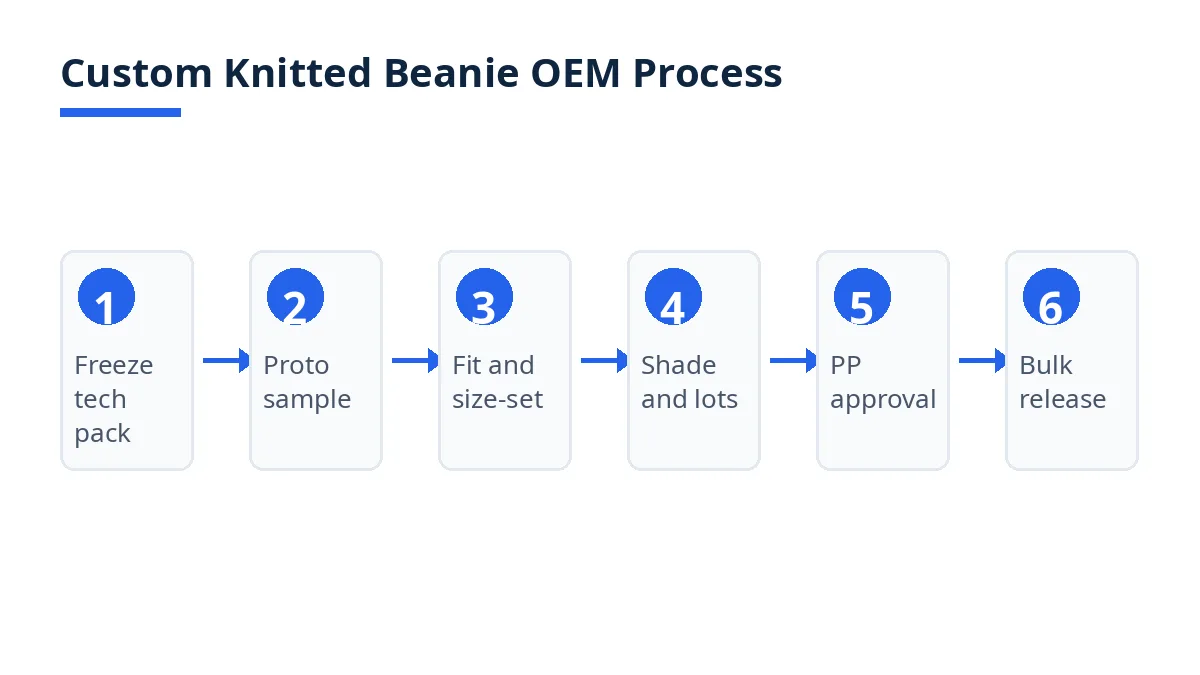
Under OEM, you supply the design and specification for a custom knitted beanie and the factory in Bangladesh executes exactly those specifications under your brand. Freeze one versioned tech pack covering gauge, yarn, measurements, construction, trims, labels and packing, work the sampling ladder from proto to pre-production sample, approve yarn lots, shade and label proofs, and release bulk only on a written pre-production approval.
On this page
Key takeaways
Under OEM you arrive with completed designs and the factory executes exactly those specifications under your brand, while under ODM the factory originates the styles and under private label you apply branding to ready-made styles.
A tech pack has nine sections, from cover sheet and flat sketch to measurement chart, bill of materials, construction, labeling, artwork, packing and colorways, and every measurement needs a tolerance and a stated method.
Machine gauge is the total number of needles in one inch of a needle bed, and yarn count and type mainly depend on the gauge, so gauge, machine type and yarn count must be stated together.
The sampling ladder runs proto, fit, size-set, lab dip, pre-production and top-of-production samples, and the pre-production sample in production yarn, gauge, color, trims, labels and packing is the bulk release gate.
Verification on Exportain is a document and photo review, not a factory inspection, and a badge is not a guarantee of production capacity, product quality or delivery.
Working with a custom knitted beanies manufacturer in Bangladesh starts before any yarn is knitted. The beanie that ships is the beanie described in writing: its gauge, yarn, measurements relaxed and stretched, crown closing, cuff, lining and pom-pom where specified, and the labels sewn into it. A photograph cannot carry those decisions, and a factory left to guess will fill the gaps with its own house standard. This guide follows the document trail that prevents that outcome, from the first tech pack version to the written bulk release.
In an original equipment manufacturer (OEM) arrangement, you arrive with completed designs and the factory executes exactly those specifications under your brand, while in an original design manufacturer (ODM) arrangement the factory originates the styles and you select, adjust, brand and buy.1 Private label sits further along the same scale: ready-made styles with branding elements applied and little or no modification.1 Under OEM the tech pack, the corrections and the bulk release are yours. Under ODM or private label, the starting point belongs to the factory, and a second buyer can start from the same base.1 Choose OEM when shape, gauge, yarn and fit must be yours alone, and record the model in the order record.
The gates below run in order. No later gate repairs an earlier gate that was skipped, and a sample approved in the wrong yarn proves nothing about bulk.
What a custom order buys: OEM, ODM and stock, decided up front
A custom order buys decision rights, not only beanies. Before sampling, settle in writing which model applies to this style, who supplies the design, who controls materials and construction, and what happens to the pattern and grading work if the order is not repeated. One knitwear factory guide puts the OEM position plainly: you arrive with completed designs, including tech packs, graded patterns and approved references, and the factory executes exactly those specifications under your brand.1 The same guide notes that OEM carries the longest time to market, through a full development cycle from proto sample to fit sample to pre-production sample, and the highest upfront development cost in sampling rounds and pattern work.1 That cost is the price of ownership. A factory that quotes OEM work without asking for a tech pack, a measurement chart or a yarn specification has not priced your beanie.
The tech pack is the bulk contract
A tech pack is the specification document a factory works from: measurements, materials, construction, labeling and packing.2 One factory-side guide lists nine sections: cover sheet, flat sketch, measurement chart, bill of materials, construction detail, labeling, artwork, packing and colorways.2 Adapt each section to the knitted piece. The flat sketch shows the beanie front and back, the cuff folded and unfolded, the crown closing, and any lining, pom-pom, patch or embroidery placement. The measurement chart gives every point of measure with its tolerance and method: relaxed or stretched, cuff folded or unfolded, and how the stretch is applied. The bill of materials lists every input, not only the body yarn: cuff yarn where it differs, lining, pom-pom, thread, woven label, care label, hang tag, polybag and carton.
The same guide states a rule worth adopting: if a section cannot be measured, checked or photographed, it does not belong in the document.2 "Soft hand feel" is a mood. "Yarn count, fiber composition, gauge, finished weight and washed measurements" is a specification. Give a tolerance for every measurement, set per point for circumference, height and cuff depth. Without stated tolerances, there is no basis to reject a batch and no basis for the factory to know what close enough means.2 Number every version. A tech pack without a version number lets a factory build to an older iteration without either party knowing.
Gauge, yarn and construction decisions a knitter needs in writing
Gauge decides what a beanie can be. Machine gauge is defined as the total number of needles present in one inch of a needle bed, represented by G or E.3 Knitwear is normally produced on 2.5- to 14-gauge machines, with traditional knitwear more likely in the 7- to 12-gauge range.3 The selection of yarn count and type for knitting mainly depends on the gauge of the machine.3 A finer gauge gives smaller loops and finer fabric, a coarser gauge gives larger loops and bulkier fabric, and yarn too thick for the gauge causes breakage while yarn too thin gives an unstable fabric.3 State the gauge in the same unit the factory uses, with the machine type, circular or flat-bed.
Name the fiber composition and percentages, yarn count, number of ends, and whether the yarn is stocked, dyed to order or bought for this order. Name the color standard for each color, and state whether body, cuff and pom-pom are matched together or separately. A second yarn lot can differ in shade, so record the lot position and the approval a lot change requires. State the knit structure, cuff construction and depth, crown closing method, lining attachment and pom-pom attachment in the same section.
The sampling ladder for custom knitted beanies
Sampling is a ladder, and each rung answers one question. Do not let one sample answer two questions, and do not approve bulk on a sample that answered the wrong one.
Proto sample. Proves construction: knit structure, cuff behavior, crown closing, lining placement and pom-pom attachment. It may use substitute yarn, and proves nothing about shade or washed size.
Fit sample. Proves measurements on the base size against the chart, relaxed and stretched, with the cuff folded as it will be worn.
Size-set sample. Proves grading across every size, measured the same way as the fit sample. A crown or cuff that holds at base size can pull or slip at the largest size.
Lab dip and shade approval. Proves color against the standard for body, cuff and pom-pom together, under more than one light, cuff folded. The factory guide cited above notes that two rounds are normal for difficult shades and advises retaining the approved dye recipe so repeat orders match.2
Pre-production sample. Made in the production yarn, gauge, color, lining, trims, labels and packing. Measure it, wash it through the process the end user will use, check shade, cuff recovery, crown shape and pom-pom attachment after washing, and check every label word for word. This sample is the bulk release gate.
Top-of-production sample. Taken from the bulk run and compared side by side with the sealed pre-production sample, not from memory.
Fit approvals: relaxed, stretched and washed measurements
A beanie has few measurements and almost every one of them is stretched in use. The measurement chart must state the condition for every point: relaxed, under a controlled stretch, or after washing, with the cuff folded or unfolded and the method of applying the stretch written down. Measure circumference relaxed and stretched and record both figures. Measure height uncuffed and cuff depth separately, and state the fold line position for cuffed styles. A cap that measures correctly flat on a table can still sit too tight, ride up, or lose its cuff fold after washing, and size problems found after bulk knitting cannot be corrected, because the yarn is already knitted.
Wash the fit and pre-production samples before approval, checking shrinkage, colorfastness, pilling, cuff recovery, crown shape worn as well as flat, and lining behavior in the worn position. Agree the wash method and the number of washes in the tech pack, record the washed measurements against the chart, and require a new approval if the washed result fails.
Lot, shade and trim approvals before bulk knitting starts
Bulk knitting starts only after three approvals sit in the order record: yarn lot, shade standard and trim set. Approve the yarn and dye lots as lots, not as catalog descriptions. Name the fiber composition, yarn count, color standard and lot for each color, and require a new approval if any lot changes. Judge shade across body, cuff and pom-pom under daylight and a second light, cuff folded, because a cuff folds layers of the same yarn over each other and a small shade difference becomes visible in the stack. A shade approval under office lighting alone is not an approval.
List every trim and label in the bill of materials: pom-pom, woven label, care label, size label, hang tag, lining and packing, each with its specification and approval. In the European Union, a textile product shall be labeled or marked with the name and percentage by weight of all constituent fibers in descending order.4 Check the fiber percentages against the yarn ordered, approve each label proof word for word, and confirm care, origin and fiber rules for every destination market before the label run. Certificate scope needs the same care. The OEKO-TEX STANDARD 100 certificate and label are only awarded if all components of an item meet the required criteria without exception, and a product may not carry the label if only individual components meet the requirements.5 A beanie whose surface comes into direct contact with the skin sits in Product Class II, and a STANDARD 100 certificate is valid for 12 months and can be renewed annually.5 Check the certificate number, class, articles covered and expiry date.
Bulk release: the written gate, change control and inspection
Bulk release is a written approval, not a message saying to proceed. Release bulk only when the pre-production sample is approved in writing, the yarn and dye lots match the approved lots, the shade standard and label proofs are approved, and the inspection standard is agreed in the purchase order. Any change after pre-production approval needs a new tech pack version and a new sample where it affects fit, yarn, gauge, shade, construction, trims or labels. A new yarn lot, a new dye lot, a new pom-pom supplier or a new label wording is a change, even if the style number stays the same. Record every change in a new quotation version. On Exportain, every quotation is versioned and states unit price, MOQ, lead time, Incoterm, payment terms and validity.6
Agree the inspection standard before production. ISO 2859-1:2026 provides sampling schemes indexed by acceptance quality limit (AQL) for lot-by-lot inspection, and AQL stands for acceptance quality limit, the maximum average percentage of defective items considered acceptable during random sampling.7 Name the AQL values, the inspection level and the defect classifications in the purchase order, and add beanie-level checks for cuff recovery, crown shape, shade, pom-pom attachment, lining placement, label accuracy and packing. Inspect against the sealed pre-production sample, the measurement chart and the approved lots, and inspect finished, packed goods across cartons. The knitted beanies quality control checklist sets out the same relaxed and stretched measurement method and the cuff, crown, shade, pom-pom, lining, label and packing checks in checklist form.
Heading 6505 covers hats and other headgear, knitted or crocheted, or made up from lace, felt or other textile fabric, in the piece, whether or not lined or trimmed, with hair-nets of any material.8 Treat that heading as indicative until the broker confirms the full code for the destination tariff. For export clearance in Bangladesh, goods shall not be loaded unless an export declaration, known as the Bill of Export or Shipping Bill, is submitted to Customs in the prescribed format and approved, with enclosed documents including the export letter of credit or export contract or purchase order, the commercial invoice, the packing list, the EXP form, the certificate of origin, the VAT registration certificate and the taxpayer identification number.9
Reading the quotation by gate: cost lines and time lines
Read a custom beanie quotation as lines tied to gates, not as a single unit price. Ask for the price split by yarn and dyeing, knitting, lining and pom-pom, trims and labels, sampling and set-up, testing, inspection, packing, and inland transport and port handling, each with its quantity basis and delivery term. The Incoterms 2020 rules give 11 rules with a clear allocation of cost, risk and obligations, used globally since 1936 and updated in 2020.10 State one delivery term with its named place on every quotation, because quotations on different terms are not comparable on price alone. The MOQ is counted per order, per style or per color as the supplier states, and a supplier can combine a quantity minimum with a minimum order value.11 Ask how the minimum is counted before planning the color and size mix.
Example figures show structure only. Every amount below is an example figure, not a market price. Example figures: one custom beanie style in one color shows yarn and dyeing 44 units, knitting 24 units, lining and pom-pom 9 units, trims, labels and packing 11 units, sampling, testing and set-up 7 units, and inland transport and port handling 5 units, for an example total of 100 units. If the yarn line rises by 10 units, the example total rises to 110 units. If a second color is added, the dye lot, trim run and label run lines move with it, even when the knitting line barely changes. Compare quotations only on the same specification, counting basis, delivery term and packing.
Ask for a date for each gate, not one delivery date. Yarn and dye readiness and correction rounds usually decide the timeline, because a color cannot be knitted until its lot is ready. The factory guide cited above gives a realistic sampling rhythm: a well-built tech pack usually reaches approval in two sample rounds, while a weak one runs to four or five, with each round adding roughly two weeks plus sample cost.2 Treat that as a planning warning, not as a promise about any single order.
Where custom knitted beanies orders go wrong
Approving a sample in substitute yarn. A proto proves construction only. The pre-production sample must be in the production yarn, gauge and color, with production trims and labels, and the lot numbers must match the bulk lots.
Writing gauge without a machine type. Gauge is needles per inch on a needle bed.3 Without the machine type and the yarn count range that machine knits, two factories can read the same number differently.
Measuring in one condition only. A beanie approved relaxed and never stretched, or stretched and never washed, has not been approved in its worn state. Record relaxed, stretched and washed figures.
Accepting shade under one light. Body, cuff and pom-pom must match under daylight and a second light, cuff folded. A lot that matches under one light and differs under another must be held, not blended into bulk.
Treating a trim change as no change. A new pom-pom, label or lining needs a new tech pack version, a new trim approval and, where it affects fit or appearance, a new sample.
Treating a badge as proof of knitting capability. Verification on Exportain is a document review by its team, not a factory inspection, and not a check against any government database.12 A badge is not a guarantee of production capacity, product quality or delivery.12 The Bangladesh Knitwear Manufacturers and Exporters Association (BKMEA), established in 1996, represents approximately 2,540 knitwear member factories as an apex trade body for the knitwear sector.13 Membership says nothing about beanie capability on its own, so confirm any membership claim with the association.
Comparing quotations on different terms. The Incoterms rules allocate cost, risk and obligations differently under each rule.10 A lower unit price on a different delivery term, counting basis or packing is a different offer, not a cheaper one.
Tech-pack checklist before you release bulk
Before bulk release, every line below should be answered in writing, with version numbers that match the order record.
Tech pack frozen at a numbered version, with cover sheet, flat sketches, measurement chart, bill of materials, construction detail, labeling, artwork, packing and colorways.2
Model stated: OEM, ODM or private label, with design and pattern ownership in writing.1
Gauge and machine type stated, with fiber composition, yarn count, ends, color standards and lot position for each color.3
Cuff, crown closing, lining and pom-pom specified, with attachment checks on the washed sample.
Fit, size-set and pre-production samples approved in writing, measured relaxed, stretched and washed.
Lab dip and shade approved across body, cuff and pom-pom under more than one light, cuff folded.
Label proofs approved word for word, with fiber percentages in descending order for the European Union and care, origin and fiber rules confirmed for each market.4
Certificate scope checked with the issuer, including STANDARD 100 class, articles covered and expiry date.5
MOQ counting basis confirmed in writing: per order, per style, per color, or combined with a minimum order value.11
Quotation versioned, with cost lines, delivery term and named place, payment terms and validity.6
Inspection standard agreed: AQL values, level, defect classifications and beanie-level checks in the purchase order.7
Classification treated as indicative, with the full destination code confirmed before filing.8
Export document set agreed, including Bill of Export enclosures and which documents sit inside the quoted price.9
Change control agreed: any post-approval change needs a new tech pack version and a new sample where it affects the specification.
What should I know first about a custom knitted beanie order?
Know that the order is decided in the tech pack, not at the knitting machine. Under OEM, you supply the design and specification and the factory executes exactly those specifications under your brand.1 Freeze one versioned tech pack covering gauge, yarn, measurements, construction, trims, labels and packing, then work the sampling ladder in order and release bulk only on a written pre-production approval in the production yarn and color.
What are the typical costs and timelines for a custom beanie order?
There is no single typical cost or timeline for a custom beanie order. Cost follows the yarn and dye lot, gauge, style, color count, size split, lining, pom-pom, labels and packing, and the MOQ counting basis.11 Time follows the gates, from tech pack freeze to shipment readiness. Ask for a date and a cost line for each gate, and compare quotations only on the same specification, counting basis, delivery term and packing.
Which documents are needed for a custom beanie order?
Keep three sets in one order record under one legal name for each party. The order set holds the versioned tech pack, quotation versions, purchase order and sample approvals. The product set holds the measurement chart, shade standard, label proofs, lot approvals and certificate evidence.5 The shipment set holds the commercial invoice, packing list, transport document, EXP form, certificate of origin and the Bill of Export with its enclosed documents.9 Name each style and color plainly on its own invoice line, with fiber content, gauge, measurements, quantities, unit prices and the delivery term.
What are the most common mistakes in a custom beanie order?
The most common mistakes are approving a sample in substitute yarn, writing gauge without a machine type, measuring in one condition only, accepting shade under one light, treating a trim change as no change, treating a badge as proof of knitting capability, and comparing quotations on different delivery terms. Each one is listed above with its fix. The fix in every case is the same discipline: one versioned document, one sample per question, and a written approval before bulk.
Next steps on Exportain
Browse suppliers on Exportain, filter by badge, sample availability and OEM or ODM capability, and send every candidate the identical versioned tech pack. Read how supplier verification works before you shortlist, so a badge is read for what it covers and nothing more, and see how to buy for the eight steps from catalogue search to shipment. When the tech pack is frozen, post a free RFQ on Exportain and get quotes from Bangladeshi suppliers on the same specification, counting basis and delivery term.
Post a free RFQ on Exportain and get quotes from Bangladeshi suppliers → https://exportain.com/rfqs
Sources
- OEM vs ODM vs Private Label: Choosing Your Manufacturing Model. China Knitwear, (accessed )
- Tech Pack for Clothing | Trusted Ultimate 9-Section Guide 2026. A&J International Apparel, (accessed )
- Machine Gauge - an overview. ScienceDirect (accessed )
- Regulation (EU) No 1007/2011 on textile fibre names and related labelling and marking of the fibre composition of textile products. European Union, (accessed )
- OEKO-TEX STANDARD 100 for textiles tested for harmful substances. Hohenstein (accessed )
- How to source and buy from Bangladesh. Exportain (accessed )
- ISO 2859-1:2026 - Sampling procedures for inspection by attributes — Part 1: Sampling schemes indexed by acceptance quality limit (AQL) for lot-by-lot inspection. ISO (accessed )
- HS, 2017 - Code 6505 Classification Detail. United Nations Statistics Division (accessed )
- Customs Clearance Procedures for Export. Bangladesh Customs, National Board of Revenue (accessed )
- Incoterms® 2020. International Chamber of Commerce (ICC) (accessed )
- MOQ Meaning (Minimum Order Quantity). Exportain (accessed )
- Trust & Safety Center. Exportain (accessed )
- BKMEA at a Glance. BKMEA (accessed )
About the author
Sourcing from Bangladesh?
Post a request for quotation and suppliers on Exportain can send you their quotes directly.
Post an RFQ