

Custom Knit Dresses Manufacturer in Bangladesh: OEM Process From Tech Pack to Bulk
A stage-by-stage OEM guide to custom knit dresses from Bangladesh: silhouette and drape-knit development, print and embellishment approval, size-curve try-on, bulk production and inspection, with costs, timelines and documents.
Short answer
A custom knit dress OEM order in Bangladesh runs in stages: you send a dress tech pack with the silhouette and drape intent, the factory proves the drape-knit hung and washed, develops the silhouette, print and embellishment and the size curve, and you approve a pre-production sample in bulk materials before bulk production, inspection and shipment.
On this page
Key takeaways
A custom knit dress order closes four development gates in order, drape-knit, silhouette, print and embellishment, and size curve, each ending in a written approval before bulk cutting starts.
Judge the drape-knit as a full-length hanging sample, washed and hung again, because hem fall, wash twist and edge behaviour decide a dress and a flat swatch shows none of the three.
Sign print as a strike-off on the bulk knit at full placement and embellishment after washing, since a repeat can crowd at the waist or break at a seam and added weight can drag a stretch knit.
Sign the size curve from a try-on set that spans the range, because bust, waist, hip and length grades compound and a silhouette that holds at a middle size can fail at the end sizes.
Platform verification is a document and photo review, not a factory inspection, so drape, silhouette, surface and size-curve approvals and lot inspection stay with the buyer.
A knit dress exposes faults a shorter knit garment can hide: the hem swings with every step, a print repeat has a full body length to drift across, and a grade that works at a middle size can fail at the smallest and largest sizes. This guide therefore treats a custom knit dress order as four development gates, each closed by a written sign-off: the drape-knit gate, the silhouette gate, the surface gate for print and embellishment, and the size-curve gate. Bulk cutting starts only after all four gates, plus a pre-production sample in bulk materials, are approved.
BKMEA, the knitwear association, counts roughly 2,540 member factories,1 and Export Promotion Bureau figures put knitwear exports at $5,963.76 million for July to September 2026, up 6.88 percent year on year.2 Depth of supply is not evidence that one factory can hold your silhouette in your knit; the gates below test that, factory by factory, before the order is locked.
Why this matters for buyers and sellers
For a buyer, the cost of a knit dress fault depends on when it surfaces. A hem that twists after washing, a motif that crowds at the waist, or a bodice that binds at the largest size is a small correction at sample stage and a rejected lot at final inspection.
For a seller, the same gates turn an open-ended dress brief into a sequence the factory can plan around. Knitting, dyeing, print, embellishment and sewing lines each need booked time, and a gate approval signals one block finished and the next ready to start. Late changes then carry a clear price, because they reopen a closed gate.
What should I know first about knit dresses?
Start with the code and fibre mix, not the style name. Heading 6104 covers women's or girls' dresses and related garments, knitted or crocheted, and the cotton dress line is 610442.3 The code follows the fibre, so a blend change between sample and bulk knit can move the line. For European Union sales, Regulation (EU) No 1007/2011 requires the name and percentage by weight of every constituent fibre, in descending order.4 Settle both points before artwork and labels are fixed, because a label correction after production is a relabelling job.
Then match the knit to the job the dress has to do. Single jersey is light and soft with stretch, but its edges curl and it can twist after washing, while double knits, made with two sets of needles, lie flat and feel thicker and more stable.5 Ponte, a firm double knit with a smooth face, keeps a tailored shape, and rib contracts across its width with strong widthwise stretch and recovery, suiting neckbands, cuffs, waistbands and close-fitting panels.5
What the dress must do | Knit behaviour that delivers it | Proof to ask for on the sample |
|---|---|---|
Fall softly from shoulder to hem | A fluid jersey that moves with the body | Full-length hang, wash, hang again |
Keep a clean, tailored line | A firm double knit that resists sagging | Shape after wear and washing |
Fit close through the bodice | A knit with elastane and strong recovery | Neckline hold after stretching |
Carry a textured, casual surface | A pique or jacquard with visible structure | Pattern scale at dress length |
Step-by-step: how it works
The eight stages below follow the gate order: pack, drape-knit, silhouette, surface, size curve, pre-production, bulk, inspection and shipment.
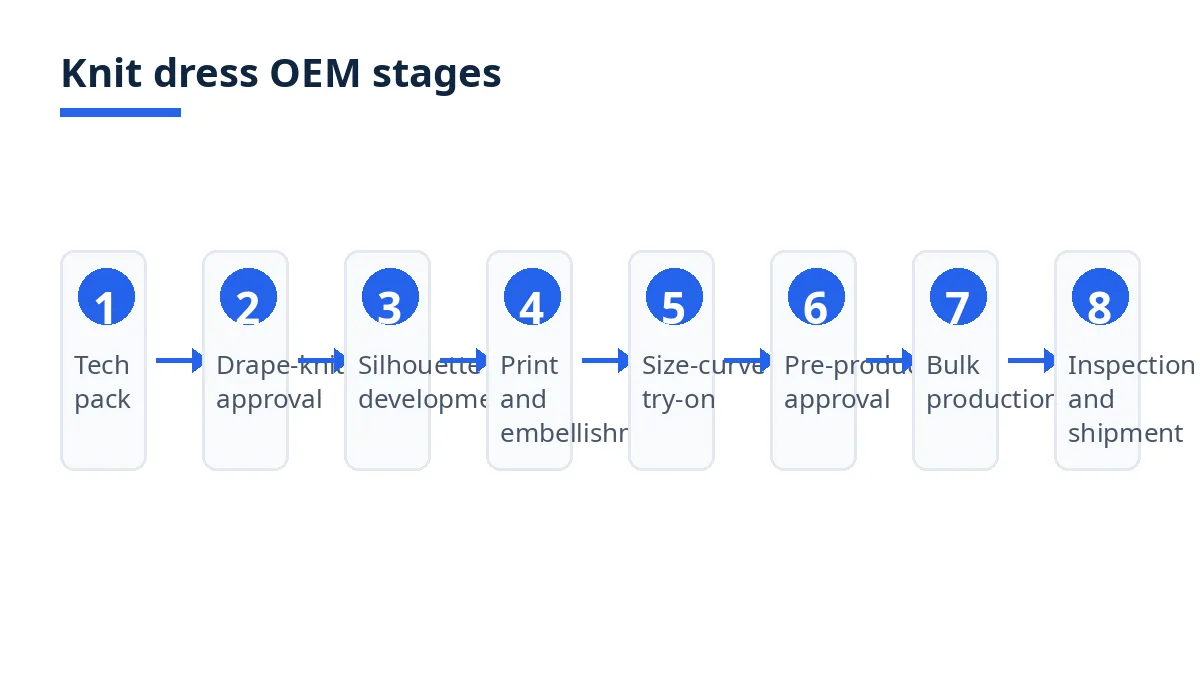
One pack to every candidate, with nothing left to guess. Give each factory the same silhouette sketch, drape intent, knit construction and weight, fibre mix, neckline, sleeve and hem treatment, length per size, size chart covering bust, waist and hip, print or embellishment method and placement, label text, packing method and delivery term.
Close the drape-knit gate on a hanging length, never on a flat swatch. Ask for a length of the proposed knit cut to dress length, hung on a form and photographed from front, side and back, then washed and hung again. Record construction, weight and fibre mix, and for each colour whether the knit is stocked or dyed to order. A flat swatch cannot show hem fall, wash twist or edge behaviour, and those three decide a dress.
Close the silhouette gate on a form, across the full length. The factory cuts a proto sample from the pattern in an available knit to test shape and proportion. Check shoulder line, bust and waist placement, flare or taper from waist to hem, sleeve set and hem level on the form, and measure the sample against the size chart. Send corrections back in writing with measurements. A proto sign-off covers shape and construction only.
Close the surface gate on the dress itself, at full placement. A motif that repeats cleanly on a flat panel can crowd at the waist or break across a seam, and an all-over print needs checking where its repeat lands at the hem and armhole. Embellishment adds weight to a stretch knit, so test whether beads, sequins or applique drag the neckline or hem, and how they come through washing. Sign a strike-off on bulk knit, in the bulk colour, at the exact placement.
Close the size-curve gate with a try-on set, not a graded chart alone. Grading a dress shifts bust, waist, hip and length together, so a grade that holds at a middle size can drift at the ends of the range. Ask for a try-on set spanning the range, measured and tried on, with corrections logged size by size. Approve the curve only when the end sizes still hold the silhouette.
Close the pre-production gate in bulk materials, in writing. The pre-production sample uses the bulk knit, colour, print or embellishment, trims and labels, at the approved silhouette and grade. Wash, wear and measure it, and check the labels against the agreed text. This sample is the reference bulk is judged against, so keep one sealed sample, attach the written approval with photographs to the purchase order, and allow no bulk cutting before that approval exists.
Run bulk in factory order, with reports at each handover. Bulk moves through knitting and dyeing where applicable, print and embellishment work, cutting by marker, sewing, finishing and packing. Ask for reports at fabric-ready, print-complete, cutting-complete and sewing-complete points, by colour and size, so a delay in one stage is visible early.
Inspect twice, then ship on one agreed term. Agree an inline inspection part-way through sewing, while a silhouette, print-placement or measurement fault can still be corrected on unsewn pieces. ISO 2859-1 sets out acceptance sampling plans for inspection by attributes, indexed by acceptance quality limit (AQL) for lot-by-lot inspection,6 and the AQL is the maximum average percentage of defective items treated as acceptable during random sampling.6 Put the inspection level, AQL values and defect classes for silhouette, drape, print placement, embellishment, measurements and labels into the purchase order before production starts, and check the finished lot against the sealed sample at final inspection. Quotations only compare when they share a delivery term and named place; Incoterms 2020 supplies 11 rules for splitting cost, risk and obligations.7
Costs, timelines and documents
What are the typical costs and timelines?
No guide can state typical costs or timelines as fact, because each factory prices your knit, silhouette complexity, print or embellishment work, dye lots, packing and delivery term for your specification.7 What you can fix is the structure of the quote. Ask for development lines, meaning silhouette and pattern work, print screens, embellishment set-up and sampling charges, apart from the unit price, and for the split by colour and size, since that split drives dye and cutting cost.
For timelines, ask for dated lines rather than one delivery week: tech-pack confirmation, each gate approval, fabric ready, bulk, inspection and shipment. One week hides which gate is late, and the late gate decides what can still be fixed.
Example figures: a silhouette proto round of 14 days, a print strike-off round of 6 days and a pre-production round of 9 days add to 29 days (14 + 6 + 9 = 29) before bulk production. Example figures: set-up lines of 240 dollars for silhouette and pattern work and 160 dollars for print screens add to 400 dollars (240 + 160 = 400). Over an order of 2,000 dresses, the example figures give 0.20 dollars per dress (400 divided by 2,000 = 0.20). These are example figures only, not a market price.
Which documents are needed?
Keep two bundles on the order thread. The first proves what was agreed: the tech pack, itemised quotation, purchase order carrying the split by style, colour and size, written gate approvals with photographs, and the inspection plan with AQL values6 plus inspection reports. The second proves the shipment: the Bill of Export with the commercial invoice, packing list, EXP form certified by an authorised dealer, and certificate of origin issued by the EPB or a Chamber of Commerce and Industry, with goods loaded only after the export declaration is submitted to Customs and approved.8
Bangladesh-specific rules and tips
Check association claims with the association. A supplier claiming BKMEA membership should be checked with BKMEA itself. Membership shows an active knitwear business,1 not whether that factory can hold your silhouette, run your print or grade your size curve.
Lock the fibre split before artwork locks. The dress line under heading 6104 divides by fibre, with cotton dresses under 610442,3 and the European Union fibre rule requires fibre names and percentages in descending order.4 Confirm the split against the bulk knit, not the proto knit, since a blend change between the two changes both code and label.
Map which stages leave the factory. A factory that knits and dyes in-house controls its fabric dates, while print, embellishment or dyeing sent elsewhere follows that workshop's calendar. Ask which stages are in-house, because a stage report only helps when it covers the stage that can slip.
Use one legal name on every paper. The export declaration names the exporter and foreign buyer,8 so align the trade licence, quotation, proforma invoice and payment account on one legal name before shipment is booked.
Mistakes and red flags
What are the most common mistakes?
Judging drape from a flat swatch. A swatch cannot show hem fall, wash twist or edge behaviour. Judge the knit hung at full length, washed, then hung again.
Signing the silhouette at one size only. A shape holding at a middle size can fail at the ends of the range. Sign the try-on set across the curve before bulk.
Signing print from artwork, or embellishment before washing. Artwork cannot show how a repeat falls at the waist, hem or armhole, and unwashed embellishment cannot show whether it pulls the knit. Sign both on bulk knit, washed, at full placement.
Changing shape or surface once bulk is running. If a change cannot be avoided, stop the affected stage, record it in writing, and agree a fresh pre-production sample for the changed part first.
Shortlisting on price alone. A cheaper reply that quietly swaps the knit, drops the surface method or moves the delivery term has not beaten the other quotes; it has answered a different brief.7 Freeze the pack, the term and the named place first, and only then rank on price.
Reading a badge as dress capability. A badge records checks already done; it does not approve your silhouette, drape, print or size curve. Platform verification is a document and photo review, not a factory inspection,9 so gate approvals and inspection remain the buyer's work.
Checklist
One identical pack to every candidate: silhouette sketch, drape intent, knit, sizes, surface work, labels, packing.
Colour and size split on the quotation.
Hanging, washed drape-knit sign-off per colour, with stocked or dyed-to-order status noted.5
Silhouette proto measured on a form, corrected in writing, length and flare confirmed.
Print strike-off and embellishment sample signed on bulk knit, washed, at full placement.
Size curve signed from a try-on set spanning the range, corrections logged per size.
Pre-production sample in bulk knit, colour, surface work, trims and labels, washed, measured, signed, photographs attached, one sealed sample kept.
Quote split into development lines and unit price.7
Inspection level and AQL values in the purchase order, with defect classes for silhouette, drape, print placement, embellishment, measurements and labels.6
Stage reports agreed at fabric-ready, print-complete, cutting-complete and sewing-complete points, by colour and size, plus inline inspection part-way through sewing.
Final inspection passed against the sealed sample before release for loading.6
Shipment papers agreed, one legal name across trade licence, quotation, proforma invoice and payment account.8
How Exportain helps
Put one pack summary, covering silhouette, drape direction, surface needs, size curve and delivery term, out through the RFQ board, and look for candidates among suppliers. Ask each reply to show sampling charges and set-up lines apart from the unit price. Treat badges as a record of document and photo checks only: platform verification is not a factory inspection, and a badge guarantees neither capacity, quality nor delivery.9 10 The supplier verification explainer and the knit dresses MOQ guide explain both points before you confirm.
FAQs
What should I know first about knit dresses?
Know the silhouette, drape-knit and classification before the tech pack is written. Heading 6104 covers women's or girls' dresses, knitted or crocheted, with cotton dresses under 610442,3 and European Union sales require fibre names and percentages in descending order.4 Then fix the knit to the silhouette with a hanging, washed sample.
What are the typical costs and timelines?
No typical figures can be relied on, because each factory sets price and lead time for your knit, silhouette complexity, surface work, dye lots, packing and delivery term.7 Ask for development lines apart from the unit price, and separate dates for each gate, fabric readiness, bulk, inspection and shipment.
Which documents are needed?
The agreement bundle is the tech pack, itemised quotation and purchase order, written gate approvals with photographs, and the inspection plan with its reports. The shipment bundle is the Bill of Export, commercial invoice, packing list, EXP form certified by an authorised dealer, and a certificate of origin from the EPB or a Chamber.8
What are the most common mistakes?
The most common mistakes are judging drape from a flat swatch, signing the silhouette at one size only, signing print from artwork or embellishment before washing, changing shape or surface mid-bulk, ranking quotations built on different packs or terms,7 and reading a badge as proof of silhouette, print or size-curve capability.9
Next steps on Exportain
Look for candidates on the supplier pages, then send the pack summary out through the request for quotation board and ask each respondent to quote gate by gate.
Sources
- BKMEA at a Glance. BKMEA (accessed )
- RMG exports rise 6.10pc to US$10.58b in July-Sept of FY27. The Financial Express, (accessed )
- Classification Detail — HS Code 610442. United Nations Statistics Division (accessed )
- Regulation (EU) No 1007/2011 on textile fibre names and related labelling and marking of the fibre composition of textile products. European Union, (accessed )
- Different Types of Knit Fabrics: Weft and Warp Knits Explained. TextileNotes, (accessed )
- ISO 2859-1:2026 - Sampling procedures for inspection by attributes — Part 1: Sampling schemes indexed by acceptance quality limit (AQL) for lot-by-lot inspection. ISO (accessed )
- Incoterms® 2020. International Chamber of Commerce (ICC) (accessed )
- Customs Clearance Procedures for Export. Bangladesh Customs, National Board of Revenue (accessed )
- Trust & Safety Center. Exportain (accessed )
- Supplier verification: Earn trust badges buyers can see. Exportain (accessed )
About the author
Sourcing from Bangladesh?
Post a request for quotation and suppliers on Exportain can send you their quotes directly.
Post an RFQ


