Typical MOQ for Knit Dresses in Bangladesh (and How to Negotiate It Down)
No single knit dresses MOQ in Bangladesh: how drape-knit dye lots, print and embellishment minimums, size curves and silhouette changes set the minimum, and how to negotiate a smaller order.
Short answer
There is no single typical MOQ for knit dresses from Bangladesh. Each factory sets its minimum per colour, per design and per silhouette for your specification, driven by drape-knit dye lots, print and embellishment set-up, three-measurement size grading and pattern work. Ask for the minimums layer by layer in writing, then negotiate the structure: fewer colours, one cloth shared across silhouettes, and set-up paid as a separate line.
On this page
Key takeaways
There is no single typical MOQ for knit dresses from Bangladesh, because each factory sets its minimum per colour, per design and per silhouette for your specification.
Drape-knit dye lots set the first floor: a long dress yields fewer pieces per lot than a short garment, and shade must hold along the full dress length.
Print repeats, embellishment set-up, three-measurement size grading and silhouette pattern work each add their own minimum on top of the cloth lot.
Ask for the minimums layer by layer in writing, and name the binding layer for your split before you confirm. Exportain verification is a document and photo review, not a factory inspection, and a badge is not a guarantee.
Negotiate the structure first: fewer colours, one cloth shared across silhouettes, phased lengths and edge sizes, stocked cloth, and set-up paid as a separate line.
A knit dress asks a factory to commit cloth before it commits machines. One colour choice locks a dyed lot, one artwork choice locks a print length, and one shape choice locks a pattern set. The order moves only as far as the tightest of those three commitments allows, so a buyer who starts from the total quantity starts from the wrong number. Find which commitment binds, and the negotiation follows from it.
Dress cloth is chosen for how it falls. Viscose blends, modal blends and fine cotton jerseys drape rather than hold a rigid shape, and that drape makes the minimum awkward: a dress needs a long, uninterrupted length, shade must stay even from shoulder to hem, and one lot yields fewer dresses than the same lot would of a short garment. A colour dyed for your order carries the whole lot, while a stocked colour may run much smaller. Put blend, construction, weight, drape and stocked-or-dyed status per colour in the enquiry, with shade checked along a full length rather than on a swatch.
Scale gives context, not a shared figure. Export Promotion Bureau data reported for July to September 2026 put knitwear exports at $5.963 billion, up 6.88 percent year on year, inside $10.578 billion of ready-made garment exports,1 and the Bangladesh Knitwear Manufacturers and Exporters Association (BKMEA), founded in 1996, counts about 2,540 member factories.2 Each factory still sets its own floor for a given dress.
The dye lot comes first
Think of the dye lot as the first gate your order must pass. When a colour is dyed to order, the vessel fixes the batch size, and your dress quantity in that colour must clear it on its own, whatever the order total says. A long dress sharpens the effect because each piece draws more cloth. The question for every colour is narrow: stocked or dyed, and how many dresses does the lot actually yield.
Print and embellishment add their own floors
An all-over print turns the minimum into a cloth-length problem: the artwork repeats along the fabric, and the run must cover the repeat plus set-up waste before cutting begins, so a short order in an all-over print can fail on cloth even when the garment count looks adequate. A placement print needs a screen per artwork colour, with the motif landing in the same place on every size. Beading, sequins, lace insertion and embroidery add a third floor, because the design must be digitised and sampled for that placement at the same cost for a short run as a long one. Ask whether each minimum is counted in metres or dresses.
Why the size curve bites harder on a dress
A dress size is graded on bust, waist and hip together, so one size step moves three measurements at once. Demand usually piles into the middle sizes and thins toward the ends, and an end size with only a handful of pieces can fall below the cutting line even when the colour total looks healthy, because laying a marker for a few long pieces wastes cloth. Lengths multiply the problem: a mini, a midi and a maxi version of one dress are three marker sets, and each length needs its own quantity to justify its marker. State the range, ratio per colour and quantity per size, treating every length as a separate style.
A new silhouette is a new pattern bill
Changing the shape of a dress is pattern work, not a cloth decision. Moving from an A-line skirt to a fit-and-flare skirt, changing a sleeve or altering a neckline each creates a new pattern, new grading, a new marker and a new sample, even when the cloth and colour stay identical. Two shapes in one order therefore carry two pattern minimums, and a shape added after the quotation arrives as a second bill of pattern work. Settle the silhouette set first, and ask in writing whether two shapes in one cloth and colour can share the dye lot while keeping separate pattern minimums.
Dress decision | What it commits you to | Detail that prevents a surprise |
|---|---|---|
Colour and cloth | One dye lot per colour, fewer dresses per lot on a long garment | Blend, weight, drape, stocked or dyed, full-length shade |
All-over or placement print | A print length, or a screen per artwork colour | Method, repeat, colours, placement on each size |
Beading, sequins, lace or embroidery | Digitising and sampling for one placement | Motif, placement, density, spans two shapes? |
Size curve and lengths | A marker per size set and per length | Range, ratio, quantity per size, lengths separate |
Silhouette set | A pattern, grading and marker per shape | Shape, sleeve, neckline, lengths fixed first |
Example figures: a dye lot yielding 400 mini dresses yields only about 260 maxi dresses from the same cloth length, so length alone can move a colour below its floor. For the size curve, Example figures: 500 dresses in one colour across five sizes on a ratio of 1-2-4-2-1 give ten parts of 50, so end sizes sit at 50 while the middle size sits at 200. These example figures show structure only, not a typical MOQ, price or lead time.
Ways to bring a dress minimum down
A factory moves when the commitment behind the number shrinks, not when the number itself is argued down. Put every change on the quotation and purchase order, tied to its split.
Drop a colour, not the order. Each colour removed raises the quantity behind every remaining dye lot, print placement and trim lot at the same total.
Let one colour serve two shapes. When two dress shapes use the same drape knit in the same colour, the cloth behind them can be dyed as a single lot, even though pattern work stays separate for each shape. The enquiry should therefore ask the factory to confirm, in writing, that the lot floor is assessed on the combined cloth quantity rather than on each shape alone.
Start from the stock list. A standard colour in a stocked drape knit, with stock lace or buttons, removes the dye lot and several small lots at once.
Bill the set-up on its own line. Grading, screens and digitising are fixed costs, so asking for them apart from the piece price lets a short run stand on its own, and the same paid work can be reused on the repeat.
Why this matters for buyers and sellers
For a buyer, a dress minimum is a capital decision measured in long garments: each unsold dress ties up more cloth than an unsold small item, and a first order whose colour or size split falls short cannot test a shape at all.
For a seller, the floor protects work that has no second buyer. Cloth dyed in your colour cannot be recut, a print run in your artwork cannot be reused, and a pattern graded to your shape fits nobody else. That is why the cost per dress climbs as the quantity per colour and per size falls. A buyer who understands that trade can negotiate the structure instead of asking the factory to absorb work it cannot recover.
Step-by-step: how it works
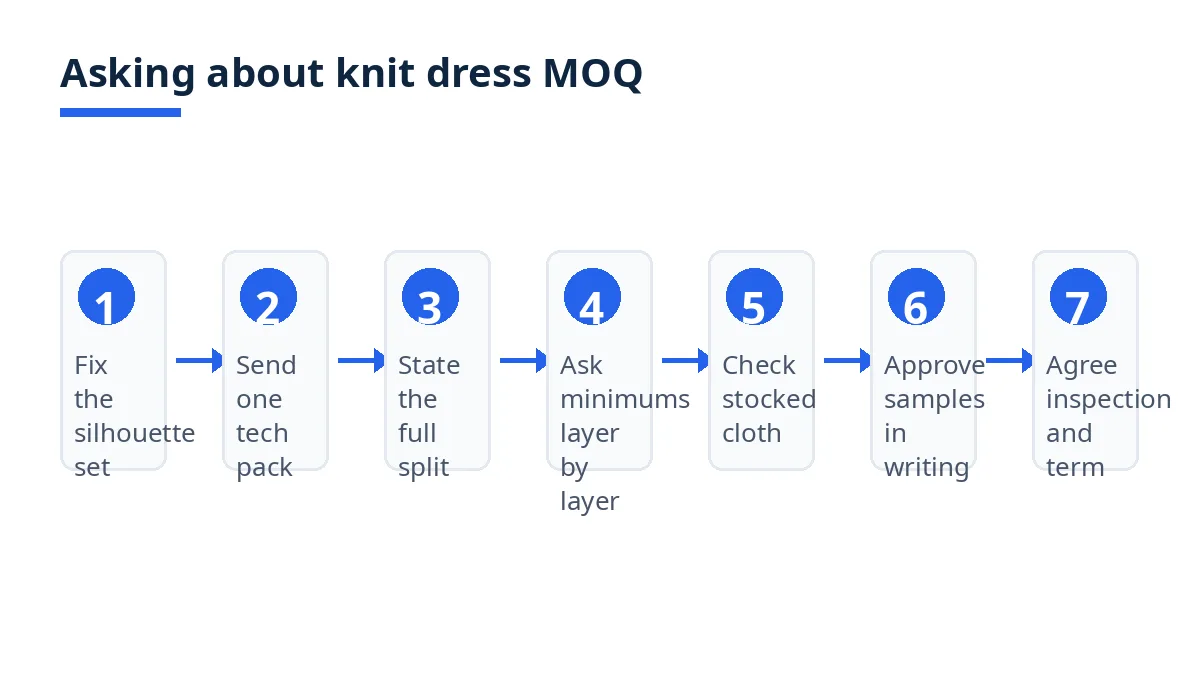
Settle cloth and colour before shapes are finalised. Record blend, construction, weight and drape per colour, stocked or dyed status, and full-length shade checks.
Fix the silhouette set as separate styles. List each shape with sleeve, neckline and length, with a size chart per length.
Send one tech pack to every candidate. Include cloth and drape, silhouette and grading points, print or embellishment method and placement per size, lace and trim specification, labels and packing.
State the full split, not a headline total. Give quantity per silhouette, per colour, per size and per length, with one size ratio per colour.
Ask for the floors layer by layer. Request the dye minimum per colour, the print and embellishment minimum per design, the cutting minimum per silhouette and size, and the separate trim, label, tag and carton minimums, and ask which layer binds.
Approve samples in the real materials. Order a proto sample, then a pre-production sample in the actual cloth, colour, print or embellishment, shape and labels. Measure it, check drape and full-length shade, wash it, then approve or list corrections in writing.
Write the controls into the purchase order. State the inspection level and AQL values, following the attribute-sampling system in ISO 2859-1,3 and name one Incoterm and one named place for every quotation, so quotes stay comparable.4
Costs, timelines and documents
What are the typical costs and timelines?
No guide can state typical dress costs or timelines as fact, because each factory prices your cloth, shape and grading, print or embellishment, trim, label and carton runs, finishing, packing and delivery term.4 Ask for sampling, cloth-ready, production and inspection dates as separate lines.
Which documents are needed?
The order papers are the tech pack, the itemised quotation and the purchase order, each carrying the minimum per colour, per design and per silhouette. For shipment, the usual export file covers the approved Bill of Export with the commercial invoice, packing list, EXP form and certificate of origin.5
Bangladesh-specific rules and tips
Check a BKMEA claim with the association. A supplier may claim BKMEA membership, and the association itself is the place to confirm it. Membership shows a business operates in knitwear,2 and it says nothing about the minimum on offer or capacity for your dress range.
Match the names before the file is built. If the exporter name on the invoice, the bank account and the licence do not line up, the shipment file needs correcting. Check the names while the quotation is still a draft, when a fix costs nothing.5
Ask which inputs arrive from abroad for your dress. Viscose or modal yarns, lace and specialty buttons for a particular specification may be bought in, and an imported input can set both the floor and the earliest cutting date. Settle that question while colours and trims are still open.
Mistakes and red flags
What are the most common mistakes?
A headline total hides the weak line. One colour, one artwork or one end size inside a healthy-looking total can sit under its own floor, and the factory then surcharges that line, drops it or delays the start.
Adding a shape after the quotation. A second silhouette introduced late brings a second pattern, grading and marker set, and can push a feasible order below the cutting line for the new shape.
Comparing minimums across different offers. A smaller minimum on a stocked jersey, a shorter length, stock labels or a different delivery term is a different offer, not a better price for the same dress. Compare replies only on the same tech pack and delivery term.4
Put agreements where production can see them. A spoken yes about a smaller run, a combined lot or a waived charge disappears the moment the conversation scrolls away. Have the concession entered in the quotation and purchase order, tied to its colour-size split, before anything is paid.
Reuse set-up you already own. Grading, screens and digitising bought on the first order belong to your dress, so send the repeat enquiry with those paid lines attached, quoting the first purchase order number, and ask for them to be struck from the new price.
Treating a profile badge as a capacity promise. A listing and a badge do not show whether a factory can cut your drape knit or hold shade along a full dress length, and neither promises capacity, quality or delivery.6 Keep sample approval and inspection as your own controls, since ISO 2859-1 sampling is the last check before goods become your stock.3
Checklist
Check the list against the factory's written replies.
Silhouette set fixed, each shape, sleeve, neckline and length a separate style.
Tech pack sent: cloth, drape, grading, print or embellishment, trims, labels, sizes, lengths, packing.
Split stated per silhouette, colour, size and length, with one size ratio per colour.
Minimum confirmed per colour, per design and per silhouette, with the binding layer named.
Cloth status per colour recorded: stocked or dyed, shade checked along a full length.
Print, embellishment, trim, label, tag and carton minimums confirmed apart from the garment minimum.
Pattern and set-up costs itemised apart from the unit price, paid set-ups recorded for repeats.
Pre-production sample measured, drape-checked, washed and approved in writing.
Inspection level and AQL values in the purchase order.3
Export file agreed: invoice, packing list, EXP form, certificate of origin, Bill of Export.5
How Exportain helps
On Exportain, browse suppliers and post your tech pack summary, full split and delivery term on the RFQ board, asking each reply for its minimums layer by layer. Verification on Exportain is a document and photo review by staff, not a factory inspection, and a badge records what was checked rather than promising capacity, quality or delivery: see how supplier verification works on Exportain.6 7
FAQs
What should I know first about knit dresses?
Start from the cloth, not the total. The minimum is set layer by layer: a dye lot per colour, a print or embellishment set-up per design, a pattern and cutting minimum per silhouette and size, and separate trim, label and carton runs. For tariff classification, women's or girls' knitted or crocheted dresses fall under heading 6104 (cotton 610442, synthetic fibres 610443, artificial fibres 610444).8 EU fibre labelling follows Regulation (EU) No 1007/2011, requiring fibre names and weight percentages in descending order.9
What are the typical costs and timelines?
Dress prices and lead times are quoted per specification, so no published standard applies. Cloth choice, shape complexity, artwork, the colour-size split and the delivery term set the price,4 and the calendar follows sampling, dyeing, finishing, trim arrival and line time.
Which documents are needed?
The commercial file comes first, and the minimum belongs in it: tech pack, itemised quotation and purchase order, each one naming the floor for every colour, design and silhouette in the split. Only then does the shipment file follow, with the origin certificate, EXP form, packing list and invoice behind the approved Bill of Export.5
What are the most common mistakes?
The errors that recur are a total quoted without its split, a shape added after pricing, minimums compared across different cloths, lengths or terms,4 a spoken concession never written down, set-up charged a second time, and a badge read as a promise of capacity.6
Next steps on Exportain
When the split is ready, look through suppliers and put the pack summary and split on the RFQ board. Read how to import knit dresses from Bangladesh and the MOQ definition guide before confirming.
Sources
- Exports up over 6% to $13.1bn in Q1 of current fiscal. United News of Bangladesh (accessed )
- BKMEA at a Glance. BKMEA (accessed )
- ISO 2859-1:2026 - Sampling procedures for inspection by attributes — Part 1: Sampling schemes indexed by acceptance quality limit (AQL) for lot-by-lot inspection. ISO (accessed )
- Incoterms® 2020. International Chamber of Commerce (ICC) (accessed )
- Customs Clearance Procedures for Export. Bangladesh Customs, National Board of Revenue (accessed )
- Trust & Safety Center. Exportain (accessed )
- Supplier verification: Earn trust badges buyers can see. Exportain (accessed )
- Classification Detail — HS Code 6104. United Nations Statistics Division (accessed )
- Regulation (EU) No 1007/2011 on textile fibre names and related labelling and marking of the fibre composition of textile products. European Union, (accessed )
About the author
Sourcing from Bangladesh?
Post a request for quotation and suppliers on Exportain can send you their quotes directly.
Post an RFQ