Custom Hotel Linen Manufacturer in Bangladesh: OEM Process From Tech Pack to Bulk
OEM hotel linen in Bangladesh, from tech pack to bulk: what the tech pack must specify, how proto, sales, and pre-production samples are judged, and which laundry-durability gates to set before bulk approval.
Short answer
A custom hotel linen order in Bangladesh runs as an OEM process: the buyer freezes a tech pack covering construction, fibre, thread count, yarn, GSM, size tolerances, whiteness, hem, labels, and packing; the factory then proves it through proto, sales, and pre-production samples; laundry-durability gates are tested on the pre-production sample; and bulk starts only after written approval naming the sample, test results, and inspection plan.
On this page
Key takeaways
A hotel-linen OEM order is governed by the tech pack: construction, fibre, thread count, yarn, GSM with tolerance, size with tolerance, whiteness or colour standard, hem and stitch, labels, and packing must all be written and frozen before sampling.
Proto, sales, and pre-production samples are different proofs: only the pre-production sample, made from bulk fabric, bulk dye lot, bulk trims, and bulk labels, proves the factory can repeat the item.
Laundry-durability gates belong on the pre-production sample, not on bulk: agree the wash method, cycle count, dimensional change, whiteness retention, colour fastness, appearance, and stress-point checks before bulk starts.
Bulk starts only after written approval naming the approved sample, the accepted test results, and the inspection plan, with a sealed reference sample kept by both sides.
A hotel sheet can look right on first inspection and still fail in service. After repeated commercial washing, it can shrink past its hem, thin at the fold, or turn grey next to the rest of the stock. That failure usually traces to a specification never written down, a sample approved on appearance alone, or bulk started before the laundry test came back.
An original equipment manufacturer (OEM) order for hotel linen works differently from buying stock. You supply the specification, the factory makes to it, and each stage ends with a written approval before the next stage starts. This guide follows that process only: the tech pack, the sampling stages, the laundry-durability gates, and the bulk approval. It does not cover brand building, wholesale distribution, or price negotiation.
Bangladesh is a large textile exporter. Ready-made garment exports reached US$10,578.56 million in July to September of fiscal 2026-27, with woven exports at US$4,614.80 million, according to data released by the Export Promotion Bureau (EPB).1
Why the tech pack decides the bulk result
Every dispute in an OEM hotel-linen order traces back to a line that was missing, vague, or read differently by the two sides. Thread count alone does not describe a sheet: two sheets can share a thread count and differ in yarn type, weave, weight, finish, and size after washing. When the tech pack names each of those, factory, sample, and bulk inspection all work to one specification.
The tech pack also protects the sampling stages. A proto sample from substitute fabric shows the design but cannot prove laundry performance; a pre-production sample from bulk fabric, bulk colour, bulk trims, and bulk labels can. If the tech pack does not state which materials each stage must use, a look sample may be submitted where a performance sample was needed. For the seller, it protects the production plan against late changes after dyeing.
What a hotel-linen tech pack must contain
A hotel-linen tech pack is a manufacturing instruction, not a product description: a second factory, reading only the document, should produce the same item. The lines below matter most for hotel use, where the item is washed, pressed, and handled far more often than household linen.
Tech pack line | What to state |
|---|---|
Item and construction | Sheet, duvet cover, pillowcase, towel, or table linen; weave; yarn type; fibre composition |
Thread count and yarn | Thread count as counted; yarn count; single or plied yarn |
Weight (GSM) | Grams per square metre, with tolerance, measured on finished fabric |
Size and size tolerance | Finished size per item, plus or minus tolerance, measured flat and after washing |
Whiteness and colour | Whiteness reference or colour standard, with an approved swatch kept by both sides |
Hem, stitch, and edge | Hem width and fold; stitch type and stitches per inch; corner treatment |
Labels and branding | Fibre content; care label content and placement; brand label artwork and position |
Packing | Fold method; pieces per polybag and carton; carton marking; assortment by size |
State tolerances as numbers, not adjectives. "Approximately 180 centimetres wide" cannot be inspected; "180 centimetres, plus or minus 1 centimetre, measured flat after washing" can. Give the GSM figure and its tolerance band, and state whether it applies to greige fabric, finished fabric, or the finished item.
When you sell into the European Union, Regulation (EU) No 1007/2011 requires a textile product to be labelled or marked with the name and percentage by weight of all constituent fibres in descending order.2 Put that exact composition in the tech pack and on the label artwork, and check that the two match before pre-production approval.
Step-by-step: from tech pack to bulk approval
The OEM process runs in gates, each with one question, one sample type, and one written outcome: approved, approved with corrections, or rejected. Do not let a later stage start on a verbal approval from an earlier one.
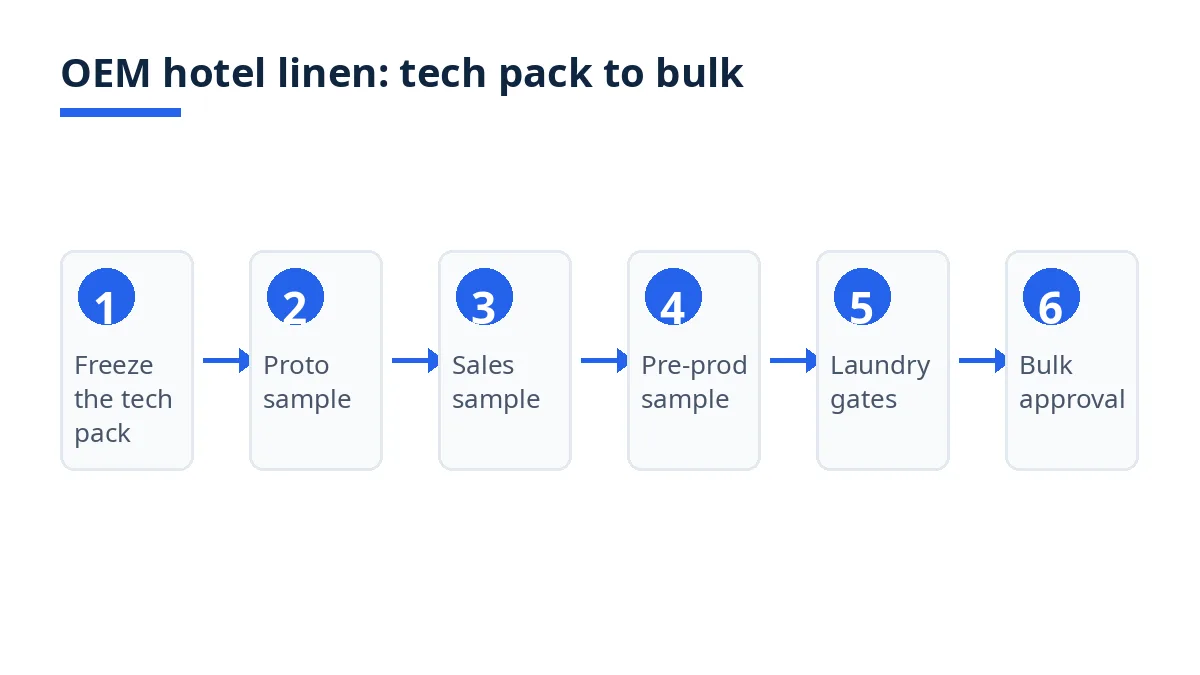
Freeze the tech pack and the price basis. Send the full tech pack, size range, colour or whiteness standard, packing spec, and delivery term. Record what is stocked and what is made to order, and agree the inspection plan now, before any sample is made.
Proto sample: check the design. The factory makes a first sample to confirm construction, size, hem, stitching, and overall look, judged against the tech pack only. A proto from substitute fabric proves the design, not the material.
Sales sample: check the selling item. This sample uses the intended fabric, colour, and finish. Measure it and list every correction in writing.
Pre-production sample: check the bulk recipe. This sample must be made from bulk fabric, bulk dye lot, bulk trims, and bulk labels, on the production line or its equivalent. It proves the factory can repeat the item, and it carries the laundry tests below.
Agree the bulk inspection plan before bulk starts. Write the inspection level, the acceptance quality limit (AQL) values by defect class, and the inspection point into the purchase order. ISO 2859-1 provides sampling schemes indexed by AQL for lot-by-lot inspection by attributes.3 AQL is the worst tolerable process average for a continuing series of lots, not a promise about any single lot.
Approve bulk in writing, with conditions. Bulk approval names the approved pre-production sample, the agreed corrections, the test results accepted, and the inspection plan, plus what happens to a failed lot: rework, re-inspection, or rejection.
Laundry-durability testing gates
Laundry testing is the gate that separates a hotel-linen OEM order from a standard textile order. A sheet that passes measurement and visual inspection can still fail after washing, so test the pre-production sample against gates set in the tech pack, before bulk approval.
Agree the wash method first. ISO 6330 specifies domestic washing and drying procedures for textile testing, including reference detergents and ballast, and it is used for evaluations such as dimensional change, smoothness appearance, and colour fastness to domestic laundering.4 Hotel laundry is commercial, not domestic, so do not copy a domestic procedure into a hotel contract without stating the difference. Agree in writing whether the test uses a domestic procedure, a commercial laundry simulation, or your hotel's own wash cycle,.
Set a gate for each property that matters in service:
Dimensional change. Measure length and width before and after the agreed wash cycles, flat and relaxed, as a percentage per dimension. Example figures: a buyer may agree a gate of 2 percent shrinkage on a flat sheet. The figure is an example only.
Whiteness retention. Compare the washed sample against the approved whiteness standard under the same light, not against memory.
Colour fastness and staining. For coloured or striped linen, test colour fastness to washing and check that white items washed with the sample do not pick up colour.
Appearance after washing. Check smoothness, pilling, seam puckering, hem curling, and edge fraying after the agreed cycles.
Strength at stress points. Check hems, corners, buttonholes, and joins after washing.
Example figures: a buyer testing a flat sheet might agree 25 wash cycles for the pre-production gate and a further check at 50 cycles on a bulk-retained sample. Those numbers are examples, not a standard, and they work only because both sides agreed them before bulk started. Record every test result against the sample identity: sample type, fabric lot, dye lot, wash method, and cycle count.
Costs, timelines and documents
There are no typical OEM costs or timelines that a guide can state as fact, because each order prices its own fabric, yarn, dye lot, construction, trims, labels, packing, and delivery term. Example figures: sampling, fabric, and set-up charges may be itemized apart from the unit price, so a repeat order reuses the paid set-up rather than paying it twice. Ask for that split in writing, and for sampling, fabric-ready, production, and inspection dates as separate lines rather than a single delivery week.
Sampling time depends on fabric availability and correction rounds: a proto from stocked fabric moves faster than a pre-production sample waiting on a dyed lot. Bulk time depends on dyeing, finishing, trim delivery, and line capacity.
For the delivery term, use one Incoterm and one named place on every quotation, and compare quotations only on the same term. The Incoterms 2020 rules give a clear allocation of cost, risk, and obligations across 11 rules.5
The order documents are the tech pack, the itemized quotation, the purchase order with the inspection plan and AQL values, the sample approval records, and the test reports. Keep the sealed reference sample with that file. The export documents are covered in the Bangladesh section below.
Bangladesh-specific rules and tips
Confirm the classification before you quote freight or duty. In the Harmonized System, heading 6302 covers bed linen, table linen, toilet linen, and kitchen linen, with subheadings by material and construction.6 Hotel sheets, duvet covers, and pillowcases generally sit under bed linen, while towels sit under toilet linen. Confirm the exact subheading with your customs broker, since the heading alone does not decide duty.
Match one legal name across every paper. For export clearance in Bangladesh, goods may not be loaded unless an export declaration, the Bill of Export or Shipping Bill, is submitted to Customs and approved.7 The documents enclosed with it include the export contract or purchase order where there is no export letter of credit, the commercial invoice, the packing list, the EXP form certified by an authorized dealer, and a certificate of origin issued by the EPB or a Chamber of Commerce and Industry.7 The exporter name on the trade licence, quotation, proforma invoice, and payment account should match.
Ask which inputs are imported for your order. Yarns, dyes, and some trims may be bought in for your specification, and an imported input can set both the earliest production date and the dye-lot minimum. Inspection should also finish before the Bill of Export is filed, not after the goods are stuffed, since a failed lot at that point is a return or a claim, not a correction. See the hotel linen quality control checklist and the HS code for hotel linen guide.
Mistakes and red flags
Approving a sample on appearance alone. A sample measured but never washed proves size and look only. Hotel linen must pass the laundry gates before bulk approval.
Leaving tolerances as adjectives. "Good white", "soft hand", and "standard size" cannot be inspected. Every judged line needs a number, a method, and a tolerance band.
Mixing sample types. A proto from substitute fabric, a sales sample from bulk fabric, and a pre-production sample from a second dye lot are three different proofs. If the file does not record which material each sample used, a later dispute cannot be settled.
Starting bulk before the laundry test returns. Bulk fabric dyed and cut before the pre-production laundry result is known cannot be un-dyed or un-cut. Hold the bulk start until the test report is accepted in writing.
Comparing quotations on different specifications or terms. A lower price on a lighter GSM, a different weave, stock labels, or a different Incoterm is a different offer.5 Compare only replies to the same tech pack on the same term.
Treating a profile or a badge as a production proof. A company profile shows what a supplier states. It does not test whether the factory can hold whiteness, size, and GSM across a bulk lot after washing.
Red flags include a factory that will not name the fabric lot for the pre-production sample, no space for corrections on the sample form, a refusal to agree wash-test gates in writing, and a bulk start date before the test result date.
Checklist
Before bulk approval, every line below should be answered in writing.
Tech pack frozen: item, construction, fibre, thread count, yarn, GSM and size with tolerances, whiteness or colour standard, hem and stitch, labels, packing.
Sample history recorded: proto, sales, and pre-production samples identified by material and lot.
Pre-production sample made from bulk fabric, bulk dye lot, bulk trims, and bulk labels.
Laundry gates agreed and tested: wash method, cycle count, dimensional change, whiteness, colour fastness, appearance, stress points.
Inspection plan in the purchase order: level, AQL values by defect class, inspection point.3
Bulk approval signed: approved sample, corrections, test results accepted, failed-lot action.
Sealed reference sample signed by both sides, kept with the order file.
Quotations compared on the same tech pack and Incoterm.5
Export set agreed: invoice, packing list, EXP form, certificate of origin, Bill of Export.7
Classification confirmed under heading 6302.6
How Exportain helps
On Exportain, browse suppliers and post a request for quotation (RFQ) on the RFQ board with your tech pack summary, the sampling stages you require, and the laundry gates you will apply, so suppliers quote against the same process. Ask each reply to state which fabric lot the pre-production sample will use and when the laundry test result will be available.
Read the badges for what they record. Exportain verification is a document and photo review, not a factory inspection, and verification is free with staff review of every submission.8 Membership plans are a separate product and never grant a trust badge.8 That review does not test laundry performance, so the sample gates and inspection plan here remain your controls.
FAQs
What should I know first about hotel linen?
Judge hotel linen by its life after washing, not by its look on the sample table. The tech pack must state construction, fibre, thread count, yarn, GSM and size with tolerances, whiteness or colour standard, hem and stitch, and labels.
What are the typical costs and timelines?
There are no typical OEM costs or timelines a buyer can rely on, because each factory prices your fabric, construction, dye lot, trims, labels, packing, and delivery term.5 Ask for set-up and sampling charges itemized apart from the unit price, and for sampling, fabric-ready, production, and inspection dates as separate lines.
Which documents are needed?
The order documents are the tech pack, itemized quotation, purchase order with the inspection plan, sample approvals, and test reports. The export set is the Bill of Export, commercial invoice, packing list, EXP form certified by an authorized dealer, and a certificate of origin issued by the EPB or a Chamber of Commerce and Industry.7
What are the most common mistakes?
The most common mistakes are approving a sample on appearance alone, leaving tolerances as adjectives, mixing sample types, and starting bulk before the laundry test returns.
Next steps on Exportain
Browse suppliers, then post your tech pack summary, sampling stages, and laundry gates on the RFQ board so suppliers quote against the same OEM process. Before you confirm, read the hotel linen quality control checklist and the hotel linen MOQ guide.
Sources
- RMG exports rise 6.10pc to US$10.58b in July-Sept of FY27. The Financial Express, (accessed )
- Regulation (EU) No 1007/2011 on textile fibre names and related labelling and marking of the fibre composition of textile products. European Union, (accessed )
- SIST ISO 2859-1:2003 - Sampling procedures for inspection by attributes, Part 1: Sampling schemes indexed by acceptance quality limit (AQL). International Organization for Standardization, (accessed )
- BS EN ISO 6330:2021 Textiles — Domestic washing and drying procedures for textile testing. BSI, (accessed )
- Incoterms® 2020. International Chamber of Commerce (ICC) (accessed )
- HS 2017 - Code 6302: Bed linen, table linen, toilet linen and kitchen linen. United Nations Statistics Division (accessed )
- Customs Clearance Procedures for Export. Bangladesh Customs, National Board of Revenue (accessed )
- Supplier verification: Earn trust badges buyers can see. Exportain (accessed )
- supplier verification
- quality control
- buyer guide
- Bangladesh sourcing
- home textiles
- Hotel linen
- OEM manufacturing
About the author
Sourcing from Bangladesh?
Post a request for quotation and suppliers on Exportain can send you their quotes directly.
Post an RFQ